

advertise vacation rental
How to Advertise Your Vacation Rental to Boost Bookings
Posted on Nov 25, 2025
TL;DR: Advertising a vacation rental isn't about spending more on OTAs — it's about using paid and owned channels to push demand toward the booking path you actually control. The operators who win do three things in order: fix the listings that already get traffic, stand up a direct-booking site so paid clicks land on commission-free inventory, then turn ad spend into a measurable cost-per-acquisition you can compare against the 8–16% you hand OTAs on every stay.
What "advertising a vacation rental" really means in 2026
Here's the distinction most generic marketing advice misses: there's a difference between getting seen and getting booked on your terms. Listing on Airbnb gets you seen — but every booking that comes through it carries a commission. Under Airbnb's host-only fee, that's typically 14–16% of the booking subtotal; Vrbo's pay-per-booking model runs 8% (5% commission plus 3% processing); and Booking.com averages 15%, ranging from 10% up to 25% depending on market (Hostaway).
So when we say "advertise your vacation rental," the real goal is to move as much of that demand as possible onto channels where you keep the margin: your own site, your past-guest list, and paid campaigns that point at both. Think of advertising as a system with three layers — optimize the listings you already have, build a destination for paid traffic to land, and then buy demand profitably. We'll work through each, with the numbers that make the decisions for you.
Layer 1: Turn the OTA listings you already have into booking magnets
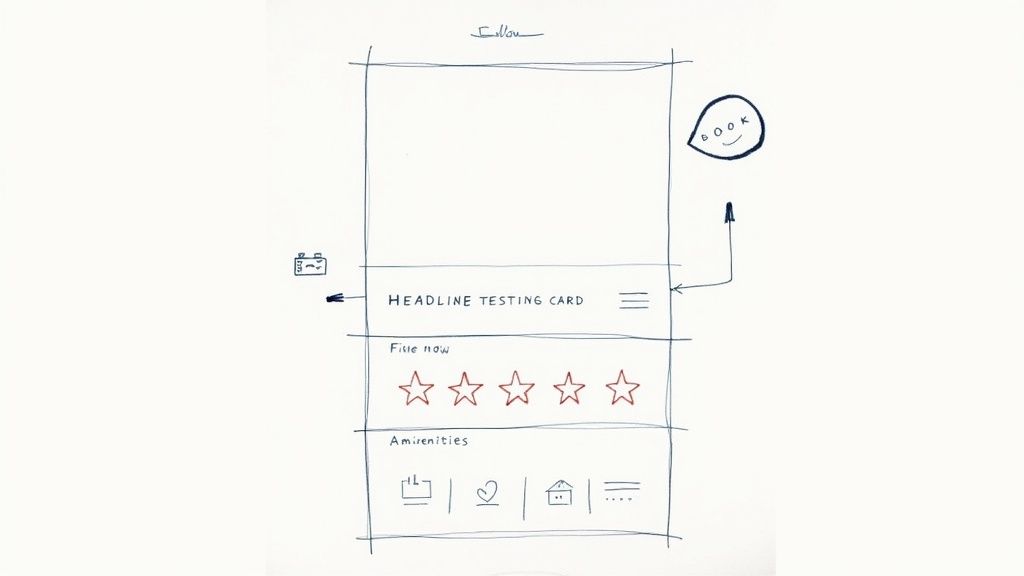
Before you spend a dollar on ads, fix the assets that are already getting impressions for free. Your OTA listings are your highest-traffic storefronts, and most are leaving conversions on the table.
Define the guest you're actually selling to
Every listing tweak below works better when it's aimed at one specific traveler. You don't need a marketing-textbook persona — you need to answer three operator-level questions for each property:
- Who books this unit, and why? A 2-bedroom with bunk beds and a fenced yard sells to road-trip families; a downtown studio with a fast desk sells to remote workers on multi-week stays. Same building, different buyer, different ad.
- What makes them hesitate? Price, unclear pet policy, slow Wi-Fi for the workcation crowd, no proof the photos match reality. Your listing and ads should answer the objection before it's raised.
- Where do they decide? The family scrolls Facebook; the remote worker searches Google for "monthly furnished rental near [city]." Match the channel to the buyer.
Headlines that sell the stay, not the floor plan
Your title is the only thing competing in a grid of thumbnails. Lead with the experience, then the feature.
Before: Cozy Mountain Cabin → After: Secluded Cabin with Hot Tub Under the Stars
Before: Beachfront Apartment → After: Oceanfront Escape with Private Sunset Balcony
Descriptions and photos that close the click
Once you have the click, the description has to deliver the promise. Walk the guest through a day at the property instead of listing amenities: "Wake to mountain views, brew coffee in the stocked kitchen, and take it onto the private deck where the only sound is the aspens." Then back it with professional photography — staged, lit, and including a 60–90 second walk-through video. Visuals are the single biggest driver of a booking decision, and the cheapest insurance against the "I hope it looks like the pictures" hesitation that kills conversions.
Optimizing OTA listings isn't the strategy — it's the price of entry. It makes the channel you don't fully control work harder while you build the one you do.
Layer 2: Stand up a direct-booking site so paid traffic has somewhere to convert
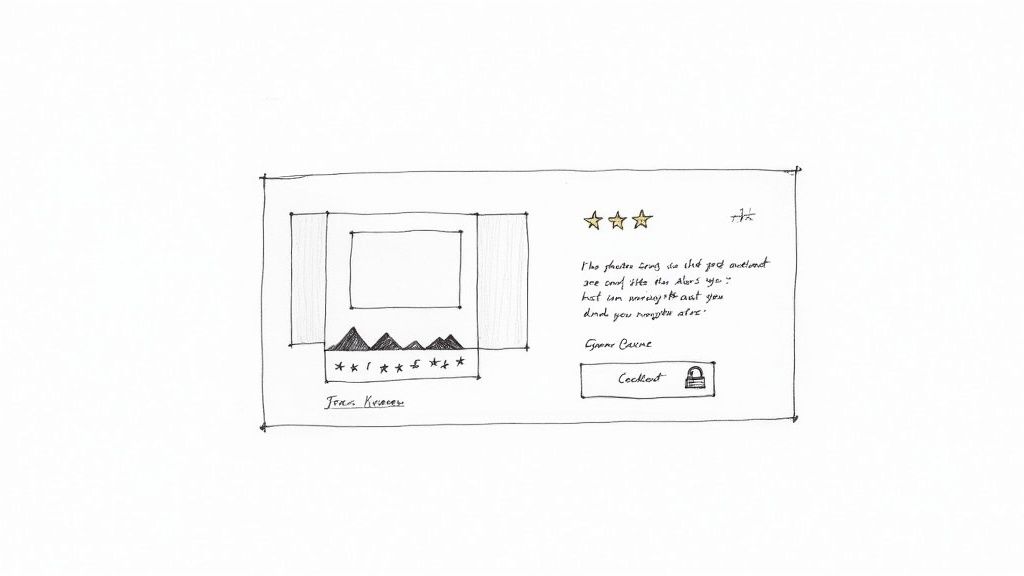
This is the layer that changes your economics. Every paid click you send to an OTA listing still gets taxed on conversion. Send that same click to your own site and the commission goes to zero — which is exactly why a direct-booking site is the prerequisite for advertising profitably, not an optional upgrade.
Do the margin math before you build
Here's why this matters in dollars. Take a property doing $80,000 a year in bookings. At a blended OTA commission of 12%, you're handing over $9,600 a year in fees on revenue you'd otherwise keep. Now suppose advertising can shift just 30% of those bookings to direct — that's roughly $2,880 a year recovered per property, every year, on inventory you already had. Across a 10-unit portfolio that's nearly $29,000 in annual margin that was quietly leaking to distribution. That recovered commission is the budget that funds your ads — and unlike a commission, it compounds, because a direct guest can be remarketed to for free forever.
What a high-converting site needs
- A frictionless booking engine: live availability, a transparent price breakdown with no surprise fees, and checkout in a few clicks. Every extra form field leaks bookings.
- Visible social proof: real guest reviews on the homepage and near the booking button, ideally pulled from your OTA ratings.
- Clear policies and an FAQ: cancellation, check-in, and house rules up front, which also cuts pre-booking inbox volume.
For the full build checklist, see our guide on how to build a vacation rental website.
Layer 3: Buy demand profitably with paid channels
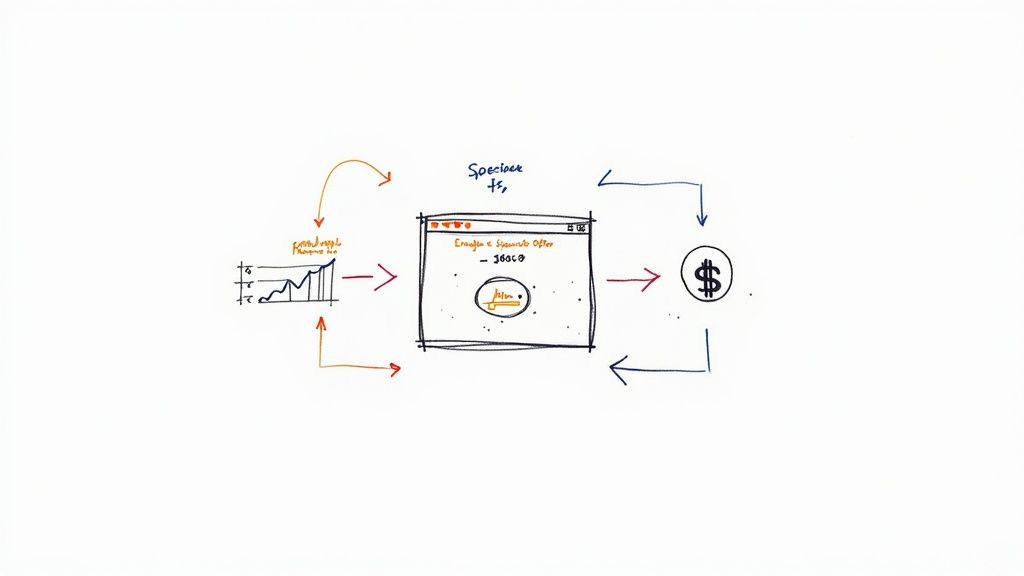
With listings sharp and a direct site live, paid ads let you fill shoulder-season gaps and pull traffic straight to commission-free inventory. The two channels that matter most do different jobs.
Google Ads: capture travelers at the moment of intent
When someone searches "oceanfront condo in Destin for rent," they're deciding, not browsing. The good news for STR operators: travel is one of the cheaper verticals to advertise in. WordStream's 2025 Google Ads benchmarks put the travel industry at a $2.12 average CPC, an 8.73% CTR, and a 5.75% conversion rate — well below the all-industry average CPC of $5.26 (WordStream).
Put those benchmarks into a planning example. At a $2.12 CPC and a 5.75% conversion rate, ~100 clicks (about $212 in spend) converts to roughly 5–6 inquiries or bookings. If your average booking nets a few hundred dollars in commission-free revenue, a single direct booking covers the campaign and then some — which is why intent-driven search, pointed at your own site, is usually the first paid dollar an operator should spend. Skip broad terms like "Asheville cabin" and bid on booking-intent long-tail queries ("pet-friendly cabin near Asheville with fenced yard"): lower competition, higher intent, cheaper clicks.
Social ads: create demand and recover abandoners
Facebook and Instagram are where you build the want and win back the almost-bookers. Target by interest and geography — a family cabin in the Smokies shown to "family travel" and "hiking" audiences within a five-hour drive — but the highest-ROAS social spend is almost always retargeting: serving the "Secluded Cabin with Hot Tub" ad to people who visited your direct site and didn't book. That audience already chose you once; a gentle nudge (sometimes a small time-boxed offer) is the cheapest booking you'll buy.
Which channel for which job
| Channel | Best for | Targeting basis | Cost profile |
|---|---|---|---|
| Google Search | Capturing high-intent travelers actively searching your market | Keywords, location, search history | ~$2.12 avg travel CPC; higher intent, higher conversion |
| Building demand and retargeting site visitors | Demographics, interests, behaviors, life events | Lower CPC; best ROAS on retargeting | |
| Visual-first reach to younger travelers via Reels/Stories | Same as Facebook, visual creative | Varies; strong for photogenic properties |
A blended approach wins: social to create and recover demand, Google to capture it at the point of decision — both pointed at your direct site, not an OTA.
Turn first bookings into repeat revenue with email automation
The most profitable advertising channel you own isn't an ad platform at all — it's the guest list you build from every booking. A past guest already stayed, already trusts you, and costs nothing to reach again. The catch is that doing this by hand across a portfolio doesn't scale, which is where automation earns its place.
A few sequences carry most of the value:
- Pre-arrival: check-in details, local weather, a packing nudge — sent automatically a week out to build anticipation and cut day-of questions.
- Post-stay rebooking: a thank-you plus a returning-guest rate, triggered a set number of days after checkout while the stay is still fresh.
- Off-season win-back: a local-events or seasonal-offer email timed to when guests start daydreaming about the next trip.
This is the gap between generic "send some emails" advice and an actual retention engine. hostAI automates these post-stay and rebooking flows so repeat stays happen on autopilot — turning the guests your ads paid to acquire once into bookings you don't pay for again.
Frequently asked questions
How much should I budget to advertise a vacation rental?
A common starting point is 5–10% of projected rental income, but don't deploy it all at once. Begin with a test budget — say $15/day on one platform — to learn which creative and targeting actually drive clicks, then concentrate spend on your peak booking window. Track every dollar to a booking so each future dollar is better spent. Early ad spend is really a purchase of data.
What's the best way to advertise besides OTAs?
A direct-booking website paired with intent-driven Google Search ads and social retargeting. The site removes the 8–16% commission OTAs charge, and the ads point qualified traffic straight to it. Listing on Google Vacation Rentals is a useful add-on for capturing high-intent searchers.
How can I advertise my vacation rental for free?
- Maximize OTA listings: professional photos, keyword-rich descriptions, every amenity tagged. It's free real estate — make it convert.
- Build an organic social presence: post local guides and scenery, not just "book now."
- Engineer reviews: ask every guest, every time. Social proof is your highest-leverage free asset.
- Partner locally: cross-promote with cafés, tour operators, and shops to reach new audiences at no cost.
Ready to keep more of what your ads earn? The operators winning in 2026 advertise toward direct bookings, not away from them. See how hostAI helps you build a high-converting direct-booking site and automate the guest email flows that turn one stay into many.