conversion optimization best practices

10 Conversion Optimization Best Practices for STRs in 2025

Posted on Nov 30, 2025

Hero

In the competitive world of short-term rentals, getting traffic to your direct booking site is only half the battle. The real challenge, and where the most profit is unlocked, lies in converting those visitors into confirmed guests. A high-converting website doesn't just happen by accident; it's the result of strategic, data-driven decisions and a deep understanding of guest behavior. A one percent increase in your conversion rate can have a massive impact on your bottom line, making this one of the highest-leverage activities you can focus on.

This guide cuts through the noise to deliver a comprehensive roundup of essential conversion optimization best practices specifically tailored for STR managers. We will move beyond generic advice and dive into actionable strategies you can implement today. You will learn how to meticulously analyze and refine every step of your booking funnel, from the initial property search to the final payment confirmation.

We'll explore practical techniques for A/B testing your calls-to-action, optimizing your booking forms to reduce friction, and leveraging powerful psychological triggers like social proof to encourage guests to book now. More importantly, we'll demonstrate how to implement these sophisticated practices using advanced tools like hostAI, turning abstract concepts into measurable increases in your direct booking revenue. Get ready to transform your website from a simple online brochure into a highly efficient, automated booking engine that consistently turns more lookers into bookers. This is your playbook for achieving conversion mastery.

1. A/B Testing (Split Testing)

A/B testing, also known as split testing, is a methodical approach to comparing two versions of a webpage, email, or other marketing asset to determine which one performs better. It's a controlled experiment where you split your audience to show them variant A or variant B and then measure which version was more effective in achieving a specific goal, such as booking a stay. This practice is foundational to data-driven conversion optimization best practices because it removes guesswork and bases decisions on actual user behavior.

For short-term rental managers, this means you can test changes to your direct booking site with confidence. Instead of debating whether a "Book Now" or "Check Availability" button is more effective, you can run an A/B test and let your potential guests' actions provide a definitive, statistically significant answer.

Sketch of a split screen showing A/B test versions of charts and user interfaces.

Actionable Strategies for Short-Term Rentals

To implement this, start with a clear hypothesis. For example, "Changing the primary call-to-action button color from blue to orange will increase clicks by 15% because orange creates more contrast with our site's design." This focused approach ensures your tests are purposeful.

Here are some practical tips:

  • Test One Variable: Isolate a single element per test (e.g., headline, hero image, button text) to know exactly what caused the change in performance.
  • Ensure Sufficient Sample Size: Use a statistical significance calculator to determine how many visitors you need in each group before you can trust the results. A confidence level of 95% is the standard.
  • Run for a Full Cycle: Let tests run for at least one to two full weeks to account for fluctuations in traffic and booking behavior between weekdays and weekends.
  • Document Everything: Maintain a log of all tests, including your hypothesis, the variants, the duration, and the results. This builds an internal knowledge base of what works for your specific audience.

By systematically testing and iterating, you can make incremental improvements to your booking funnel that compound over time, leading to significant increases in direct bookings and revenue.

2. Conversion Rate Optimization (CRO) Funnel Analysis

Conversion Rate Optimization (CRO) funnel analysis involves mapping and measuring the complete user journey on your website, from the moment a potential guest lands on a page to the final booking confirmation. It's a strategic approach to identify exactly where users abandon the process. By visualizing this path as a funnel with distinct stages, you can pinpoint the biggest drop-off points and focus your optimization efforts where they will have the most significant impact. This method is crucial for data-driven conversion optimization best practices because it reveals hidden friction in your booking experience.

For short-term rental managers, this means understanding the entire search-to-book flow. You can see what percentage of users who view a property proceed to check availability, how many of those add dates to their cart, and finally, how many complete the payment. Identifying a major drop-off between viewing availability and starting the checkout process, for example, tells you precisely where to investigate for issues like unclear pricing or a confusing interface.

Hand-drawn sales funnel with stages: Awareness, Consideration, and Decision, showing people progressing.

Actionable Strategies for Short-Term Rentals

To implement funnel analysis, begin by defining the key stages of your booking process in an analytics tool like Google Analytics. A typical funnel might be: Homepage > Property Search > Property Page View > Availability Check > Checkout > Booking Confirmation. This setup allows you to quantify the conversion rate between each step.

Here are some practical tips:

  • Set Baseline Metrics: Before making changes, establish your current conversion rates for each funnel stage. This baseline is essential for measuring the true impact of your optimizations.
  • Use Heatmaps & Session Recordings: Combine quantitative funnel data with qualitative tools. Session recordings let you watch how users interact with pages where they drop off, revealing their exact points of frustration.
  • Segment Your Analysis: Don't treat all visitors the same. Segment your funnel by traffic source (e.g., Google, social media), device (mobile vs. desktop), and user type (new vs. returning) to uncover more specific insights.
  • Optimize One Stage at a Time: Focus your efforts on fixing the biggest leak in your funnel first. By isolating changes to one stage, you can accurately attribute any performance improvements to that specific change.

Analyzing your booking funnel provides a clear roadmap for improvement. You can learn more about how these small adjustments lead to significant gains by exploring how to improve website conversion rates. By systematically addressing user drop-off points, you directly increase your direct bookings and revenue.

3. Value Proposition Optimization

Your value proposition is a clear, concise promise of the value a guest will receive by booking with you. It's the primary reason a potential guest should book on your direct site instead of an OTA or a competitor's property. Optimizing this proposition involves refining your messaging to instantly communicate the unique benefits of your rentals, which is a cornerstone of conversion optimization best practices because it directly answers the guest's core question: "Why should I book here?"

For short-term rental managers, this goes beyond just listing amenities. It's about articulating the unique experience, convenience, or value you offer. Instead of simply saying "Beachfront Condo," a stronger value proposition might be "Your Private Slice of Paradise: Skip the Crowds and Enjoy Direct Beach Access." This immediately communicates exclusivity and a better vacation experience, reducing hesitation and encouraging direct bookings.

Actionable Strategies for Short-Term Rentals

Start by deeply understanding what your ideal guests truly want. Is it a family-friendly space with included gear, a pet-friendly policy that's truly welcoming, or a seamless work-from-anywhere setup? Your value proposition should speak directly to that primary need.

Here are some practical tips:

  • Lead with the Core Benefit: Place your primary value proposition front and center in your website's hero section, "above the fold." A visitor should understand your unique offer without having to scroll.
  • Use Guest Language: Leverage reviews and guest feedback to identify the words and phrases your happiest guests use to describe their stay. Incorporate this language into your messaging for authenticity.
  • Focus on Benefits, Not Features: Instead of listing "a king-sized bed," frame it as "a guaranteed restful night's sleep on our premium memory foam mattress." The benefit is the outcome, not just the object.
  • Test Your Message: Use A/B testing tools to experiment with different headlines and subheadings on your homepage. Test a value proposition focused on "saving money" versus one focused on "a more exclusive experience" to see which resonates more with your audience.

A powerful, well-optimized value proposition acts as a powerful filter, attracting the right guests while clearly differentiating your properties from the competition, ultimately driving higher-quality traffic and more direct conversions.

4. Form Optimization and Friction Reduction

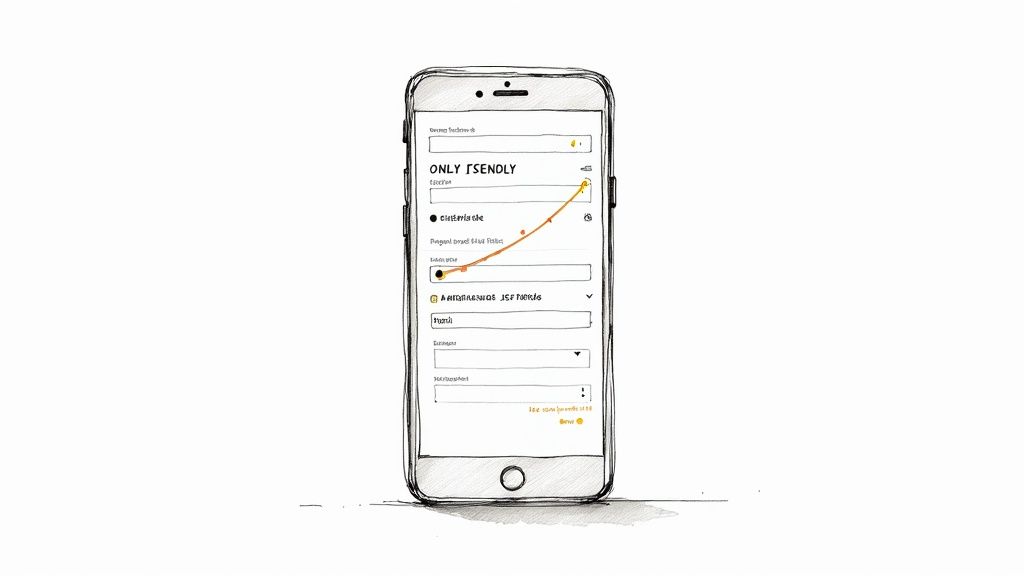
The booking form is often the final and most critical step in the conversion funnel. Every field, every click, and every moment a potential guest spends on this form is an opportunity for them to abandon the process. Form optimization is the practice of systematically reducing friction, simplifying the user experience, and removing any non-essential steps to make completing the booking as quick and effortless as possible.

For short-term rental managers, this means scrutinizing your checkout process. Each unnecessary field, from a mandatory "title" (Mr./Mrs.) to a redundant address line, adds a small amount of cognitive load that can collectively deter a user from finalizing their booking. Research from conversion experts at CXL has shown that even minor adjustments, like removing a single field, can boost form completion rates by several percentage points, making this one of the most impactful conversion optimization best practices you can implement.

Hand-drawn sketch of a smartphone displaying an application form with a rising performance graph.

Actionable Strategies for Short-Term Rentals

The goal is to only ask for the information that is absolutely essential to secure the booking. You can always gather secondary information, like guest preferences for an upcoming stay, in a post-booking confirmation email. This keeps the initial transaction lean and focused.

Here are some practical tips:

  • Remove Non-Essential Fields: Conduct a ruthless audit of your booking form. Do you truly need a guest's home phone number if you have their mobile number and email? Start with the absolute minimum: name, email, phone, and payment details.
  • Use Smart Defaults and Auto-Population: Pre-fill information whenever possible. For example, use location services to suggest the guest's country or connect with Google's Address Autofill API to simplify address entry.
  • Implement Inline Validation: Provide real-time feedback as a user fills out the form. A green checkmark for a valid email or an immediate red box for an incorrect credit card number is far better than showing all errors only after the user hits "submit."
  • Optimize for Mobile: Use a single-column layout, large input fields, and mobile-friendly keyboards (like a numeric keypad for phone number fields). Ensure the entire form is easily navigable on a small screen.

By minimizing the effort required to book, you directly increase the likelihood that a user will complete the transaction, turning a hesitant visitor into a confirmed guest.

5. Landing Page Optimization and Relevance

Landing page optimization is the practice of creating dedicated, standalone web pages designed for a specific marketing or advertising campaign. The core principle is "message match," ensuring the content, visuals, and offer on the landing page are directly relevant to the ad or link the visitor clicked to get there. This focused approach is a cornerstone of conversion optimization best practices because it minimizes distractions and guides the user toward a single, specific action.

For short-term rental managers running paid ad campaigns, this means creating a seamless journey from ad to booking. If a potential guest clicks a Facebook ad showcasing a "pet-friendly family getaway," they should land on a page that exclusively features that property, highlights its pet-friendly amenities, and has a clear call-to-action to check availability, not your general homepage with dozens of other options.

Actionable Strategies for Short-Term Rentals

The goal is to eliminate friction and build immediate trust by delivering exactly what was promised in the ad. A high-relevance landing page not only improves user experience but also increases your Quality Score in platforms like Google Ads, lowering your cost-per-click.

Here are some practical tips:

  • Mirror the Message: The headline on your landing page should closely match or mirror the headline of the ad that brought the user there. This confirms they are in the right place.
  • Remove Distractions: Eliminate the main website navigation, footer links, and any other elements that could lead the user away from the primary conversion goal.
  • Showcase with High-Quality Visuals: Use professional, high-resolution images or a compelling video of the specific property right at the top. For STRs, where visuals are paramount, understanding essential real estate photography tips can significantly boost your listing's performance.
  • Create Segment-Specific Pages: Build unique landing pages for different audience segments or campaigns. A page for "romantic couple retreats" should have different imagery and copy than one for "corporate housing solutions."

By creating highly relevant, goal-oriented landing pages, you reduce bounce rates and guide more qualified traffic directly into your booking funnel, dramatically improving the return on your ad spend.

6. Call-to-Action (CTA) Optimization

The call-to-action (CTA) is the pivotal moment in the booking journey; it's the button a potential guest clicks to move from browsing to buying. CTA optimization is the practice of refining the text, color, size, and placement of these buttons to maximize clicks and completions. This is one of the most high-impact conversion optimization best practices because even minor tweaks can dramatically improve user engagement and drive more direct bookings.

For a short-term rental website, the primary CTA is typically "Book Now," "Reserve Your Stay," or "Check Availability." Optimizing this single element guides users clearly and confidently toward making a reservation. Instead of leaving guests to guess the next step, a compelling CTA tells them exactly what to do, removing friction at the most critical point of conversion.

Actionable Strategies for Short-Term Rentals

To optimize your CTAs, focus on creating clarity, urgency, and visual prominence. Your goal is to make the desired action both obvious and appealing, ensuring it stands out from the rest of the page content.

Here are some practical tips:

  • Use Action-Oriented Verbs: Start your CTA text with strong, commanding verbs. Instead of a passive "View Details," test more compelling options like "Reserve My Spot" or "Check My Dates."
  • Create Visual Contrast: Your CTA button should be impossible to miss. Use a color that contrasts sharply with your site's background and surround it with ample white space.
  • Optimize for Mobile: Ensure your CTA buttons are large enough to be easily tapped on a mobile screen. Aim for a minimum touch target of 48x48 pixels to meet accessibility standards.
  • Add Supporting Microcopy: Reduce hesitation by placing reassuring text near the CTA. Phrases like "Instant confirmation" or "Free cancellation before [Date]" can provide the final nudge a user needs to click.

By treating your CTAs as the crucial signposts they are, you can effectively guide more visitors through the booking funnel, turning casual browsers into confirmed guests.

7. User Experience (UX) and Page Speed Optimization

User experience (UX) and page speed are foundational pillars of conversion optimization best practices. UX encompasses every interaction a potential guest has with your website, from navigation clarity to visual appeal, while page speed measures how quickly your content loads. A slow, confusing site is a direct barrier to bookings; studies from Google show that even a one-second delay in page load time can reduce conversions by up to 20%.

For short-term rental managers, this means a seamless, lightning-fast direct booking site is non-negotiable. If a guest struggles to find availability, view property photos, or complete a payment because the site is slow or poorly designed, they will quickly abandon the process and book on an OTA instead. A smooth, intuitive experience builds trust and directly translates to more completed reservations.

Actionable Strategies for Short-Term Rentals

Optimizing UX and speed involves a blend of design strategy and technical execution. The goal is to remove friction at every step of the guest's journey, making it as easy as possible for them to book. For a deeper look into creating an effective site, explore these principles for vacation rental website design.

Here are some practical tips:

  • Prioritize Page Speed: Use tools like Google PageSpeed Insights to diagnose issues. Compress all property images without sacrificing quality, implement lazy loading for content that appears below the fold, and use a Content Delivery Network (CDN) to ensure fast load times for guests worldwide.
  • Simplify Navigation: Ensure your menu is logical and uncluttered. Guests should be able to find properties, check availability, and access the booking page in just a few clicks. A prominent search bar is essential.
  • Focus on Mobile-First Design: With the majority of travel research happening on mobile, your site must be fully responsive and easy to use on a small screen. Test your booking process on multiple devices to ensure a flawless experience.
  • Address Core Web Vitals: Pay close attention to Google's Core Web Vitals (LCP, FID, CLS) as they impact both user experience and search rankings. For a deeper dive into the technical aspects, understanding how to approach improving application performance can provide valuable insights into ensuring your site runs smoothly.

By investing in a high-performance website, you create a professional and trustworthy impression that encourages direct bookings and reduces reliance on third-party channels.

8. Social Proof and Trust Signals

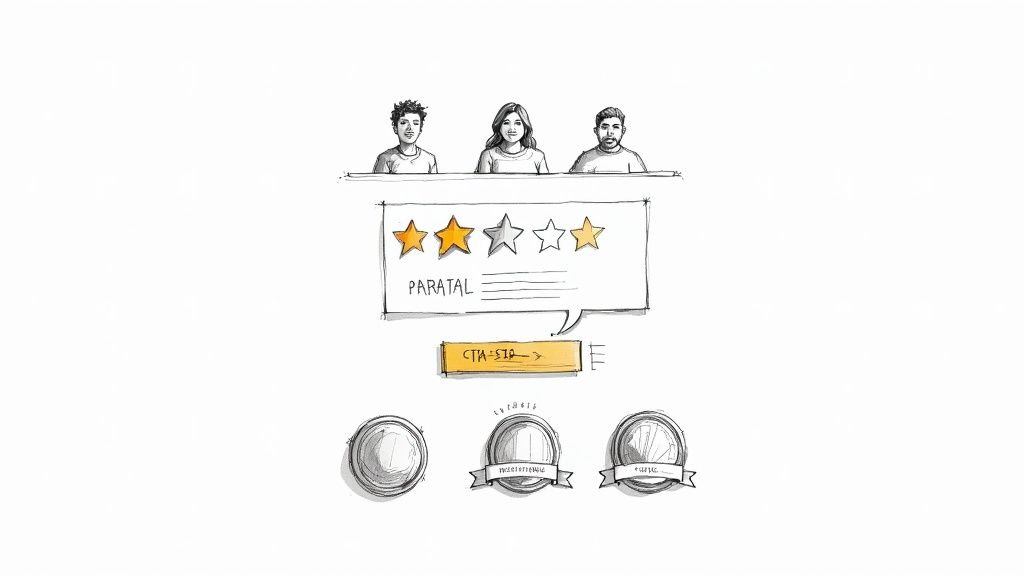
Social proof is a psychological principle where people assume the actions of others reflect correct behavior for a given situation. For conversion optimization best practices, this means showcasing that other guests have chosen, enjoyed, and trusted your properties. By displaying testimonials, star ratings, and security badges, you reduce a potential guest's hesitation and perceived risk, making them feel more confident in their decision to book with you.

For short-term rental managers, this is about building credibility instantly. A new visitor to your direct booking site doesn't know you, but if they see glowing reviews from past guests or a secure payment seal, their trust increases significantly. This validation can be the deciding factor that persuades them to book directly with you instead of a competitor or a third-party OTA.

Hand-drawn sketch illustrating user feedback with star ratings, a CTA button, and professional badges.

Actionable Strategies for Short-Term Rentals

To implement social proof effectively, strategically place these trust elements at key decision points in the booking journey, like on property pages or at the checkout. The goal is to reassure guests exactly when they might feel uncertain.

Here are some practical tips:

  • Display Specific Testimonials: Instead of generic praise, feature reviews that highlight specific aspects like "The check-in process was seamless" or "The kids loved the pool." Place these near the "Book Now" button for maximum impact.
  • Showcase Star Ratings Prominently: Integrate star ratings from platforms like Google or Airbnb directly onto your property listings. Visual cues like a 4.9-star average are powerful and quickly understood.
  • Use Trust Badges: Add logos of secure payment processors (Stripe, PayPal) and any professional accreditations or local tourism board memberships. These signals communicate professionalism and security.
  • Leverage User-Generated Content: Encourage guests to share photos on social media using a specific hashtag and feature these authentic images on your website (with permission). This provides a genuine, relatable glimpse into the guest experience.

By integrating various forms of social proof, you create an environment of trust that calms guest anxieties and directly encourages them to complete their booking.

9. Personalization and Segmentation

Personalization is the practice of tailoring the guest experience to individual users based on their behavior, demographics, and previous interactions with your brand. Closely related, segmentation involves grouping users into cohorts with shared characteristics to deliver more relevant messaging. This approach is a cornerstone of modern conversion optimization best practices because it replaces a one-size-fits-all website with a dynamic, responsive experience that speaks directly to each visitor's needs.

For short-term rental managers, this means moving beyond a static booking site. Instead of showing the same featured properties to a family of five and a solo business traveler, you can dynamically present listings and offers that align with their specific context. This relevance builds trust and significantly shortens the path from browsing to booking, with studies showing it can increase conversions by 5-15%.

Actionable Strategies for Short-Term Rentals

To implement personalization effectively, start with a clear understanding of your guest segments. A simple first step is differentiating between first-time visitors and returning guests. You could welcome new users with an introductory offer, while greeting returning guests with a "Welcome back!" message and showing properties similar to their last search.

Here are some practical tips:

  • Segment by Behavior: Group visitors based on their browsing history. If a user consistently views pet-friendly, three-bedroom cabins, highlight those listings on their subsequent visits or in retargeting ads.
  • Leverage Past Booking Data: For previous guests, use their booking history to recommend similar properties for their next trip or send targeted emails with special offers for their favorite locations. hostAI's hostMail can automate these segmented campaigns.
  • Implement Dynamic Content: Use tools to change website elements in real-time. For example, a visitor from a cold climate searching for a summer vacation could see your beachfront properties featured prominently on the homepage.
  • Respect User Privacy: Be transparent about the data you collect and how you use it. Always provide guests with control over their personal information to maintain trust and comply with regulations like GDPR.

By treating each potential guest as an individual, you create a more engaging and effective booking journey. For a deeper dive into this topic, you can learn more about what website personalization is and how it drives results.

10. Offer and Pricing Optimization

How you price your properties and frame your offers is one of the most powerful levers in conversion optimization. Offer and pricing optimization involves systematically testing different pricing structures, discounts, and value propositions to find the combination that maximizes both booking volume and revenue. This practice moves beyond setting a static nightly rate and into the realm of dynamic, psychologically-informed pricing strategies.

For short-term rental managers, this means understanding how potential guests perceive value. A small adjustment, like offering a "Stay 7 nights, pay for 6" package instead of a simple percentage discount, can dramatically change how a guest perceives the deal. This is a core conversion optimization best practice because it directly influences the final, most critical decision in the booking journey: the purchase itself.

Actionable Strategies for Short-Term Rentals

To implement this, start by analyzing your current pricing against market data and guest booking patterns. Form a hypothesis, such as, "Introducing a non-refundable rate that is 10% cheaper than our flexible rate will increase overall booking volume by 5% by appealing to price-sensitive travelers."

Here are some practical tips:

  • Test Discount Framing: Compare how guests respond to different ways of presenting the same value. For example, A/B test a "Save $100 on your weekly stay!" message against a "15% Off 7-Night Bookings" offer to see which one converts better.
  • Utilize Dynamic Pricing Tools: Leverage algorithms, like those in hostAI's pricing engine, that automatically adjust rates based on demand, seasonality, local events, and competitor pricing. This ensures you are always offering the most competitive rate.
  • Create Urgency and Scarcity: Use messaging like "Only 2 weekends left this summer!" or implement a countdown timer for a special offer. This psychological trigger encourages hesitant bookers to commit.
  • Bundle and Upsell: Test offers that bundle experiences with the stay, such as a "Romantic Getaway Package" including a late checkout and a bottle of wine. This can increase the average booking value while providing a compelling offer.

By continuously testing and optimizing your pricing and offers, you can appeal to a wider range of guests, reduce booking friction caused by price hesitation, and significantly boost your direct booking revenue.

Top 10 Conversion Optimization Best Practices Comparison

Approach Implementation complexity Resource requirements Expected outcomes Ideal use cases Key advantages
A/B Testing (Split Testing) Medium — experiment setup and stats Analytics tools, adequate traffic, testing platform Statistically validated lifts; clear winners UI/copy/CTA changes, checkout tweaks Definitive, data-driven decisions; low-risk rollouts
CRO Funnel Analysis Medium-high — mapping & multi-step analysis Analytics, segmentation data, UX research Identify major drop-off points; prioritization roadmap Multi-step flows (checkout, onboarding) Targets highest-impact bottlenecks; guides strategy
Value Proposition Optimization Low-medium — research and copy iteration Customer interviews, copywriters, some testing Higher relevance, lower bounce, improved engagement Homepages, landing pages, new product positioning Clarifies benefits; improves first impression quickly
Form Optimization & Friction Reduction Low-medium — UX & front-end changes Designers, front-end dev, analytics Direct conversion lift; reduced abandonment Signups, lead capture, checkout forms Immediate improvements; better data quality via progressive profiling
Landing Page Optimization & Relevance Medium — design, copy, and testing Landing page builder, designers, copywriters Higher conversion rates; improved ad quality scores Paid campaigns, campaign-specific pages Increases relevance and ROI on traffic sources
Call-to-Action (CTA) Optimization Low — small iterative changes Minimal design/dev, A/B testing tool Incremental conversion improvements (10–20%) Any conversion touchpoint (buttons, banners) Low-cost, quick wins that compound with other efforts
UX & Page Speed Optimization High — technical and design work Developers, performance tooling, monitoring Significant conversion and SEO gains; lower bounce High-traffic sites, mobile-first experiences Broad impact on engagement, retention, and rankings
Social Proof & Trust Signals Low — content curation and placement Customer testimonials, review platforms, design assets Increased trust and conversions (15–25%) High-consideration purchases, B2B, SaaS Builds credibility quickly with minimal cost
Personalization & Segmentation High — data, targeting, and orchestration Data infrastructure, personalization engine, compliance Targeted lifts (5–15%); higher AOV and retention E‑commerce, returning users, recommendation systems Relevance improves conversions and lifetime value
Offer & Pricing Optimization Medium — strategic testing and analysis Business analytics, pricing experiments, ops alignment Direct revenue and conversion impact SaaS pricing, promotions, tiered offerings Can yield large revenue changes; captures different segments

From Optimization to Automation: Your Path to Doubling Direct Revenue

Navigating the landscape of conversion optimization best practices can feel like assembling a complex puzzle. We've explored the critical pieces, from the granular details of A/B testing your booking button to the high-level strategy of optimizing your entire conversion funnel. You now have a blueprint for transforming your direct booking website from a simple digital brochure into a powerful, automated revenue engine. The journey begins with understanding that every click, every page view, and every hesitation is a data point offering insight into your guest's mindset.

The key takeaway is that true conversion mastery isn't about finding a single "magic bullet." Instead, it’s about creating a compounding system of continuous improvement. Optimizing your value proposition, enhancing your website's speed, and streamlining your booking forms are individual tactics. However, when combined, they create a seamless, trustworthy, and compelling user experience that systematically converts lookers into bookers. This holistic approach, where social proof reinforces your value proposition and personalized pricing makes your call-to-action irresistible, is what separates stagnant businesses from high-growth hospitality brands.

Bridging Theory and Action

The real challenge lies not in understanding these principles but in consistently implementing them. For busy short-term rental managers, the resources required for constant analysis, testing, and personalization can be a significant barrier. This is precisely where the paradigm shifts from manual optimization to intelligent automation. Adopting conversion optimization best practices is no longer a luxury reserved for large corporations with dedicated marketing teams; it's an accessible strategy for any host ready to grow their direct channel.

Think of it as building a flywheel. Each improvement you make adds momentum:

  • Reduced Friction: Simplifying your booking form leads to fewer abandoned carts.
  • Increased Trust: Adding guest reviews and security badges reassures hesitant travelers.
  • Enhanced Relevance: Personalizing offers and content makes guests feel understood.
  • Smarter Recovery: Automated abandoned cart emails bring high-intent travelers back to complete their booking.

This integrated approach ensures that your efforts build on each other, creating a powerful, self-reinforcing cycle of growth. The goal is to move beyond simply reacting to performance dips and instead proactively engineer a high-conversion guest journey from the first click to the final confirmation. By embracing this system, you are not just making incremental gains; you are fundamentally changing the economic model of your business, increasing profitability, and building a more resilient, brand-driven operation. Your path to doubling direct revenue starts now, with the first test, the first form field you simplify, and the first personalized email you send.


Ready to turn these best practices into automated results? hostAI integrates all the tools you need-from an optimized booking engine (hostFront) to AI-powered email automation (hostMail)-into a single, intelligent platform. See how hostAI can help you implement a complete conversion optimization strategy and start turning more of your website traffic into profitable direct bookings today.

Get a Free Demo

Join other leading STR brands in leveraging the power of AI to boost your direct bookings.

Go Live the Next Day