
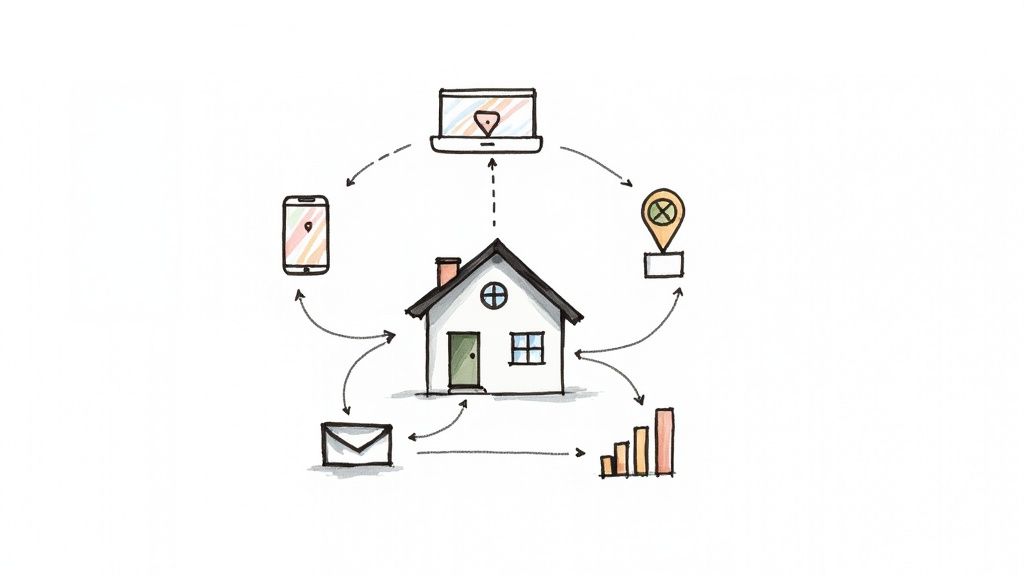
vacation rental advertising
Vacation Rental Advertising That Books Solid
Posted on Dec 1, 2025
Smart vacation rental advertising isn't about just boosting a post and hoping for the best. It’s a strategic game that starts way before you spend your first dollar. The campaigns that truly kill it are built on a rock-solid foundation: knowing your ideal guest inside and out, keeping an eye on your competition, and setting goals you can actually measure.
Getting this groundwork right is the difference between guessing and growing.
Building Your Advertising Foundation

Jumping straight into paid ads without a plan is like setting sail without a map. Sure, you're moving, but you'll probably end up lost at sea. Before you even think about launching a campaign, you need to nail down the core elements that will guide every single decision, from the words you use in your ads to the channels you pick.
This foundational work isn't just busywork; it's what ensures your budget gets spent wisely, hitting the right people with a message that actually resonates.
And make no mistake, the vacation rental market is more crowded than ever. To really make an impact, you need a basic grasp of the broader field of digital marketing that powers every successful campaign. The industry is absolutely booming—global revenue is projected to hit $97.85 billion in 2025, a huge leap from $90.55 billion in 2023.
Here in the United States, we’re looking at $21 billion by 2025. With numbers like that, just "winging it" is not an option.
Define Your Ideal Guest Persona
So, who are you really trying to reach? It's time to move beyond generic labels like "families" or "couples." A detailed guest persona brings your target audience to life, letting you sharpen your advertising with laser precision.
To really flesh out your persona, ask yourself these kinds of questions:
- What's their motivation? Is your ideal guest hunting for adventure, craving total relaxation, or trying to find a killer spot for a "work-cation"? A family planning a jam-packed Disney trip has completely different priorities than a digital nomad who just needs lightning-fast Wi-Fi and a decent desk.
- What are their pain points? What drives them crazy when they're booking travel? Maybe they can never find properties that are truly pet-friendly, or they're constantly worried about how clean a rental will be. Your ads can speak directly to these frustrations.
- How do they search? Where do they spend their time online? Are they scrolling Instagram for travel inspo, diving deep into travel blogs, or plugging specific keywords into Google? This tells you exactly where you need to show up.
When you create a specific persona—let's call her "Remote-Worker Rachel," a 32-year-old graphic designer searching for a month-long mountain getaway—your messaging instantly becomes clearer and more powerful.
Analyze Your Local Competition
You're not operating in a bubble. A quick look at your local competition can reveal huge gaps in the market and golden opportunities to make your property shine. You don't need a 50-page report; a simple spreadsheet will do the trick.
Here’s what to look for in your local market:
- Messaging Gaps: Are all your competitors saying the same thing, like "charming cottage"? If so, you can zig while they zag. Focus on a unique benefit, like being "your fully-equipped remote office with a killer view."
- Amenity Highlights: Does every other listing have a hot tub? Cool. But maybe your secret weapon is the high-end espresso machine, the outdoor pizza oven, or the ridiculously comfortable bedding. Find what makes you different and shout about it.
- Keyword Opportunities: Check out the terms your competitors seem to be targeting in their listings and ads. Nailing your search terms is crucial. If you need a hand, you can learn more about finding the perfect vacation rental keywords in our comprehensive guide.
Key Takeaway: Understanding what your competitors are—and are not—doing is your secret weapon. It allows you to position your rental not just as another option, but as the best option for a specific type of guest.
Set Clear and Measurable Goals
"Get more bookings" is a wish, not a goal. To be effective, your advertising needs to be driven by specific, measurable objectives that you can track. Without them, you're just throwing money at the wall and hoping something sticks.
Your goals should be concrete and actionable. For example:
- Increase direct bookings by 20% over the next quarter to cut down on OTA fees.
- Fill 80% of our shoulder-season weekends in October and November.
- Achieve a 5:1 Return on Ad Spend (ROAS) for all our paid campaigns.
These kinds of clear targets let you know, without a doubt, if your campaigns are working. You'll see exactly what's bringing in the bookings and where to put your budget for the biggest impact. This data-driven approach is what turns advertising from a simple expense into a profit-generating machine.
Creating Assets That Convert Lookers into Bookers
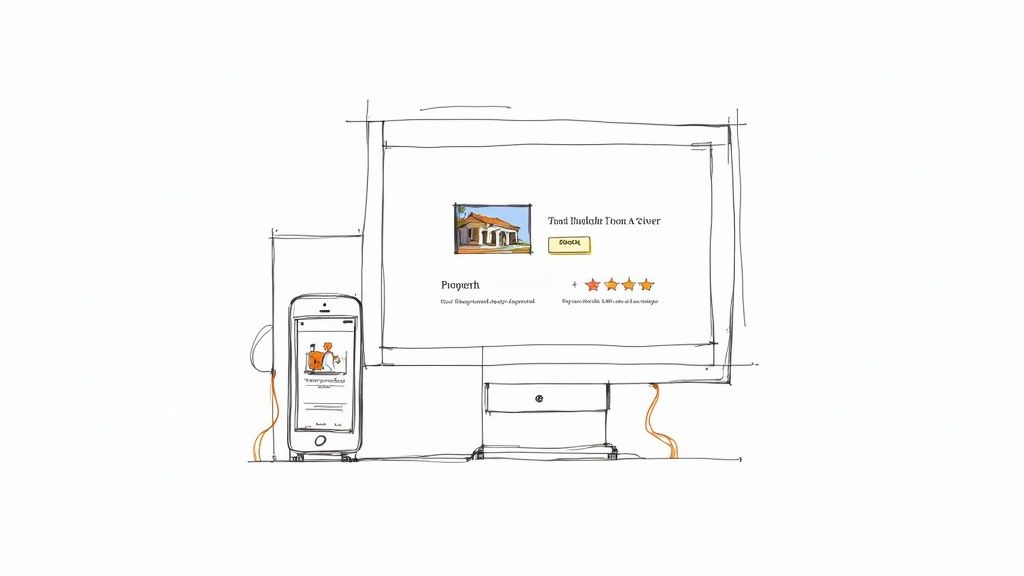
Your online presence is your digital handshake. It has to be strong enough to stop a potential guest mid-scroll and make them pay attention. The assets you build—from your photography and videos to your direct booking website—form the very core of your advertising. They're doing the heavy lifting, telling your story and convincing travelers your property is the one.
This isn't just about throwing a listing online. It's about crafting an experience before the guest even packs their bags. With online channels projected to drive a massive 80% of all vacation rental revenue by 2029, a weak digital storefront simply won't cut it anymore. That's a huge shift you can't afford to ignore. For more on this trend, check out the latest vacation rental industry statistics.
Beyond Just Good Photos and Videos
We all know professional photos are table stakes. Let's push past that baseline. Your visuals shouldn't just document a room; they need to sell an entire experience. Think about the story you're trying to tell.
- Photography that Sells an Experience: Ditch the sterile, wide-angle shots of empty rooms. Instead, capture the lifestyle. Show a steaming mug of coffee on the balcony at sunrise, a board game mid-play by the fireplace, or two wine glasses next to the hot tub under the stars. These are the images that help guests picture themselves making memories in your space.
- Short-Form Video is Essential: A quick 30-second video tour can communicate the flow and vibe of a property in a way photos never will. Create snappy, engaging Reels or TikToks that show off the best features. Even a simple walk-through video shot on your phone can dramatically boost engagement and build trust.
Honestly, high-quality visuals are the single most important investment you can make. They create instant credibility and make your property shine, which is absolutely critical when you're up against thousands of other listings.
Writing Descriptions That Spark Imagination
Once your visuals have grabbed their attention, your words need to seal the deal. So many property descriptions are just a boring list of features. Don't be that host. Focus on the benefits, not just the specs.
Instead of just stating, "The kitchen has a new stove," paint a picture: "Whip up a pancake breakfast for the whole family in the fully-equipped chef's kitchen."
The goal is to make the guest feel what it's like to be there. Use sensory language and a warm, inviting tone. And please, break up your text! Use short paragraphs and bullet points so it's easy to scan. Lead with the experience, then fill in the details.
Pro Tip: Your description needs a hook. Don't start with "This is a 3-bedroom home." Try something that captures the unique feeling of your rental, like, "Escape to this sun-drenched mountain hideaway where peaceful mornings and starlit nights are guaranteed."
Building a Direct Booking Site That Converts
Your direct booking website is your single most valuable asset in this entire game. It's the one corner of the internet where you have complete control over your brand, your messaging, and—most importantly—your revenue, free from OTA commissions.
But just having a website isn't enough. It has to be engineered from the ground up to turn visitors into booked guests.
This means being obsessed with the user experience (UX). A clunky, slow, or confusing website will send potential guests running straight back to the familiar comfort of Airbnb or Vrbo. Your site must be clean, intuitive, and lightning-fast, especially on mobile, where the vast majority of travel research now begins.
To build a site that actually performs, you need to nail these elements:
- Mobile-First Design: Your website has to look and work flawlessly on a smartphone. Period. Test every button, every form, and every page on a mobile device to make sure the experience is seamless.
- A Frictionless Booking Engine: The booking process should be almost stupidly simple. A guest needs to see availability, get a clear price, and complete their booking in just a few clicks. Every extra step is a chance for them to leave.
- Compelling Calls-to-Action (CTAs): Use clear, unmissable buttons like "Book Your Stay" or "Check Availability Now" on every single page. Make it completely obvious what you want the visitor to do next.
A site that excels in these areas is what builds guest trust and makes the direct booking process feel safe and professional. For a much deeper dive, check out our guide on the 14 must-have features for a high-converting short-term rental website. At the end of the day, a strong direct booking site is the hub of your business, turning all your advertising efforts into profitable, commission-free revenue.
Launching Smarter Ad Campaigns
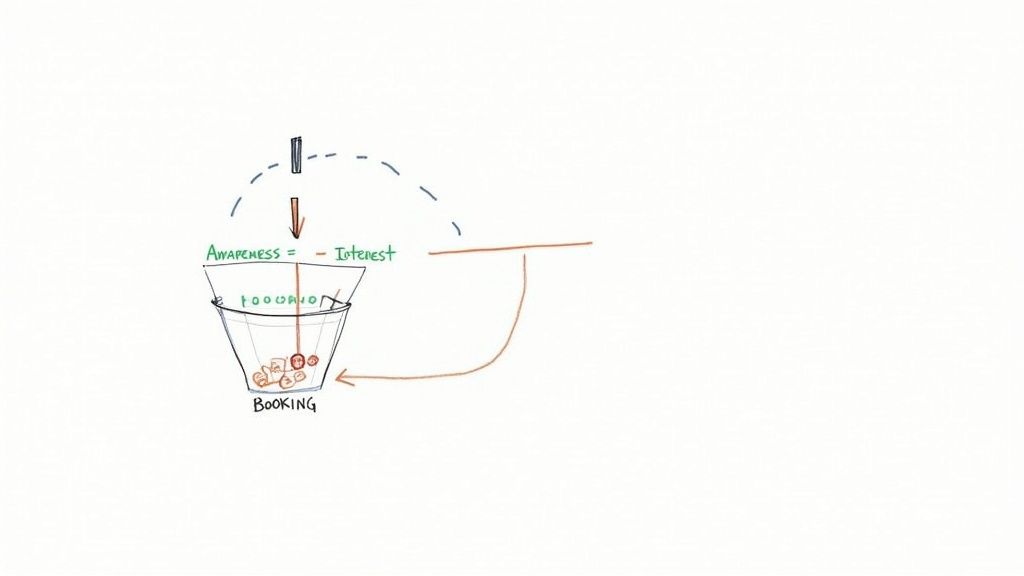
You’ve built a killer direct booking site and have a library of gorgeous photos and videos. Now what? It's time to stop waiting for guests to stumble upon you and start actively hunting them down. This is the shift from a passive to an active advertising strategy, where we use data to find and convert your ideal guests with surgical precision.
We're not just talking about listing on the OTAs anymore. We’re diving into smart, targeted campaigns that fill your calendar with high-value direct bookings. These are the tactics that put your properties in front of potential guests long before they even think about typing "Airbnb" into a search bar.
So, What Is Programmatic Advertising?
Imagine you run a family-friendly beach house. Now, imagine you could show an ad for that house specifically to a mom who’s been reading articles about "top family beach destinations" and just browsed a site for kids' swimwear.
That’s programmatic advertising in a nutshell.
Instead of just buying ad space on a single website and hoping for the best, programmatic uses automated tech and massive amounts of data to put your ads in front of specific people across millions of websites, apps, and social platforms. You're targeting the person, not the place.
With this approach, you can:
- Catch Guests Early: Connect with travelers while they're still in the daydreaming phase of their trip planning.
- Target with Precision: Zero in on users based on their browsing behavior, demographics, and interests that align with your ideal guest persona.
- Stretch Your Budget: Automatically bid on ad space in real-time, so you only pay to reach the most relevant audiences out there.
For a vacation rental manager, this means your ads for a pet-friendly mountain cabin could pop up for someone who just searched for local hiking trails or read a blog post about traveling with dogs. It's a much smarter way to spend your ad dollars, cutting out the waste and focusing only on people who are genuinely likely to be interested.
Key Takeaway: Programmatic advertising isn't just for mega-brands anymore. It's a surprisingly accessible tool that lets you find and influence your perfect guests all over the internet, not just on the usual travel sites.
The Magic of Retargeting (When Done Right)
What about all those people who visited your website, maybe even clicked on a specific property, but then bounced without booking? These are your warmest leads. This is where retargeting comes in, and frankly, it's the most powerful tool in your vacation rental advertising kit.
Retargeting is simple: you show ads specifically to people who have already interacted with your website. These aren't cold leads; they’ve already raised their hand and shown interest, making them far more likely to convert.
Think of it as your digital second chance. A well-timed, relevant ad can be the exact nudge a potential guest needs to come back and finish what they started.
A Real-World Facebook Retargeting Campaign
Let's break down how this works in practice. We'll turn a "window shopper" into a booked guest using a simple Facebook retargeting campaign.
The Scenario: A potential guest lands on your direct booking site. They spend two minutes looking at your "Seaside Cottage" page but leave without booking. They're gone, but not forgotten.
Here’s how you reel them back in:
- Install the Facebook Pixel: First things first, you need the Facebook Pixel (a little snippet of code) on your website. This is what tracks what visitors do, like which property pages they view.
- Build a Custom Audience: Head into Facebook Ads Manager and create a "Custom Audience." You’ll set the rules to include anyone who visited the "Seaside Cottage" URL in the last 30 days but—and this is key—has not visited your "booking confirmation" page. This isolates the non-bookers.
- Create a Killer Ad: Now for the fun part. Design an ad just for this audience. Don't just reuse the main photo. Try a carousel ad that showcases the cottage's best features—the porch swing, the ocean view, the cozy fireplace.
- Write Specific, Nudging Copy: Your ad headline should be direct and inviting. Something like, "Your Seaside Escape is Waiting." Then, in the body text, add a gentle push: "Still dreaming of the coast? The Seaside Cottage has a few dates left this fall. Book your getaway before it's gone!"
This hyper-targeted ad feels personal and helpful, not creepy. You’re simply reminding a warm lead about a place they already liked, which dramatically boosts the odds they’ll come back to book. This is how you turn casual interest into confirmed, profitable reservations.
Putting Your Marketing on Autopilot with AI
If you're managing multiple properties, juggling ad campaigns, and handling constant guest communication, you know it's a fast track to burnout. The sheer manual effort needed to keep everything running smoothly—and effectively—can feel like a tidal wave.
This is where smart AI tools are really starting to shine. They aren't here to replace you. Think of them as a tireless marketing assistant, chewing through the repetitive grunt work so you can finally focus on strategy and growth. The real goal isn't just to work less, but to work smarter. By automating the right pieces of your vacation rental advertising workflow, you can claw back dozens of hours a week and, at the same time, give your guests a more personal, responsive experience. It's about building a system that drives bookings 24/7, even when you’re not online.
Syndicating Listings and Ads Hands-Free
Keeping your brand story straight across a dozen different channels is a manual nightmare. The description on Airbnb has to match your direct booking site, which needs to line up with your latest Facebook ad. Make one small update to your amenities, and you're suddenly logging into five different platforms to make the same change.
An AI-powered distribution tool like hostDistro flips that entire process on its head.
Instead of chasing down every listing, you just maintain a single source of truth. The AI then takes over, syndicating all your property details, photos, and descriptions across every channel you're on.
- Update Once, Publish Everywhere: Change a price or add a new photo in one spot, and the system instantly pushes that update to every platform.
- Maintain Brand Voice: The AI ensures your messaging stays consistent, reinforcing your brand no matter where a potential guest finds you.
- Launch Campaigns Faster: You can roll out targeted ads across different networks without the soul-crushing copy-and-paste routine. Promotions go live in minutes, not hours.
This kind of automation just about eliminates human error and frees up an unbelievable amount of admin time. You get to think about the big picture, not data entry.
Personalizing the Guest's Digital Journey
A generic, one-size-fits-all website just doesn't cut it anymore. AI can turn your direct booking site from a static brochure into a dynamic, personalized storefront for every single person who visits. An intelligent website builder, like hostFront, can analyze a visitor's behavior in real-time and tailor the experience on the fly.
For instance, imagine a visitor who spent time looking at your pet-friendly cabins. The next time they land on your site, the AI can automatically feature those exact properties on the homepage or even showcase a blog post about "The Best Dog-Friendly Hikes Nearby."
This isn't a gimmick; it's a powerful way to boost conversions. When you show people exactly what they're looking for without making them search for it, you remove friction and make the path to booking feel like it was designed just for them.
Automating the Entire Email Workflow
Email marketing is still one of the most powerful tools for driving repeat business, but trying to manage it manually is impossible once you start to scale. This is where automation truly becomes your best friend. An AI-driven tool like hostMail can run your entire guest communication lifecycle without you lifting a finger.
Think about a workflow like this, all running in the background:
- Pre-Arrival: A week before check-in, an email automatically goes out with directions, door codes, and a link to your digital guidebook.
- Mid-Stay Check-in: On day two of their stay, another automated email checks in to see if everything is going well. It's proactive service that guests love.
- Post-Stay Review Request: The day after checkout, an email asks for a review while the great experience is still fresh in their mind.
- Re-engagement Offer: Six months down the road, the system sends a personalized "welcome back" email with a special discount to entice them to book again.
This hands-off approach ensures no guest ever slips through the cracks. It turns every touchpoint into a chance to build loyalty. If you want to dive deeper into using this kind of tech, check out this practical guide to AI marketing for small businesses. By plugging in these AI-powered systems, you're not just saving time—you're building a sophisticated marketing machine that consistently drives revenue.
To see how these pieces connect, here is a quick look at how an AI platform can manage an entire campaign from start to finish.
Sample AI-Powered Marketing Campaign Workflow
This table illustrates how different components of an AI platform can be used in a cohesive workflow to launch and manage a vacation rental advertising campaign.
| Campaign Stage | Action | Tool Used | Outcome |
|---|---|---|---|
| 1. Setup & Content | AI analyzes property data to generate compelling ad copy and consistent listing descriptions. | hostDistro | High-quality, brand-aligned content is created and syndicated across all channels instantly. |
| 2. Ad Campaign Launch | AI uses the generated content to create targeted ads and landing pages for specific guest segments. | hostDistro | A targeted Google Ads campaign is launched, driving qualified traffic to a dedicated landing page. |
| 3. Website Engagement | The website dynamically personalizes content for visitors based on the ad they clicked. | hostFront | Visitors see properties and offers relevant to their search, increasing the likelihood of booking. |
| 4. Booking & Nurture | Once a booking is made, the guest is entered into an automated pre-stay communication sequence. | hostMail | The guest receives timely, helpful information, enhancing their experience and reducing questions. |
| 5. Post-Stay & Loyalty | After checkout, AI triggers emails for review requests and future re-engagement offers. | hostMail | Positive reviews are encouraged, and a database of past guests is built for future marketing. |
This integrated approach shows that with the right tools, you can automate almost the entire marketing funnel, ensuring a seamless and effective process that drives direct bookings while you focus on delivering amazing guest experiences.
Measuring What Matters and Optimizing for Profit
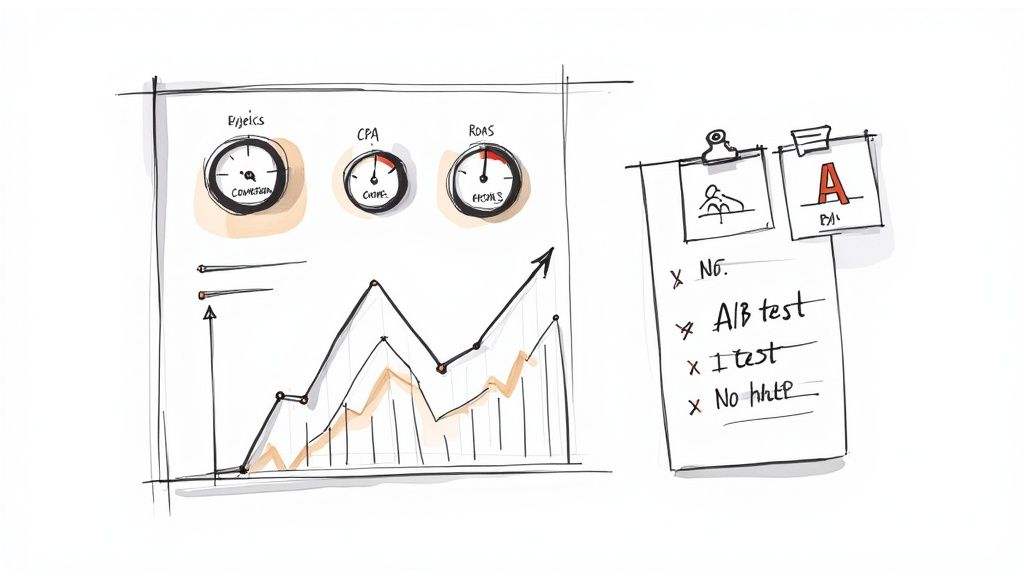
Launching a few ad campaigns is the easy part. The real work in vacation rental advertising begins when you have to figure out if you're actually making money or just lighting your budget on fire. It's so easy to get mesmerized by big numbers like clicks and impressions, but let's be honest—those are vanity metrics. They might look good in a report, but they don't pay the bills.
If you're serious about building a profitable direct booking engine, you have to cut through the noise. It’s about zeroing in on the handful of key performance indicators (KPIs) that are directly tied to your bottom line. This is the shift from guessing to making data-backed decisions that actually grow your business.
Tracking the KPIs That Actually Drive Revenue
Your goal isn't just to get more website traffic; it's to get more profitable bookings. To make that happen, you need to get obsessed with the metrics that tell the true story of your advertising performance. These are the numbers that reveal the real health of your marketing funnel.
Here are the three most critical KPIs to live and breathe:
- Conversion Rate: Simple and powerful. What percentage of your website visitors actually complete a booking? A high conversion rate is a sign that your website, photos, and descriptions are all working together to turn lookers into bookers.
- Cost Per Acquisition (CPA): This one is brutally honest. It tells you exactly how much you're spending to get a single direct booking. The math is easy: just divide your total ad spend by the number of bookings from that campaign.
- Return On Ad Spend (ROAS): This is the holy grail. For every dollar you put into ads, how many dollars in booking revenue are you getting back? A ROAS of 5:1 means you're generating $5 for every $1 you spend. Now that's a number you can take to the bank.
Keeping a close eye on these figures gives you a crystal-clear picture. You'll know in an instant which campaigns are your winners—the ones you should double down on—and which ones are duds that need to be tweaked or cut.
Following the Guest Journey with Simple Analytics
So, how do you even start tracking these numbers? It all begins with understanding the path a guest takes, from the moment they see your first ad to when they hit that "Confirm Booking" button. Setting up basic tracking is way easier than you might think, and Google Analytics is the perfect (and free) tool to get started.
Just by installing a simple tracking code on your direct booking site, you can start connecting the dots. You'll see which ad campaigns are sending you the most visitors, which pages they're lingering on, and—most importantly—how many are actually booking. This kind of visibility is absolutely essential for understanding what's working.
Crucial Insight: The real magic of analytics is in understanding the entire guest journey. Knowing which ad led to a booking is the core of marketing attribution—a fancy term for giving credit where credit is due across all your marketing touchpoints.
If you really want to get this right, you need to dive into attribution. We have an entire article that breaks down the fundamentals of what marketing attribution is and why it matters for your business.
The vacation rental industry is already seeing real, tangible results from these focused strategies. Recent findings show that in 2025, around 37.5% of operators successfully grew their direct bookings. At the same time, nearly 40% managed to boost both their occupancy and average daily rates over the previous year. These numbers prove it: effective advertising, backed by solid measurement, directly drives growth. You can see more insights in Hostaway's report on 2025 vacation rental trends and performance benchmarks.
Continuously Improving with A/B Testing
Once your tracking is in place, the real fun begins: optimization. The best way to do this is with A/B testing, which is just a simple method of comparing two versions of something to see which one performs better. Don't let the technical-sounding name fool you; it can be incredibly straightforward.
The key is to change only one thing at a time. That way, you know for sure what caused the change in performance.
Here are a few simple A/B tests you can run right away:
- Test Your Ad Headlines: Run the exact same ad but with two different headlines. Does a headline focused on "Ultimate Relaxation" get more clicks than one about "Your Next Adventure"?
- Compare Your Main Photos: Use two different hero images for the same property in your ads. Does a photo of that stunning mountain view outperform a shot of the cozy, fire-lit living room?
- Experiment with Your Call-to-Action: On your website's booking page, try testing the button text. Does "Book Your Stay" convert better than the simpler "Check Availability"?
By constantly running these small experiments, you'll gather priceless data on what truly resonates with your ideal guest. This cycle of testing and improving is what separates the amateurs from the pros, allowing you to steadily increase your conversion rates and maximize your profitability over time.
Got Questions? We’ve Got Answers.
Running a vacation rental business means wearing a lot of hats, and it's natural to have questions when you add "digital marketer" to the list. Here are some straight answers to the most common things we hear from property managers building out their advertising strategy.
How Much Should I Actually Budget for Ads?
There's no single magic number, but a solid rule of thumb is to start with 5-10% of your projected rental revenue.
If you’re just launching a brand-new property or trying to muscle your way into a super competitive market like Destin or the Smoky Mountains, you'll want to lean toward the higher end of that range. You have to spend a bit more upfront to build that initial momentum and get noticed.
The real game-changer, though, is obsessively tracking your Return on Ad Spend (ROAS). Think about it this way: every direct booking saves you the 15% (or more!) you'd pay in OTA commissions. That means you can comfortably spend up to that commission fee to get the booking yourself and still come out ahead financially. A smart budget will balance steady, ongoing investment in your brand (like your direct booking site) with targeted ad campaigns you can ramp up during peak booking season.
Should I Ditch the OTAs and Just Advertise My Own Site?
Don't think of it as an either/or fight. It's more of a one-two punch.
OTAs like Airbnb and Vrbo are marketing behemoths. They spend billions to get eyeballs, and you can ride those coattails. Let them be the giant billboard that introduces new guests to your amazing properties. But if you only rely on them, you're essentially just renting your customers from them, trip after trip. You never own the relationship.
Here's the winning playbook:
- Use OTAs for Discovery: Let their massive marketing engine bring you fresh leads.
- Drive Direct for Loyalty: Once a guest stays with you, use every tool you have—from targeted retargeting ads and phenomenal service to post-stay email flows—to make sure their next trip is booked directly on your site.
Your north star should always be growing your percentage of direct, commission-free bookings. That's how you build a resilient, profitable, and long-term business.
I'm Ready to Start. What Are the First, Easiest Fixes for My Ads?
If you want to see an immediate lift, pour your energy into two places: your photos and your words.
First, your visuals. Stop taking photos on your phone and hire a professional photographer. Seriously. It is the single best investment you can make in your marketing. Your photos need to be bright, crisp, and sell the feeling of being there—the morning coffee on the porch, the sunset from the balcony—not just the four walls and a bed.
Second, nail down exactly who you're talking to. Stop trying to be everything to everyone. Are you the go-to spot for families with a golden retriever? The perfect escape for remote workers who need rock-solid Wi-Fi? Craft your ad headlines and copy to speak directly to that person. A generic ad about a "nice 3-bedroom condo" is invisible. An ad for a "Dog-Friendly Beach House with a Fenced-In Yard" gets the click.
Ready to stop guessing and start growing your direct bookings? With hostAI, you can automate your advertising, personalize your guest experience, and measure what truly matters. Discover how hostAI can transform your vacation rental business today.