

vacation rental pricing
Vacation rental pricing strategy: maximize revenue
Posted on Dec 2, 2025
A smart vacation rental pricing strategy is your single most active lever for getting more bookings and making more money. It’s all about ditching the old "set it and forget it" mentality and actually using data to react to what the market is doing. When you treat pricing as a dynamic tool, you can turn market swings into opportunities, boosting both your occupancy and your bank account.
Why Your Pricing Strategy Is Your Most Powerful Tool
In today's crowded market, just having a listing isn't enough to get by. Your price is the first thing potential guests see, and it sends a powerful signal about your property's value, quality, and availability. Nailing your pricing is the difference between a fully booked calendar and a season full of missed chances.
Stop thinking of your price as a fixed number. It’s a flexible response to the world around your rental. A local music festival, a holiday weekend, or even a competitor down the street slashing their rates—these are all signals that should make you rethink your price. Ignoring them is like trying to sail without a rudder. Sure, you're moving, but you have no control over where you end up.
The Growing Market Demands a Smarter Approach
The vacation rental industry is absolutely booming. The global market was pegged at around $97.85 billion in 2023, and it's projected to rocket up to $134.26 billion by 2029. You can dig into more of these growth insights on StayFi. This explosion in competition means that guessing at your rates or just copying your neighbor is a surefire way to get left behind.
A deliberate, thought-out vacation rental pricing strategy lets you:
- Maximize Revenue: You can adjust your rates on the fly to capture the absolute highest price the market will tolerate during peak demand.
- Increase Occupancy: During the slow season, you can offer more competitive prices to attract travelers on a budget and keep your property from sitting empty.
- Attract the Right Guests: Your pricing should reflect the value you provide. This helps you attract the kind of guests who appreciate your unique amenities and are happy to pay for them.
A great pricing strategy doesn’t just earn you more money on one booking. It builds a foundation for consistent, year-round profitability by perfectly balancing what guests want with what your property is worth.
This guide will walk you through the core concepts you need to build a strategy that's driven by data, not guesswork. We'll break down foundational models like dynamic, seasonal, and value-based pricing, reframing them as essential tools for any serious host. It’s time to turn your pricing from a simple number into your most valuable business asset.
Choosing Your Foundational Pricing Model
Picking the right pricing model is like choosing the foundation for a house. Get it right, and everything you build on top of it will be solid. Get it wrong, and you'll be dealing with cracks for years to come. Your choice here sets the entire tone for how you'll make money with your vacation rental.
There are really three core models to build from: Dynamic Pricing, Seasonal Pricing, and Value-Based Pricing. Each one works best in different situations and for different kinds of properties. Let's break down what they are, who they're for, and how to know which one is the right starting point for you.
Dynamic Pricing: The Real-Time Responder
Think of dynamic pricing as the stock market for your rental. Rates go up and down every single day—sometimes every hour—based on what's happening in the market right now. This approach uses data to automatically adjust your prices for local events, what your competitors are doing, how far in advance people are booking, and even the day of the week.
This is the go-to model for properties in busy, unpredictable markets.
- Urban Apartments: You can cash in on weekday business travel, weekend getaways, and those sudden demand spikes from a big concert or convention.
- Properties Near Major Venues: A big game or festival is announced? Your prices can react instantly, before you even read the news.
- Highly Competitive Markets: When the rental next door drops their price, your system can adjust to stay competitive, keeping you one step ahead.
The magic of dynamic pricing is that it squeezes every last drop of revenue out of your calendar. You never leave money on the table during a surprise surge, and you can fill empty nights during slow periods with smarter, more attractive rates. It's not uncommon for a property using this model to earn up to 40% more per year than one with flat rates.
Seasonal Pricing: The Predictable Planner
Seasonal pricing is the tried-and-true classic. It's a more straightforward approach where you set different base rates for predictable chunks of the year—think high season, low season, and those "shoulder" seasons in between. It’s less about tiny daily tweaks and more about a smart, long-term calendar strategy.
This model is a perfect fit for destinations with a clear, reliable tourism rhythm.
- Beachfront Homes: You'll obviously command top dollar in the summer months and can offer great deals to attract guests in the winter.
- Mountain Ski Chalets: Maximize your income during the snowy season, then adjust for the summer hiking and biking crowd.
- Rural Retreats: You can price higher during peak fall foliage or for popular holidays like Thanksgiving when families are looking to get away.
Seasonal pricing gives you a sense of stability and is way easier to manage by hand than a fully dynamic system. It lets you forecast your revenue months ahead and ensures you capitalize on the obvious busy times in your market.
Value-Based Pricing: The Unique Specialist
Last but not least, we have value-based pricing. This strategy throws market demand out the window and focuses entirely on what makes your property a one-of-a-kind experience. If you've got a place that competitors simply can't copy, this is for you. The price isn't based on the number of bedrooms; it's based on the incredible value and unique experience you offer the guest.
This is a specialist’s strategy, tailored for truly exceptional properties.
- Architectural Marvels: A Frank Lloyd Wright-inspired home isn't just a place to sleep; it's an experience worth a premium.
- Properties with Exclusive Amenities: Got a private beach, a professional-grade home theater, or a rooftop infinity pool? That's your price justification right there.
- Historically Significant Homes: People will pay more for the story and the chance to stay somewhere with a unique past.
To pull this off, you absolutely must be able to sell the story of what makes your property so special. A great way to ground your strategy is to learn how to price rental property like a pro, which digs into the kind of market analysis and expense tracking that ensures your unique value also makes solid financial sense.
To help you figure out the best starting point, the table below breaks down these three foundational models.
Comparison of Foundational Pricing Models
| Strategy | Best For | Key Driver | Pros | Cons |
|---|---|---|---|---|
| Dynamic Pricing | Urban rentals, event-heavy areas | Real-time demand | Maximizes revenue, high occupancy | Requires automation, complex |
| Seasonal Pricing | Traditional vacation spots | Predictable seasons | Easy to manage, stable | Misses short-term opportunities |
| Value-Based Pricing | Unique, luxury properties | Property's unique features | High-profit margins, attracts ideal guests | Niche market, requires strong branding |
Ultimately, this table is a guide. Your property might even blend elements from two models. The key is to pick a primary approach that aligns with your property, your market, and your personal goals as a host.
The Power of Real-Time Dynamic Pricing
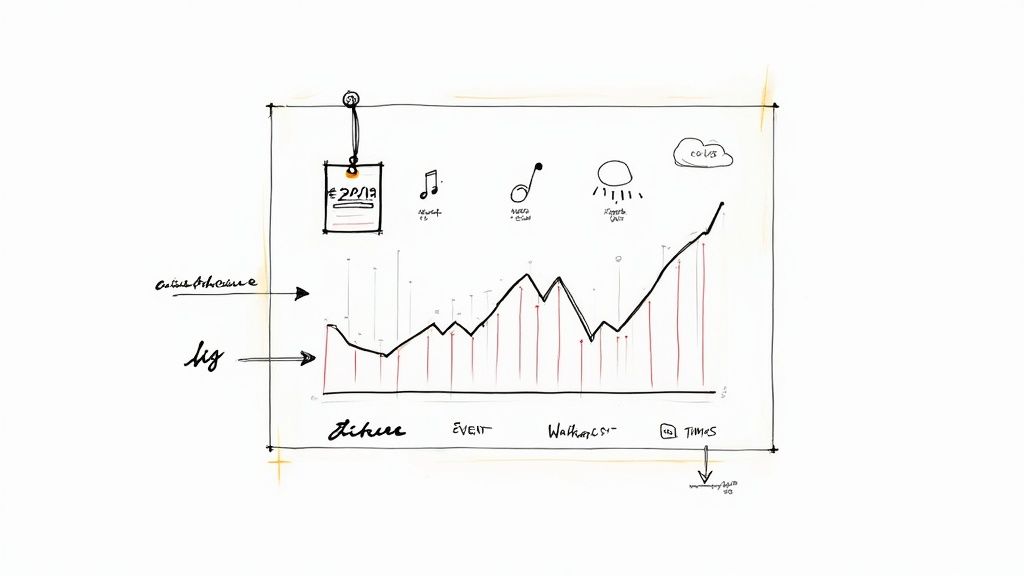
The days of setting your prices once a season and forgetting about them are long gone. The most profitable vacation rentals today run on dynamic pricing, which is all about adjusting your rates based on what’s happening in the market right now. This approach turns your pricing from a static number into a responsive, money-making tool.
Imagine a major concert is suddenly announced in your city for what's usually a dead weekend. If you’re stuck with a static price, you've just left a ton of money on the table. But with dynamic pricing, your rates can automatically jump to capture that surge in demand, turning a standard booking into a huge win.
This is the very core of a modern vacation rental pricing strategy—you start thinking like a revenue manager, acting on the small, immediate signals your competitors are probably missing.
What Fuels Dynamic Pricing Decisions
A real dynamic strategy isn't just about cranking up prices for big events. It's about making thousands of tiny adjustments based on a constant flow of data. A good pricing tool or algorithm should be looking at far more than just the calendar.
Here are a few of the key data points:
- Competitor Availability: When nearby properties start booking up, the supply in your area shrinks, making your place more valuable. Your prices should tick up to reflect that scarcity in real time.
- Booking Lead Times: Are guests booking further out than they normally do? That’s a massive signal of high demand, telling you that you can probably hold firm on your rates or even nudge them higher.
- Local Events: This goes beyond huge festivals. Even smaller local conferences or sporting events create pockets of intense demand that absolutely justify a premium.
- Weather Forecasts: For a beach house or ski cabin, a perfect 10-day forecast can be a powerful driver for last-minute bookings. Good weather can literally increase your pricing power overnight.
This isn't just about reacting; it's about anticipating. By constantly monitoring these signals, you ensure your property is perfectly priced at the exact moment a guest is ready to click "book."
Moving Beyond Last Year's Numbers
For a long time, pricing was all about looking in the rearview mirror—basing this year's rates on last year's performance. Dynamic pricing completely flips that script. It prioritizes what's happening live in the market over what happened in the past. While historical data is a decent guide, real-time market behavior is a much better predictor of your immediate booking potential.
And this shift is working. In fact, dynamic pricing has become a game-changer, with roughly 40% of operators using it to increase both their occupancy and their average daily rates at the same time. Live demand trends now matter more than old seasonal calendars, allowing savvy hosts to cash in on booking surges from all sorts of micro-demand events.
Making Dynamic Pricing Work for You
Putting a real-time strategy into action might sound overwhelming, but it's more accessible than ever. This isn’t about being chained to your laptop 24/7. It's about setting up smart, automated rules and letting the right tools do the heavy lifting. This is a foundational concept in modern vacation rental revenue management, where technology empowers you to make smarter, faster decisions.
The goal is to automate the analysis of all those demand signals so your rates adjust logically and instantly.
- For a surprise festival: You could set a rule to automatically boost rates by 30% for any dates within a 5-mile radius of the venue.
- For a competitor sell-out: If market occupancy for your property type hits 90%, you can have a rule that automatically bumps your remaining nights by 15%.
- For last-minute availability: Create a rule that gradually discounts an unbooked night by a small percentage each day as the check-in date approaches, protecting you from a total loss without giving the night away too early.
By embracing real-time dynamic pricing, you stop playing defense—just trying to fill empty nights—and start playing offense, maximizing the value of every single booking on your calendar.
Tracking the Metrics That Actually Matter
Trying to craft a pricing strategy without data is like flying blind. You might be moving, but you have no idea if you’re heading toward profitability or flying straight into a cliff. To get a real handle on your business's health, you have to track the non-negotiable metrics that paint the full picture.
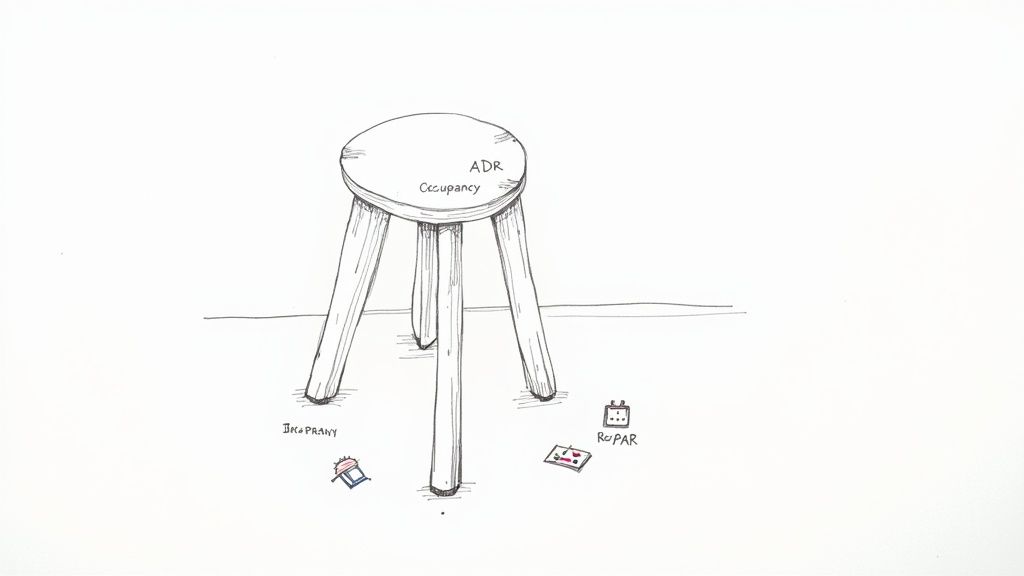
Think of your core metrics as a three-legged stool. If any one of those legs is weak or missing, the whole thing gets wobbly and eventually collapses. Your three essential legs are Average Daily Rate (ADR), Occupancy Rate, and Revenue Per Available Room (RevPAR).
The Three Pillars of Pricing Performance
Here's the thing: a sky-high nightly rate means absolutely nothing if your property sits empty most of the month. On the flip side, a fully booked calendar isn't a win if you've slashed your rates so low you're barely breaking even. That’s why you have to look at these three metrics together.
- Average Daily Rate (ADR): This is simply the average revenue you earn per booked room on any given day. It’s a clean measure of what guests are actually paying to stay with you.
- Occupancy Rate: This tells you the percentage of available nights that were actually booked over a period. It's your most direct indicator of demand.
- Revenue Per Available Room (RevPAR): This is the gold standard. RevPAR is what you get when you multiply your ADR by your Occupancy Rate. It gives you a holistic view of how much you're earning across your entire inventory, whether it's booked or not.
RevPAR is the ultimate truth-teller. It cuts through the noise and reveals how well you’re balancing price and occupancy to maximize your total income, saving you from the false security of a high ADR or a full calendar.
The vacation rental market has seen some wild pricing shifts lately, and these metrics tell the story. For example, not long ago, Europe and North America saw ADRs jump by 18.8% and 13.9%, respectively. This growth was fueled by solid demand, even with occupancy rates hanging below 60%, which just goes to show how a strong ADR can lift your entire revenue boat.
Looking Beyond the Core Metrics
While ADR, Occupancy, and RevPAR are your foundation, a few other numbers provide crucial context for your pricing moves. Understanding the full range of KPIs is vital, and you might even want to learn how to calculate a yield on a property to get an even deeper financial picture.
One of the most important secondary metrics is Booking Lead Time. This is just a fancy way of saying "how far in advance are people booking?" A long lead time screams strong demand, giving you the confidence to hold firm on your prices or maybe even nudge them up.
But a short lead time? That's a signal of weaker demand and might be your cue to roll out a strategic last-minute discount to fill an otherwise empty night. Analyzing these data points is what helps you shift from just reacting to your P&L statement to proactively shaping it.
Of course, tracking these numbers is just one piece of the puzzle. You also need to see how they connect to your bigger business goals. Check out our guide on how to measure marketing ROI to see exactly how your promotional efforts are impacting these key performance indicators.
Building Your Pricing Strategy Step By Step
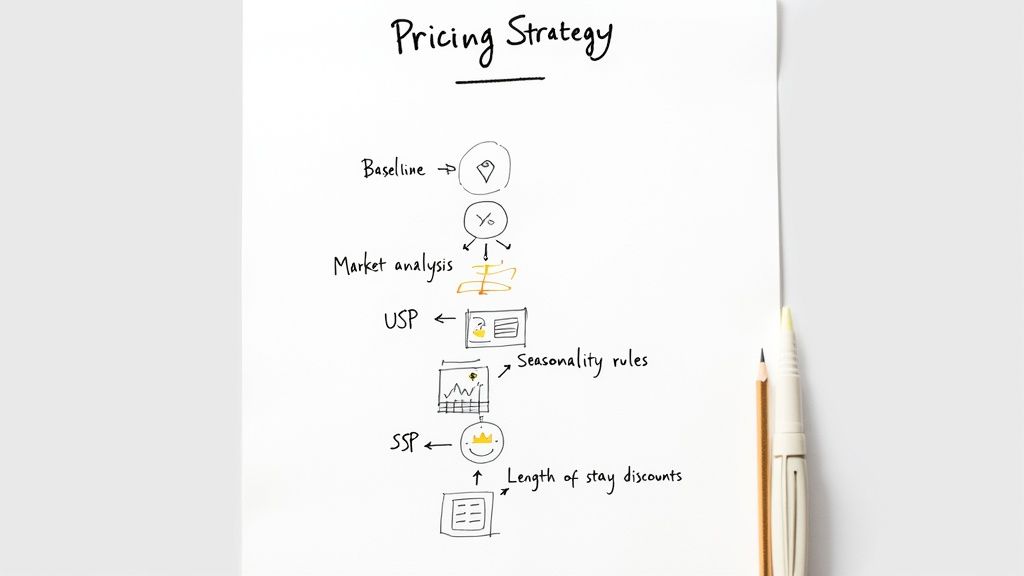
Alright, now that you've got the concepts and metrics down, it’s time to roll up our sleeves and build your actual pricing strategy. This isn't about plucking a number out of thin air; it's a methodical process that balances what you need to earn with what the market will actually pay.
Think of it like building a house. You don't start with the fancy roof tiles, you pour a solid foundation. In pricing, your foundation is the baseline rate—the absolute minimum you must charge to cover costs and make a profit. Once that's set in stone, we can start layering on market intel and smart adjustments to really maximize what you take home.
Step 1: Calculate Your Baseline Nightly Rate
Before you even glance at your competitors, you need to know your floor. This is your break-even number, plus your profit goal. If you dip below this rate, you're literally paying for someone to stay at your property, no matter how packed your calendar looks. This number keeps your entire strategy grounded in reality.
Here’s how to nail it down:
- Tally Up Your Total Annual Costs: Add up every single expense required to run your rental for a year. This means fixed costs like your mortgage, insurance, and property taxes, but also the variable stuff like utilities, cleaning supplies, and routine maintenance.
- Add Your Desired Profit Margin: What do you want to make? A good starting point for many hosts is a 15-20% profit margin on top of total costs, but this really comes down to your own financial goals.
- Divide by Potential Booking Nights: Take your total (costs + profit) and divide it by the number of nights you realistically expect to be booked. If you're new, aiming for 50-60% occupancy is a solid target. That's about 182-219 nights a year.
The number you're left with is your baseline nightly rate. This isn't the price you'll advertise, but it's the hard-and-fast minimum you should never go below, even for a last-minute deal.
Step 2: Analyze Your Market and Competitors
With your financial foundation in place, it’s time to look outside your own four walls. Market analysis is all about figuring out where your property fits in the local pecking order. Blindly copying your neighbor is a recipe for disaster, but ignoring them completely is just as foolish.
The key is to identify your true competitors. You're looking for properties that are an apples-to-apples comparison:
- Location: Same neighborhood or a similar distance to the main attractions.
- Size: The same number of bedrooms and bathrooms.
- Amenities: Similar perks, like a pool, hot tub, or pet-friendly policy.
- Guest Reviews: A comparable review score and volume of reviews.
Pull together a list of 5-10 direct competitors and start tracking what they charge for weekdays, weekends, and major holidays. This will give you a real-world picture of the pricing ceiling and floor in your immediate market.
Step 3: Define Your Unique Selling Proposition
So, what makes your place special? Your Unique Selling Proposition (USP) is the reason a guest will happily pay your rate—or even a premium—over the place next door. It could be that killer ocean view, the professionally designed interior, or the fact that you're a two-minute walk from the best tacos in town.
Your USP is your pricing power. If you have an amenity no one else does, you can—and should—charge more for it. Clearly highlighting this value in your listing is essential for converting lookers into bookers at your target price.
For example, a property with a private hot tub can often fetch 15-25% higher nightly rates than a similar rental without one. Figure out your top three USPs and start thinking about how much value they add. This "value bump" should be factored directly into your pricing.
Step 4: Set Your Strategic Pricing Rules
This is the final layer, where you build in the dynamic and seasonal adjustments that let your pricing adapt on the fly. These rules are what turn a static price into a revenue-maximizing machine that responds to demand all year long.
- Seasonality: Create distinct rates for your high, low, and shoulder seasons based on historical travel patterns in your area.
- Events: Pinpoint major local events—concerts, festivals, big conferences—and set rules to automatically spike your rates for those dates. It's not uncommon for major events to boost nightly rates by over 100%.
- Length-of-Stay Discounts: Encourage longer, more profitable bookings. Offering a small discount, like 10% off for a week-long stay, can drastically reduce your turnover costs and hassle.
- Last-Minute Adjustments: Don't let a night go unbooked. Build rules that strategically discount rates as the check-in date gets closer, turning a potential zero-dollar night into revenue.
Automating Your Strategy with Smart Pricing Tools
In a fast-moving market, manually tweaking your prices every day isn't just a headache—it’s a surefire way to lose money. Trying to keep up with competitor availability, local events, and booking trends by hand is like trying to drive while looking only in the rearview mirror. You're reacting to what's already happened, not what's coming.
This is where smart pricing tools change the game. These platforms automate and sharpen your entire vacation rental pricing strategy, taking the guesswork and emotion out of your most important financial decisions. Think of them as your 24/7 revenue manager, constantly crunching thousands of data points to land on the perfect rate for every single night.
How Dynamic Pricing Software Works
At its core, a dynamic pricing tool plugs into your Property Management System (PMS) and digests a massive amount of real-time market data to either suggest or automatically set your nightly rates. This isn't just a simple high-and-low-season calendar; it’s a sophisticated engine that reacts instantly to shifts in demand.
Here’s a glimpse of what these tools are watching around the clock:
- Real-Time Market Demand: They track the overall booking pace in your specific neighborhood.
- Competitor Pricing & Occupancy: They know the second your direct competitors get booked, signaling a golden opportunity to raise your rates.
- Local Events & Holidays: From big concerts to local food festivals, the software flags demand spikes you might otherwise miss.
- Booking Lead Time: It analyzes how far in advance guests are booking to get a read on demand strength.
By processing all this information in real-time, these tools ensure your rates are never too high (scaring guests away) or too low (leaving money on the table). They find that profitable sweet spot between occupancy and Average Daily Rate (ADR).
This screenshot gives you an idea of what a dynamic pricing dashboard looks like, showing recommended nightly rates based on live market data.
The key takeaway here is the visual story it tells. You can see exactly why a random Tuesday is priced differently than a Saturday during a holiday weekend, all laid out clearly.
The Benefits of Automation
Bringing a smart pricing tool into your workflow does more than just boost your bottom line; it fundamentally changes how you run your business. Instead of losing hours each week to spreadsheets, you let the technology do the heavy lifting. This frees you up to focus on the bigger picture, like elevating the guest experience or scouting your next property.
It's not uncommon for properties using dynamic pricing tools to see a revenue lift of up to 40% compared to those sticking with static rates. This automation also syncs your new rates across all your channels—like Airbnb and Vrbo—preventing costly mistakes and keeping your pricing consistent everywhere. Integrating this kind of tech is a cornerstone of modern hosting operations, which you can read more about in our guide to short-term rental booking software.
Ultimately, automating your pricing is about making smarter, data-backed decisions faster than your competition. It lets you capitalize on every small shift in demand, ensuring your property is always priced for maximum profit.
Got Questions About Vacation Rental Pricing?
Even with a killer strategy in hand, pricing can feel like a moving target. It’s totally normal to have questions pop up as you try to strike that perfect balance between a full calendar and maximum revenue. Let's tackle some of the most common ones we hear from hosts.
How Often Should I Be Changing My Prices?
If you're using a dynamic pricing strategy (either on your own or with a tool), you need to be checking your rates daily. Seriously. Market demand, what your competitors are doing, and even local events can flip on a dime. You might not actually change the price every single day, but that daily check-in is what keeps you ahead of the game.
For those using a more traditional seasonal approach, you'll want to lock in your main rates 6-12 months out to snag those early planners. But don't fall into the "set it and forget it" trap. You should still be glancing at your booking pace at least weekly.
A sudden flood of bookings—or a complete dry spell—is the market screaming at you. It's a signal to dive back into your pricing and figure out what’s going on. Agility is everything here.
What’s the Biggest Pricing Mistake New Hosts Make?
Hands down, the most common and costly mistake is blindly copying what the host down the street is doing. It's so tempting to just look at a similar listing and match their price, but that’s a recipe for disaster. You have no clue what their mortgage is, what their cleaning fees are, what their business goals are, or if their 5-star rating is propping up a higher price.
Your pricing has to be built on the foundation of your property's value and your numbers. This leads to the second-biggest mistake: not calculating a baseline rate. If you don't know the absolute minimum you need to charge to cover costs and turn a profit, you could have a fully booked calendar and still be losing money on every single guest.
Should I Price My Property Differently on Airbnb vs. Vrbo?
Yes, absolutely. This is a smart move called channel-specific pricing. Different platforms hit you with different commission fees, so tweaking your rates on each one is just good business to protect your margins. If one channel takes a bigger cut, you bump your price up slightly on that platform to cover it.
This is also a fantastic way to steer more guests toward booking directly with you. Many savvy hosts offer a slight discount for guests who book through their own website. It’s a win-win: travelers feel like they’re getting a deal, you save a bundle on OTA commissions, and you get to build a direct relationship with that guest for future stays. Just make sure your channel manager is set up correctly to handle this so you don't end up with double bookings or pricing messes.
Ready to stop guessing and start earning what you're worth? hostAI gives you the power to launch a high-converting direct booking website and put your marketing on autopilot. Take back control of your pricing and your profits. See how hostAI can double your direct revenue.