

vacation rental seo
Vacation Rental SEO Your Guide to Direct Bookings
Posted on Dec 5, 2025
So, what exactly is vacation rental SEO?Think of it as the art and science of getting your direct booking website to the top of Google. When travelers search for a place to stay, you want them to find you first, not another OTA. It’s your ticket to more direct bookings, stronger guest relationships, and finally breaking free from those hefty OTA commissions.
Why SEO Is Your Key to More Direct Bookings
Let's be honest: relying completely on OTAs feels like building your business on rented land. You're playing by their rules, subject to their algorithm whims, and handing over a significant chunk of your hard-earned cash. Those commission fees, often between 10-30% of your earnings, add up fast. SEO is how you take back control. It’s about transforming your own website into a commission-free booking machine that works for you 24/7.
This playbook isn't about fluffy theories. We're getting straight into the practical, actionable tactics that successful property managers are using right now to pull in guests directly. The goal isn't just to get more clicks; it's about attracting the right kind of traffic—travelers who are ready to book.
The Shift Toward Direct Discovery
The travel landscape is seeing a huge change. The global vacation rental market hit a mind-boggling USD 174.84 billion in 2024, and the way people find these properties is evolving right along with it.
A massive 83% of revenue in this space already comes from online bookings, and search engines have become the go-to discovery tool. In fact, by 2025, it's projected that nearly 70% of travelers will use search engines to find their next stay. This isn't just a trend; it's a fundamental shift that makes having a solid SEO foundation more urgent than ever.
This is about building a sustainable asset for your business—one that consistently generates bookings and moves you from dependency to independence. If you're new to this whole world or just want to brush up on the fundamentals, this guide on What is Search Engine Optimization offers a great primer on the mechanics behind it all.
Building a Foundation for Growth
A smart SEO strategy delivers much more than just commission savings. It's about building your brand's authority and creating real, direct relationships with your guests.
Here’s what you stand to gain:
- Increased Revenue: You keep 100% of the booking fee. Every dollar goes directly to your bottom line.
- Stronger Guest Relationships: Direct communication from the start allows for personalized service, which leads to repeat stays and glowing reviews.
- Reduced OTA Dependency: Your business becomes more resilient. You're no longer at the mercy of another company's policy changes.
- Greater Control: You set your own rules, build your own brand, and—crucially—own your guest data for future marketing.
The real magic of SEO is that it puts you in front of travelers at the exact moment they’re looking for a place like yours. You're not interrupting them with an ad; you're providing the perfect answer to their search.
Getting your vacation rental SEO right is a journey, but it’s one of the most profitable investments you can make in your business. By truly understanding the advantages of direct bookings for small vacation rental businesses, you can start building a more profitable, stable future. This guide is the step-by-step playbook to help you do just that.
Finding Your Guests with Keyword Research
An effective SEO strategy starts with one simple question: What are your potential guests actually typing into Google? This isn't just about targeting a broad term like "Miami rental." It's about getting inside their heads to uncover the specific, high-intent phrases that signal they're ready to book.
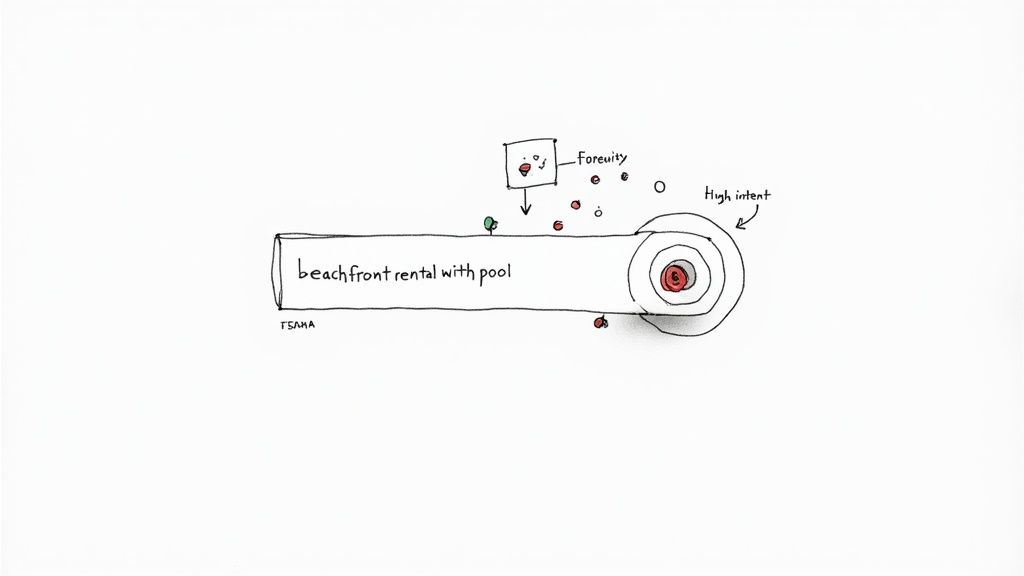
The real magic is in understanding search intent—the "why" behind every search. A traveler Googling "things to do in Destin" is just starting their research. But someone searching for "beachfront rental in Destin with a private pool"? They're practically holding their credit card. Your job is to show up for that second person.
Uncovering High-Intent Keywords
The most valuable search terms are almost always long-tail keywords. These are longer, more descriptive phrases. While they have lower search volume individually, they attract incredibly qualified traffic. It’s the difference between shouting into a crowded stadium and having a one-on-one conversation with someone who wants exactly what you offer.
So, how do you find these hidden gems?
- Google Autocomplete is your friend. Start typing a core phrase like "Smoky Mountains cabin rental" and watch what Google suggests. Phrases like "smoky mountains cabin with indoor pool" are direct insights into what real people are looking for.
- Mine the "People Also Ask" box. This section in the search results is a goldmine for understanding the questions your guests have. Answering these questions is a perfect way to build out helpful blog content that draws people in.
- Analyze your competitors. Check out the top-ranking direct booking sites in your market. What phrases pop up in their page titles and property descriptions? You're not looking to copy them, but to spot patterns and find gaps you can fill.
Taking the time to dig into keyword research best practices will pay dividends. It helps you zero in on your ideal audience and learn the exact language they use when they're ready to book.
Your property’s unique features are your secret weapons for keywords. A hot tub isn't just an amenity; it's the core of a powerful long-tail keyword like "Gatlinburg cabin with a hot tub for couples."
To really dial this in, you need to think in terms of modifiers. These are the extra words guests add to a location-based search to find exactly what they need.
High-Impact Keyword Modifiers for Vacation Rentals
| Modifier Category | Example Modifiers | Target Audience |
|---|---|---|
| Amenities | with pool, with hot tub, pet-friendly |
Guests with specific non-negotiable features. |
| Property Type | cabin, condo, villa, cottage |
Travelers looking for a particular type of stay. |
| Features | beachfront, ocean view, downtown, secluded |
Guests prioritizing location or a specific vibe. |
| Guest Type | for families, for couples, for large groups |
Travelers planning for a specific group dynamic. |
Combining these modifiers with your base location creates hyper-targeted phrases that attract guests who are much closer to making a decision.
Applying Keywords to Your Property Pages
Once you have a solid list of keywords, it’s time to weave them into your website. The goal is to integrate them naturally, especially on your individual property pages where the booking decisions happen.
Here are the most critical spots to focus on:
- Title Tags: This is the clickable blue headline in Google's search results. It needs to be concise and powerful. A great formula is: Primary Keyword + Location + Key Selling Point | Your Brand. For example: Luxury Beachfront Villa with Private Pool in Malibu | Seaside Escapes.
- Meta Descriptions: This is the short blurb under the title. While it doesn't directly impact rankings, a compelling description is your sales pitch to get the click. Mention key amenities and a call to action like, "Book directly and save!"
- Headings (H1, H2): Your main page heading (the H1) should include your primary keyword. Use related variations in subheadings (H2s) to break up the content and improve readability.
- Image Alt Text: Don't forget your photos! Describe each image using relevant keywords (e.g., "master-bedroom-ocean-view-malibu-vacation-rental.jpg"). This helps your properties show up in Google Image searches and makes your site more accessible.
For an even bigger list of ideas, check out our guide on finding the best vacation rental keywords that attract travelers eager to book.
Using Schema Markup to Stand Out
Beyond just words, you can give Google structured, machine-readable information about your properties using Schema markup. Think of it as a cheat sheet for search engines. This code, added to your website's backend, explicitly tells Google about amenities, price ranges, availability, and guest ratings.
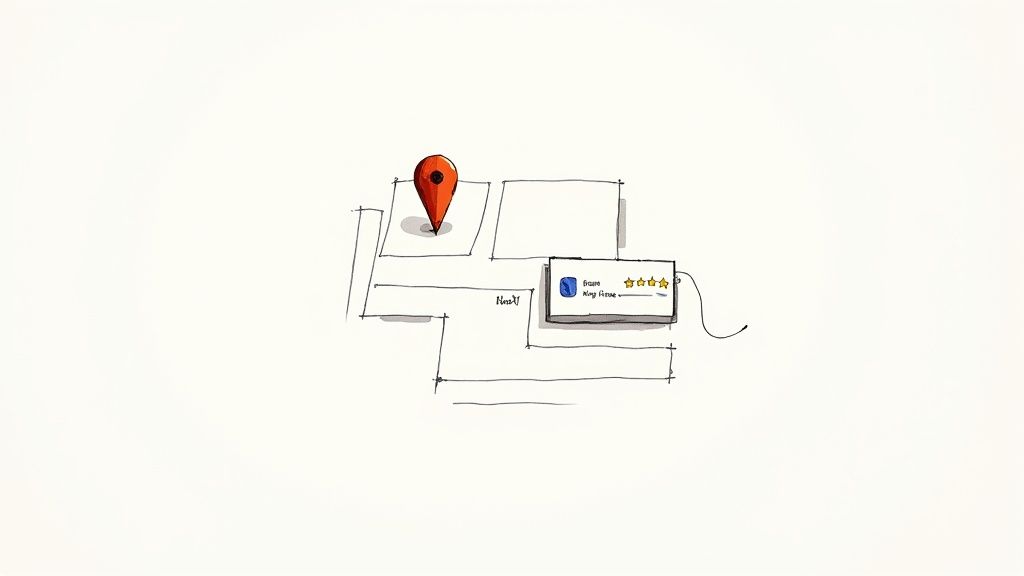
When you do this right, Google can reward you with rich snippets. These are the eye-catching extras you see in search results, like star ratings, review counts, and price information displayed right on the page.
This extra bit of info makes your listing pop, grabbing the user's attention and dramatically increasing your click-through rate. It’s a slightly more technical step, but it provides a massive competitive advantage, turning a plain search result into a compelling ad for your property.
Winning the Local Search and Google Maps Game
When it comes to vacation rentals, some of the most powerful searches are happening right now, from a phone, with the simple phrase "near me." Think about it: travelers already on the road, families switching up plans last minute, or spontaneous adventurers looking for a place tonight. They aren't just browsing; they're ready to book.
Winning in this arena—local search and Google Maps—isn't just a nice-to-have. It's where immediate booking decisions are made, and it's a non-negotiable part of a solid SEO strategy.
Your entire local search presence hinges on your Google Business Profile (GBP). This free listing is what gets you into the coveted Google Map Pack—that little box of three local businesses sitting pretty at the top of the search results. Google themselves say that businesses with a verified, complete profile are twice as likely to be considered reputable. Your GBP is your digital storefront, and it needs to look its best.
Dialing in Your Google Business Profile
Just claiming your GBP isn't enough. The real magic happens when you meticulously optimize it, giving Google (and your future guests) every possible signal that your properties are the best choice. It’s about creating a rich, detailed, and completely accurate profile.
Here’s where to put your energy:
- Get the Category Right: This seems basic, but it's crucial. Your primary category must be "Vacation Rental." This tells Google exactly what you are, filtering out irrelevant searches and putting you in front of the right people.
- Fill Out Everything: Don't leave any section blank. I mean everything—amenities, accessibility info, your business hours (even if you’re "open" 24/7). A profile that's 100% complete tells Google you're an active, legitimate operation.
- Use High-Quality, Geotagged Photos: Visuals sell stays. Period. Upload professional photos of every room, the exterior, the view, and any standout amenities. But here’s the pro tip: before you upload, use a free online tool to add geotags (GPS coordinates) to your image files. This explicitly connects your photos to your physical address, which is a powerful local ranking signal.
The Power of Consistent NAP
One of the most common (and costly) mistakes I see is inconsistent NAP (Name, Address, Phone Number) information scattered across the web. Google is a verification machine; it cross-references your business info on your GBP with data from countless other online directories like Yelp, TripAdvisor, and local business sites to confirm you are who you say you are.
Little inconsistencies—like using "St." on one site and "Street" on another, or "Suite 100" vs "#100"—create confusion for search engines and can seriously hurt your local authority. Do a quick audit. Make sure your business name, address, and phone number are identical everywhere they show up online. This simple housekeeping task builds a rock-solid foundation for your local SEO.
Every single guest review is a direct message to Google about your quality and relevance. A steady flow of recent, positive reviews is arguably the most powerful ranking factor for the local Map Pack.
Turning Guest Reviews into a Ranking Machine
Reviews are the lifeblood of your local search presence. They provide the social proof that convinces a potential guest to click "book," and they send massive ranking signals to Google. If you’re serious about local SEO, you need a proactive review strategy. It's not optional.
Your plan should have two simple, but critical, parts:
- Ask for the Review: Don't just hope for them. After a great stay, send your guests a friendly follow-up email with a direct link to leave a review on your Google Business Profile. The easier you make it, the more likely they are to do it.
- Respond to Every. Single. Review: Thank guests who leave positive feedback—use their name and mention something specific about their stay to show you're paying attention. For the inevitable negative review, respond with professionalism and empathy. Acknowledge their concerns without getting defensive. This shows both Google and future guests that you're an engaged, trustworthy host who cares.
Building a Technically Sound Website That Converts
Your website is your digital storefront. Simple as that. And just like a physical shop, if the foundation is shaky, it doesn't matter how great the stuff inside is. A slow, confusing, or insecure site will send eager travelers packing in seconds.
This is where technical SEO comes in. It's all the behind-the-scenes work that makes sure your website is a smooth experience for both people and search engines. You can have the best photos and most compelling property descriptions in the world, but without a solid technical base, you're building on sand.
Think of it as making sure the roads leading to your properties are freshly paved and clearly marked for your guests.

Prioritize Blazing-Fast Page Speed
When someone is excited about booking a vacation, their patience is thin. In fact, just a one-second delay in your site's load time can slash conversions by a whopping 7%. For a vacation rental manager, that's a painful amount of lost bookings. Your site has to be fast, period. This is especially true on mobile, where most travel research kicks off.
Here are a few practical ways to speed things up right now:
- Compress Your Images: Those gorgeous, high-resolution property photos are non-negotiable, but they're also huge files that slow everything down. Use a tool like TinyPNG or an image optimization plugin to shrink file sizes down without sacrificing quality. It's a game-changer.
- Enable Browser Caching: Caching tells a visitor's browser to save static parts of your site—like your logo and navigation menu. The next time they visit, the page loads instantly because their device already has those pieces.
- Minimize Code: Clean code is fast code. If you're using a website builder, opt for a lightweight, performance-focused theme. For custom sites, have your developer minify CSS and JavaScript files to strip out all the unnecessary characters.
For a deeper dive into building a site that’s optimized from the ground up, our guide on how to build a vacation rental website covers these foundational pieces in much more detail.
Adopt a Mobile-First Mindset
The shift to mobile isn't on the horizon; it's in the rearview mirror. A responsive, mobile-friendly design is an absolute cornerstone of any modern SEO plan. Nearly 60% of travel searches for short-term rentals now happen on a phone. Because of this, Google now primarily uses the mobile version of your site to decide how to rank you.
"Mobile-first" means you design for the smallest screen first, then adapt the design for larger screens like tablets and desktops. This forces you to prioritize what's most important and ensures a flawless experience for the majority of your visitors. Your photo galleries, property details, and especially your booking process have to be effortless to navigate with just a thumb.
A website that isn't optimized for mobile is practically invisible to a huge portion of your potential guests. It’s no longer an option—it’s a requirement for survival.
Create a Logical and Secure Site Structure
A clean website structure acts like a map, helping both users and search engines understand what your site is about and where to find things. It guides visitors logically from your homepage to specific listings with zero confusion.
A common, effective flow looks something like this: Homepage > Location Pages (e.g., Destin, FL) > Property-Type Pages (e.g., Beachfront Condos) > Individual Property Pages. This hierarchy feels natural to users and helps spread ranking authority (or "link equity") throughout your entire site.
Beyond structure, security is table stakes. That little padlock you see in the browser bar means the site has an HTTPS connection, which encrypts data between your site and your visitor. For a guest about to enter their credit card info, it’s a massive trust signal. For Google, it's a confirmed ranking factor.
If your site is still on HTTP, making the switch to an SSL certificate should be your immediate priority. It’s a simple move that protects your guests and gives your SEO a nice little boost.
Creating Content That Establishes Local Authority
A technically sound website is a great start, but it's only half the battle. If you really want to own the search results for your area, you have to transform your site from just another place to book a stay into the definitive local guide. This is where a smart content strategy completely changes the game for your vacation rental SEO.
You'll start attracting guests while they're still in the dreaming and planning phase. More importantly, you'll start earning the kind of high-quality backlinks that signal to Google you're a true authority. It’s all about answering the questions travelers are asking before they even think about which property to book.
By creating genuinely helpful content, you build incredible trust and position your brand as an essential resource. When it comes time to book, your properties will already be top of mind.
Brainstorming Content Your Guests Actually Want
The best content strategies start by putting yourself in your guests' shoes. What are they worried about? What are they curious about? What questions pop into their heads while planning a trip to your town? It's time to stop thinking about generic blog posts and start delivering real, tangible value.
Your mission is to create the absolute best guides for your city, region, or neighborhood.
Think about the different types of travelers you host and what they need at various stages of their journey:
- For the Family Planner: "The Ultimate Guide to a Rainy Day in [Your Town]" or "5 Kid-Friendly Restaurants in [Your Location] with Outdoor Seating."
- For the Adventurous Couple: "3 Breathtaking Hiking Trails Within an Hour of [Your City]" or "A Local's Guide to the Best Breweries in [Your Area]."
- For the First-Time Visitor: "Navigating Public Transportation in [Your City]: A Stress-Free Guide" or "The Best Time of Year to Visit [Your Location] for Good Weather and Fewer Crowds."
The best content doesn't just sell a stay; it sells the entire experience. When you help a guest plan their perfect trip, you're not just a host—you're a trusted partner in their vacation.
This approach lets you rank for a huge range of informational keywords, capturing a massive audience that the big OTAs often completely ignore. It's a powerful signal to Google that you have deep expertise about your location, which is a massive trust factor.
To help you get started, here is a simple framework for brainstorming content ideas that target different traveler personas and build your site's topical relevance.
Content Idea Matrix for Local Authority
| Traveler Persona | Content Topic Idea | SEO Goal |
|---|---|---|
| Foodies | A "Best Of" Guide to Local Coffee Shops | Rank for "best coffee in [city]" |
| Families with Kids | 10 Free Things to Do with Children in [Area] | Capture "family activities [location]" searches |
| Outdoor Adventurers | The Top 5 Mountain Biking Trails Near [Town] | Attract "biking trails near [location]" traffic |
| Couples on a Getaway | A Weekend Itinerary for a Romantic Trip to [City] | Target "romantic getaway [location]" keywords |
| Pet Owners | [Location]'s Most Dog-Friendly Parks and Patios | Rank for "pet-friendly [location]" phrases |
| Budget Travelers | How to Experience [City] on a Budget | Appear for "cheap things to do in [location]" |
This matrix is just a starting point. The key is to consistently create content that solves real problems for your potential guests, establishing your brand as the go-to source for local information.
Turning Local Partnerships into Powerful Backlinks
Okay, so you're creating all this fantastic local content. What's next? Getting other respected local websites to link back to it. In the world of SEO, these backlinks are like votes of confidence. Google sees them and thinks, "Hey, this site must be legit."
Simply put, the more quality backlinks you have pointing to your site, the more authoritative you look.
But how do you get these links without feeling spammy or desperate? It's all about building real-world relationships and creating content so good that people want to share it.
- Partner with Tour Operators: Write a detailed blog post like "The 5 Best Kayak Tours in [Your Location]" and feature a local company you genuinely recommend. Once it's live, shoot them a friendly email. They'll almost always be thrilled with the free press and happy to share it on social media or even link to it from their own website.
- Collaborate with Restaurants and Cafes: Create a "Foodie's Guide to [Your Neighborhood]" and highlight your favorite local gems. These small businesses are often active online and really appreciate the promotion, making a backlink or a social share an easy ask.
- Engage with Local Event Organizers: Is there a big annual festival or a popular farmers' market? Write the ultimate guide for attendees. Then, reach out to the event organizers. They’re often looking for helpful resources to add to their "Visitor Info" page.
This strategy is a true win-win. You're creating valuable, shareable content for potential partners, and in return, you're earning the kind of backlinks that will dramatically boost your vacation rental SEO and cement your reputation as a true local authority.
How to Measure SEO and Boost Your Booking Rate
Let's be real: all the effort you pour into your vacation rental SEO only matters if it puts more money in your pocket. This is where the rubber meets the road—measuring your return on investment to prove that all this work is actually leading to more commission-free bookings.
It's time to stop chasing vanity metrics and start focusing on the numbers that have a real impact.
Your command center for this mission will be Google Analytics (GA4) and Google Search Console. Together, they give you a clear window into how travelers find you online and what they do once they land on your site. Don't let the sheer volume of data intimidate you; we're going to zero in on just a few key performance indicators (KPIs) that tell the whole story.
Key Metrics to Track
The goal here is simple: connect the dots between your visibility in search results and your actual revenue. By keeping a close eye on these core metrics, you’ll quickly see what’s working, what isn't, and where you need to shift your strategy.
Organic Traffic: This is your baseline. It tells you how many visitors are finding you through organic, non-paid search results. A steady climb in this number is the first sign that your SEO efforts are gaining traction.
Keyword Rankings: Dive into Google Search Console to see the exact search queries bringing people to your site. Are you starting to rank for those high-intent, money-making phrases like "beachfront condo in Destin with a pool"? That's what you want to see.
Booking Conversion Rate: This is the big one. Of all the visitors who arrive from organic search, what percentage actually completes a booking? This KPI tells you if you're attracting the right kind of traffic and how persuasive your website is.
SEO gets guests to your digital front door. Conversion Rate Optimization (CRO) is what convinces them to walk inside and book a stay.
Turning Lookers into Bookers
Getting traffic is only half the battle. Once visitors are on your site, you have to make the booking process so easy and appealing that they can't help but click "Book Now." This is the art of Conversion Rate Optimization (CRO), and for vacation rental sites, it almost always boils down to building trust and eliminating friction.
A clunky booking process is a conversion killer. If a guest has to click through five different pages and fill out a dozen forms, they're gone. You need to get them from browsing to booked in just two or three simple steps.
Next, lean into social proof—it's your most powerful sales tool. Make sure your best guest reviews and testimonials are front and center on your property pages. When a potential guest sees glowing feedback from happy travelers, it builds instant confidence in their decision. And finally, if you haven't already, invest in professional photography. It's often the single most important factor in showcasing your property's true value and getting that booking.
The numbers don't lie. A recent industry analysis found that in summer 2025, 37.5% of operators grew their direct bookings by investing in their own websites and SEO. With an average daily rate of $326, every single direct booking you generate is a massive win for your bottom line. You can find more insights into how operators are boosting direct revenue on stayfi.com.
Vacation Rental SEO FAQs
Got questions? You're not alone. Here are some of the most common questions property managers ask when they first start digging into SEO.
How Long Does It Take to See SEO Results?
This is probably the #1 question I get, and the honest answer is: it takes time. SEO is a marathon, not a sprint. Unlike flipping on a paid ad and seeing instant traffic, SEO is about building a long-term asset.
Generally, you can expect to see the first signs of life—some positive movement in your rankings and traffic—within 3 to 6 months. But the real, stable, needle-moving results? Those tend to build up over 6 to 12 months of consistent effort. Your specific timeline will really depend on how competitive your market is, the current state of your website, and how consistently you work on it.
Can I Do SEO Myself, or Should I Hire an Agency?
You can absolutely get your hands dirty and make a real difference on your own. Honestly, if you just follow the foundational steps laid out in this guide, you'll be ahead of most of your competition. Nailing your Google Business Profile, doing some solid keyword research for your property pages, and creating local content will move the needle. Big time.
So, when does an agency make sense? If you're in a hyper-competitive market like Destin or Gatlinburg, or you simply don't have the hours in the day, bringing in a specialized agency can pour gasoline on the fire. They have the deep technical know-how and resources to scale things like content and link-building much faster than you could alone.
What's the Single Most Important Part of Vacation Rental SEO?
If I had to tell you to focus on just one thing, it would be local SEO. Hands down. For almost every vacation rental business, winning means showing up in the Google Map Pack and for all those "cabin rentals near me" searches.
Your Google Business Profile is your golden ticket. A perfectly optimized GBP, backed by a constant flow of fresh, glowing guest reviews, is the most powerful weapon in your arsenal for attracting travelers who are ready to book right now.
Everything else we've talked about is important, but this is the foundation. It drives visibility and, just as crucially, it builds trust. Nailing your GBP and review strategy will give you the fastest and most significant return on your time. Build everything else on top of that.
Ready to turn these SEO strategies into a hands-free booking machine? hostAI uses advanced AI to create intelligent websites and automated marketing campaigns that boost your direct revenue. See how leading STR managers are doubling their direct bookings at https://gethostai.com.