property description samples

Property Description Samples: Compelling Listings to Boost Bookings

Posted on Dec 10, 2025

Hero

In the competitive world of short-term rentals, your property description is your most powerful sales tool. It’s the digital handshake, the first impression, and the final nudge that turns a casual browser into a confirmed guest. A generic, uninspired description can leave your property invisible, lost in a sea of similar listings.

A well-crafted narrative does more than just list amenities; it paints a vivid picture, evokes emotion, and highlights unique value. This is the key to standing out, justifying premium pricing, and driving direct bookings. A powerful description is the difference between being just another option and being the only option a guest considers.

This article provides a deep dive into proven, high-converting property description samples, complete with editable templates and strategic analysis. We move beyond generic advice to give you a tactical playbook for writing compelling copy that converts.

You will learn how to:

  • Adapt your tone for different property types and target guests.
  • Integrate essential SEO keywords naturally to boost visibility.
  • Structure your descriptions for maximum impact on platforms like Airbnb and Vrbo.

We'll break down the psychology behind each style, from luxurious and evocative to minimalist and modern, giving you the tools to write descriptions that not only attract attention but secure bookings. Get ready to transform your listings from simple text into a compelling sales pitch and watch your calendar fill up.

1. The Luxury Escape: Evoking Exclusivity and Aspiration

When your property commands a premium price, the description must do more than list amenities; it must sell an exclusive lifestyle. This approach moves beyond functional details to craft a narrative of opulence, tranquility, and unparalleled comfort. The goal is to make discerning guests feel that booking your property is an investment in an aspirational experience.

This style uses sophisticated, sensory language to paint a picture. It targets travelers seeking a memorable, high-status escape rather than just a place to sleep. The tone is elegant and confident, highlighting bespoke features, unique architectural elements, and the prestige of the location. Think of it less as a rental listing and more as a feature in a luxury travel magazine.

Property Description Sample: The Luxury Escape

"Villa Azure: A Serene Oceanfront Sanctuary in Malibu"

Summary:
Escape to Villa Azure, an architectural masterpiece perched above the Pacific. This 4-bedroom oceanfront estate offers an unparalleled retreat where modern luxury meets the timeless allure of the California coast. Designed for discerning guests, every detail is curated for an experience of serene exclusivity.

The Space:
Step through the grand entrance into a world of refined elegance. Floor-to-ceiling glass walls frame breathtaking, panoramic ocean views, seamlessly blending the indoors with the expansive horizon. The gourmet chef's kitchen, outfitted with Sub-Zero and Wolf appliances, is an epicurean's dream, perfect for crafting intimate dinners or hosting a private chef.

Each of the four master suites is a private sanctuary, featuring a king-sized bed with Frette linens, an en-suite spa bathroom with a rainfall shower, and a private balcony to greet the morning sun. The infinity pool appears to spill directly into the ocean below, while the adjacent fire pit lounge offers the perfect setting for sunset cocktails.

Guest Access:
Your stay includes exclusive access to the entire property, a private cinema room, a state-of-the-art fitness center, and direct beach access via a secluded pathway. A dedicated 24/7 concierge is at your service to arrange bespoke experiences, from private yacht charters to in-villa spa treatments.

Strategic Breakdown

This is one of the most effective property description samples for the luxury market because it focuses on the feeling of the stay, not just the features.

  • Evokes Exclusivity: Phrases like "architectural masterpiece," "serene exclusivity," and "private sanctuary" position the property as a rare and special find. The mention of a "dedicated 24/7 concierge" reinforces a high-touch, bespoke service level.
  • Uses Sensory Language: The description appeals to the senses with "breathtaking, panoramic ocean views," "Frette linens," and the image of the "infinity pool spilling into the ocean." This helps the potential guest imagine themselves in the space.
  • Highlights Premium Brands: Naming high-end brands like Sub-Zero, Wolf, and Frette acts as a powerful signifier of quality. It provides tangible proof of the luxury experience promised in the description.

Actionable Takeaways & Best Practices

To craft your own luxury escape description, follow these tips:

  1. Lead with the Aspiration: Start with what makes your property a dream destination. Is it the view, the architecture, the privacy? Make that the focal point.
  2. Focus on "Who," Not Just "What": Instead of saying "a big kitchen," describe it as "a gourmet chef's kitchen, an epicurean's dream." This helps the guest visualize who they will become during their stay.
  3. Create a Narrative Flow: Structure the description like a tour. Start from the entrance, move through the main living spaces, describe the private quarters, and end with the unique outdoor amenities.
  4. SEO & Personalization:
    • Keywords: Integrate terms like "luxury villa," "oceanfront estate," "private retreat," and location-specific keywords (e.g., "Malibu luxury rental").
    • Call to Action (CTA): A luxury CTA should be subtle and inviting. Instead of "Book Now!" try: "Contact us to arrange your bespoke coastal getaway" or "Inquire to begin planning your unforgettable escape."

2. The Casual & Conversational: Building Connection and Trust

Not every property is a luxury villa, and not every guest is looking for one. The casual and conversational approach builds a connection by speaking directly to the traveler in a friendly, approachable, and authentic voice. This style swaps formal, high-brow language for warmth and relatability, making potential guests feel like they're getting a recommendation from a trusted friend.

The goal is to paint a vivid picture of the experience of living in the space and the neighborhood. This approach is perfect for family-friendly homes, cozy cabins, and urban apartments where the local vibe and practical comforts are the main draw. It focuses on lifestyle compatibility, highlighting how the property fits into the guest’s daily routine and vacation plans.

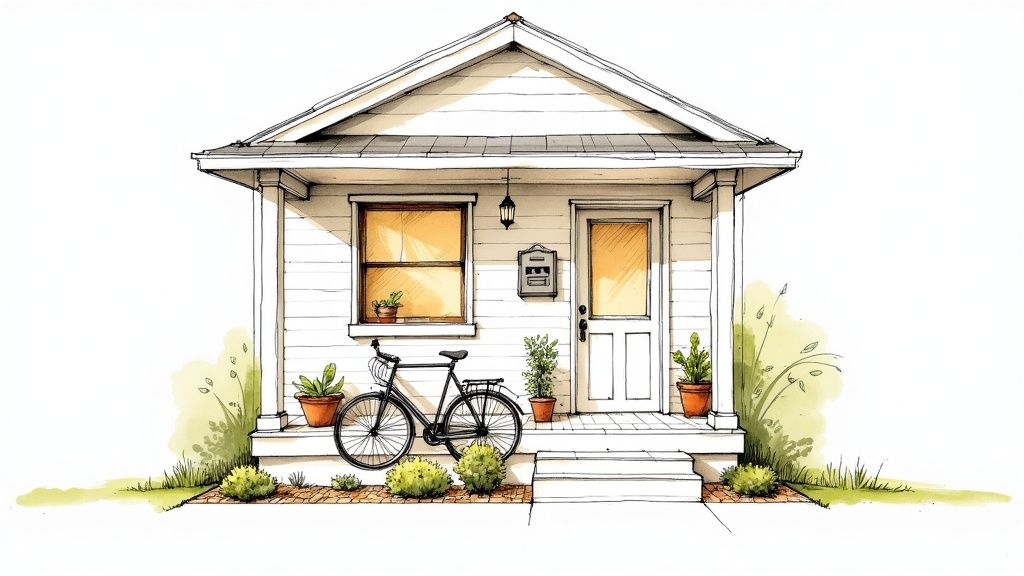
A detailed watercolor sketch of a cozy white house with a porch, bicycle, and potted plants.

Property Description Sample: The Casual & Conversational

"Your Cozy Home Base for Austin Adventures!"

Summary:
Ready to explore Austin like a local? Our sunny 3-bedroom bungalow in the heart of the vibrant South Congress neighborhood is the perfect home base. Forget the stuffy hotel room, this is where you can kick back, relax, and plan your next adventure, all within walking distance of the city's best food, music, and fun.

The Space:
We've designed our home to be your happy place! The open living area is super bright and comfy, perfect for morning coffee or streaming a movie on the smart TV after a long day of exploring. The kitchen has everything you need to whip up a quick breakfast (we've got you covered with coffee and a coffee maker!) or a full family dinner.

The master bedroom has a super-comfy king bed, and the other two rooms are great for kids or friends, with one queen and two twins. The backyard is fully fenced, so it’s a safe spot for the little ones to run around, and you can enjoy a local craft beer on the patio.

Guest Access:
You’ll have the whole house to yourself! That includes free rein of the full kitchen, washer and dryer (because who wants to go home with dirty laundry?), and the private backyard. There's also free, easy street parking right out front. We'll send you a code for keyless entry, so you can check in whenever works for you after 3 PM.

Strategic Breakdown

This is one of the most relatable property description samples because it prioritizes personality and practical benefits over formal features.

  • Uses a Friendly, Direct Tone: Phrases like "Ready to explore?", "We've got you covered," and "who wants to go home with dirty laundry?" create an immediate, friendly connection. Using contractions (like "it's" and "you'll") makes the text feel like a real conversation.
  • Focuses on Lifestyle and Experience: The description centers on what guests can do: "explore Austin like a local," "kick back," and "enjoy a local craft beer on the patio." This helps them envision their vacation, not just the physical space.
  • Highlights Practical, Relatable Amenities: Mentioning a "fully fenced" yard, "easy street parking," and a "washer and dryer" speaks directly to the needs of families and longer-stay travelers, solving potential pain points before they even ask.

Actionable Takeaways & Best Practices

To write your own casual and conversational description, use these tips:

  1. Write Like You Talk: Read your description out loud. Does it sound like something you’d say to a friend? If it sounds stiff or robotic, rewrite it using more natural language and contractions.
  2. Sell the Neighborhood, Not Just the House: Guests are booking a destination. Talk about the local coffee shops, the walk to the park, or your favorite taco spot nearby. This shows you're a knowledgeable local host.
  3. Answer Questions Before They're Asked: Think about common guest questions. Is there parking? Is it kid-friendly? Can I do laundry? Address these practical concerns directly in the description to build trust and confidence.
  4. SEO & Personalization:
    • Keywords: Use conversational keywords like "cozy bungalow," "family-friendly Austin rental," "home base for exploring," and "walkable to South Congress."
    • Call to Action (CTA): A casual CTA should be low-pressure and inviting. Try: "Have questions? Just ask!" or "We'd love to host you! Send us a message to book your dates."

3. The Technical/Professional: Precision and Data for Informed Decisions

When the target audience values data over dreams, a technical description is paramount. This approach strips away emotive language and focuses on hard facts, specifications, and verifiable details. It’s built for audiences like investors, developers, or long-term tenants who make decisions based on numbers, zoning, and structural integrity rather than aspirational narratives.

This style prioritizes clarity, precision, and transparency. The goal is to answer every potential question before it's asked, providing a comprehensive dossier of the property's physical and legal characteristics. Think of it less as a story and more as a detailed spec sheet or an investment prospectus, designed to build trust through objective information.

Hand-drawn floor plan sketch of a small dwelling, showing room labels, dimensions, and highlighted areas.

Property Description Sample: The Technical/Professional

"For Lease: 1,250 SQFT Multi-Use Commercial Loft - Zone C2"

Summary:
A 1,250-square-foot commercial loft space located in the downtown arts district, zoned C2 for mixed-use commercial and residential. This property offers a prime opportunity for a live-work studio, gallery, or creative office. Unit features an open-concept floor plan, 14-foot ceilings, and robust infrastructure.

The Space:

  • Total Area: 1,250 sq. ft. (25' W x 50' L)
  • Ceiling Height: 14 ft. clear height to exposed rafters.
  • Layout: Open-plan main area (950 sq. ft.) with one enclosed office/bedroom (200 sq. ft.) and one ADA-compliant restroom (100 sq. ft.).
  • Flooring: Reinforced, sealed concrete slab rated for light industrial use.
  • Systems: HVAC system (5-ton unit, installed 2022). Electrical: 200-amp, 3-phase panel. Plumbing: Copper, updated 2021.

Guest Access:
The unit is accessible via a secured street-level entrance and a rear freight elevator (6'x8' cab, 2,500 lb capacity). The lease includes one dedicated parking space in the adjacent private lot. All utility connections (water, electric, high-speed fiber) are active and ready for transfer.

Strategic Breakdown

This is one of the most practical property description samples for commercial or investment-focused listings because it prioritizes objective data over subjective appeal.

  • Leads with Key Data: The title immediately communicates the most critical information: square footage and zoning designation (C2). This instantly qualifies or disqualifies potential leads based on their specific needs.
  • Uses Quantifiable Metrics: Every feature is described with numbers: "14-foot ceilings," "5-ton unit," "200-amp... panel." This removes ambiguity and provides concrete information for business planning or investment analysis.
  • Organized for Scannability: The use of bullet points and bolded categories makes it easy for a busy professional to quickly find the exact information they need, whether it's the electrical capacity or the age of the HVAC system.

Actionable Takeaways & Best Practices

To write your own technical property description, focus on these elements:

  1. Quantify Everything Possible: Replace subjective words like "spacious" with exact measurements like "1,250 sq. ft." and "14-foot ceilings."
  2. Structure with Bullet Points: Organize specifications into logical categories (e.g., Area, Systems, Access) using lists. This enhances readability and allows for quick comparison between properties.
  3. Prioritize Logistical Information: Include details crucial for business operations or investment, such as zoning codes, utility capacities, and accessibility features like freight elevators.
  4. SEO & Personalization:
    • Keywords: Use precise, technical keywords such as "commercial loft for lease," "C2 zoning," "live-work space," along with the specific square footage and location. For more insights on keyword strategy, you can learn more about vacation rental SEO, as many principles apply.
    • Call to Action (CTA): Keep the CTA direct and professional. Effective examples include: "Request a full spec sheet and floor plan" or "Contact us to schedule a technical walkthrough."

4. The Storied Haven: Crafting a Narrative Experience

Some properties have a soul, a history, or a unique character that cannot be captured by a simple list of features. The narrative approach transforms your listing from a mere description into a compelling story. It invites guests to become part of the property’s legacy, appealing to their imagination and desire for a meaningful, immersive experience.

This style is perfect for historic homes, architecturally significant buildings, or properties with a unique restoration journey. It uses evocative language to weave a tale around the space, connecting guests to its past, its purpose, and the vision behind it. The tone is often warm, intimate, and enchanting, making the property feel like a cherished discovery rather than a transactional rental.

Property Description Sample: The Storied Haven

"The Blacksmith's Loft: A Historic Charleston Hideaway"

Summary:
Step into a piece of Charleston's living history at The Blacksmith's Loft. Originally a 19th-century ironworks, this meticulously restored 2-bedroom loft blends industrial-chic design with the timeless soul of the Holy City. This is more than a place to stay; it's an invitation to inhabit a story.

The Space:
Exposed original brick walls whisper tales of the past, while soaring 20-foot ceilings and massive reclaimed wood beams speak to the building's industrial heritage. The open-concept living area is bathed in light from restored arched windows, illuminating a curated collection of local art and artisan-crafted furniture.

The modern kitchen respects the loft's history, featuring custom soapstone countertops and salvaged heart-pine cabinetry alongside state-of-the-art appliances. Each bedroom offers a tranquil retreat, where the gentle scent of aged wood and plush linens promise a restful night's sleep. From the private rooftop terrace, you can watch the city lights twinkle, feeling the pulse of Charleston's history all around you.

Guest Access:
Guests will have the entire loft to themselves, including the private rooftop terrace with city views. A complimentary welcome guide details the loft’s restoration journey with before-and-after photos, along with our favorite historic walking tours that begin just steps from your front door.

Strategic Breakdown

This is one of the most compelling property description samples because it sells an experience steeped in authenticity and character, attracting travelers who seek more than just comfort.

  • Creates a Strong Identity: Terms like "living history," "industrial heritage," and "tales of the past" give the property a distinct and memorable personality. It's not just a loft; it's "The Blacksmith's Loft."
  • Connects Features to the Story: Instead of just listing "brick walls," it describes them as "exposed original brick walls [that] whisper tales of the past." This technique gives every feature a purpose within the narrative.
  • Engages the Senses: The description invites guests to imagine the experience through sensory details like the "gentle scent of aged wood," the feel of "plush linens," and the sight of "light from restored arched windows."

Actionable Takeaways & Best Practices

To write your own storied haven description, use these strategies:

  1. Uncover the "Why": What is your property's story? Was it a schoolhouse, a barn, an artist's studio? Research its history, architectural style, or your own renovation journey to find the core narrative.
  2. Give Features a Backstory: Connect amenities to the narrative. "Heart-pine floors salvaged from the original structure" is more powerful than "hardwood floors."
  3. Structure as a Journey: Guide the reader through the space as if you're telling a story. Start with the historical context, introduce the main "character" (the living area), and move to the private, intimate spaces.
  4. SEO & Personalization:
    • Keywords: Use terms like "historic home," "renovated loft," "unique stay," and location-specific keywords (e.g., "Charleston historic rental"). Learn more about how to find the best keywords for your property description samples on gethostai.com.
    • Call to Action (CTA): A narrative CTA should feel like an invitation. Try: "Become a part of our story. Book your historic Charleston escape" or "Inquire to reserve your chapter at The Blacksmith's Loft."

5. The Investment/Commercial Property: Highlighting ROI and Financials

When the target audience is an investor, private equity firm, or commercial operator, the property description shifts from an emotional narrative to a data-driven prospectus. This style is built on a foundation of financial metrics, operational efficiency, and future revenue potential. It replaces sensory language with hard numbers, projections, and market analysis.

The goal is to present the property not as a place to live or visit, but as a high-performing asset. The tone is professional, analytical, and direct. It provides all the necessary due diligence information upfront, demonstrating transparency and building confidence with sophisticated buyers who are focused on one primary goal: return on investment (ROI).

Property Description Sample: The Investment/Commercial Property

"FOR SALE: The Metro Lofts - 12-Unit Multifamily Asset in Downtown Core"

Executive Summary:
Presenting The Metro Lofts, a stabilized 12-unit multifamily property located in the highly desirable Downtown Core submarket. Offering a compelling 6.5% cap rate and a proven history of strong occupancy, this asset represents a secure investment with significant value-add potential. Current NOI is $125,000 annually, with pro-forma projections indicating an 8% cash-on-cash return post-renovation.

The Asset:
This well-maintained brick building features ten (10) 1-bedroom/1-bath units and two (2) 2-bedroom/1-bath penthouse units. All units are individually metered for electricity, minimizing landlord operating expenses. The current tenant roster consists of young professionals with an average lease term of 18 months remaining, ensuring stable cash flow.

A detailed due diligence package is available upon request, including a T-12 (trailing 12 months) P&L statement, current rent roll, and operating expense history. The property is zoned C-2, allowing for potential mixed-use development or future expansion.

Value-Add Opportunity:
Market analysis reveals that comparable renovated units in the submarket achieve rents 20-25% higher. A strategic capital improvement plan focused on cosmetic unit upgrades (kitchens, baths, flooring) could significantly increase Gross Potential Rent and drive the property's cap rate closer to 7.5% within 24 months.

Strategic Breakdown

This is a powerful example of an investor-focused property description sample because it prioritizes the language of finance over the language of lifestyle.

  • Leads with Key Metrics: The description immediately presents the most critical data points for an investor: the number of units, cap rate, NOI, and potential returns. This grabs the attention of serious buyers instantly.
  • Focuses on Operational Efficiency: Details like "individually metered for electricity" and "stable cash flow" are crucial for an investor's financial model. They speak directly to the property's profitability and ease of management.
  • Highlights Future Upside: The "Value-Add Opportunity" section is essential. It clearly outlines a practical strategy for increasing the asset's value, which is often a primary motivation for an investment purchase.

Actionable Takeaways & Best Practices

To write an effective commercial or investment property description, follow these steps:

  1. Create an Executive Summary: Start with a brief, high-level summary that includes the most important financial figures. This is the "hook" for an investor.
  2. Quantify Everything: Use numbers and percentages wherever possible. Instead of "good rental history," state "98% average occupancy over the last 36 months." Be precise and provide verifiable data.
  3. Structure for Due Diligence: Organize the information logically, moving from the current state (financials, tenants) to future potential (value-add, market trends). Make it easy for the reader to underwrite the deal.
  4. SEO & Personalization:
    • Keywords: Use terms like "multifamily investment," "commercial real estate," "cap rate," "net operating income (NOI)," "[City] investment property," and "value-add opportunity."
    • Call to Action (CTA): The CTA should be professional and facilitate the next step in the sales process. Use phrases like: "Contact us to request the full Offering Memorandum and Due Diligence package" or "Schedule a confidential tour and financial review."

6. The Minimalist Haven: Emphasizing Simplicity and Design

In a world of noise, simplicity sells. This property description style caters to the modern guest who values clean design, functionality, and intentional living. It mirrors the principles of minimalism and Scandinavian design: less is more, every element has a purpose, and tranquility is the ultimate luxury. The goal is to attract guests who appreciate thoughtful design, natural light, and uncluttered spaces.

This approach uses concise, direct language that focuses on core elements like light, space, and quality materials. It avoids ornate adjectives and instead lets the property's inherent design speak for itself. The tone is calm, confident, and sophisticated, appealing to travelers seeking a peaceful retreat from the chaos of daily life. It’s perfect for architecturally significant homes, city lofts, or any space where design is a key feature.

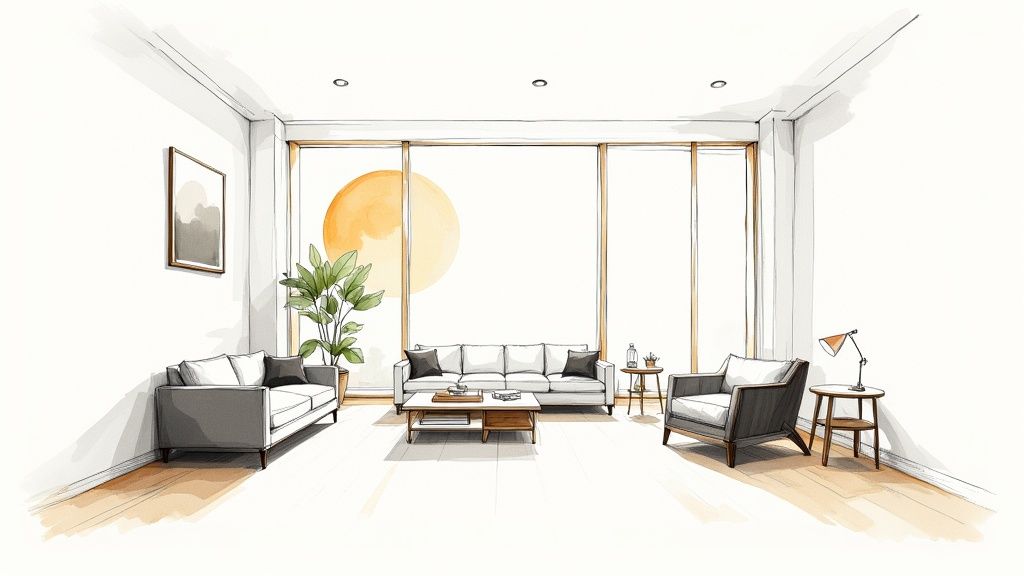
Minimalist living room sketch with contemporary furniture, a potted plant, and a large bright window.

Property Description Sample: The Minimalist Haven

"The Hygge Loft: A Sun-Drenched Minimalist Retreat in the City Center"

Summary:
Discover The Hygge Loft, a serene 2-bedroom apartment designed for calm and clarity. Located in the vibrant Arts District, this space offers a peaceful escape centered on natural light, clean lines, and mindful design. It is an intentional space for those who find beauty in simplicity.

The Space:
An open-concept living area greets you, defined by soaring ceilings and expansive windows that flood the space with natural light. Polished concrete floors meet warm oak accents, creating a balanced and calming atmosphere. The functional kitchen features integrated European appliances and a waterfall quartz island, designed for effortless living.

Both bedrooms are sanctuaries of rest, with plush queen beds, organic cotton bedding, and blackout blinds. The bathroom continues the minimalist ethos with a walk-in rain shower and matte black fixtures. Unwind with a book in the sunlit reading nook or enjoy the curated local art that adds a touch of warmth to the space.

Guest Access:
Guests have full access to the entire loft, including a communal rooftop terrace with city views, a secure building entrance, and in-unit laundry. High-speed Wi-Fi and a dedicated workspace are provided for seamless remote work.

Strategic Breakdown

This is an excellent example of property description samples for design-forward rentals because it sells a feeling of peace and intentionality, which is exactly what its target audience seeks.

  • Emphasizes Core Design Principles: The description highlights "natural light," "clean lines," and "mindful design." Terms like "open-concept," "polished concrete floors," and "integrated European appliances" reinforce the minimalist and functional aesthetic.
  • Uses Purposeful Language: Every word is chosen for impact. Instead of "big windows," it's "expansive windows that flood the space with natural light." The focus is on the effect of the features, not just their existence.
  • Creates a Sense of Calm: Phrases like "sanctuaries of rest," "calming atmosphere," and "intentional space" directly communicate the experience a guest can expect. This appeals to travelers looking to de-stress and recharge.

Actionable Takeaways & Best Practices

To write your own minimalist haven description, use these strategies:

  1. Lead with the Feeling: Start by describing the atmosphere. Is it serene, calming, inspiring, or focused? Use that feeling as your hook.
  2. Focus on Materials and Light: Mention specific, high-quality materials (e.g., "warm oak," "waterfall quartz island"). Always describe the quality and abundance of natural light, as it is a cornerstone of this design style.
  3. Keep Sentences Clean and Concise: Your writing style should mirror the property's design. Use short, impactful sentences and avoid flowery, unnecessary adjectives. Let the space be the star.
  4. SEO & Personalization:
    • Keywords: Include terms like "minimalist apartment," "Scandinavian design," "Japandi style," "natural light," "modern loft," and your city name (e.g., "Arts District retreat").
    • Call to Action (CTA): A minimalist CTA should be simple and direct. For example: "Reserve your serene city escape" or "Experience mindful living. Inquire for availability."

7. The First-Person Voice: Building Trust and Personal Connection

In a market saturated with impersonal listings, the first-person voice cuts through the noise. This approach involves the host, owner, or agent writing the description from their personal perspective ("I," "we"). It transforms a transactional listing into a heartfelt recommendation, creating an immediate sense of trust and authenticity.

This style is about sharing genuine enthusiasm and insider knowledge. It targets guests who value a personal touch and want to feel like they are being welcomed into a space by someone who truly loves it. The tone is warm, inviting, and conversational, aiming to build a direct rapport with the potential guest before they even book. It’s like getting a trusted tip from a friend.

Property Description Sample: The First-Person Voice

"Our Cozy Mountain Hideaway: A Personal Invitation"

Summary:
Hi, I’m Sarah, and I’m so excited to share our family's mountain cabin with you! For years, this has been our personal escape from the hustle and bustle, and I've poured my heart into making it the coziest, most restorative retreat imaginable. If you’re looking for a place to truly unplug and reconnect with nature (and each other), I believe you’ve found it.

The Space:
What I love most is waking up and enjoying coffee on the wraparound deck, listening to nothing but the birds. We've designed the open-plan living area to be the heart of the home, with a wood-burning stove that I think is perfect for chilly evenings with a board game. The kitchen is fully stocked with everything I use myself, so you can cook a real family meal.

Both bedrooms feature memory foam mattresses because, for me, a great night's sleep is non-negotiable on vacation. My favorite little secret is the reading nook upstairs; it gets the best afternoon light and has views straight into the pine forest. It’s my personal happy place.

Guest Access:
You’ll have the entire cabin to yourselves. I'll send you my personal list of our favorite local hiking trails and the best spot in town for a hearty breakfast. I’m always available via message if you need anything at all during your stay.

Strategic Breakdown

This is one of the most compelling property description samples for building rapport because it replaces a corporate voice with a personal one.

  • Builds Instant Trust: Using "I," "my," and "our" creates an immediate connection. The host isn't just a business; they're a person (Sarah) sharing a beloved space. This human element can be a powerful deciding factor for guests.
  • Shares Insider Knowledge: The description offers personal tips, like the best spot for morning coffee or the "secret" reading nook. This makes guests feel like they are receiving privileged information, enhancing the value of their stay.
  • Highlights with Emotion: Instead of just listing features, it explains why they matter to the host. "A great night's sleep is non-negotiable" is far more persuasive than "comfortable beds." It shows a host who cares deeply about the guest experience.

Actionable Takeaways & Best Practices

To write your own first-person description, follow these tips:

  1. Introduce Yourself: Start by briefly saying who you are. This simple act of introduction sets a warm and welcoming tone from the very beginning.
  2. Share Your "Why": Why do you love this property? What’s your favorite memory or feature? Share your genuine passion; it’s contagious and helps guests feel your excitement. For more ideas on crafting a narrative, check out these vacation rental description examples.
  3. Frame Amenities as Personal Recommendations: Instead of "has a deck," try "My favorite thing to do is enjoy coffee on the deck." This reframes a feature as an experience.
  4. SEO & Personalization:
    • Keywords: Weave in keywords naturally. For instance: "As a host, I wanted to create the perfect family-friendly cabin rental in Asheville..."
    • Call to Action (CTA): A personal CTA should feel like an invitation. Try: "I can't wait to welcome you to my favorite place" or "Send me a message if you have any questions about planning your mountain getaway."

7-Style Property Description Comparison

Style Implementation complexity Resource requirements Expected outcomes Ideal use cases Key advantages
Luxury Real Estate Description High — needs crafted, evocative prose High — professional writer, staging, photography Attracts high-net-worth buyers; supports premium pricing High-end estates, luxury condos, exclusive listings Enhances perceived value; emotional appeal; differentiates listing
Casual/Conversational Property Description Low — straightforward, informal copy Low — basic agent input, neighborhood knowledge Increased engagement and relatability Family homes, starter homes, social media listings Approachable tone; quick buyer connection; authentic feel
Technical/Professional Property Description Medium — requires accurate data and structure Medium–High — measurements, reports, inspections Clear comparisons; credibility for technical buyers Commercial listings, investor materials, MLS Precise, reduces disputes, facilitates analysis and appraisal
Narrative/Storytelling Property Description High — research and creative writing required High — historical research, skilled copy, multimedia Memorable, shareable listings with strong emotional pull Historic homes, architecturally unique properties, editorial features Strong differentiation; emotional resonance; media-friendly
Investment/Commercial Property Description High — financial modeling and market analysis High — financial records, market reports, tenant data Attracts investors; supports valuation and underwriting Multi-family, retail, office, institutional offerings Demonstrates ROI; investor-focused; supports financing decisions
Minimalist/Scandinavian Property Description Low — concise, disciplined writing style Low — clean photography, design-focused edits Scannable listings that appeal to design-conscious buyers Contemporary and modern properties, showrooms, new builds Clear, modern aesthetic; emphasizes function and light
First-Person/Agent Voice Property Description Low to medium — consistent personal voice needed Low — agent time, personal anecdotes, contact info Builds trust and personal connection; increased inquiries Boutique agents, local listings, agent-led marketing Personal credibility; relationship-building; authentic endorsement

Turn Words into Bookings: Automate Your Success with AI

Throughout this guide, we've explored a diverse collection of property description samples, each tailored to a specific audience and objective. From the evocative language of luxury listings to the data-driven precision of investment properties, the core lesson is clear: a one-size-fits-all approach simply doesn't work. The most effective descriptions are strategic, authentic, and laser-focused on the ideal guest.

You've seen how a casual, conversational tone can build instant rapport for a family-friendly cabin, while a minimalist, Scandinavian-inspired description perfectly complements a modern urban loft. By mastering these different voices and structures, you move beyond simply listing amenities; you start selling an experience.

From Inspiration to Implementation: Your Actionable Next Steps

The journey from understanding these examples to implementing them across your portfolio is where the real work begins. To truly leverage the power of a well-crafted narrative, focus on these three pillars of success:

  • Define Your Avatar: Before writing a single word, create a detailed profile of your ideal guest. Are they a digital nomad seeking a work-friendly space, a family looking for a relaxing getaway, or a couple celebrating a romantic occasion? This avatar will dictate your tone, highlight the most relevant amenities, and shape your call to action.

  • Embrace a Multi-Style Strategy: Don't limit yourself to one style. A single property might require a slightly different narrative on Airbnb versus a direct booking website. Use the storytelling approach for your primary description, but incorporate technical details (like square footage and appliance models) in an "About this space" section to satisfy detail-oriented guests.

  • Audit and Optimize Continuously: Your property description is not a "set it and forget it" asset. Regularly review its performance. Are you getting the bookings you want? Are guests asking the same questions repeatedly? Use this feedback to refine your copy, add clarity, and ensure it remains compelling and accurate.

The Lasting Impact of a Perfect Description

Mastering the art of the property description is about more than just filling a text box. It's the foundational element of your entire guest acquisition strategy. A powerful description builds trust, pre-qualifies guests, and sets clear expectations, which is the first step toward earning glowing feedback. After all, a compelling listing that accurately reflects the experience is crucial for guest satisfaction. For more on this, learning how to encourage positive feedback by Mastering Airbnb Reviews can help you build social proof and increase your booking velocity.

Ultimately, by transforming your words into powerful marketing tools, you attract the right guests, reduce vacancies, and command higher nightly rates. While the property description samples in this article provide a robust framework, scaling this personalized, high-quality approach can be demanding. This is where automation becomes your most valuable partner, allowing you to replicate this level of detail and creativity without sacrificing hours of your time. By combining strategic insight with intelligent technology, you can ensure every listing in your portfolio is a high-converting asset, consistently turning browsers into booked guests.


Ready to stop staring at a blank page and start generating high-converting listings in seconds? Let hostAI do the heavy lifting by creating unique, SEO-optimized descriptions tailored to your property and ideal guest. Elevate your marketing and reclaim your time with the power of AI at hostAI.

Get a Free Demo

Join other leading STR brands in leveraging the power of AI to boost your direct bookings.

Go Live the Next Day