
airbnb guest review examples
8 Airbnb Guest Review Examples That Drive Direct Bookings
Posted on Feb 11, 2026
TL;DR: A 5-star average gets you in the search results. The words inside your reviews are what close the booking — and what you can lift off OTAs and put to work on your own direct-booking site. This guide breaks down 8 review types worth engineering for, the exact post-stay prompt that earns each one, and how to stop leaving that social proof stranded on Airbnb.
Why reviews decide the booking (the data)
If you run a portfolio, reviews are not a vanity metric — they are a revenue lever, and the numbers are blunt about it:
- Reviews are the deciding input. In PhocusWright research commissioned by TripAdvisor, 53% of travelers won't commit to a booking until they've read reviews, and 80% read between 6 and 12 reviews before they book. Your reviews aren't supporting copy — for most guests they are the sales page.
- Rating moves your P&L. Per AirDNA's 2023 analysis, Airbnb listings averaging 4.9 stars or higher earned a 7.7% higher ADR, 9.7% higher occupancy, and 18.2% higher revenue than lower-rated counterparts. The half-star is worth real money.
- Volume compounds. Per 2025 STR analysis from BNBCalc, listings with fewer than 10 reviews convert at roughly half the rate of listings with 10–20. The climb from your first review to your tenth is the single biggest conversion gain you'll ever buy.
Here's the thesis this whole guide runs on: hoping for good comments is not a strategy. The operators who win don't collect reviews at random — they engineer the stay and the ask so the right kind of review shows up, then they repurpose that review where it actually converts: their own site, not Airbnb's. Below are the eight types worth engineering for.
1. The Detailed Experience Review — your trust anchor
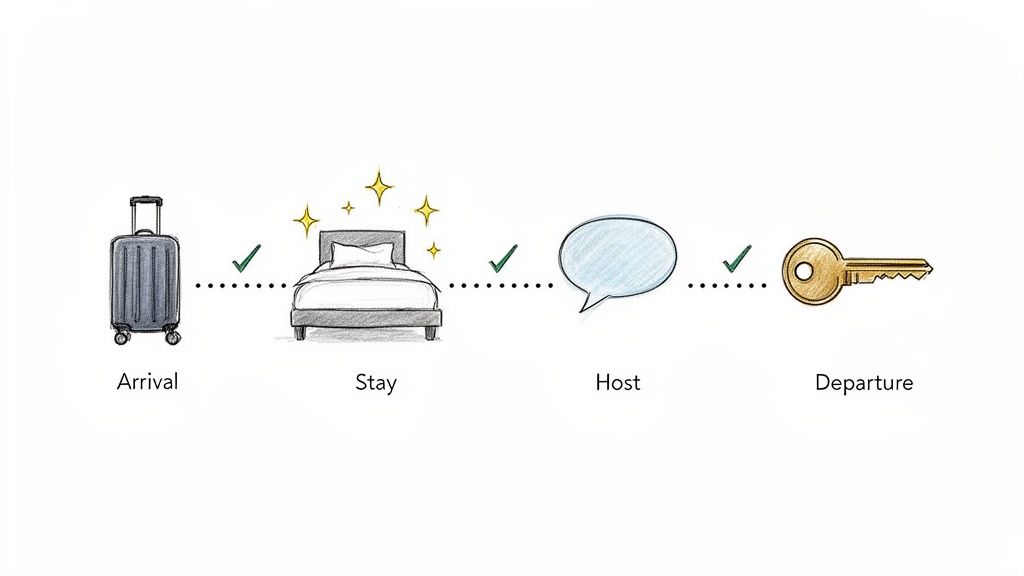
Unlike a one-line "great stay," the detailed experience review walks a prospect through the whole journey — booking, check-in, the stay, host contact, checkout. It turns abstract listing claims into a concrete, relatable story, which is exactly what a hesitant booker needs.
Example:
"From the moment we booked, Maria was an exceptional host. The check-in instructions were crystal clear, and the property was spotless on arrival. The photos don't do the view justice. We loved the fully-stocked kitchen — everything we needed to cook our own meals. The bed was incredibly comfortable, and the whole stay felt peaceful and private. Maria checked in once by message to make sure we had everything, without being intrusive. A perfect 5-star experience start to finish."
Why it works: it covers every objection point in sequence — pre-arrival certainty, cleanliness, accuracy ("photos don't do it justice" flips the usual fear), amenities, and a host who's present but not hovering.
The ask that earns it: a generic "please review us" gets a generic line. Prompt for the narrative: "We'd love to hear what stood out — a favorite amenity, a moment from the stay, anything that made it easy?" Open-ended questions pull stories; yes/no questions pull one-liners.
2. The Quick 5-Star Plus Comment — your volume engine
Short, positive, one or two sentences with a high rating. Less depth, but volume and velocity are the point — and velocity is exactly what the algorithm reads. Given the conversion cliff below 10 reviews, your first priority on any new listing is simply getting more reviews on the board fast.
Example:
"Amazing stay! Host was incredibly responsive and the sunset view from the deck was breathtaking. Can't wait to come back. Highly recommend!"
Why it works: low effort = higher completion rate, and it isolates one hero feature (the sunset deck) that lodges in a prospect's mind.
The ask that earns it: make it a 30-second job. Mobile-friendly message, direct link to the review page, sent within 24 hours of checkout while the trip still feels warm — and seed one feature: "Hope you caught the sunset from the deck — a quick line about your stay would mean a lot."
3. The Photo-Inclusive Review — proof you can't fake
When guests upload their own photos, they answer the question every booker silently asks: "Will it actually look like the listing?" Guest photos validate your professional shots in a way your own marketing never can.

Example:
"Absolutely loved our stay! Just as beautiful as advertised — the host has thought of everything. I've attached a few photos of the balcony view and the spotless kitchen so you can see for yourself. No surprises. We'd 100% book again." [5 photos: balcony at sunset, organized pantry, welcome basket, tidy bedroom.]
Why it works: "no surprises" kills the single biggest STR fear, and the images double as user-generated content. With permission, guest photos are some of the highest-converting assets you can put on a direct-booking page.
The ask that earns it: give them photogenic spots (a coffee station, a reading nook, the view) and ask directly: "If you snapped any good shots, we'd be thrilled if you added a photo or two."
4. The Niche Guest Testimonial — proof for one segment
A review from a guest who is your ideal customer — remote worker, family, pet owner — speaking to the exact need that segment cares about. A digital nomad isn't booking a bed; they're booking reliable Wi-Fi and a desk.
Example (remote worker):
"As a remote worker I was nervous about a month somewhere new. This was perfect. The Wi-Fi was rock-solid for video calls (I tested it at 200+ Mbps) and the dedicated office was quiet and comfortable. John even made sure there was a great coffee maker. Stayed productive, felt at home. Highly recommend for other digital nomads."
Why it works: it answers the segment's unspoken questions with a number (200+ Mbps) and persona language ("other digital nomads") that creates instant recognition.
The ask that earns it: tailor the question to who you hosted. Family stay? "Were the high chair and board games useful for the kids?" Then put that testimonial on the matching landing page — a parent's review converts parents far better than a generic one.
5. The Comparison Review — "better than expected"
This review answers the deciding question — "is it worth it?" — by benchmarking your place against the guest's past stays, their expectations, or a hotel. It neutralizes hesitation by proving superior value.
Example:
"I've stayed at a lot of Airbnbs in this area, and this one is genuinely special. Usually there's something — dirty edges, awkward furniture, spotty Wi-Fi. Not here. Everything is thoughtfully maintained and everything works. For the price I expected decent; what we got beat a luxury hotel I stayed at last year at 3x the cost. Worth every penny."
Why it works: the "I've stayed at many Airbnbs" opener gives the reviewer authority, and the hotel comparison reframes your rate as a bargain rather than an expense.
The ask that earns it: invite the comparison directly: "We hope the stay beat your expectations — what surprised you most?"
6. The Specific Problem-Solution Review — objection handling
This one confronts a known concern — street noise, stairs, parking — and reframes it as a managed non-issue. It tells the next guest: "I had your exact worry, and here's why it didn't matter."
Example:
"I worried about street noise since the apartment is right downtown. But David was upfront about the location and mentioned the soundproof windows in the listing. He was right — we couldn't hear a thing at night and slept perfectly. So close to the action without the noise. That attention to detail made the stay."
Why it works: it pre-answers the "downtown = noisy" objection and makes you look transparent, not defensive.
The ask that earns it: when a guest raised a concern at booking, follow up on it: "Hope the soundproof windows did the job despite the central location — was that a win for you?" (For the reviews that go the other way, knowing how to keep a guest relationship warm after a bump matters just as much.)
7. The Experience-Focused Review — emotional pull
This review sells the feeling, not the amenities — the memory, the reconnection, the moment. It connects to why people travel in the first place, which makes it your best brand-storytelling asset.

Example:
"My daughter said this was her favorite vacation ever. She felt like a princess in the bedroom, and we watched the most beautiful sunset as a family from the balcony. This place gave us what we didn't know we needed — a chance to reconnect. Away from work and noise, we laughed more and talked more. Memories we'll treasure. Thank you for the setting for such a magical trip."
Why it works: "favorite vacation ever" and "memories we'll treasure" speak to the outcome travelers actually want, and a vivid scene lets prospects picture themselves there.
The ask that earns it: ask for the moment, not the amenity: "Was there a moment from the trip that stood out?"
8. The Host-Focused / Hospitality Review — the human edge
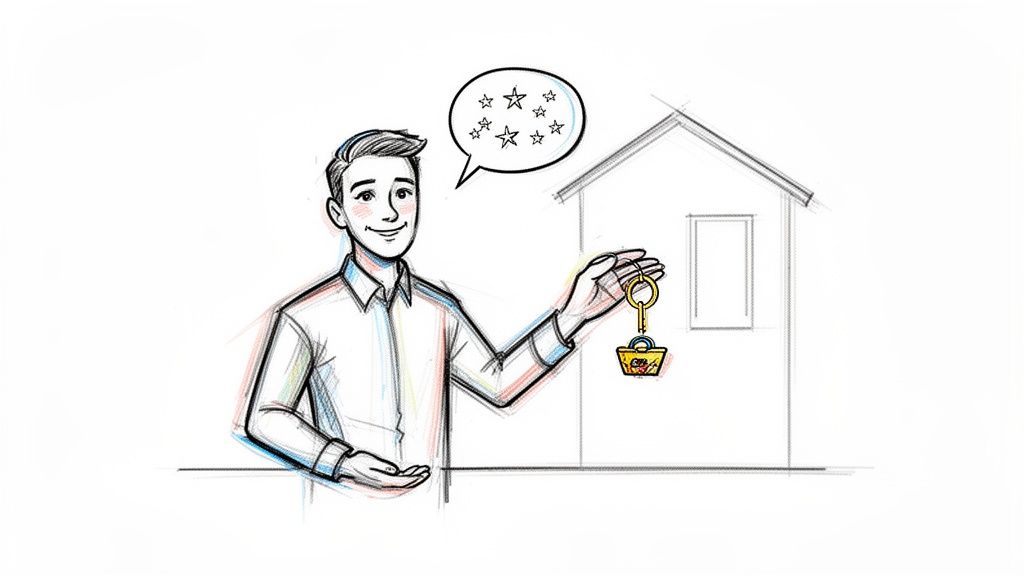
This one centers on you — responsiveness, the personal touches, the genuine care. It's the review that builds loyalty and, done right, points guests toward booking with you directly next time.
Example:
"Sarah, the host, is what makes this place special. She replied within minutes, gave us restaurant recommendations tailored to what we like, and even arranged our airport pickup. A welcome basket was waiting, and she checked in to make sure we had everything. Her kindness made the stay feel personal. We felt like we were staying at a friend's, not renting from a stranger."
Why it works: naming the host and citing specific actions (tailored recs, airport pickup) makes the hospitality concrete — and "a friend's, not a stranger's" is exactly the brand you want to own when you ask for the repeat booking.
The ask that earns it: "We hope our hospitality made the stay — was there anything we did that stood out?"
The 8 review types at a glance
| Review Type | Effort to Earn | What It Does | Where to Use It |
|---|---|---|---|
| Detailed Experience | Medium — needs an open-ended prompt | Builds deep trust; full proof of standards | Property pages, SEO content |
| Quick 5-Star + Comment | Low — one-click / SMS ask | Volume + velocity; algorithm signal | Getting past the 10-review cliff fast |
| Photo-Inclusive | Medium — needs a direct photo ask | Kills the "will it look like the photos" fear | Direct site, social, ads (UGC) |
| Niche Testimonial | Medium — segment-specific ask | Converts a target persona | Persona landing pages, targeted ads |
| Comparison | Low–Medium — invite the comparison | Reframes rate as value; cuts hesitation | Competitive markets, retargeting |
| Problem-Solution | Medium — follow up on a raised concern | Neutralizes a known objection | FAQ / objection handling |
| Experience-Focused | Medium — ask for the moment | Emotional pull; brand storytelling | Hero sections, email, brand pages |
| Host-Focused | Medium — ask about the service | Loyalty, referrals, repeat direct bookings | Direct-booking campaigns |
The part most operators skip: making the ask consistent
Every review type above depends on a follow-up message that's well-timed and well-worded. Sent within 24–48 hours of checkout, while the experience is fresh, that ask converts far better than one that arrives a week late — or never, because you were turning over the next unit.
For a one-property side hustle, doing this by hand is fine. Across a portfolio, it's the first thing that falls off, and missed asks are missed reviews — which, per the conversion data above, are missed bookings. This is where a post-stay sequence pays for itself. A practical setup looks like this:
- Trigger on checkout. The message fires automatically the morning after departure — no manual tracking per unit.
- Personalize the prompt to the guest type. Remote worker gets the workspace question; family gets the kid-amenity question. That's how you steer which of the 8 review types you earn.
- Drop in the direct review link. One tap, mobile-first, no hunting for the page.
- Then make the second ask. The same sequence that requests a review is the one that invites the guest back to book direct next time.
This is exactly what hostMail automates — the timed, personalized post-stay sequence that turns checkouts into reviews and reviews into repeat direct stays, at portfolio scale. (For the rebooking side of that sequence, our guide to guest rebooking emails goes deep on the templates.)
Stop leaving your best proof on Airbnb
Here's the kicker: every review in this post is sitting on a platform that owns the relationship and charges you commission for it. The whole point of cultivating great reviews is to move them — onto a direct-booking site where they convert guests who pay you, not the OTA. As we argue in why direct distribution is a strategic necessity, your reputation is an asset you should own, not rent.
Quick FAQ
How many reviews does an Airbnb listing need to convert well?
The biggest jump comes in the first ten. Per 2025 STR analysis from BNBCalc, listings with fewer than 10 reviews convert at roughly half the rate of those with 10–20, so getting a new listing past that threshold quickly is the highest-leverage move.
Do reviews really affect revenue, or just ranking?
Both. Per AirDNA's 2023 data, listings averaging 4.9+ stars earned 7.7% higher ADR, 9.7% higher occupancy, and 18.2% higher revenue than lower-rated listings.
What's the single best way to get more reviews?
A timed, personalized follow-up sent 24–48 hours after checkout with a direct link to the review page. The wording of that prompt determines which of the 8 review types you earn.
Can I reuse Airbnb reviews on my own website?
Yes — quoting a guest review (and, with permission, their photos) on your direct-booking site is standard practice and one of the highest-converting things you can put on a property page.
Your reviews are the most persuasive sales copy you'll ever have — and right now most of it is working for the OTA, not for you. hostAI helps STR operators automate the post-stay ask, capture the right reviews, and showcase them on a direct-booking site that converts. See how hostAI turns guest reviews into direct bookings.