
direct booking
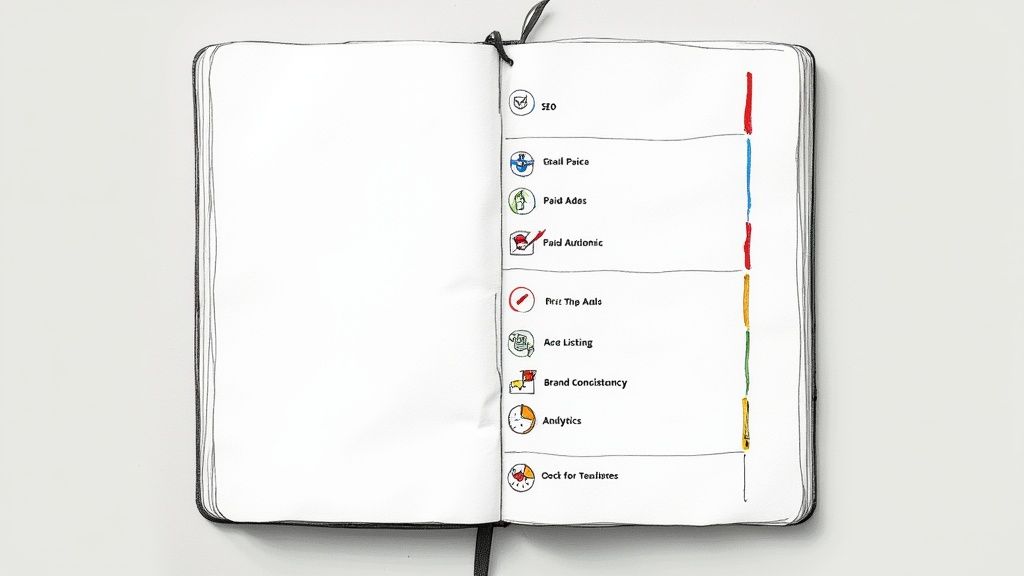
The STR Direct-Booking Marketing Checklist (3 Pillars)
Posted on Dec 22, 2025
TL;DR: Most "STR marketing checklists" hand you ten generic tasks that would fit a dentist's office as easily as a 70-unit portfolio. This one is built around the only question that moves your P&L: how do you stop renting your guest relationships from the OTAs and start owning them? Three pillars do that work — your owned booking website, your guest-communication engine, and your channel mix. Everything else is a tactic in service of one of those three.
Here's the reality check. Top hotel brands take 75–80% of bookings direct. Vacation rental managers? Often single digits — even a tech-enabled operator like Vacasa reported just 35% of booking value coming direct. That gap is the opportunity. Close even part of it and you stop paying Airbnb's 15.5% host fee on every stay, you keep your cash on day one instead of post-checkout, and — critically — you own the guest, not the channel.
What is direct-booking marketing for STRs? It's the discipline of acquiring, converting, and re-booking guests on channels you own — your website and your guest list — so that a growing share of revenue arrives without an OTA commission attached. The goal isn't to leave the OTAs. It's to stop being dependent on them.
Why three pillars, not ten
If you run a portfolio, you don't have a "marketing problem." You have a distribution problem wearing a marketing costume. The generic checklist tells you to "build buyer personas" and "design a customer journey map" — fine, but those are means, not ends. The end is owning the guest relationship across three moments that decide your margin:
- Acquisition & conversion — can a high-intent traveler find you and book direct? (Your website.)
- Retention — do first-time guests come back without you re-paying to acquire them? (Your guest comms.)
- Channel economics — does every OTA stay feed your direct engine instead of just enriching the platform? (Your channel mix.)
Work the three in order. Here's the checklist for each.
Pillar 1 — Own the booking website (acquisition + conversion)
Your website is the only storefront where a booking costs you 0% in commission. It's also where most operators leak the most demand — a beautiful listing that doesn't convert, or worse, doesn't get found. Travel planning is rarely impulsive; on average it takes 33 searches across 12 travel sites (Bain) before a booking. Your job is to be the site that wins the last session.
Checklist:
- Show the direct-booking advantage on the price, not in a banner. The most effective incentive is a real-time comparison: your direct rate next to the OTA rate, with the savings made explicit at the moment of decision. If a guest can see they save by booking with you, the "why book direct" essay writes itself.
- Target high-intent, long-tail search — not "vacation rental." You will never outspend Booking.com on a head term. You can out-rank them on "pet-friendly cabin with hot tub near Gatlinburg" or "downtown Austin loft for a bachelorette." These queries signal a guest who's close to booking and looking for exactly your inventory.
- Give every property — and every value prop — its own page. One operator we work with, Sojourn, manages 250+ units in Washington D.C. and now regularly outperforms major OTAs on direct production by building detailed pages around their guests' actual selling points (location, design, the "premium experience") rather than generic amenity lists. Depth of relevant content is what earns the high-intent ranking.
- Pass Core Web Vitals — with the current metrics. A slow, janky site bleeds bookings. Check your site against Google's three Core Web Vitals: LCP (loading), CLS (visual stability), and INP (interaction responsiveness). Note: as of March 12, 2024, INP replaced FID — if your last audit still references First Input Delay, it's out of date. Use PageSpeed Insights to find the bottlenecks.
- Capture the visitor who isn't ready yet. Most site traffic won't book on the first visit. A non-intrusive email capture (a local guide, early access to new properties) turns an anonymous bounce into a name you can re-book later. Skip the aggressive day-one discount pop-up — it cheapens the brand.
The kicker: AI travel assistants are about to make the owned website matter even more. When an agent compares the same property across channels and finds your direct rate is lowest, recommending the direct booking is a no-brainer for it. The operators whose sites are discoverable, fast, and clearly cheaper direct are the ones AI will funnel guests toward. (More on that in why AI companions will make direct the default.)
Pillar 2 — Build the guest-communication engine (retention)
Acquisition is the expensive half of marketing. Retention is the profitable half — and it's where STR operators leave the most money on the table. Here's the uncomfortable number: across operators we've analyzed, repeat guests account for a median of just 5% of total booking revenue (the range runs from 1% to 26%). Most STR brands are, in effect, paying to acquire the same kind of guest over and over because they never built the relationship that brings the first one back.
The fix isn't a louder newsletter. It's a system that treats your guest list as the owned asset it is. Every past guest is someone you already paid to acquire — re-booking them direct is the highest-margin booking you'll ever make.
Checklist:
- Capture a contact point on every stay — including OTA stays. An email or phone number from an OTA guest is the seed of a future direct booking. If you're not collecting it post-stay, you're handing the relationship back to the platform. This is the single highest-leverage habit in STR marketing.
- Segment by relationship, not by demographics. First-time inquirers, one-to-two-stay guests, VIP repeat guests, and lapsed guests (no booking in 18+ months) each need a different message. A re-engagement offer to a lapsed guest and a loyalty perk to a VIP are not the same email.
- Automate the lifecycle, don't hand-send it. A welcome sequence for new subscribers, a pre-arrival sequence with check-in logistics and local tips, and a post-stay sequence that asks for the review and plants the seed for a return booking. The pre-arrival flow alone turns the most common guest anxiety — "where do I go, what's the code?" — into confident anticipation.
- Personalize on behavior, not just first name. A guest who booked the pet-friendly cabin should hear about the new dog-friendly property — not a generic blast. The data to do this already lives in your booking history.
Bottom line: empirical research shows guests who book through an intermediary develop more affinity to the channel than to your brand. In other words, the OTA owns your customer until you do something about it. Guest comms is how you take ownership back.
Pillar 3 — Engineer the channel mix (distribution economics)
Going direct does not mean abandoning the OTAs. It means making them work for your direct engine instead of against it. The OTAs are the top of your funnel; your owned channels are where the margin lives. The art is converting one into the other over time.
Checklist:
- Use the OTA "Billboard Effect" deliberately. Cornell research documents the Billboard Effect — guests discover a property on an OTA, then seek out the brand to book direct. Treat your OTA listing as a billboard for your brand, not just a transaction endpoint: consistent name, professional photography, a brand promise that travels.
- Know your true cost per channel. Layer the commission, the payment-processing cut, and the delayed payout on top of each OTA booking, then compare it to the fully-loaded cost of a direct booking (including ad spend). You'll usually find a direct booking is dramatically more profitable — and that number is what justifies your direct-booking discount.
- Run paid acquisition against intent, and measure to booking. Point Google Search ads at high-intent terms ("book cabin in Gatlinburg"); use social for the inspirational top of funnel. But set up conversion tracking through to the completed booking — not the click — so you can manage to cost-per-acquisition, not vanity traffic.
- Retarget the visitors who didn't book. A pixel on your site lets you re-serve the exact property a guest viewed. Warm-audience retargeting is consistently among the highest-ROI ad spend you can run, because you're nudging someone who already chose your brand.
The reality check: a channel mix isn't a static pie chart. It's a flywheel — OTA discovery feeds your guest list, your guest list feeds direct re-bookings, direct re-bookings fund the content and ads that win the next high-intent search. Measured quarterly, the share of revenue arriving commission-free is the one number that tells you the flywheel is turning.
How to sequence this if you're starting today
Don't try to run all three pillars at full speed at once. Diagnose where you're leaking, and start there:
- Low traffic / not getting found? Start with Pillar 1 — long-tail search and property-level pages.
- Traffic but low direct conversion? Stay in Pillar 1 — fix the price-comparison display, site speed (INP/LCP/CLS), and lead capture.
- One-and-done guests? Go to Pillar 2 — capture contacts on every stay and turn on the post-stay re-booking sequence.
- Over-reliant on OTAs? Work Pillar 3 — quantify true channel cost and lean on the Billboard Effect to convert OTA discovery into direct loyalty.
The 75–80% direct share that top hotels enjoy didn't appear overnight, and yours won't either. But every point of direct share you claw back is margin that funds your brand instead of someone else's platform.
Running these three pillars by hand across a portfolio is a lot of moving parts. hostAI was built to run them as one system for STR operators — a high-converting direct-booking site (hostFront), automated guest communication for retention, and AI-driven distribution that points high-intent demand at your direct channels. If you're ready to turn this checklist into a working engine, see how it works.