

digital marketing tips for small business
10 Essential Digital Marketing Tips for Small Business STR Owners in 2026
Posted on Jan 13, 2026
In the highly competitive short-term rental market, relying solely on Online Travel Agencies like Airbnb and Vrbo means leaving money on the table and sacrificing control over your brand. The key to long-term success lies in building a robust direct booking engine, transforming your property from a simple listing into a sustainable, independent business. This guide provides ten essential digital marketing tips for small business owners in the vacation rental space, designed to help you attract more guests, increase revenue, and build a powerful, resilient brand.
These aren't abstract theories. We are providing actionable strategies that you can implement immediately to drive tangible results. We will explore how to build a high-converting website, master email automation for guest retention, and implement programmatic SEO to capture niche traveler intent. You will also learn how to optimize your pricing with AI-powered tools and run targeted retargeting campaigns that bring potential guests back to your booking page. To unlock your direct booking potential, understanding effective social media marketing for vacation rentals is a crucial step in reaching your target guests and building a community around your brand.
Each tip in this listicle is crafted to be a practical, step-by-step component of a larger strategy. From leveraging user-generated content to building strategic local partnerships, these insights will empower you to take control of your bookings. By applying these digital marketing tips, you can reduce your dependency on OTAs, avoid hefty commission fees, and foster direct relationships with your guests, ensuring your small business not only survives but thrives. Let's dive into the strategies that will redefine your booking potential.
1. Build a High-Converting Direct Booking Website
While listing on Online Travel Agencies (OTAs) like Airbnb and Vrbo is essential for visibility, relying on them exclusively means sacrificing significant revenue to commission fees and losing control over the guest relationship. One of the most impactful digital marketing tips for a small business in the short-term rental space is to establish a dedicated, high-converting direct booking website. This asset serves as your brand’s central hub, allowing you to bypass OTA commissions (often 15-30%) and build a direct line of communication with your guests.
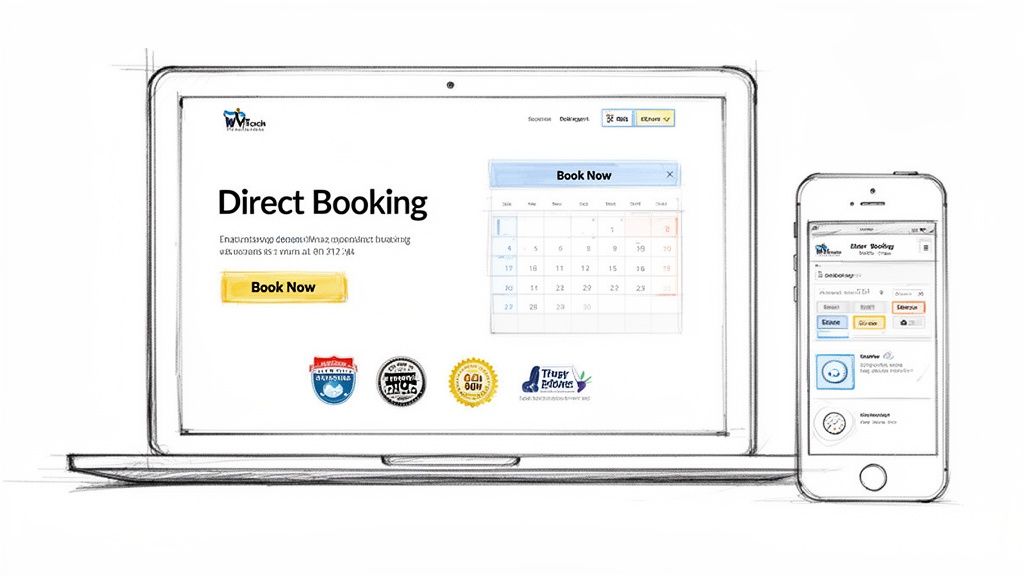
A direct booking site transforms your property from a simple listing into a legitimate, bookable brand. It empowers you to capture valuable guest data for future email marketing campaigns, control your branding, and offer unique packages or promotions unavailable on third-party platforms. Leading property management companies like Vacasa and AvantStay have scaled their operations by centralizing their portfolios on powerful branded domains, demonstrating the model's effectiveness.
How to Implement This Strategy
To create an effective direct booking website, focus on building trust and minimizing friction in the booking process. Modern tools are designed specifically for hosts, making this more accessible than ever.
- Use an STR-Specific Website Builder: Platforms like hostAI’s hostFront are engineered for vacation rentals. They integrate with property management systems (PMS), handle real-time pricing and availability, and offer professionally designed templates that are optimized for conversions right out of the box.
- Optimize for a Seamless User Experience: Ensure your site features high-resolution photography, a clear and prominent "Book Now" call-to-action, and complete pricing transparency. The booking process should be intuitive and, most importantly, flawless on mobile devices, where the majority of travelers research and book their stays.
- Showcase Social Proof: Prominently display guest testimonials, reviews, and any press mentions. Social proof is critical for building the trust needed to convince a potential guest to book directly with you instead of through a familiar OTA.
For an in-depth guide on creating a site that captures more commission-free revenue, you can learn more about how to optimize a vacation rental website for direct bookings.
2. Implement Programmatic SEO for Long-Tail Keywords
While standard SEO focuses on a few high-competition keywords like "vacation rental," programmatic SEO is a more advanced digital marketing tip for a small business aiming to dominate niche searches. This strategy involves automatically generating hundreds or even thousands of highly specific landing pages targeting long-tail keywords that potential guests use when they are close to booking. These are searches like “pet-friendly cabin with a hot tub near Asheville” or “3-bedroom beachfront rental Outer Banks with pool.”
By creating a unique page for each specific combination of location, property type, and amenity, you can capture high-intent search traffic that broader marketing efforts miss. Instead of competing for generic terms, you attract guests who know exactly what they want, leading to higher conversion rates and more direct bookings. Large aggregators and property management companies leverage this model to rank for thousands of granular search queries, effectively blanketing their target markets in organic search results.
How to Implement This Strategy
The key to successful programmatic SEO is creating unique, valuable content at scale without it being flagged as thin or duplicate content. Modern AI-powered tools are making this strategy accessible to smaller operators.
- Leverage AI-Powered Tools: Platforms like hostAI’s hostWriter can automate the creation of these landing pages. By connecting to your property data, these tools can generate unique descriptions, highlight relevant amenities, and craft content tailored to hyper-specific keyword templates (e.g., [Neighborhood] + [Property Type] + with [Amenity]).
- Focus on a Granular Keyword Matrix: Identify all possible combinations of locations (city, neighborhood), property types (cabin, condo, house), and key amenities (hot tub, pet-friendly, oceanfront). This matrix becomes the blueprint for the pages you will generate, ensuring comprehensive market coverage.
- Build an Internal Linking Structure: Ensure all programmatically generated pages link back to your main market pages and to each other where relevant. This internal linking strategy helps distribute link equity across your site and signals to search engines the relationship between your pages, boosting overall domain authority.
3. Master Email Marketing Automation for Guest Retention
Acquiring a new guest can cost five times more than retaining an existing one, making guest retention one of the most cost-effective digital marketing tips for a small business. Mastering email marketing automation allows you to build a reliable system for driving repeat bookings and referrals. By creating automated email sequences triggered by guest behavior and booking milestones, you can maintain a connection with past guests, who are the most likely to rebook, without constant manual effort. This direct line of communication keeps your brand top-of-mind and has the highest ROI of any digital channel, returning an average of $42 for every $1 spent.
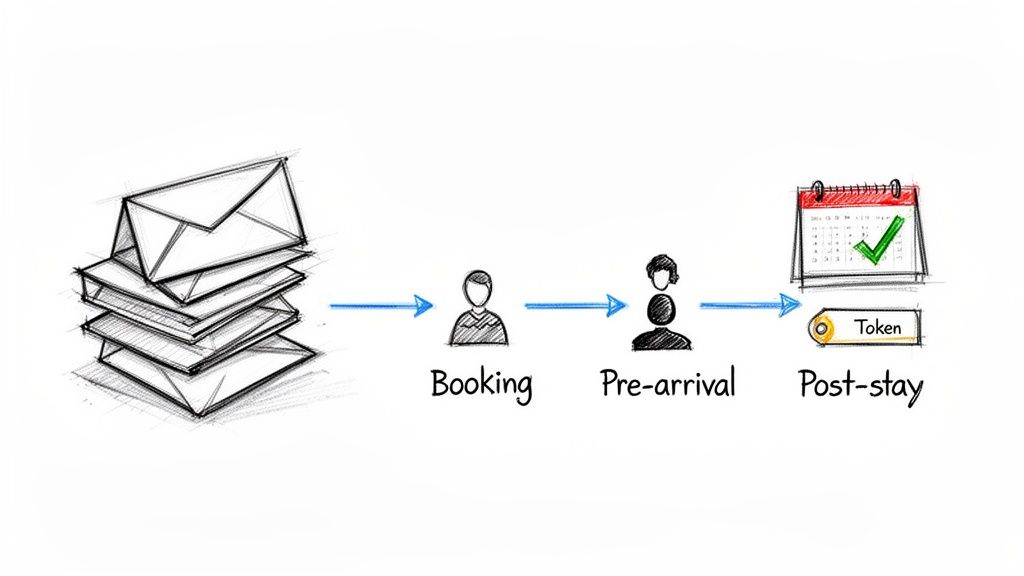
Automated sequences ensure consistent, timely communication that builds trust and loyalty. Property managers have seen repeat booking rates increase by 25-40% simply by sending automated post-stay surveys and follow-up offers. Similarly, luxury rental brands use personalized welcome emails containing detailed property guides to enhance the guest experience, while portfolio owners send targeted seasonal promotions to past guests just before peak travel times to secure early bookings.
How to Implement This Strategy
The key to successful email automation is delivering the right message at the right time. Modern tools built for the short-term rental industry make this simple and effective.
- Build a Core Welcome Sequence: Use a tool like hostAI’s hostMail to create an essential automated flow: booking confirmation, pre-arrival preparation tips, and a post-stay thank you note with a request for a review and a special offer for a future stay.
- Personalize and Segment Your Messaging: Use dynamic content to insert the guest's name and the specific property they booked. Segment your email list by guest type (e.g., families, couples, business travelers) to send highly targeted promotions that resonate with their needs.
- Optimize for Engagement: A/B test your subject lines to improve open rates, aiming for 25% or higher. Include high-quality property photos and videos in your emails and add clear, compelling calls-to-action (CTAs) that encourage guests to check availability or book a future stay.
To dive deeper into crafting compelling messages that drive revenue, explore this ultimate guide to guest rebooking emails for short-term rental owners.
4. Leverage User-Generated Content and Guest Reviews
In the trust-driven hospitality industry, what other guests say about your property is often more persuasive than any professional marketing copy you can write. Leveraging user-generated content (UGC) and guest reviews is a powerful digital marketing tip for small business owners because it provides authentic social proof that builds credibility and drives bookings. Potential guests rely heavily on the experiences of others, with studies showing that reviews influence the purchasing decisions of over 93% of consumers.
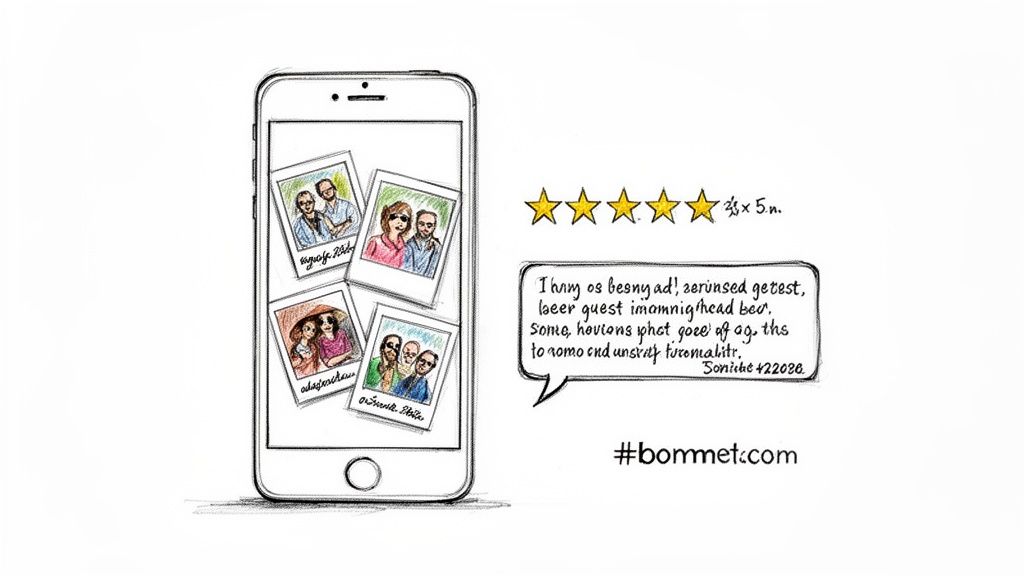
Actively collecting and showcasing guest photos, videos, and testimonials transforms satisfied visitors into a volunteer marketing team. This content is not only cost-effective but also perceived as more genuine, directly influencing conversion rates. Leading platforms like Airbnb have built their entire trust model on this concept, where properties with hundreds of positive reviews can command significant price premiums over those with none. Your goal is to systematically encourage, collect, and display this powerful content across your website, social media, and email campaigns.
How to Implement This Strategy
A successful UGC strategy involves making it easy for guests to share their experiences and then strategically showcasing that content where it will have the most impact. The process should be integrated into your post-stay communication.
- Systematize Your Review Requests: Don't leave reviews to chance. Use automated post-stay emails, sent 24-48 hours after checkout, to politely ask for a review. Include direct links to your Google Business Profile, direct booking site, or OTA listings to make the process seamless for your guests.
- Encourage Visual Content with a Branded Hashtag: Create a unique and memorable hashtag for your property (e.g., #TheLookoutLodge) and encourage guests to use it when posting photos on social media. Feature the best guest photos prominently on your website's homepage, in your gallery, and across your social feeds to inspire others.
- Respond to All Feedback Professionally: Engage with every review, both positive and negative. A thoughtful response to a positive review shows appreciation, while a professional and constructive reply to a negative one demonstrates a commitment to guest satisfaction and can mitigate potential damage. This active management builds trust with future bookers.
5. Run Targeted Retargeting and Pixel-Based Advertising
The reality of the travel booking journey is that most guests don't book on their first visit. They compare properties, check flights, and consult with travel partners. A powerful digital marketing tip for a small business is to use pixel-based retargeting to bring these high-intent visitors back. By placing a tracking pixel (a small snippet of code) on your website, you can serve targeted ads to users who have already shown interest in your property across platforms like Facebook, Instagram, and Google.
This strategy is highly effective because it focuses your ad spend on a warm audience, resulting in conversion rates often 3-5 times higher than campaigns targeting cold traffic. Instead of letting a potential guest forget about your stunning property, retargeting keeps your brand top-of-mind. It’s a crucial tool for closing the gap between initial interest and a confirmed booking, effectively turning "window shoppers" into paying guests.
How to Implement This Strategy
Setting up a successful retargeting campaign involves capturing visitor data and delivering relevant, timely ads that encourage them to complete their booking.
- Install Tracking Pixels Immediately: The first step is to install the Meta Pixel (for Facebook and Instagram) and the Google Ads tag on every page of your direct booking website. This allows you to start building audiences based on user behavior right away.
- Create Custom Audiences: Segment your visitors based on their actions. Create audiences for users who visited specific property pages, viewed the pricing or availability calendar, or, most importantly, abandoned the checkout process. This allows you to tailor your ad creative and offers to their specific level of interest.
- Use Dynamic and Sequential Ads: For property managers with multiple listings, use dynamic ads that automatically show the exact properties a user viewed. Also, consider sequential retargeting: show an ad highlighting guest testimonials first, followed by one emphasizing a limited-time offer to create urgency.
To explore which platforms offer the best ROI for your campaigns, you can find a breakdown of the best retargeting platforms for vacation rentals.
6. Optimize Pricing Strategy with AI-Powered Dynamic Pricing
Setting nightly rates manually is one of the most common revenue-limiting mistakes small business owners in the short-term rental market make. Static pricing leaves money on the table during high-demand periods and fails to attract bookings during slower seasons. Implementing an AI-powered dynamic pricing strategy allows you to automatically adjust rates based on real-time market data, including seasonality, local events, competitor pricing, and booking pace, ensuring you maximize revenue per available room (RevPAR).
This approach moves beyond simple seasonal adjustments, using sophisticated algorithms to pinpoint revenue opportunities. For example, a property near a major conference venue might see its rates automatically surge by 35% during event dates, while a beachfront home could increase its pricing by over 40% for a peak summer holiday weekend. This level of granular optimization can add tens of thousands of dollars in annual revenue per property without any manual intervention.
How to Implement This Strategy
Adopting dynamic pricing doesn't require a degree in data science. Modern tools are built specifically for vacation rental managers, making it easy to automate and optimize your pricing structure while maintaining full control.
- Integrate a Vacation Rental Pricing Tool: Use specialized platforms like PriceLabs, which are designed for the short-term rental market. These tools analyze billions of data points to provide daily rate recommendations that sync directly with your Property Management System (PMS) and booking channels.
- Set Strategic Pricing Guardrails: While the AI handles daily adjustments, you must set the strategic boundaries. Define your absolute minimum nightly rate to cover costs and your maximum rate for peak demand periods. This ensures the algorithm operates within a profitable and logical framework.
- Factor in Local and Seasonal Nuances: Customize your strategy by layering in rules for local events, holidays, and seasonal trends. Implement automated "early bird" discounts to secure bookings far in advance and length-of-stay discounts to reduce turnover costs and attract longer, more profitable reservations.
7. Build Strategic Social Media Presence on Video-First Platforms
Static images and text updates are no longer enough to capture traveler attention in a crowded market. One of the most potent digital marketing tips for a small business in the vacation rental industry is to build a strategic presence on video-first platforms like TikTok, Instagram Reels, and YouTube Shorts. Short-form video is the fastest-growing content format, generating significantly more engagement and shares than traditional posts, making it a powerful tool for reaching new audiences and driving direct bookings.
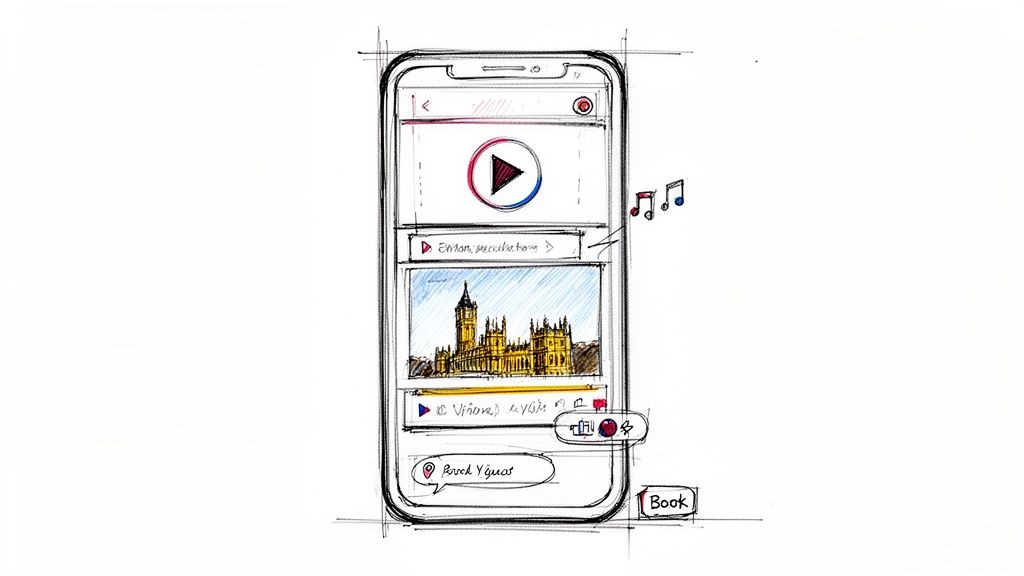
This approach transforms your properties from passive listings into dynamic, aspirational destinations. Engaging video content, such as property tours, clips of local attractions, or behind-the-scenes glimpses, builds an authentic connection with potential guests. Successful vacation rental accounts have gained tens of thousands of followers and secured direct bookings by creating viral 30-second property highlight reels, proving that even small operators can achieve massive reach without a large ad budget.
How to Implement This Strategy
The key to success on these platforms is consistency and authenticity. Viewers want to see the real experience, not a polished corporate advertisement. Focus on creating content that is both visually appealing and adds value for the viewer.
- Prioritize High-Impact Visuals: The first three seconds of your video are critical. Start with the most captivating shot of your property, whether it's a stunning view, a unique amenity, or a cozy fireplace. Use high-quality video that showcases your rental in the best possible light.
- Leverage Trends and Audio: The algorithms on TikTok and Instagram heavily favor content that uses trending sounds and music. Incorporate popular audio into your videos to dramatically increase their visibility and reach audiences who may not be actively searching for rentals.
- Create a Clear Call-to-Action (CTA): Don't let engagement go to waste. End your videos with a clear CTA, such as "Book your stay at the link in our bio!" or "Comment 'info' for our seasonal rates." This directs interested viewers to your direct booking website, converting social media buzz into tangible revenue.
For a visual guide on how to create compelling short-form video content that resonates with travelers, the video below provides excellent insights.
8. Implement Strategic Local SEO and Google My Business Optimization
While broad SEO targets travelers worldwide, local SEO captures guests actively searching for accommodations in your specific location. Optimizing for local search, especially your Google Business Profile (GBP), is one of the most powerful digital marketing tips for a small business because nearly half of all Google searches have local intent. When a potential guest searches "vacation rental in [Your City]," a well-optimized GBP can place your property directly in the coveted Google Maps "local 3-pack" at the top of the results.
This strategy is critical for driving direct, high-intent traffic from travelers who are past the initial research phase and are ready to book. It positions your brand as a legitimate, local authority, often ranking you above massive OTAs in map-based searches. Successful hospitality brands leverage this by accumulating hundreds of positive Google reviews, ensuring their properties dominate local search for neighborhood-specific queries and appear as the top choice for travelers exploring the area on Google Maps.
How to Implement This Strategy
A comprehensive and active Google Business Profile is the cornerstone of any local SEO effort. The goal is to provide Google with strong signals that your business is a relevant and trustworthy answer for local accommodation searches.
- Complete and Optimize Your GBP: Fill out every single section of your Google Business Profile. This includes adding high-quality photos and videos of your properties, listing all amenities as "services," writing a detailed business description, and ensuring your name, address, and phone number (NAP) are 100% accurate and consistent everywhere online.
- Build a Strong Review Profile: Actively encourage guests to leave reviews on Google through your post-stay email automations. Positive reviews are a massive ranking factor. Make it a policy to respond professionally to all reviews, both positive and negative, to show engagement and build trust.
- Create Location-Specific Content: Develop content on your website that targets local keywords. This can include creating dedicated landing pages for each neighborhood you operate in, writing blog posts about local attractions, or mentioning nearby landmarks in your property descriptions. This reinforces your local relevance to search engines.
9. Create and Distribute Valuable Content Marketing
Paid advertising can deliver quick traffic, but content marketing builds a sustainable, long-term asset that attracts, engages, and converts guests. Instead of directly selling your properties, this strategy involves creating and sharing valuable, relevant content like destination guides, travel tips, or local event highlights. This approach positions your brand as a trusted local expert, not just another place to stay, which is a powerful digital marketing tip for any small business looking to build lasting relationships.
Content marketing is exceptionally effective because it captures guests in the early "dreaming" and "planning" stages of their travel journey. By providing answers to questions like "best family-friendly hikes in [Your City]" or "romantic restaurants near [Your Landmark]," you attract high-intent organic traffic. Industry leaders have shown that a robust blog with hundreds of posts can dominate local search results, while property management YouTube channels build massive brand awareness, proving the model's scalability and impact.
How to Implement This Strategy
A successful content strategy focuses on consistency and providing genuine value that helps potential guests plan their perfect trip, making your property the natural choice for their stay.
- Target Destination-Specific Keywords: Use tools like Google Keyword Planner to find what travelers are searching for related to your location. Create a content calendar and aim to publish two to four blog posts per month targeting these specific keywords. Focus on topics like "Top 10 Things to Do in [City]" or "A Weekend Guide to [Your Neighborhood]."
- Diversify and Repurpose Content: A single blog post can be repurposed into multiple assets. Turn key points into a short video for YouTube or Instagram Reels, create an infographic for Pinterest, and share snippets in your email newsletter. This maximizes your reach without requiring you to create entirely new content from scratch.
- Include Clear Calls-to-Action (CTAs): Every piece of content should guide the reader toward the next step. End your blog posts with a clear CTA that links directly to your relevant property listings or booking page, such as, "Ready to explore [City]? Book your perfect home base here."
10. Develop Strategic Partnership and Affiliate Programs
Relying solely on your own marketing efforts limits your reach to audiences you can directly target. A powerful digital marketing tip for any small business in the short-term rental market is to build a network of strategic partnerships and affiliate programs. This approach turns local businesses, influencers, and complementary services into a commission-based sales force, driving referral bookings at a fraction of the cost of traditional advertising.
Strategic alliances provide a cost-effective customer acquisition channel, as you typically only pay for confirmed bookings, not for clicks or impressions. Successful property managers often find that a well-managed partner network can deliver 15-30% of their total booking volume. This model is highly effective for targeting niche audiences, such as corporate travelers through housing providers or adventure seekers via local tour companies, filling occupancy gaps with high-value guests.
How to Implement This Strategy
Building a successful partner program requires a structured approach to outreach, management, and tracking. Your goal is to make it as easy as possible for partners to promote your properties and earn commissions.
- Identify and Vet Potential Partners: Create a target list of 10-15 potential partners, including local tour operators, wedding planners, corporate housing agencies, and travel influencers whose followers match your ideal guest profile. Prioritize partners who genuinely align with your brand.
- Establish a Clear Commission Structure: Offer a competitive commission, typically between 10-20% of the booking value. To expand your reach and attract more guests, consider developing strategic partnership and affiliate programs, like exploring options available on Klap's affiliate page to see how modern platforms structure these relationships.
- Equip Partners for Success: Provide your partners with a dedicated toolkit, including unique trackable booking links, high-resolution photos, pre-written property descriptions, and any co-branded marketing materials. The easier you make it for them to promote you, the more bookings they will generate.
10-Point Small Business Digital Marketing Comparison
| Strategy | Implementation Complexity | Resource Requirements | Expected Outcomes | Ideal Use Cases | Key Advantages |
|---|---|---|---|---|---|
| Build a High-Converting Direct Booking Website | Medium–High (design, dev, integrations) | Web development, professional photography, payment gateway, SEO, ongoing maintenance | Increased direct bookings, lower OTA fees, captured guest data | Property managers, luxury brands, owners wanting brand control | Lower commissions, full pricing/availability control, guest data capture |
| Implement Programmatic SEO for Long-Tail Keywords | High (technical SEO, automation) | SEO automation tools, templates, content QA, developer support, monitoring | Scaled organic traffic and bookings over 3–6 months | Large inventories, multi-location portfolios, competitive markets | Capture high-intent long-tail searches at scale; cost-effective long-term |
| Master Email Marketing Automation for Guest Retention | Low–Medium (flow setup, segmentation) | Email platform, guest data, templates, compliance processes | Higher repeat bookings, strong ROI, improved LTV | Hosts with repeat guests, portfolios focusing on retention | Highest ROI, personalized automated outreach, drives rebookings |
| Leverage User-Generated Content and Guest Reviews | Low–Medium (collection & display workflows) | Review collection tools, social management, moderation, display integrations | Increased trust and conversion, better social proof and SEO | Consumer-facing properties, social-first marketing strategies | Authentic social proof, improved conversion rates, cost-effective content |
| Run Targeted Retargeting and Pixel-Based Advertising | Medium (pixel setup, ad sequencing) | Pixels, ad spend, creative assets, analytics, audience build | Higher conversion rates (vs cold traffic), lower CPA for warm leads | Sites with steady traffic, cart abandoners, high-intent visitors | Efficient remarketing, dynamic ads tailored to user behavior |
| Optimize Pricing Strategy with AI-Powered Dynamic Pricing | Medium–High (integration and tuning) | Pricing engine, historical data, PMS/channel integration, monitoring | Increased RevPAR, reduced vacancy, measurable revenue uplift | Seasonal/event-driven markets, larger portfolios | Automated revenue optimization, responsive to market changes |
| Build Strategic Social Media Presence on Video-First Platforms | Medium (consistent content production) | Content creators, cameras/smartphones, editing tools, publishing cadence | Greater brand awareness and engagement; slower direct conversions | Targeting younger demographics, building brand personality | High organic reach and engagement; viral potential with low production cost |
| Implement Strategic Local SEO and Google My Business Optimization | Low–Medium (listing & citation work) | GMB optimization, local citations, photos, review solicitation | Better local visibility, improved map rankings, higher local conversions | Properties relying on local search and footfall, urban rentals | High intent local traffic, cost-effective visibility on Maps/search |
| Create and Distribute Valuable Content Marketing | Medium–High (consistent production & distribution) | Writers, video producers, SEO, distribution channels, editorial calendar | Long-term organic traffic, authority, lead generation (3–6 months) | Brands building thought leadership and planning-stage traffic | Sustainable inbound leads, repurposable assets, SEO authority |
| Develop Strategic Partnership and Affiliate Programs | Medium (partner management & tracking) | Partner outreach, commission budget, tracking/portal, legal agreements | New referral bookings, diversified acquisition, measurable ROI | Local businesses, influencers, corporate travel channels | Performance-based acquisition, access to partner audiences, lower upfront cost |
Bringing It All Together: Your Path to Digital Independence
Navigating the digital landscape can feel like a monumental task, but the journey from reliance on Online Travel Agencies (OTAs) to building a self-sustaining, profitable short-term rental brand is paved with strategic, incremental steps. You've just explored a comprehensive toolkit of digital marketing tips for your small business, each designed not just to attract guests, but to build a resilient, direct-booking-first operation. The power isn't in trying to implement everything at once; it's in understanding how these individual strategies interconnect to create a powerful, self-reinforcing marketing engine.
From building a high-converting direct booking website to leveraging the precision of programmatic SEO, each tactic addresses a critical piece of the guest journey. Email automation transforms one-time visitors into repeat loyalists, while dynamic pricing ensures you’re maximizing revenue for every single night. The common thread weaving through all these strategies is the pursuit of control and profitability. When you own your digital presence, you own your guest relationships and, ultimately, your brand's future.
Your Actionable Roadmap to Digital Mastery
The most common hurdle isn't a lack of knowledge; it's knowing where to begin. To overcome this, let's distill this comprehensive guide into a clear, actionable plan. Don't feel pressured to tackle everything simultaneously. Instead, choose a starting point that aligns with your most immediate business needs.
Here are your key takeaways and immediate next steps:
- Establish Your Foundation: Your direct booking website is non-negotiable. It's your digital storefront and the central hub for all other marketing efforts. If you don't have one, or if your current site isn't optimized for conversions, start here. This is the single most important asset for reducing OTA dependency.
- Focus on 'Free' Traffic First: Before spending a dollar on ads, maximize your organic reach. Optimize your Google My Business profile for local searches and begin creating valuable content that answers guest questions. This builds long-term authority and a steady stream of traffic that doesn't cost you per click.
- Nurture Your Existing Audience: Your past guest list is a goldmine. Implementing even a simple automated email sequence, like a post-stay "thank you" with a return-guest discount, is a low-effort, high-impact strategy. It's one of the most effective digital marketing tips for small business owners because it costs very little and delivers a high return on investment.
- Embrace Smart Automation: You cannot do it all manually. The true path to scaling is leveraging technology to handle repetitive tasks. Whether it's using an AI-powered tool to manage dynamic pricing or automating social media posts, technology frees you to focus on high-level strategy and guest experience.
The ultimate goal is to create a symbiotic system where your efforts compound. Your engaging content drives SEO, which brings traffic to your website. Pixel-based retargeting then re-engages visitors who didn't book, while your email automation nurtures past guests, encouraging them to return. Each element supports the others, creating a robust framework that consistently drives direct bookings and strengthens your brand's position in the market. The path to digital independence is a marathon, not a sprint. Start with one focused initiative, master it, measure its impact, and then build upon that success.
Ready to put these strategies into action without the technical headache? The hostAI platform is an all-in-one solution built specifically for short-term rental managers, integrating many of the digital marketing tips for small business we've discussed. From an AI-powered website builder to automated email marketing and ad distribution, hostAI simplifies your path to more direct bookings and greater profitability.