
guest reviews examples
Guest Review Examples for STRs: 8 Types That Drive Bookings
Posted on Dec 21, 2025
TL;DR: A guest review isn't a report card — it's the most persuasive, free marketing copy you'll ever own, and a free operational audit on top of it. The problem: most of it sits buried on OTA listings working to fill their funnel, not yours. Below are 8 guest review examples STR operators actually receive, what each one is worth, and how to pull that value onto your direct booking site and into your retention flows — where it compounds margin instead of feeding the OTA.
What counts as a "good" guest review (and why it's a growth asset)
A good guest review is specific, recent, and decision-relevant: it names a touchpoint a prospective guest is silently worried about — cleanliness, the check-in, whether the Wi-Fi actually works, whether the "ocean view" is real — and resolves that doubt with a concrete detail. Star ratings get you onto the consideration list. Reviews are what close the booking.
Here's the strategic catch most operators miss. The reviews you've earned are doing their hardest work on Airbnb, Vrbo, and Booking.com — platforms that take a cut of every reservation and own the guest relationship. The same review, surfaced on your own direct booking site, converts a guest you keep, at full margin, with their email in your CRM. So the question isn't just "how do I get more reviews?" It's "how do I get the reviews I've already earned working for my brand instead of the OTA's?"
This guide breaks down 8 review archetypes you'll recognize from your own inbox, the exact operator move each one unlocks, and how to stop letting your best social proof live rent-free on someone else's platform.
Key takeaways:
- Every review type maps to a specific guest persona and a specific objection — match the review to the guest you want to attract.
- Detailed, persona-specific reviews convert better than generic 5-star praise because they pre-answer the booker's real doubts.
- Reviews on OTAs grow the OTA's brand; the same reviews on your direct site grow yours. Move them.
- Constructive (3–4 star) reviews are an operational roadmap and, when you respond well, a trust signal — not a problem to bury.
1. The Detailed Experience Review
The gold standard: a multi-paragraph narrative that walks through the whole arc — the booking, the self-check-in code that worked on the first try, the beds in the "Ocean View Suite," the coffee you stocked, the late checkout you granted. These are the reviews that read like a story.
What it sounds like: "From the first message Maria sent us a detailed arrival guide, so check-in at 9pm with two sleeping kids was painless. The unit was spotless, the kitchen had everything we needed to cook, and the walk to the beach was exactly the 4 minutes the listing promised. We've already booked it again for next summer."
Why it's worth more than a 5-star rating
It pre-answers the silent objections — Is it clean? Is check-in a hassle? Is the listing honest about distance? — that otherwise send a hesitant booker back to comparison-shop. That last line ("booked it again") is the tell: detailed reviewers are disproportionately your repeat guests, the cheapest revenue you'll ever earn.
The operator move
- Prompt for the narrative. Don't ask "How was your stay?" Ask, in your post-stay message, "What was the one thing about the place that surprised you?" Specific questions produce specific, quotable answers.
- Pull it onto your own site. A rotating "Guest stories" block on your direct booking page does the comparison-shopper's homework for them. The review you earned on Airbnb is converting Airbnb's traffic; the same review on your site converts a guest you keep.
- Close the loop with the guest. A reviewer who wrote you a paragraph is a warm lead. Add them to a "past guests" segment and they're your highest-intent audience for an off-season offer.
2. The Pros & Cons Structured Review
A balanced, skimmable breakdown — bulleted strengths against a short list of nitpicks. Comparison shoppers love it because it lets them weigh your place fast, and the honesty of an admitted con makes every pro more believable.
What it sounds like: Pros: blazing Wi-Fi, walkable to three restaurants, host responded within minutes. Cons: street parking was tight on a Friday night, and the second bedroom runs warm.
Why it's worth more than a 5-star rating
Transparency converts. A flawless review reads like marketing; a review that names one real con and still recommends you reads like a friend. The "cons" are also the most honest prioritized maintenance list you'll ever get — for free.
The operator move
- Mine the cons for recurring themes. If "parking was tight" shows up three times, that's not a one-off — it's a pre-arrival message waiting to be written.
- Turn the con into proactive content. Add a parking map and a "best spots after 6pm" tip to your direct site's FAQ and your check-in guide. You've now defused the objection before it becomes a future con.
- Show the fix publicly. "You flagged the warm bedroom — we've added a portable AC unit." Responsiveness is the single most underused trust signal in this business.
3. The Photo-Rich Visual Review
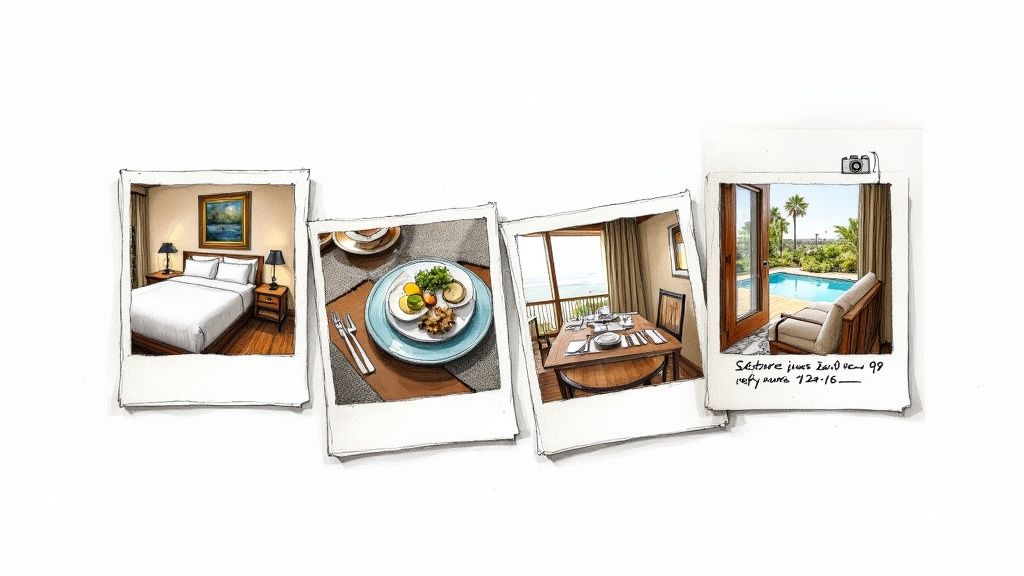
Guest-taken photos and clips: the real sunset off the balcony, the actually-clean bathroom, the kitchen as it looks on a Tuesday. User-generated images read as proof in a way your professional listing shots never can — bookers assume your photos are staged and theirs are not.
Why it's worth more than a 5-star rating
A guest photo confirming the "ocean view" is real does what no amount of copy can: it closes the gap between "what they're promising" and "what I'll actually get." That gap is where bookings die. Visual proof is also your defense against the cynicism every traveler now brings to listing photography.
The operator move
- Make it one tap to share. In your post-stay note, ask for the single favorite photo from the trip — not an album. Low friction, high yield.
- Build a "real guest photos" gallery on your direct site. Side-by-side with your pro shots, it signals you've got nothing to hide. Manage expectations and you cut the worst-converting message you get: the pre-booking "is it really like the photos?"
- Feed housekeeping the wins. A guest photo of a perfectly made bed is a stronger motivator for your cleaning team than any checklist.
4. The Value Review
This guest isn't cheap — they're calculating. The value review answers the one question every mid-market booker asks: was it worth it? It often comes with a comparison baked in, which means the reviewer is doing your competitive selling for you.
What it sounds like: "At $180 a night with free parking, a full kitchen, and a 5-minute walk to the harbor, this beat the $160 hotel down the road once you added their $35 parking and zero kitchen. We'd book direct again."
Why it's worth more than a 5-star rating
It's third-party validation of your rate. When a prospect on the fence sees a stranger conclude "worth it," it neutralizes price hesitation — and lets you hold your rate instead of discounting to win the booking. Critically, value reviewers are exactly the guests most likely to seek you out directly next time to skip the OTA's service fee.
The operator move
- Kill fee surprises. Hidden cleaning or "resort" fees are the fastest way to turn a value review into a value complaint. State everything upfront — it's also a direct-booking advantage, since your site can be cleaner on fees than the OTA's checkout.
- Prompt the comparison. Ask, "Did the stay feel like good value for the price?" You're guiding them to frame the review in the terms that convert future bookers.
- Quote the math. "Free parking saved us $35 a night" is a tangible selling point — put it on your direct site and in your offers.
5. The Business Traveler Review
Functional and unsentimental: Wi-Fi that held a video call, a real desk, a quiet room, fast walkable coffee. This persona books mid-week, books repeatedly, and is the least price-sensitive guest you have. For an STR operator chasing weekday occupancy, this is gold.
Why it's worth more than a 5-star rating
One reviewer confirming "the Wi-Fi handled back-to-back Zooms and the desk was a proper workspace" is a direct signal to every other remote worker scanning your listing. Mid-week business stays are how you flatten the weekend-only revenue curve that crushes so many STR P&Ls.
The operator move
- Ask the targeted question. "Did the workspace and Wi-Fi support your work without a hitch?" surfaces the exact quote you want.
- Build a "good for remote work" section on your direct site. Speed-test screenshot, desk photo, quiet-hours note, the business-traveler quotes. You're now visible to a segment most STR listings ignore.
- Fix the small gap. One reviewer notes "no outlet near the desk" — a $15 fix that earns the next five-star and the repeat booking.
6. The Family-Oriented Review
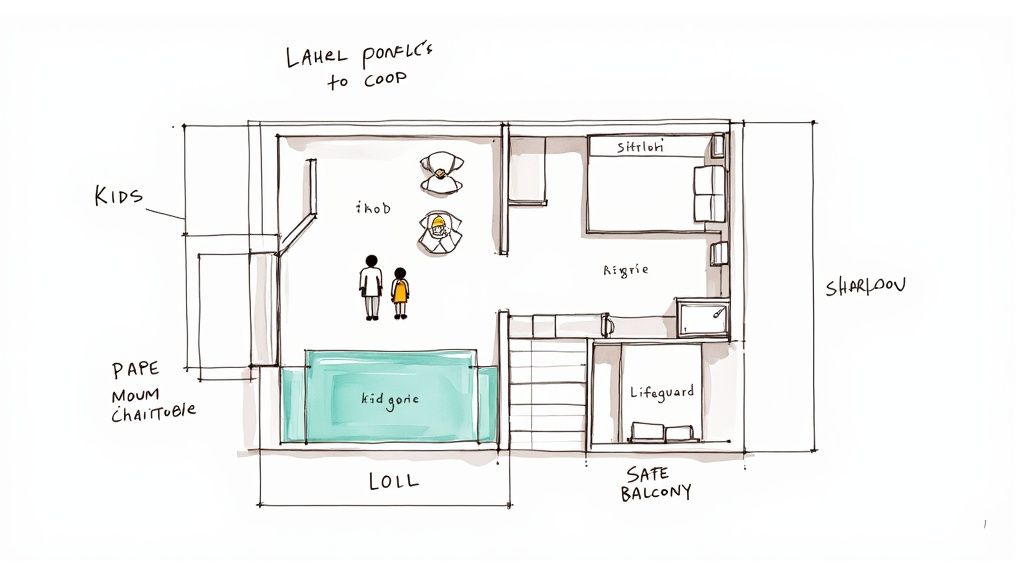
Written from a parent's perspective and packed with the practical details that make or break a trip with kids: the secure balcony, the high chair, the bunk beds, the kitchen stocked with plastic cups. Family travelers fill your calendar during school holidays — peak rate, peak demand.
Why it's worth more than a 5-star rating
Parents book on the strength of other parents' reassurance. A review naming the pool fence, the stair gate, or the "bunk beds were a hit with our 8-year-old" answers the safety questions a parent won't even type into your messages — and removes the anxiety that sends them to the listing next door.
The operator move
- Ask family-specific questions. "Did the kitchen work for family meals? How did the kids like the space?" gets you the quotes that close family bookings.
- Build a "kid-friendly features" page on your direct site and syndicate the best family quotes across your channels so the social proof travels with the listing.
- Act on the small asks. "Blackout curtains would've helped at nap time" is a cheap upgrade with an outsized payoff. (More groundwork here: tips on hosting for Airbnb.)
7. The Luxury & Premium Review
From the guest who notices the linens, the welcome bottle, the seamless check-in, the proactive "anything you need?" message. This review uses sensory, evocative language and exists to justify your premium rate by naming the details that earn it.
Why it's worth more than a 5-star rating
For a premium STR, the review is the brand. A guest describing the experience as elevated and effortless does more to defend your ADR than any amount of your own marketing copy — because aspirational bookers trust a peer's praise over a host's pitch.
The operator move
- Engineer the noticeable details. Premium linens, a handwritten welcome note, anticipatory communication — these are what generate the language that sells the next premium booking.
- Use sophisticated prompts. Replace "How was your stay?" with "Which of the details made the stay feel special?" to invite the descriptive review you want to feature.
- Pair the quote with the visual on your direct site's gallery. Authentic premium praise next to a stunning photo is the combination that converts discerning, direct-booking guests.
8. The Problem-Solution Review (Critical but Constructive)
A 3- or 4-star review that names a real issue but frames it fairly — often noting how fast you fixed it. Counterintuitively, this is one of the most valuable reviews you can receive.
What it sounds like: "The Wi-Fi dropped on day two, but I messaged the host and they had a mobile hotspot delivered within the hour. Handled better than most hotels would."
Why it's worth more than a 5-star rating
A profile of only 5-star reviews reads as suspicious; a constructive review paired with a visible, gracious fix reads as honest. It shows prospective guests the thing they most want to know before they hand you their vacation: if something goes wrong, will this operator handle it? That's often the deciding factor.
The operator move
- Respond with the fix, not just an apology. "Thanks for flagging the shower pressure — we've installed a new high-pressure head." That public reply markets your responsiveness to every future reader. (Our full playbook: how to respond to a negative review.)
- Track recurring issues across reviews. One drafty-window mention is anecdote; four is your next maintenance priority.
- Treat the resolution as content. "You asked, we fixed it" posts and replies turn your blind spots into proof of a manager who's paying attention.
The pattern: stop letting your best social proof feed the OTA
Look across these eight and one thing is constant. Every review is a precise, persona-matched conversion asset — and by default it's working hardest on the platform that owns the guest relationship and takes a cut of the stay. The growth move isn't writing more reviews. It's systematically pulling the reviews you've already earned onto the surfaces you control:
- Your listing copy: the exact phrases guests repeat ("serene patio," "spotless kitchen") belong in your descriptions, because they're the words your future guests are searching for.
- Your direct booking site: persona-matched review blocks — business, family, luxury, value — meet each visitor's specific objection at the moment of decision, at full margin.
- Your guest-retention emails: a pre-arrival note that quotes a past guest ("families love the fully-stocked kitchen") sets expectations and builds anticipation before check-in.
- Your operations: the constructive reviews are a standing, guest-approved to-do list for the upgrades that protect your rate.
Doing this by hand across a portfolio is the bottleneck — nobody has time to read every review across every channel, theme it, and re-surface it. This is exactly where AI earns its keep: hostAI reads your reviews across channels, surfaces the recurring themes, and feeds the strongest, persona-matched quotes straight onto your hostFront direct booking site and into your guest email flows — so the social proof you've already earned starts compounding your direct bookings instead of the OTA's.
FAQ
What makes a guest review effective for vacation rentals?
Specificity. A review that names a concrete touchpoint — the check-in, the Wi-Fi, the real distance to the beach — pre-answers a prospective guest's silent objection and converts far better than generic "great stay" praise.
Should I respond to negative guest reviews?
Yes, and lead with the fix, not the apology. A gracious public response that states what you changed turns a 3-star review into a trust signal, because it shows future bookers you handle problems well. A profile of only 5-star reviews actually reads as less credible than a balanced one.
How do guest reviews help with direct bookings specifically?
Reviews on OTAs convert traffic into bookings the OTA owns and taxes. The same reviews surfaced on your own direct booking site convert guests you keep — at full margin, with their contact details in your CRM for repeat stays. Moving your social proof onto channels you control is the highest-leverage thing you can do with it.
What's the best way to ask guests for a detailed review?
Ask a specific question instead of an open one. "What surprised you about the place?" or "Did the workspace and Wi-Fi support your work?" produces concrete, quotable answers; "How was your stay?" produces "great, thanks."
Reviews are the most persuasive marketing you'll ever own — and the most wasted, when they sit on a platform working for someone else's brand. hostAI helps STR operators mine guest feedback at scale and turn it into direct-booking momentum on the channels they control. See how it works.