
how to segment email lists
How to Segment Email Lists for STR Direct Bookings
Posted on Dec 9, 2025
TL;DR: To segment your email list, group subscribers by the first-party data only you own — booking history, guest lifecycle stage, and email engagement — then send each group the one offer most likely to drive a direct booking. The fastest wins come from three segments: new subscribers who haven't booked, active guests from the last 12 months, and lapsed guests you want back. Per Mailchimp's analysis of ~11,000 campaigns, segmented sends earn 14.31% higher opens and 100.95% more clicks than batch-and-blast. For an STR operator, that engagement is the mechanism for turning a one-time OTA guest into a repeat direct booker.
Why Your Guest List Is a Direct-Booking Moat — If You Segment It

Here's the thing most email advice misses for our industry: the guest data sitting in your inbox is the one asset the OTAs can't take from you. When Airbnb or Vrbo sends you a booking, they keep the relationship — the guest's real email, their preferences, their next trip. You get a masked address and a 15% commission bill. The only way you ever own that guest is by capturing them into your own list and earning the next stay directly.
That's why segmentation matters more for an STR manager than for almost any other business. Your list isn't a marketing channel — it's your direct-distribution flywheel. Top hotel brands pull 75–80% of bookings direct; most vacation-rental managers sit in the single digits to low 20s. The gap isn't talent. It's that hotels relentlessly market to first-party guest data, and most STR operators blast their whole list once a quarter and hope.
A generic blast treats the first-time family, the five-stay loyalist, and the cold lead who's never booked as one person. They aren't. Segmentation is simply respecting that — and it's the difference between an email that reads like a personal tip from a host and one that reads like junk mail.
A segmented campaign feels like a recommendation from a host who knows you. A generic blast feels like a flyer under the windshield wiper.
The Numbers Behind It
This isn't a gut feeling. In Mailchimp's study of roughly 2,000 accounts and 11,000 segmented campaigns, segmented sends beat non-segmented ones on every metric that matters: 14.31% higher opens, 100.95% more clicks, 9.37% fewer unsubscribes, and 4.65% fewer bounces (Mailchimp). For an operator, more clicks is the leading indicator of more booking-page visits — and fewer unsubscribes means you keep the guest relationship alive for the next trip, not just this one.
So segmentation isn't an advanced nice-to-have. It's the core mechanic for an operator who wants to:
- Drive more direct bookings by putting the right offer in front of the right guest at the right moment.
- Compound guest lifetime value by turning first-stay guests into repeat direct bookers instead of one-and-done OTA traffic.
- Stop wasting send reputation on irrelevant blasts that train guests to ignore you.
Choosing Segmentation Criteria That Actually Move Revenue
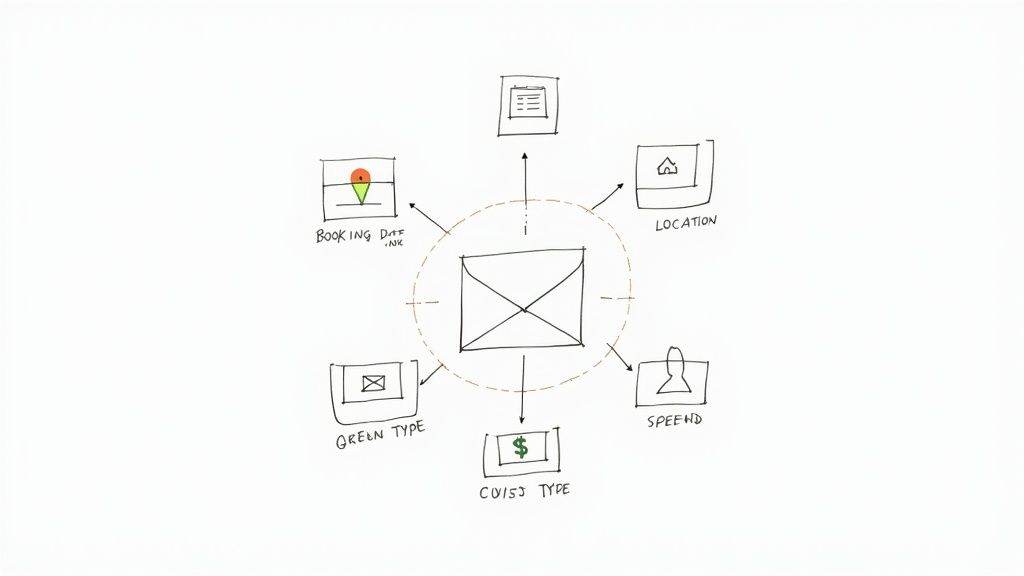
The point isn't to slice your list into clever little groups. It's to pick criteria that predict what a guest does next — and the best predictors live in data only you hold, because the booking happened on your engine. Start here.
1. Booking History — Your Highest-Signal Data
Past behavior beats every demographic guess. Three fields do most of the work:
Last booking date. Separates active guests from those drifting away. "Recent Guests" (booked in the last 6 months) versus "At-Risk" (no stay in over a year) is the simplest, most useful cut you can make.
Booking frequency. A "Repeat Guest" (2–4 stays) deserves a different message than a "VIP Loyalist" (5+ stays) who's earned an early check-in or a welcome bottle.
Average daily rate / total spend. Flags the guests who book your premium properties. These are who you give first look at a new listing.
The leverage comes from combining them. "High-value but at-risk" — guests who used to book big but have gone quiet for 18 months — is one of the most profitable win-back segments you'll ever build.
2. Guest Lifecycle Stage
Every guest sits somewhere in their relationship with your brand. Match the message to the moment:
- New subscribers — signed up, never booked. They need a warm welcome series and a reason to make a first booking.
- First-time guests — just had their first stay. This is the highest-stakes moment: a well-timed follow-up is what converts a one-off into a repeat direct booker.
- Repeat guests — have shown loyalty. Nurture with exclusive offers, local guides, and early booking access.
3. Email Engagement
A guest doesn't need a booking to signal interest. An open or click is a digital hand-raise.
- Highly engaged — open or click nearly everything. Your advocates; perfect for referrals and new-listing announcements.
- Partially engaged — open sometimes, rarely click. Try different content (a local guide instead of a promo).
- Inactive — silent for months. Send one last re-engagement before you suppress them to protect deliverability.
Which Criteria to Start With
| Criterion | Primary use | Data required | Impact |
|---|---|---|---|
| Booking history | Find high-value, loyal, or at-risk guests | Booking dates, frequency, spend | High — targets proven buyers |
| Lifecycle stage | Move guests from subscriber to advocate | Sign-up date, first-booking date, stay count | High — drives retention |
| Email engagement | Gauge interest of non-bookers | Open/click/last-activity | Medium — list hygiene, lead warming |
| Guest type | Tailor offers to traveler personas | Form data (family, business, couple) | Medium — relevance lift |
| Location | Drive-to markets, local events | Geolocation at sign-up/booking | Low–Medium — regional promos |
Booking history and lifecycle stage deliver the biggest wins because they sit closest to revenue. Start there; layer the rest later.
How to Build and Automate Your Segments
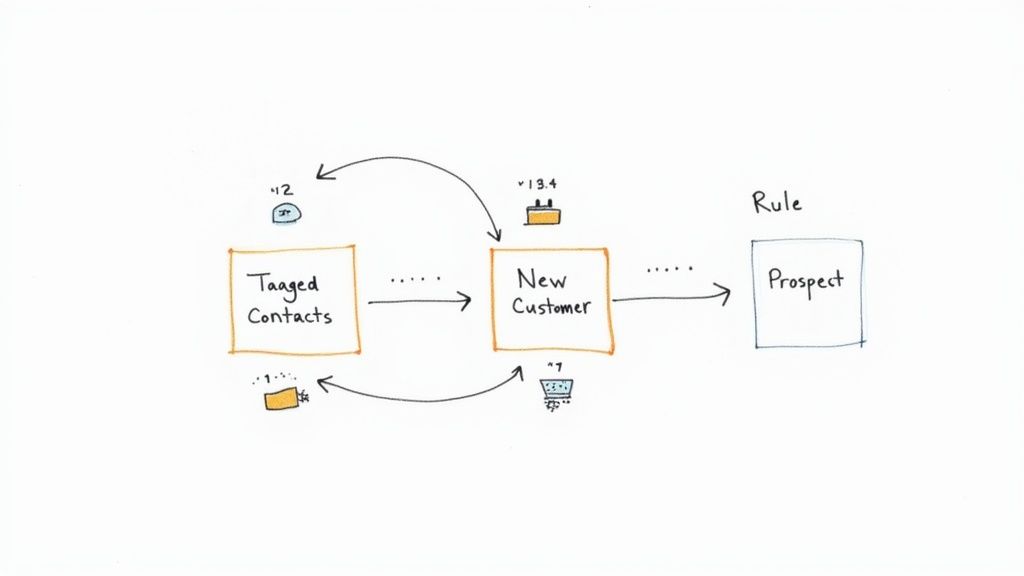
The goal is a self-updating system, not a web of rules you babysit. That means dynamic segments — groups that add and remove guests automatically based on rules you set. When a guest makes their first booking, they should drop out of "New Subscribers" and into "First-Time Guests" without you lifting a finger.
Your First Dynamic Segment
Build the one every operator needs — "Potential First-Time Guests," everyone signed up who hasn't booked:
- Subscriber IS on your main list
- AND Booking count IS EXACTLY 0
Dead simple, and now you have a dedicated audience for your best intro offers and most-popular properties.
Tags for Granularity
If rules are broad strokes, tags are the fine point. Apply them on specific actions:
- Property type booked — "Beachfront Condo" vs. "Mountain Cabin."
- Interest shown — clicked a pet-friendly link? Tag "Pet Owner."
- Amenity used — booked a hot tub or pool? Tag it for later promos.
Pro tip: Set a naming convention on day one, like
[Category] - Detail(Interest - Pets,Stay - Beachfront,Lifecycle - VIP). A messy tag system becomes useless fast.
Connect Segments to Workflows
True automation is a triggered email series. A "Post-First Stay" workflow:
- Trigger: guest enters "First-Time Guests" when their stay ends.
- Email 1 (2 days out): "How was it?" — ask for a review.
- Email 2 (14 days out): a small "welcome back" discount on the next booking. (We've got more newsletter email ideas to slot in here.)
- Action: the moment they rebook, the system moves them to "Repeat Guests" and kicks off the loyalty workflow.
That's a self-managing engine that nurtures guests from one stage to the next and quietly compounds direct bookings while you run the rest of the business.
A Worked Example: What One Re-Engagement Segment Is Worth
Templates are abstract until you put numbers on them, so let's model a realistic operator. Say you manage 25 properties at a $280 ADR and you've built a 2,000-contact list over a few seasons. The math below is illustrative — plug in your own figures — but the structure is exactly how you should size any segment before you build it.
You build one segment: At-Risk Past Guests — more than one prior stay, no booking in over 12 months. Suppose that's 320 of your 2,000 contacts. You send a three-email "we miss you" sequence with a genuine welcome-back rate.
- 320 lapsed past guests in the segment
- A 4% re-booking rate on a well-targeted win-back is a reasonable working assumption → ~13 recovered stays
- At an average 4-night stay × $280 ADR = $1,120 per booking → ~$14,500 in recovered direct revenue from one segment, one sequence
That revenue is direct — no 15% OTA commission skimmed off the top, and every recovered guest re-enters your repeat-booker flywheel. Run the same exercise on your "Recent Browser, No Booking" segment and your "First-Time Guest Nurture" segment, and you can see why operators who segment quietly out-earn the ones who blast. The discipline isn't the email copy — it's knowing, before you hit send, which 320 people are worth $14,500.
Real-World Segment Templates You Can Steal
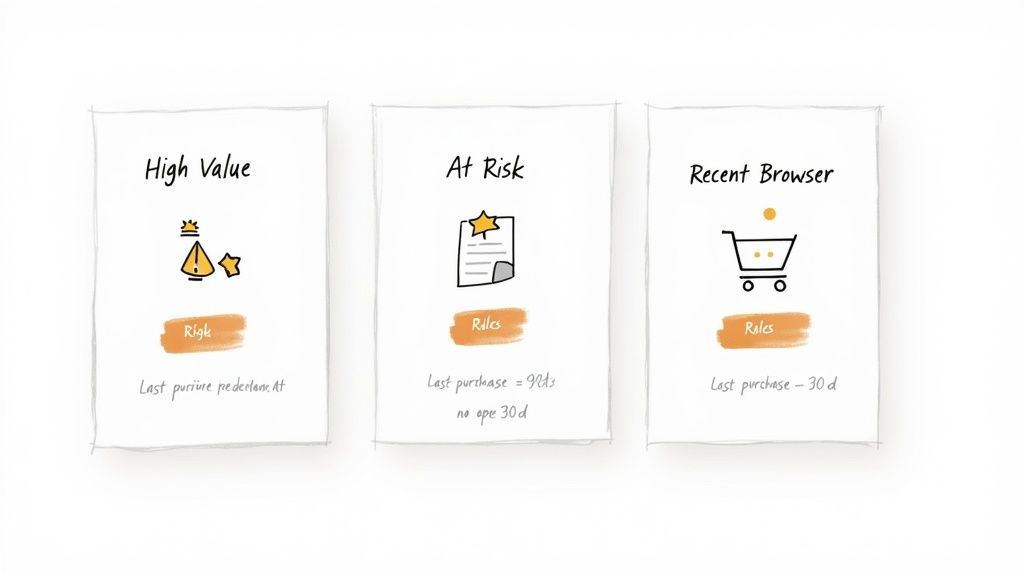
High-Value Guest
Your VIPs — premium bookings, longer stays, highest lifetime value. Goal: retention and appreciation.
- Rules: total bookings > 3 AND average booking value > $1,500, OR lifetime value in the top 10%.
- Campaign: early-bird first look at a new luxury property — "An exclusive first look for our VIPs."
At-Risk Guest
Former regulars who've gone quiet. Goal: re-engagement (this is the segment we sized above).
- Rules: last booking > 12 months ago AND total bookings > 1.
- Campaign: "It's been a while, [Name]" — reference their last stay and offer a real welcome-back rate.
Recent Browser, No Booking
The STR "abandoned cart." Hot leads who circled a property and didn't pull the trigger. Goal: conversion.
- Rules: viewed a property page ≥ 2× in the last 7 days AND bookings = 0.
- Campaign: a triggered email ~24 hours after their last visit, featuring the exact property, a key amenity, and light urgency. Subject line carries it — see email subject lines that get opened.
First-Time Guest Nurture
The single highest-leverage segment you can build. Goal: turn a first-time booker into a repeat direct guest.
- Rules: bookings = 1 AND checkout within the last 30 days.
- Campaign: a two-part series — a thank-you/review ask at day 2, a next-stay discount at day 14.
Quick-Reference Templates
| Segment | Defining criteria | Example campaign |
|---|---|---|
| Local Getaway Seekers | Home address within 50 miles of a property | "Spontaneous weekend escape? Your local hideaway awaits." |
| Holiday Planners | Past stays during major holidays | "Book your holiday getaway before the rush" (sent early October) |
| Pet Lovers | Booked pet-friendly OR used a "pet" filter | "New pet-friendly cabin just added" |
| Family Travelers | Guest count > 4 | "Spacious homes for your next family adventure" |
| Budget-Conscious | Average booking value in bottom 25% | "Affordable stays that don't compromise on comfort" |
Start with one or two, measure, then build out. The real lift comes when you combine criteria and write to the specific guest behind the segment.
Measuring and Refining Your Strategy
Going live is the milestone; refining is the work. Don't get distracted by vanity metrics — a high open rate doesn't pay the bills. Watch the numbers tied to revenue, per segment:
Segment conversion rate. What share of your "At-Risk" segment actually re-booked after the campaign? This tells you which messages land.
Revenue per email (RPE). Campaign revenue ÷ emails sent. A high RPE on a small, well-targeted segment beats a big blast every time.
Lifetime value by segment. Are your "High-Value Guests" really worth more over time? This proves whether the VIP treatment pays off.
If you're unsure how to tie email to actual booking revenue, brush up on marketing attribution models first.
A/B Test the Strategy, Not Just Subject Lines
Offer vs. offer: for budget-conscious guests, test "20% off your next stay" against "stay 3 nights, get the 4th free." Which drives more bookings?
Timing: send your weekend-getaway segment a promo Tuesday morning vs. Thursday evening.
Content vs. promo: test a "5 can't-miss local restaurants" email against a flat discount for first-time guests.
Change one variable at a time. Move the offer, the timing, or the creative — never all three — or you'll never know what worked.
Two Pitfalls to Avoid
Over-segmenting. Segments under ~50 people won't give you statistically meaningful data and cost more time than they return. Keep a manageable set of high-impact segments.
Stale, static segments. A guest who was a "First-Timer" last year may be a "Repeat Guest" now. If segments don't update on real-time data, you'll send the wrong message to the right person. Audit your rules quarterly.
Common Questions About Email List Segmentation
How many segments should I start with?
Start small — progress over perfection. Zero in on two or three high-impact segments covering the core of the guest journey: New Subscribers (signed up, never booked), Active Guests (stayed in the last 12 months), and Inactive Guests (no booking in over a year). Master these, see results, then layer in guest type and spend.
What's the biggest mistake to avoid?
Static segments that never update. Guest behavior is always in motion. Make sure your platform builds dynamic segments on real-time data — when a "New Subscriber" books, they should move to "First-Time Guest" instantly — and review your rules each quarter.
Can I segment without much guest data?
Yes. Even a new list has usable signal: sign-up source (a homepage pop-up vs. an Instagram link hints at intent), subscription date (perfect for a time-based welcome series), and email engagement (separate your openers and clickers from the quiet ones). Start with what you have and build as bookings accumulate.
Where does segmented data give me an edge over the OTAs?
The OTAs own the guest relationship on a booking they send you — you can't segment or remarket to a masked Airbnb address. Every contact you capture into your own list and enrich with booking history is data they don't have and can't monetize. That first-party data is the foundation of a direct-booking program no channel can disintermediate.
Segmentation is how you turn a list of email addresses into a repeat-direct-booking engine — but it only works if your segments update themselves off live booking data. hostMail by hostAI is built for STR operators to create dynamic, behavior-driven segments and triggered workflows that quietly convert first-time guests into loyal direct bookers. See how it fits your stack.