
property management software comparison
A Property Management Software Comparison for STR Managers
Posted on Jan 5, 2026
Choosing the right property management software is one of those make-or-break decisions for any serious short-term rental (STR) manager. It's what separates the operators who scale gracefully from those forever tangled in manual tasks. The right platform doesn’t just organize you; it automates your day-to-day, drives more direct bookings, and gives you a crystal-clear picture of your finances. A solid, head-to-head software comparison is the only way to start reclaiming your time and actually growing your bottom line.
Why Your STR Business Needs a Software Upgrade
Let's be honest: trying to run a successful STR business without proper software is a recipe for burnout. Juggling calendars, answering the same questions across five different platforms, and coordinating cleaners quickly becomes an operational mess that puts a hard ceiling on your growth. The right platform becomes the command center for your entire operation.
This shift from spreadsheets to integrated systems is why the market is exploding. The global property management software market is on track to hit USD 9.5 billion by 2030—a massive signal of how critical this tech has become. For STR managers, this isn't a "nice-to-have" anymore. It's a competitive necessity. You can dig into more of the data on this trend over at Mordor Intelligence.
The Core Challenges Modern Software Solves
Migrating to a real platform is about solving the exact problems that keep STR businesses from getting to the next level. It’s the difference between being a reactive manager putting out fires and a proactive owner building a business. Here’s where you’ll feel the impact immediately:
- Eliminating Double Bookings: A bulletproof channel manager is non-negotiable. It instantly syncs your availability across Airbnb, Vrbo, and your own direct booking site.
- Automating Guest Communication: Think of all the hours you'll get back. Templated, automated messages for check-in, check-out, and mid-stay questions ensure every guest gets five-star service without you lifting a finger.
- Increasing Direct Revenue: An integrated website builder for direct bookings lets you capture commission-free revenue and finally own your guest relationships.
By automating up to 90% of routine guest interactions, the right software frees you up to focus on the things that actually grow the business—marketing, owner relations, and strategic planning.
A Structured Approach to Comparison
To make a smart decision, you need a structured way to compare these platforms. It's easy to get mesmerized by endless feature lists, but what you really need is a framework that ties back to your specific business goals. This guide is designed to do just that, helping you cut through the marketing fluff to find a true partner for your operations.
We’re going to break down the leading options across the criteria that matter most, helping you find the perfect fit for your portfolio and where you want to take it.
| Evaluation Criteria | Software A | Software B | hostAI |
|---|---|---|---|
| Direct Booking Tools | Basic Website | Template Site | AI-Powered Website Builder |
| Automation Focus | Guest Messaging | Operational Tasks | Marketing & Revenue |
| Primary Use Case | Small Portfolios | Operations Teams | Driving Direct Bookings |
| Key Differentiator | Simplicity | Task Management | AI-Driven Growth |
Defining Your Must-Have Software Features
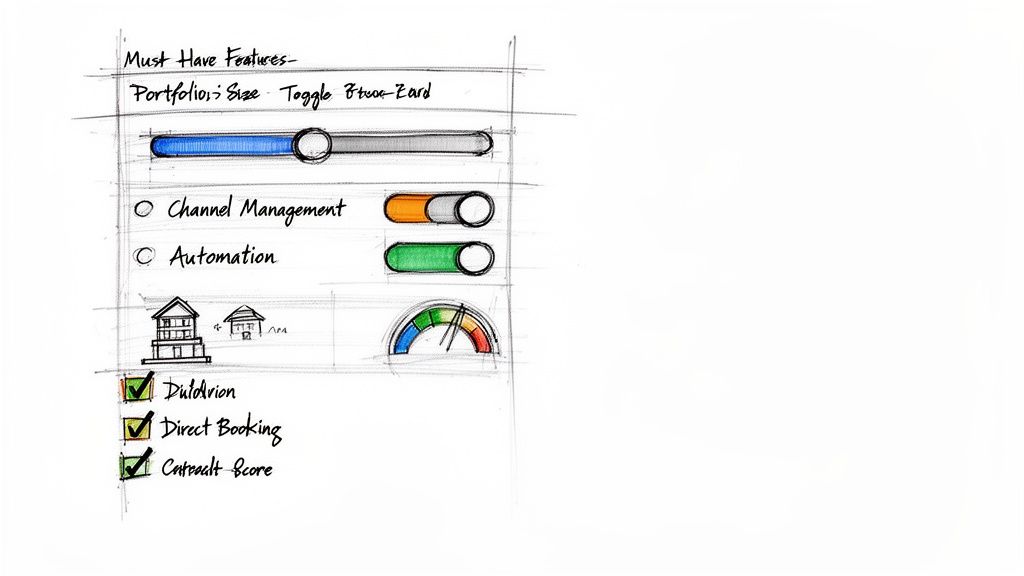
Jumping into a property management software comparison without a clear checklist is a lot like grocery shopping when you're starving—everything looks good, but you'll probably end up with a cart full of stuff you don't actually need. Before you even agree to a demo, you absolutely have to define your non-negotiables. Getting this step right from the start is what stops you from getting distracted by flashy tools that don't solve your real, day-to-day problems.
The perfect software for you is completely tied to your business model and portfolio size. An owner-operator managing two luxury cabins has a wildly different set of needs than a co-hosting company juggling 50 urban apartments. The best place to begin is by taking a hard look at your current operational bottlenecks.
Where are you losing the most time? Is it the endless grind of manually updating calendars across different sites? Maybe it's answering the same guest questions over and over, or the headache of pulling together owner statements each month. Your biggest pain points should be your top priorities.
Core Operational Must-Haves
Every single STR manager needs a solid baseline of features just to keep the business running smoothly. Think of these as the table stakes—the foundational tools that any respectable platform must have. If a software can't handle these basics, it's an immediate dealbreaker.
Kick off your evaluation by looking for these essentials:
- A Reliable Channel Manager: This one is completely non-negotiable. It has to provide real-time, two-way synchronization with the OTAs you depend on, like Airbnb, Vrbo, and Booking.com, to crush the risk of double bookings.
- Unified Inbox: Pulling all your guest messages from every single platform into one dashboard is a massive time-saver. It’s the only way to make sure nothing slips through the cracks.
- Direct Booking Engine: If you want to build a brand and boost your bottom line, you need a way to capture commission-free bookings. Look for an integrated website builder that’s straightforward to use and designed to convert visitors into guests.
Defining your must-haves completely transforms your search. Instead of asking, "What can this software do?" you start asking, "Can this software do what I need?" This simple shift in perspective is the key to finding a platform that delivers genuine ROI.
Distinguishing Needs from Wants
Once you've nailed down your core needs, it's time to separate the “must-haves” from the “nice-to-haves.” This is where your business goals really come into focus. Are you trying to scale your portfolio, or are you focused on squeezing every last drop of revenue from your current properties?
Take, for instance, a manager whose main goal is to double their direct bookings. For them, a simple website builder just won't cut it. They need more advanced tools like an AI-powered marketing engine, automated email campaigns, and programmatic SEO features. For a closer look at what these kinds of tools can do for you, check out this guide on essential property management software features.
On the other hand, a manager obsessed with operational efficiency would put a higher premium on automated cleaning schedules and maintenance task management. To build your own personalized scorecard, you can use a simple framework like this:
| Priority Level | Feature Category | My Specific Requirement |
|---|---|---|
| Must-Have | Channel Management | Flawless sync with Airbnb & Vrbo |
| Must-Have | Guest Communication | Automated check-in/out messages |
| Important | Direct Bookings | Integrated website with payment processing |
| Nice-to-Have | Automation | Dynamic pricing integration |
| Nice-to-Have | Reporting | Advanced owner statement customization |
Going through this simple exercise gives you a clear, objective filter. It arms you with what you need to cut through the marketing fluff in any property management software comparison and zero in on the platforms that truly align with your business.
Comparing the Top STR Property Management Software
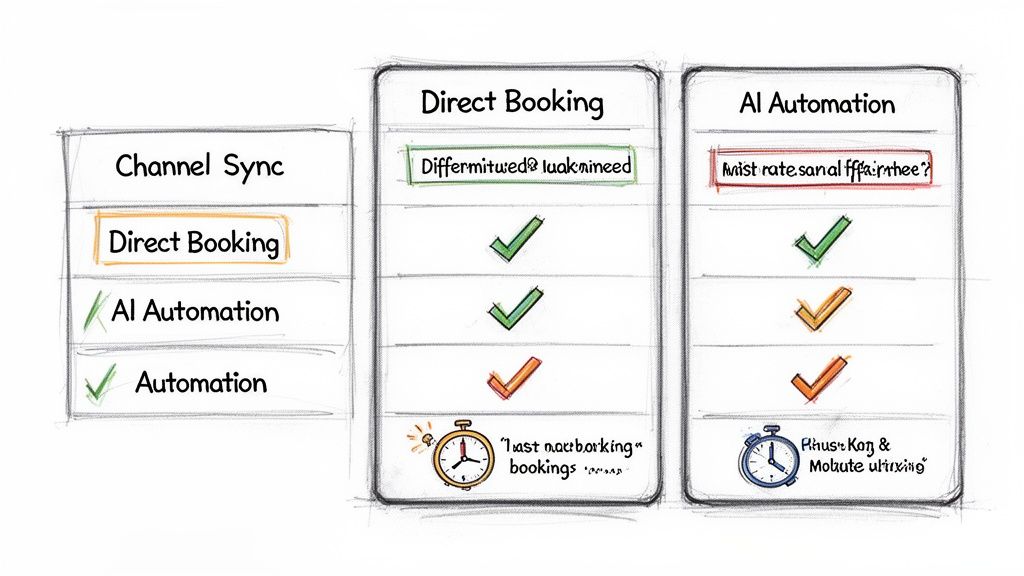
Alright, you've nailed down what you absolutely need from a software partner. Now for the fun part: pitting the top contenders against each other. We’re going to cut through the marketing fluff and get into the nitty-gritty differences that actually impact your day-to-day operations and, more importantly, your bottom line. This isn't about checking boxes on a feature list; it's about understanding how each platform performs when the pressure is on.
To do this right, we're breaking it down into four pillars that every successful STR business is built on: channel management, direct booking tools, automation & AI, and reporting. By looking at the leading software through these lenses, you'll see where each one truly shines and which is the right fit for where your business is headed.
Channel Management: A Head-to-Head Analysis
At the absolute minimum, your PMS has to nail channel synchronization. A single double booking can wipe out a week's profit and sink your reputation. Just about every modern platform has a channel manager, but the difference between them can be night and day when it comes to reliability, integration depth, and raw speed.
Take a platform like Hostaway. It's built a reputation for having one of the most bulletproof channel managers in the game. It uses deep, real-time API connections with all the major OTAs. What that means in practice is when someone books your place on Vrbo, the calendar is blocked on Airbnb, Booking.com, and your own website instantly. That near-zero latency is what kills the risk of overbooking.
Now, look at a system like Lodgify. It has a perfectly solid channel manager, but its real strength is elsewhere. For managers who are mostly on the big three OTAs, it works great. But if you're juggling a dozen niche channels, you might notice it's not quite as instantaneous as a specialist like Hostaway. The real differentiator isn't if they connect, but how deep and how fast that connection is, especially with complex rate rules.
Let’s play out a real-world scenario: You get a last-minute cancellation.
- Software A (High-Performance Sync): The second you process the cancellation, that availability is live again across every single channel, giving you the maximum window to get it rebooked.
- Software B (Standard Sync): There might be a lag of a few minutes. In the fast-paced world of last-minute bookings, those few minutes can be the difference between filling the gap and losing out on the revenue.
The gold standard for channel management isn’t just about dodging double bookings. It's about having a system so fast and reliable you can confidently run aggressive pricing strategies across every platform without worrying about the whole thing blowing up.
Powering Direct Bookings: The Path to Profitability
Getting out from under the thumb of the OTAs is the single biggest lever you can pull for growth. A powerful direct booking engine isn't just a nice perk anymore—it's the core of a profitable STR business. This is where the comparison pivots from technical sync to tools that help you with marketing and the guest experience.
This is where Lodgify really comes into its own. Its integrated website builder is specifically designed to help you create beautiful, professional direct booking sites that convert. The templates are easy to use, payment processing is built-in, and it's a fantastic all-in-one solution if building your own brand is a top priority.
On the flip side, you have platforms like OwnerRez. It offers incredibly powerful direct booking tools, but the focus is much more on function and control than on slick design. You get a ton of flexibility for things like custom quotes and booking rules, but getting that polished, modern look might mean getting your hands dirty with code or bringing in a third-party design tool.
For managers who want to push the envelope on direct bookings, platforms like hostAI are changing the game by bringing artificial intelligence into the mix. Its AI-powered website builder doesn't just give you a template; it programmatically optimizes your site for search engines and personalizes the user experience to drive more bookings. It’s a huge leap from the simple drag-and-drop sites.
Automation and AI: Driving Efficiency
Automation is how you get your time back. It's how you scale your portfolio without having to scale your payroll. This is a massive point of differentiation in any property management software comparison, because the intelligence of the automation features varies wildly.
Most platforms can handle the basics, like scheduling a pre-written welcome message. But the leaders are using AI to create much smarter, more dynamic communication.
For example, Guesty offers advanced tools like ReplyAI that can actually understand common guest questions and answer them on its own. That lets your team focus on the complex issues that need a human touch. Hostaway also has a really strong set of automation tools for building workflows, like automatically assigning cleaners and notifying maintenance based on booking events.
The real test is how well the automation connects different parts of your operation.
- Basic Automation: "Send a message 24 hours before check-in."
- Advanced Automation: "When a checkout is complete, automatically create a task for the cleaning team, notify the inspector once they mark the clean as done, and then send a message to the next guest letting them know their early check-in is approved."
The rise of cloud computing is what makes this level of integration possible. Today, cloud-based property management software is the standard, making up over 61% of the market. This allows for the seamless flow of data needed for advanced automation, helping managers slash manual work and grow their business effectively.
Reporting and Analytics: Making Data-Driven Decisions
If you can't measure it, you can't improve it. Great reporting is what separates the pros from the amateurs. The best software gives you clear, actionable data on everything from your portfolio's overall occupancy down to the nitty-gritty profitability of a single property.
OwnerRez is legendary for its powerful and detailed financial reporting. It's a beast when it comes to trust accounting, generating owner statements, and giving you granular control over every dollar. If you manage properties for multiple owners and need ironclad bookkeeping, it's tough to beat.
While your PMS is the hub, you might need dedicated financial tools. For a closer look at those, check out this review of the top accounting software for rental property.
Other platforms might offer more visual, at-a-glance dashboards that are easier to digest but don't offer the same level of customization. Guesty, for instance, has strong analytics dashboards that are perfect for tracking key metrics like RevPAN (Revenue Per Available Night) and booking lead times.
Ultimately, the right choice comes down to what you need. Do you need the forensic accounting detail of a system like OwnerRez, or do you prefer high-level dashboards for a quick business health check? For a more detailed look at the leading options, see our complete guide on the best short term rental software.
This kind of detailed property management software comparison makes one thing clear: there’s no single "best" platform. There's only the best fit for your specific business. By weighing your options against these core pillars, you can get past the sales hype and find a true partner for your growth.
Calculating the Real Cost and ROI of Your Software
The sticker price on property management software is just the tip of the iceberg. To really get a handle on the investment, you need to look beyond the monthly subscription and calculate the Total Cost of Ownership (TCO). This number paints a much more honest picture of what you’ll actually be spending.
So many platforms have extra costs that aren't splashed across their pricing page. If you ignore these, you're setting yourself up for surprise bills that can wreck your budget and leave you frustrated with a brand-new system. Any serious property management software comparison means digging into these potential hidden costs before you sign on the dotted line.
Uncovering the Hidden Costs
Beyond that base subscription fee, your TCO is made up of a bunch of other variables that can add up faster than you’d think. It's absolutely crucial to ask direct questions about these during any sales demo to see the full financial picture.
Here are the common costs you need to sniff out:
- Implementation and Onboarding Fees: Most providers will charge a one-time fee to get you set up, move your data over, and train your team.
- Booking Commissions: Some platforms, especially those advertising "free" or cheap direct booking sites, will quietly take a percentage of every booking that comes through.
- Third-Party Integration Charges: Your new PMS might connect to your favorite dynamic pricing tool, but that doesn't mean the connection is free. You might have to pay extra for that specific integration.
- Mandatory Training: Getting access to advanced training modules or a dedicated support rep sometimes comes with an extra price tag, often bundled into their premium plans.
The most expensive software isn't always the one with the highest monthly fee. A platform with a lower subscription but high booking commissions can easily end up costing you more as your direct booking revenue grows.
Forecasting Your Return on Investment
Once you know the total cost, the next step is figuring out your Return on Investment (ROI). This isn't just about saving money—it's about how the software is going to actively help you make more of it. For us STR managers, the ROI calculation really comes down to a few key metrics that directly boost the bottom line.
The biggest drivers of ROI for any STR business are:
- Increased Direct Bookings: This is the single biggest lever you can pull. By shifting bookings away from the OTAs and onto your own website, you save a massive 15-20% on commissions for every reservation. For a deeper look, check out our guide on the best direct booking tools out there.
- Time Saved Through Automation: Think about it. Calculate the hours your team wastes on manual tasks like sending guest messages, scheduling cleaners, and updating calendars. Put a dollar value on that time, and you'll quickly see the value of solid automation.
- Higher Occupancy Rates: Better tools lead to better results, simple as that. Things like dynamic pricing integrations and faster channel syncs mean you can snag more last-minute bookings and fill those annoying calendar gaps, which pushes your occupancy—and revenue—up.
A Practical ROI Case Study
Let's break this down with a quick, hypothetical scenario for a manager with a 10-property portfolio.
Scenario Details:
- Average Booking Value: $1,000
- Annual Bookings: 250 (25 per property)
- Current Direct Booking Rate: 10% (just 25 bookings)
Software Investment:
- Platform A (Cheaper): $1,000/year subscription.
- Platform B (Premium): $4,000/year subscription with advanced direct booking tools.
Projected ROI:
Platform B has a slick, AI-powered website and marketing automation that helps you crank up your direct booking rate from a measly 10% to 30%. This moves 50 bookings (that's 20% of your 250 total) from the OTAs over to your direct channel.
- Commission Savings: 50 bookings x $1,000 x 15% OTA fee = $7,500 saved.
- Net Gain: $7,500 (savings) - $3,000 (the extra cost of Platform B) = $4,500 positive ROI.
In this scenario, the more expensive software actually delivers a way better financial outcome. To get even more control over your numbers, you can explore specialized tools like property management accounting software. This kind of detailed analysis proves that just focusing on the subscription cost is a rookie mistake in any property management software comparison.
Planning a Smooth Software Implementation
You’ve done the hard work, gone through a detailed property management software comparison, and picked a winner. Huge milestone. But let’s be real: the job is only half done.
A poorly planned software rollout can undo all that effort, leading to operational chaos, a frustrated team, and a guest experience that takes a serious hit. Nailing the implementation is just as critical as the software you choose.
Getting from your old system (or a mess of spreadsheets) to a new, powerful platform doesn't just happen. It takes a solid, actionable plan covering everything from data migration and team training to a smart, phased go-live strategy. Get this right, and your investment starts paying off from day one.
Pre-Migration Preparation: Your Checklist
Before you can even think about flipping the switch, you need to lay the groundwork. This is where most implementations go off the rails. Rushing this step is a classic mistake that guarantees inaccurate data and headaches that will follow you for months.
Here’s where to put your energy first:
- Data Cleanup and Auditing: Your new system is only as good as the data you feed it. Seriously. Take the time to audit your guest records, property details, and financials. Hunt down duplicates, fix typos, and standardize everything for a clean import.
- Field Mapping Exercise: Every piece of software organizes information its own way. Create a simple spreadsheet that maps the fields from your old system to the new one. For example, "Guest Contact Number" in your spreadsheet might become "Primary Phone" in the new software. This little exercise will save you a world of pain later.
- Integration Testing: Do not wait until you’re live to see if your critical tools play nice together. Get into a sandbox or test environment and connect your channel manager, pricing tool, and smart locks. Work out the kinks now, not when you have guests arriving.
A phased rollout is your best defense against major disruptions. Don’t try to launch everything at once. Start with a small batch of properties—maybe just two or three—and test the entire workflow, from booking to checkout. This lets you find and fix problems on a small scale before they can impact your whole portfolio.
Executing a Phased Rollout
Once your data is clean and your integrations are tested, it’s time to start the migration. A phased approach minimizes risk and gives your team the space to adapt without feeling completely overwhelmed.
The drive for better tech in this space is massive, especially in North America, which accounts for over 45% of the global property management software market. That dominance, largely fueled by a 74.4% market share in the U.S., shows just how vital a seamless implementation is for STR managers trying to stay competitive. You can dive deeper into the property management software market trends on imarcgroup.com.
A successful phased launch usually looks something like this:
- Pilot Group Go-Live: Pick a few properties and run them exclusively on the new system for a full booking cycle.
- Gather Team Feedback: Talk to your team. What worked? What was clunky? Use their real-world feedback to tweak your workflows and build out your training docs.
- Iterate and Expand: Once the pilot is running smoothly, start moving the rest of your properties over in manageable chunks.
- Full System Cutover: After every property is on the new platform, set a hard date to officially shut down the old system. This avoids confusion and forces everyone to fully adopt the new tool.
Following this methodical process ensures that by the time you're fully live, your team is confident, your data is solid, and your operations are running better than ever before.
You’ve run the numbers, compared the features, and mapped out what implementation could look like. Now for the hard part: making the final call. This is where you move from spreadsheets and analysis to the real world, ensuring the platform you pick isn't just a tool, but a genuine partner for your business.
This last phase is all about pressure-testing the software. Don't just sit back and watch a polished sales demo. Get your hands dirty. Come to the free trial or demo call armed with a list of the messy, day-to-day scenarios your team actually deals with.
Ask the sales rep to show you, step-by-step, how their system handles these real-world problems. How do you block off owner stays across multiple channels at once? What does the workflow look like for a mid-stay extension? This is how you find out if a platform is truly intuitive or just has a pretty dashboard.
Questions That Go Beyond the Dashboard
A slick interface is worthless if the company behind it is a mess. Your final calls should shift from what the software does today to where the company is headed tomorrow. You're not just buying a subscription; you're vetting a long-term partner.
Drill down on the things that reveal their culture and commitment to your success:
- Customer Support: What are your guaranteed response times for business-critical issues? When I call, am I getting a dedicated account manager who knows my business, or am I just another ticket in a general support queue?
- Product Roadmap: What are you building in the next 6 to 12 months that will specifically help vacation rental managers like me? Show me you understand my world.
- Data Security: How, exactly, are you protecting my owner and guest data? Walk me through your protocol if a security breach happens.
The best software providers are refreshingly transparent. They're proud of their support SLAs, excited to talk about their product roadmap, and can clearly explain their security measures. If you get hesitation on any of these points, that's a huge red flag.
Verifying with Real-World Feedback
Finally, it's time to step outside the sales bubble and get some unbiased opinions. Sales demos are designed to be perfect, but real customer reviews on sites like G2 and Capterra will tell you what it’s really like to use the software day in and day out. Look for patterns in the feedback, especially around your must-have features and the quality of their support team.
And don't forget your most valuable resource: your network. Reach out to other STR managers you trust. Ask them what they're using and what their experience has been. A frank recommendation from a peer running a similar business is often the single most important piece of insight you can get.
By combining hands-on testing, sharp questioning, and peer validation, you’ll have all the confidence you need to choose the one platform that will actually help you scale.
Still Have Questions?
Deciding on a new property management system is a big deal, and if you're like most STR managers I've talked to, you probably have a few lingering questions. Let's tackle some of the most common ones head-on so you can move forward with confidence.
How Painful Is It to Actually Switch Software Providers?
I get it—the thought of migrating platforms can feel overwhelming. But it's not the nightmare it used to be. Most modern, cloud-based providers have gotten really good at this and have a structured onboarding process designed to get you switched over with minimal drama.
Look for a partner that gives you a dedicated migration specialist and a clear timeline. Their job is to handle the heavy lifting of data migration, get your team trained up, and make sure your guest communications don't miss a beat. The goal is zero downtime for your day-to-day operations.
What's the Biggest Mistake Managers Make When Picking a New System?
Hands down, the most common pitfall is getting fixated on the monthly subscription price instead of the long-term ROI. A "cheaper" platform that doesn't actually move the needle on direct bookings or automate your busywork will cost you a lot more in the long run through lost revenue and wasted time.
A few other classic mistakes I see all the time:
- Forgetting about mobile. If your team can't manage cleaning schedules, maintenance tickets, or check-ins from their phones, you're leaving a ton of efficiency on the table.
- Ignoring scalability. You need a system that can grow with you. Choosing software that caps out at your current portfolio size just means you'll be forced into another painful migration down the road.
- Overlooking support. When something critical breaks (and it will), terrible customer support can bring your entire operation to a grinding halt. Don't underestimate its importance.
Are There Hidden Costs I Should Watch Out For?
Absolutely. This is a huge "gotcha" in any property management software comparison. The monthly fee is just the starting point. You need to dig deeper and ask about other potential charges.
Be on the lookout for fees tied to:
- Onboarding and setup
- Payment processing
- Connecting third-party tools
- Premium customer support
Always, always ask for a complete breakdown of every single potential charge. A transparent company will have no problem laying it all out for you. If they're cagey about it, that's a red flag. This clarity isn't just about budgeting; it’s a strong signal that you're dealing with a trustworthy partner.
Ready to stop paying OTA commissions and start building your brand? hostAI uses advanced AI to create high-converting direct booking websites and automated marketing campaigns, helping you double your direct revenue. See how it works at https://gethostai.com.