
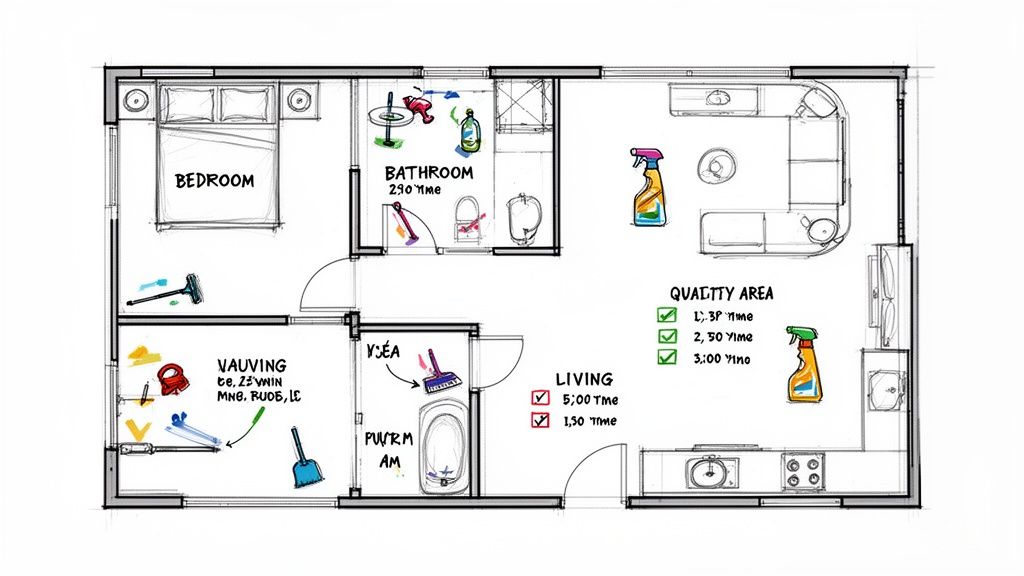
vacation rental cleaning
Vacation Rental Cleaning Checklist: 10 Steps for 2026
Posted on Feb 14, 2026
TL;DR: Your turnover isn't a chore — it's the operational backbone of your review scores, your search ranking, and ultimately your direct-booking business. This is a 10-step, room-by-room turnover checklist built for professional STR operators: how to deep-clean every zone to a five-star standard, then how to wire that checklist into your booking calendar and guest communication so cleanliness becomes a system you can scale across 5 listings or 50 — not a thing you hope your cleaner remembers.
Why the turnover is your highest-leverage operational task
Here's the reality check: on Airbnb, guests don't just leave you one star rating. They rate your home across six separate categories — check-in, cleanliness, accuracy, host communication, location, and value (Airbnb Help Center). Two of those — location and value — you largely can't control on a given turnover. Cleanliness you control completely, every single time, and it's the category guests notice first and forgive least.
That control compounds. The "Guest Favorite" badge — the visibility flag Airbnb surfaces in search — is awarded on a mix of factors, including your overall rating, review content, and reliability signals like cancellation and incident rates, ranked relative to other listings (Airbnb Help Center). Cleanliness feeds directly into that overall rating, so a run of weak cleanliness scores doesn't just sting one reservation; it quietly suppresses how often the OTA shows your listing at all. And the operators who depend on that algorithm to fill the calendar are exactly the ones paying 15-20% in commissions for the privilege.
So think of every turnover as doing double duty: it protects your OTA standing today, and it builds the cleanliness reputation that lets you eventually pull guests off the OTAs and onto your own direct-booking channel. The checklist below is the standard. The back half of this article is how you operationalize it.
The 10-step vacation rental cleaning checklist
1. Deep clean common areas and high-traffic zones
The first impression forms within seconds of the door opening. Living room, kitchen, hallways — these set the tone for the whole stay and for the cleanliness rating you'll get for it. Go top to bottom: dust ceiling fans and light fixtures first, wipe walls and baseboards, pull furniture to vacuum underneath, sanitize every light switch, remote, and door handle, and finish with streak-free windows and mirrors.
- Work top to bottom. Start at the highest points so dust and debris fall onto floors you clean last.
- Standardize with a written checklist. A documented, room-by-room standard removes the guesswork — and it's the only way a clean stays consistent when a different person performs it.
- Photograph the finished room. Post-clean photos double as a training reference for your team and a baseline you can lean on in any damage dispute.
2. Kitchen sanitization and appliance cleaning
The kitchen reads as a proxy for how clean the whole property is — if the stovetop is greasy, guests assume the bed isn't fresh either. Degrease the stovetop, sanitize all counters and the backsplash, and clean inside the fridge, microwave, and oven, not just the fronts.
- Appliance deep dive. Empty and wipe the fridge shelves and drawers, check the oven for spills, and run a cleaning cycle on the dishwasher.
- Food-prep surfaces. Use a food-safe disinfectant on counters, cutting boards, the sink, and the disposal area.
- Inventory and restock. Confirm cookware and utensils are spotless and undamaged, then restock dish soap, sponges, and paper towels so the next guest walks into a ready kitchen.
3. Bathroom deep cleaning and sanitization
Guests have a zero-tolerance policy for bathroom grime — a single stray hair or hint of mold can tank a cleanliness score on its own. Disinfect every surface from toilet base to faucet handles, scrub the shower walls, descale the showerhead, and polish chrome and mirrors.
- Sanitize all touchpoints. Toilet (inside, outside, base), sink, faucets, shower controls, light switches, doorknobs, and the toilet-paper holder.
- Attack glass and grout. Soap scum and water spots make a clean bathroom read as dirty; scrub grout lines to remove discoloration.
- Prevent cross-contamination. Use color-coded microfiber cloths — one set for the toilet, a different set for the sink and shower. This is a professional standard, not a nicety.
- Ventilate. Run the exhaust fan 20-30 minutes after cleaning to dry surfaces and discourage mold, especially in humid markets.
4. Bedroom and bedding management
The bedroom is the most personal space in the home, and sleep quality drives the review. Strip and replace all linens, inspect the mattress and protector for stains, fluff and arrange pillows, and sanitize nightstands, dressers, and sills.
- Run a par system on linens. Keep at least three sets per bed — one on the bed, one in the wash, one on the shelf — so a same-day turn never waits on a dryer.
- Wash hot. High-temperature wash cycles kill dust mites and the germs guests can't see but will assume are there.
- Inspect before you make the bed. Photograph the mattress and linens each turnover; that record protects you against unfounded stain or damage claims.
5. Floor care and carpet cleaning
Scuffed hardwood or a single stain on a light carpet undercuts everything else you did. Vacuum and mop every turnover, spot-treat spills immediately, and schedule deeper professional cleaning on a cadence.
- Use surface-appropriate cleaners. pH-neutral on hardwood and laminate to avoid stripping the finish; a specialized cleaner for tile and grout periodically.
- Invest in a HEPA vacuum. High-filtration machines pull allergens a consumer vacuum leaves behind — material in pet-friendly and family listings.
- Schedule pro deep-cleans. Carpet and upholstery every 3-6 months depending on occupancy; an annual deep-clean for hardwood and tile to protect the asset.
6. Window and glass surface cleaning
If your listing sells a view, dirty glass ruins the exact feature guests paid for. Clean interior and exterior panes, glass tabletops, shower doors, and mirrors, and wipe the sills and tracks where grime collects.
- Skip paper towels. A squeegee plus microfiber gives a streak-free, lint-free finish; technique matters more than the spray.
- Time it right. Clean on an overcast day when you can — direct sun dries the solution too fast and causes streaking.
- Split the cadence. Spot-clean glass every turnover; book a full interior/exterior clean monthly or quarterly, more often for coastal properties fighting salt spray.
7. Laundry processing and linen management
Laundry is the single most time-consuming part of any turnover — and on a same-day turn, it's the bottleneck that decides whether you make check-in. Collect, treat, wash, dry, and fold all linens and towels to a consistent standard, and track inventory so you're never short.
- Establish the par. Three sets per bed and bath keeps back-to-back bookings moving without waiting on a wash cycle.
- Outsource at scale. For higher-volume portfolios, a commercial laundry or linen service removes the bottleneck and guarantees consistent supply. See our guide to managing a vacation rental property for where outsourcing pays off.
- Inspect and retire. Pull any linen with stains, fraying, or graying — dingy towels read as "not cleaned" even when they're freshly laundered.
8. Trash removal, recycling, and waste management
A lingering odor or an overflowing bin is an instant one-star trigger. Empty every interior and exterior can, disinfect and reline them, and clear recycling and compost.
- Sanitize and deodorize. Wipe receptacles inside and out; a deodorizer at the bottom of the can prevents smell buildup between guests.
- Label clearly. Use text and icons on recycling, compost, and landfill bins to clear language barriers, and restate the rules in your digital guidebook — they vary by municipality.
- Time exterior bins. Move full bins to the curb the night before arrival so the property's first impression isn't a smell.
9. Dusting, decluttering, and surface organization
Beyond wiping, a curated surface is what makes a rental feel staged rather than just clean. Dust everything top to bottom — frames, fixtures, blinds, baseboards — then organize remotes, books, and decor so the space reads intentional.
- Use the right tools. Microfiber and extendable dusters trap particles without chemical sprays that leave residue or trigger allergies.
- Keep decor minimal. Fewer items photograph better, clean faster, and create a calmer space — aim to keep surfaces mostly clear.
- Shoot for the listing. A clean, uncluttered room photographs beautifully; your best post-clean shots are listing and direct-site assets.
10. Quality inspection, documentation, and photographic evidence
The clean isn't done until it's verified. Walk the property against the checklist, confirm every task, and capture photo and video evidence of the finished state.
- Standardize the walkthrough. A consistent digital inspection checklist gives you a uniform standard no matter who cleaned.
- Shoot in daylight. Capture key rooms — kitchen, baths, bedrooms — from the guest's point of view in bright natural light.
- Put the photos to work. Beyond dispute protection, those images feed your pre-arrival guest messaging and your direct-booking site. More on this in our guide to increasing guest satisfaction.
From checklist to system: where operators actually win or lose
Knowing what to clean is the easy part — every host has a checklist. The operators who scale are the ones who make the checklist execute reliably against a live booking calendar, across every property, without them personally babysitting it. Three operational layers separate a system from a to-do list.
Sync the clean to the booking calendar — especially same-day turns
A thorough turnover runs roughly 1.5-2.5 hours for a studio or 1-bedroom, 2.5-3.5 hours for a 2-bedroom, and 3.5-5+ hours for a 3+ bedroom property (Houfy). The danger isn't the average — it's the same-day turn, where one guest checks out at 10 a.m. and the next checks in at 3 p.m. That five-hour window is where underprepared operators lose their ratings.
The fix is to stop treating cleaning as a separate workflow from reservations. When a booking is confirmed or modified, the turnover should auto-generate against the checkout date, get assigned to the right cleaner, and flag any back-to-back as priority. The moment your cleaning schedule and your booking calendar live in two different places, a missed turn is a matter of when, not if.
Make the checklist enforceable, not aspirational
A paper checklist taped to the fridge can't tell you whether step 7 actually happened. A digital, per-property checklist your cleaner completes on their phone — with required photos on the high-risk zones (kitchen, baths, linens) — turns "I trust they did it" into "I can see they did it." That's the difference between a standard you hope for and one you can hold a contractor to across 50 properties.
Feed the inspection photos into guest communication
This is the step that converts an operational cost into a marketing asset. The photos from step 10 don't just defend against disputes — sent in a pre-arrival message a few hours before check-in ("your space is freshly cleaned and ready"), they set a five-star expectation before the guest walks in. Automate that sequence and every turnover quietly reinforces your cleanliness brand. hostAI ties this loop together — the direct-booking site that showcases your spotless listings and the automated guest email that proves it on every arrival — so the work you already do shows up where it earns repeat, commission-free stays.
Bottom line: A documented, calendar-synced, photo-verified cleaning system does three things a checklist alone can't: it removes the same-day-turn failure mode, it makes quality enforceable across a portfolio, and it turns your turnover into proof you can market — the foundation of pulling guests off OTAs and onto your own direct channel.
FAQ: vacation rental turnover cleaning
How long should a vacation rental turnover take?
A thorough turnover runs about 1.5-2.5 hours for a studio or 1-bedroom, 2.5-3.5 hours for a 2-bedroom, and 3.5-5+ hours for a 3+ bedroom property, depending on size and condition (Houfy). On a same-day turn with a 10 a.m. checkout and 3 p.m. check-in, you're working inside a five-hour window — which is why laundry should start first and supplies should be staged in advance.
Does cleanliness actually affect my Airbnb ranking?
Yes, indirectly but materially. Cleanliness is one of Airbnb's six rating categories, and the "Guest Favorite" search badge is awarded on a mix of factors — your overall rating, review content, and reliability signals — ranked relative to other listings (Airbnb Help Center). Weak cleanliness scores pull down the overall rating that drives your visibility.
What's the most overlooked step in a turnover?
Quality inspection with documentation. Most hosts clean thoroughly but never verify or photograph the finished state — so they have no record for disputes and no asset for guest communication. Photographing each turnover closes both gaps.
Should I clean myself or hire a team?
It depends on your portfolio size and turn frequency, but the deciding factor is whether your standard is documented. A written, photo-verified checklist is what lets you hand cleaning to a contractor or service without quality drifting — without it, outsourcing just multiplies inconsistency.
Your turnover is already a five-star operation on the floor — the gap is making it visible and repeatable. With hostAI, you can build a direct-booking site that showcases your spotless listings and automate the pre-arrival emails that prove your cleanliness on every stay. Stop letting your best operational work disappear into an OTA review — turn it into direct bookings.