
vacation rental web design
Vacation Rental Web Design That Converts Browsers Into Bookers
Posted on Dec 15, 2025
When we talk about "vacation rental web design," we're not just talking about making a pretty website. We’re talking about building your single most powerful tool for getting commission-free, direct bookings. It’s the art of mixing incredible visuals with dead-simple navigation and a booking process so smooth it builds trust on its own.
Ultimately, this is about creating an online home for your business that cuts the cord with the big Online Travel Agencies (OTAs).
Building Your Website's Direct Booking Foundation
Your website isn't just a digital brochure. Think of it as your virtual storefront, your brand's headquarters, and by far your most valuable sales channel. Relying only on platforms like Airbnb or Vrbo is like setting up shop on rented land. You're completely at their mercy—their rules, their ever-increasing commission fees, and the algorithm changes that can tank your revenue overnight.
A well-built direct booking site puts you firmly back in the driver's seat. It becomes the heart of your brand, giving you the space to tell your story, show off your properties without a competitor's listing right next to yours, and own the guest experience from the first click to the final checkout. This direct relationship is what builds loyalty and brings guests back year after year—something OTAs are designed to prevent.
Mapping the Ideal User Journey
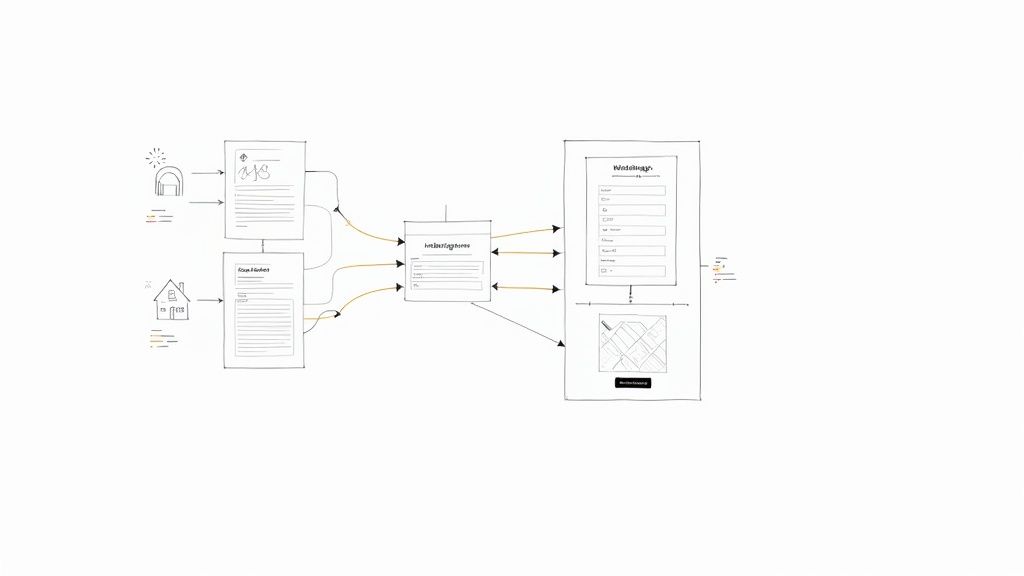
The real foundation of any website that actually converts is its architecture—how you organize and present everything. The goal is simple: create the path of least resistance from the moment someone lands on your page to the second they hit "Confirm Booking." This journey has to feel logical, intuitive, and, most importantly, reassuring.
Put yourself in your visitor's shoes. They could be coming from a Google search, a Facebook ad, or an email you sent. Your homepage has to immediately nail three questions for them:
- Where is this? (Give them the location and property type instantly.)
- Is it for me? (Showcase the exact experience your ideal guest is looking for.)
- How do I book it? (Make the call-to-action impossible to miss.)
From that point on, navigation needs to be a breeze. It doesn't matter if you have one cabin or a portfolio of fifty condos; users need a straightforward way to browse listings, drool over photos, check dates, and understand your rules without hitting a single dead end.
Core Architectural Components
Every high-performing vacation rental website rests on a few non-negotiable pillars. If you skimp on any of them, you're creating holes in your booking funnel and waving goodbye to potential guests.
A good sitemap is your blueprint. It needs dedicated pages for your properties, an "About Us" page to build that all-important human connection, a contact page, and maybe even a blog or local guide to pull in organic search traffic. If you really want your listings to pop and convince people to book direct, look into tech like virtual staging specifically for rental properties.
To give you a clearer picture, here’s a breakdown of the essential elements your site needs to drive bookings effectively.
Core Components of a High-Converting Vacation Rental Website
| Component | Primary Goal | Key Features |
|---|---|---|
| Homepage | Capture attention, build trust | Hero images/video, clear value prop, prominent booking widget, social proof |
| Property Listings | Sell the experience | High-res photos, detailed descriptions, amenities list, availability calendar |
| Booking Engine | Secure reservations | Real-time pricing, simple checkout, secure payment gateway, instant confirmation |
| About Page | Build personal connection | Your story, host photos, mission/values, what makes you unique |
| Local Guide/Blog | Attract SEO traffic, add value | Area attractions, restaurant tips, event calendars, insider advice |
| Contact/FAQ Page | Reduce friction, answer questions | Contact form, phone number, map, answers to common guest questions |
| Mobile-First Design | Convert on-the-go travelers | Responsive layout, fast load times, thumb-friendly navigation and CTAs |
These components work together to guide visitors from initial interest to a confirmed booking, making your website a true conversion machine.
A direct booking website isn't just a way to dodge commissions. It's a long-term, sustainable business asset that you own and control completely. It’s how you build a real brand, create guest loyalty, and establish a revenue stream that isn't dependent on anyone else.
The numbers don't lie. The global vacation rental market is rocketing past $100 billion and is expected to hit $105.7 billion in 2025. With a staggering 83% of all revenue in this industry coming from online sales, a powerful direct-booking website is no longer a "nice-to-have"—it's an essential tool for carving out your piece of the pie.
Getting this foundation right is everything. For a much deeper look, check out our complete guide on how to create a direct booking website for your vacation rental. By focusing on a smart structure from day one, you’re not just building a website that looks good; you’re engineering a machine built to convert.
Designing for Trust and Higher Conversions
A beautiful design is a great start, but it’s not what turns a casual browser into a confident booker. That comes down to the psychology of trust. Your website has to do more than just show off your property; it needs to forge an emotional connection and erase any doubt a guest might have about booking directly with you instead of a big OTA.
This all starts the second your page loads. High-quality, professional photography isn't just a nice-to-have—it's the single most important element on your site. Guests can't tour your property in person, so your photos do all the heavy lifting. They're not just showing rooms; they're selling an experience, a memory, a feeling of pure relaxation or adventure.
Weaving a Compelling Narrative
Beyond the stunning images, your property descriptions need to tell a story. Ditch the boring list of amenities and instead paint a picture of what a stay is really like. Instead of just stating "queen bed, full kitchen, Wi-Fi," try something more evocative.
Imagine this: "Wake up to the scent of fresh mountain air from your private balcony, brew a coffee in the fully-stocked kitchen, and plan your day’s hike with our high-speed internet." That simple shift turns features into tangible benefits and helps the guest instantly imagine themselves in the space.
Building Unshakable Trust Signals
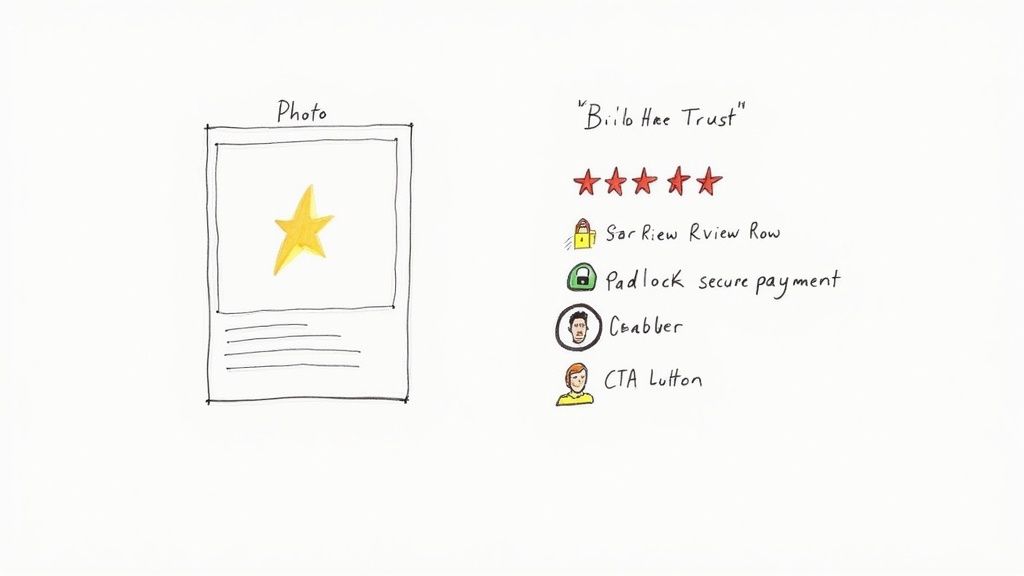
Trust is the currency of direct bookings. Period. Without the familiar safety net of a brand like Airbnb, visitors need immediate and constant reassurance that their booking is safe and your property is legitimate. These visual and informational cues are your "trust signals."
Here are the essentials every vacation rental website must have:
- Guest Reviews and Testimonials: Don't hide them. Prominently display glowing reviews from past guests. Using real names and photos (with permission, of course) adds a powerful layer of authenticity.
- Secure Payment Badges: Show the logos for Visa, Mastercard, and any secure payment processor you use. These small icons instantly signal that financial transactions are protected.
- A Genuine 'About Us' Page: This is your chance to connect on a human level. Share your story, a photo of yourself or your team, and why you love hosting. People trust people, not faceless websites.
- Clear Contact Information: Make it painfully easy for guests to reach you. A visible phone number, email address, and even a physical address for your management company builds immense credibility.
These elements work together to create a secure environment where guests feel comfortable pulling out their credit cards and committing to a stay.
Crafting Persuasive Copy and Calls to Action
Think of your entire website as a conversation with a potential guest. Every single word should gently guide them toward that booking button. This is where persuasive, benefit-driven copywriting and crystal-clear Calls-to-Action (CTAs) come into play.
The CTA is the final, crucial step. Vague buttons like "Submit" or "Continue" create hesitation. You need direct, action-oriented language that sets clear expectations.
Examples of Effective CTAs:
- Check Availability & Rates
- Book Your Mountain Getaway Now
- Reserve My Dates
These CTAs are specific, exciting, and leave no doubt about what happens next. You have a very short window to capture a visitor's attention—industry data shows travelers often spend just 59 seconds on a rental website before making a move. This makes fast-loading pages and powerful CTAs non-negotiable.
The goal is to make booking feel like the natural, easy conclusion to an enjoyable browsing experience. If a guest has to hunt for the 'book now' button, you’ve already lost momentum and potentially the booking itself.
Placement is just as important as the text. Your primary CTA—usually a booking widget or button—should be visible "above the fold" on your homepage and on every single property page. Don't make them search for it.
By combining immersive visuals, a compelling story, and undeniable trust signals, your vacation rental web design becomes a powerful conversion engine. For a deeper look into the specific elements that make a site successful, check out our guide on vacation rental website design best practices.
Let's Talk Tech: Integrating Seamless Booking and Management
A stunning website is only half the battle. Seriously. Without a rock-solid, frictionless booking system, even the most beautiful vacation rental web design will fail to convert. This is where the right technology transforms your site from a simple photo gallery into a powerful direct booking engine that works for you around the clock.
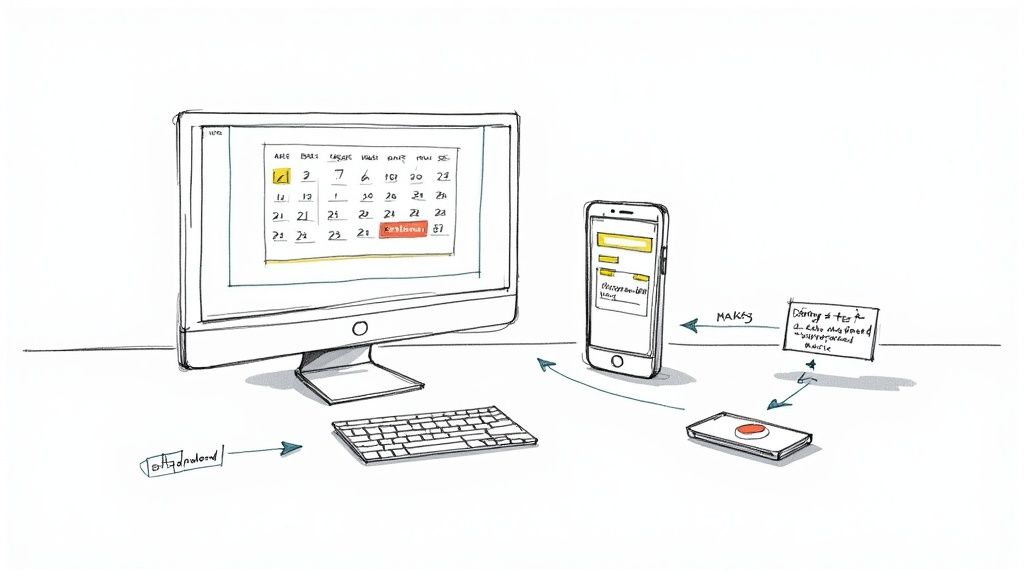
The heart of this whole operation is your booking engine. This is the software that shows your real-time availability, calculates pricing on the fly, and securely handles payments. The days of manually updating a paper calendar and chasing down payments via email are long gone. Today's tools automate the entire dance, creating a professional experience that puts you on par with the major OTAs.
Choosing Your Booking Engine
When you start digging into the tech, you'll find there are two main paths. You can grab a simple third-party widget and embed it on your site, or you can go for a fully integrated solution, which usually comes as part of a Property Management System (PMS). A good PMS is the command center for your business, syncing your calendars across all channels—like Airbnb and Vrbo—to kill double bookings before they even happen.
For most growing property managers, a PMS integration is the way to go. It’s just a smarter, more scalable choice. It guarantees that your direct booking site always has the most accurate availability and pricing because it's all pulling from the same central hub as your other listings.
The Non-Negotiables: Essential Features Your Tech Must Have
Look, not all booking software is created equal. To give guests a smooth experience and, frankly, to make your own life easier, your system needs a few critical features. Think of these as the absolute must-haves for a modern, professional direct booking site.
- Real-Time Availability Calendars: This is table stakes. Guests expect to see up-to-the-minute availability and book instantly without having to send an "Is this available?" email.
- Dynamic Pricing Tools: Being able to automatically tweak your rates based on seasonality, local events, or length of stay isn't a luxury; it's essential for maximizing your revenue.
- Secure Payment Processing: Your system has to integrate with a trusted payment gateway like Stripe or PayPal. This is non-negotiable for handling transactions securely and building guest confidence.
- Automated Guest Communications: From booking confirmations and pre-arrival instructions to post-stay review requests, automation saves you a staggering amount of time and ensures every guest gets the same great experience.
These features all work in concert to create an efficient, trustworthy booking process that gets guests to click that final "Book Now" button.
The Unspoken Requirement: Flawless Mobile Performance
In today's market, a great mobile experience isn't a "nice-to-have"—it's a fundamental requirement. A huge chunk of your potential guests will find and browse your properties on their smartphones, often while they're on a lunch break or commuting. If your booking process is clunky, slow, or a pain to navigate on a small screen, you've lost them. It's that simple.
And I'm not just talking about a site that shrinks to fit the screen. True mobile optimization means:
- Large, thumb-friendly buttons and input fields.
- A stripped-down checkout process with as few steps as possible.
- Images and page elements that load lightning-fast.
The goal is to make booking from a phone feel just as easy and secure as booking from a desktop. Any friction in the mobile experience is a direct leak in your revenue funnel, period.
The technology you choose has to be built with a "mobile-first" mindset. When you're checking out different software options, always, always test the demo on your own phone. Walk through the entire booking journey just as a guest would. A smooth process on mobile is one of the clearest signs of well-designed software.
Ultimately, the right tech should make life easier for everyone involved—you and your guests. Integrating a powerful booking engine and management system is the final piece of the puzzle, turning your beautiful website into a true revenue-generating asset. To learn more about the software that powers these experiences, check out our guide on finding the best direct vacation rental software for your business.
Driving Quality Traffic with Smart SEO
Alright, you've built a beautiful, high-converting website. Fantastic. But if potential guests can't find it, it's not going to do you much good, is it? This is where a smart Search Engine Optimization (SEO) strategy comes in, acting as the digital breadcrumb trail that leads travelers right to your booking page instead of to an OTA.
Think of SEO as the engine that powers your site's visibility on Google, which is ground zero for the vast majority of vacation planning. A focused approach ensures you're not just getting clicks, but attracting the right people—travelers actively searching for a stay in your specific area.
Mastering Local SEO for Immediate Impact
For most vacation rental owners, local SEO is your single biggest opportunity. It’s all about showing up for searches like "cabin rental in Asheville NC" or "beachfront condo near me." These are your bread-and-butter keywords, and winning them is crucial.
Your Google Business Profile (GBP) is the absolute cornerstone of this strategy. It’s that free listing that pops up in Google Maps and the local search results. You need to claim it, fill it out completely, and keep it meticulously updated. We're talking correct address (if applicable), phone number, and most importantly, a direct link to your website.
To really get the most out of local SEO, here's what to do:
- Go All-In on Guest Reviews: Actively, almost aggressively, encourage happy guests to leave reviews on your GBP listing. Positive reviews are a massive signal to Google that you’re a legitimate, quality option.
- Speak the Local Language: Weave location-specific terms naturally into your website copy. Mention neighborhoods, nearby landmarks, and popular attractions in your property descriptions and blog posts.
- Build Local Citations: Get your business name, address, and phone number listed consistently across relevant online directories. Think local tourism boards, chambers of commerce, and niche travel sites.
Scaling Your Reach with Programmatic SEO
Now, if you're a property manager with a larger portfolio, this is where things get really interesting. Programmatic SEO is a game-changer. It’s an advanced technique that uses data and automation to create hundreds or even thousands of unique, optimized pages at scale.
Instead of manually writing a page for every single search query you can think of, you create smart templates that are dynamically populated with your property data.
Imagine automatically generating landing pages for queries like:
- "Pet-friendly rentals in [City Name]"
- "Rentals with a pool in [Neighborhood]"
- "3-bedroom family rentals in [Region]"
This lets a small team target an enormous number of long-tail keywords. These are the highly specific searches from people who are much closer to making a booking decision. It’s how you can punch above your weight and compete with the massive search footprint of the big OTAs.
Programmatic SEO isn’t about creating spammy, low-quality pages. It's about using technology to serve hyper-relevant content to users based on their exact needs, which is exactly what search engines want to see.
For vacation rental managers, understanding the difference between local and programmatic SEO is key to building a comprehensive traffic strategy. One provides immediate, targeted visibility, while the other offers scalable, long-term growth.
Local vs Programmatic SEO Approaches
| Strategy | Best For | Key Tactics | Example |
|---|---|---|---|
| Local SEO | Single property owners or managers in one distinct geographic area. | Google Business Profile optimization, local keyword targeting, review generation, local citations. | Ranking #1 in Google Maps for "ski chalet in Breckenridge." |
| Programmatic SEO | Multi-property managers operating across various regions or with diverse property types. | Creating templated pages for property features, locations, and amenities at scale. | Generating thousands of pages for "oceanfront rentals with hot tubs in [Every Coastal Town You Serve]." |
Ultimately, many larger businesses will use a blend of both. They'll nail their local SEO for each primary market and then layer on a programmatic strategy to capture the long tail of search demand.
Content That Attracts Your Ideal Guest
Beyond the technical tactics, you need to create genuinely valuable content. A blog or a local guide section on your website is the perfect place to answer the questions your ideal guests are asking before they even start thinking about where to stay.
Don't just write about your properties. Become the local expert. If you manage mountain cabins, publish posts like "The 5 Best Family-Friendly Hikes in the Smokies" or "A Guide to the Top Local Breweries."
This kind of content ranks for valuable search terms and, more importantly, builds trust. You become a helpful resource, not just a place to sleep. Since vacation rentals are a core part of the travel industry, diving into a specialized guide on SEO for travel businesses can provide even more tailored insights to really boost those direct bookings.
Technical Health and Performance
Finally, none of this matters if your website is slow, broken, or a nightmare for Google to crawl. Technical SEO is about making sure your site's foundation is solid. This means lightning-fast page speed, a flawless mobile experience, and a clean, logical URL structure.
Make a habit of running site audits using free tools like Google Search Console. It will flag things like broken links or indexing errors before they become major problems. A fast, technically sound website doesn't just rank better—it provides a far better user experience, which is what convinces a visitor to stick around and hit that "Book Now" button.
How to Measure Success and Optimize Performance
Launching your website is a huge milestone, but it's really the starting line, not the finish. A truly effective vacation rental web design isn’t a "set it and forget it" project. Think of it as a living, breathing asset that you need to constantly refine.
The only way to do this right is to let the data be your guide. Stop guessing what works and start building a clear, strategic roadmap for improvement based on how real users interact with your site. It’s all about creating a powerful feedback loop: listen to what your users are doing, figure out what’s working, and relentlessly fix what isn’t.
Setting Up Your Data Toolkit
Before you can measure anything, you need the right tools in place. The absolute non-negotiable starting point is Google Analytics 4 (GA4). It’s free, incredibly powerful, and the industry standard for understanding user behavior. If you do nothing else, get this set up.
Once GA4 is installed and collecting data, your next move is to configure event tracking specifically for your booking funnel. This isn't as complicated as it sounds. You’re essentially telling Google Analytics to watch for a few key actions:
- view_property: A user clicks to view a specific property page.
- begin_checkout: A user selects their dates and initiates the booking process.
- add_payment_info: The guest moves on to the payment step.
- purchase: The final confirmation of a completed booking.
Tracking this exact sequence lets you build a visual funnel in GA4. In an instant, you'll see precisely where potential guests are dropping off and abandoning the booking process.
Your website analytics are not just reports; they are the collective voice of your visitors. Listening to this data is the most direct way to understand their needs, frustrations, and motivations, allowing you to optimize their journey and boost your bookings.
Identifying the KPIs That Actually Matter
With your analytics humming along, it's time to cut through the noise. There are dozens of metrics you could track, but only a handful truly define success for a direct booking website. Don't get overwhelmed.
These are the numbers you need to live and breathe:
- Conversion Rate: This is your north star. It’s the percentage of total website visitors who actually complete a booking. High traffic is great, but a low conversion rate is a blaring alarm that something in your user experience, pricing, or messaging is broken.
- Booking Sources (Traffic Channels): Where are your bookers actually coming from? Are they finding you through organic search (SEO)? Clicking a link in your email newsletter? Coming from a social media campaign? This tells you which marketing channels are delivering a real return on your time and money.
- Average Length of Stay (ALOS): This simple KPI, pulled from your booking data, helps you spot booking patterns. If you notice ALOS drops during shoulder season, you could test out a promotion like "Book 4 Nights, Get the 5th Free" to encourage longer, more profitable stays.
- Booking Funnel Drop-Off Rate: Using those events you set up, you can see exactly where people are bailing. For example, a 50% drop-off between the
begin_checkoutandadd_payment_infosteps is a massive red flag. It could mean your fees are causing sticker shock, or maybe the payment form is just too confusing to use.
Turning Insights into Action with A/B Testing
Data is completely useless if you don't act on it. Once you’ve pinpointed a potential problem, the next step is to test a solution. This is where A/B testing comes in. It’s a simple but powerful method of creating two versions of a page (an 'A' version and a 'B' version) to see which one performs better.
Let's say you suspect your main "Book Now" button is getting lost on the page. You could run a straightforward test:
- Version A (Control): Your current blue "Book Now" button.
- Version B (Variant): A new, larger, high-contrast orange "Book Now" button.
You’d show each version to 50% of your website visitors and measure which one gets more clicks through to the booking page. This data-driven approach takes ego and opinion out of your design decisions. You're letting your guests tell you what works.
You can test just about anything—headlines, hero images, property descriptions, even how you display your pricing. This continuous cycle of measuring, analyzing, and testing is the real secret to building a website that doesn't just look good, but consistently drives more direct bookings.
Answering Your Top Vacation Rental Web Design Questions
Jumping into the world of vacation rental web design always brings up a few key questions. It's smart to want a clear picture of the costs, timelines, and skills involved before you dive in. I get asked these all the time by property managers and owners ready to build a powerful direct booking site, so let's tackle them head-on.
Think of this as your cheat sheet for making informed decisions and setting the right expectations for your website project.
How Much Does a Professional Vacation Rental Website Cost?
This is always the first question, and the honest answer is: it really depends. The price tag can swing wildly based on how complex you need the site to be and what features you're looking for.
- DIY Builders: Platforms like Squarespace or Wix are great for getting started on a budget, usually running between $20 to $50 a month. Just remember to factor in the extra cost for a separate, third-party booking engine to handle the reservations.
- Specialized Agencies: If you're looking for a completely custom site built by an agency that lives and breathes the vacation rental world, you're looking at a bigger investment. A basic setup might start around $5,000, but for a site with all the bells and whistles—like deep PMS integration or programmatic SEO—it can easily climb to $25,000 or more.
I always tell people to reframe this as a strategic investment, not just an expense. A website that performs well will pay for itself many times over by cutting out those hefty OTA commissions and giving you a brand asset that you own outright.
Can I Build a Website Myself Without Coding Skills?
You absolutely can. The old idea that you need to be a coding wizard to build a website is long gone. Today's tools make it possible for anyone to create a professional-looking site.
For example, platforms like hostFront are built specifically for people in our industry who aren't tech experts. They come loaded with features like drag-and-drop editors, templates designed for rentals, and plug-and-play integrations with booking engines and payment systems.
Going the DIY route definitely takes some time to learn the ropes and get everything set up just right. But for hands-on owners and smaller managers, it's a fantastic and empowering way to get your direct booking channel off the ground.
How Long Does It Take for SEO to Work?
Patience is key here—SEO is a marathon, not a sprint. You have to go in with realistic expectations. For a brand-new website, you're generally looking at 6 to 12 months before you start seeing real, meaningful organic traffic for competitive keywords. That's just how long it takes for Google to find your site, understand what it's about, and start trusting it.
That said, some tactics can get you quicker wins. Focusing on Local SEO—like meticulously optimizing your Google Business Profile and actively collecting reviews—can start to move the needle for "near me" searches in just a couple of months.
The real secret is consistency. You have to keep feeding the machine by regularly adding new content, building quality links, and keeping the technical side of your site in good shape. It’s this steady effort that builds a reliable, long-term pipeline of free, high-intent traffic straight to your booking engine.
Ready to build a direct booking website that converts? hostAI provides intelligent website creation with hostFront, designed to maximize your revenue and build your brand. Discover how hostAI can double your direct bookings today.