

vacation rental business plan
Business plan for vacation rental: The Ultimate Guide to Profits
Posted on Jan 14, 2026
A business plan for your vacation rental always kicks off with a punchy executive summary. Think of this one-page snapshot as your entire business model boiled down to its most convincing points. It's designed to grab the attention of potential investors or lenders right from the start.
This is your elevator pitch on paper.
Crafting Your Executive Summary That Stands Out
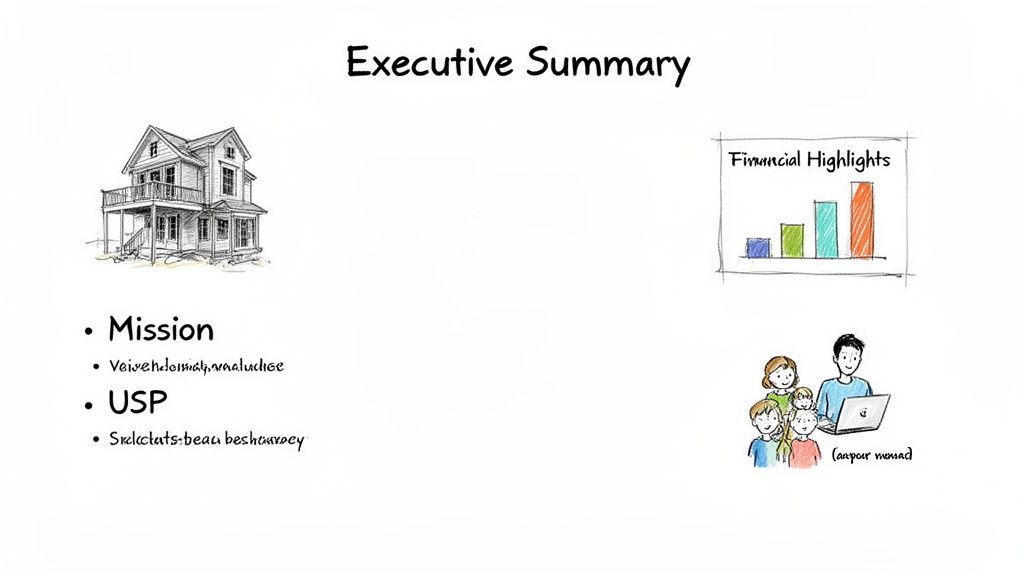
Honestly, the executive summary is probably the most critical part of your whole business plan. It’s the very first thing anyone will read, but it's often the last thing you should write. Its only job is to convince the reader that the rest of your plan is worth their time. To do that, it needs to be concise, confident, and packed with the right details.
A rookie mistake is treating this section like a simple introduction. Don't do that. It needs to work as a complete, standalone overview of your entire strategy. In just a few hundred words, you have to tell a compelling story about your business, from its core mission all the way to its financial potential.
Key Components of a Winning Summary
To make your summary truly effective, you need to hit several core elements without getting lost in the weeds. Every single sentence has to pull its weight and add to the story of a business that’s built to succeed.
Here’s exactly what to include:
- Mission Statement: A quick, one-sentence declaration of your purpose. What kind of experience are you really creating for your guests?
- Unique Selling Proposition (USP): What makes your rental unforgettable? This is where you carve out your niche and spell out your competitive edge.
- Business Goals: Be crystal clear about your objectives. Are you aiming for a single, high-profit property or scaling up to a multi-property portfolio?
- Target Market: A snapshot of your perfect guest. Specificity is key here—"families seeking luxury mountain retreats" is infinitely better than just "tourists."
- Financial Highlights: You need to show the numbers that prove your concept is solid. Include your projected annual revenue, target occupancy rate, and other key profitability metrics.
Pro Tip: Always, always write your executive summary after you’ve finished every other section of your business plan. It lets you pull the most powerful highlights and data points, guaranteeing your opening statement is cohesive and hits hard.
Defining Your Unique Value
Your Unique Selling Proposition (USP) is the beating heart of your executive summary. It directly answers the question, "Why would a guest book your property over all the others?"
In today's crowded market, just having a nice place in a good location isn't enough. Your USP has to be sharp, memorable, and threaded throughout your entire plan.
For instance, instead of just saying you offer a "nice cabin," you could define your USP as "the only pet-friendly luxury cabin in Aspen with a fenced-in acre and curated welcome baskets for dogs." That paints a vivid picture immediately and targets a very specific, high-value guest. It shows you’ve done your homework and have a real strategy.
This kind of specificity doesn't just attract the right guests; it signals to investors that you have a focused plan to capture a dedicated slice of the market. And your executive summary is where this unique identity makes its grand entrance.
Analyzing Your Vacation Rental Market
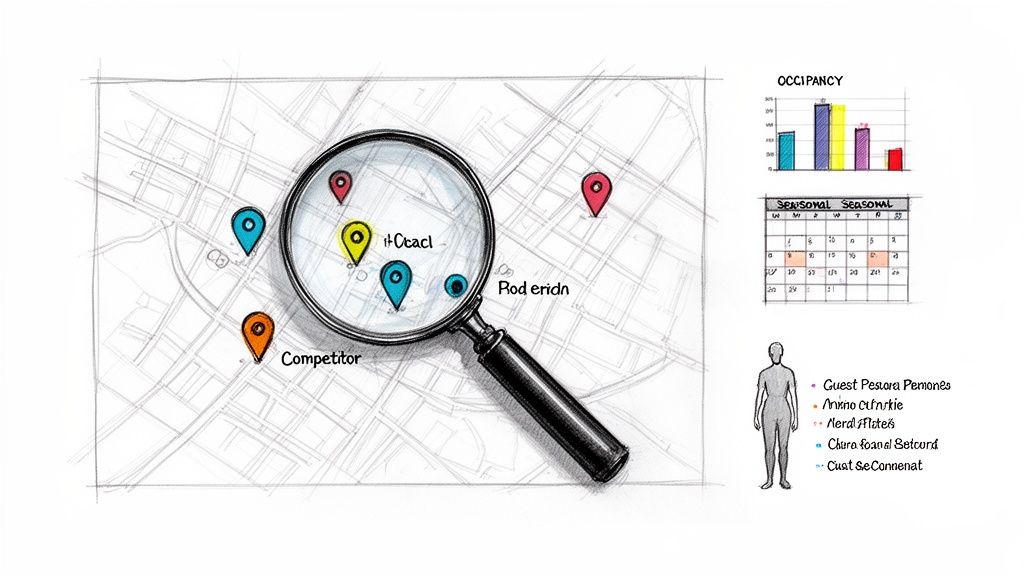
Guesswork is the fastest way to an empty calendar. A serious business plan for a vacation rental is built on a foundation of solid data, not just a gut feeling about your property's appeal. This section is your reality check—it’s where you move from dreaming about potential income to strategically planning for it.
The global vacation rental market is absolutely booming, valued at a staggering USD 174.84 billion in 2024 and on track to hit USD 396.93 billion by 2032. This incredible surge is fueled by a travel sector that just keeps spending more. Your job now is to figure out exactly how to carve out your slice of that massive pie. You can dig into more of this data over at Fortune Business Insights.
Identifying Your True Competitors
Your competition isn't just the other Airbnb down the street. To really understand the landscape, you need to look at the full spectrum of options a potential guest is weighing.
Start by building out a competitive set that includes:
- Direct STR Competitors: These are the properties most like yours—similar size, style, and price—listed on platforms like Airbnb and Vrbo.
- Indirect Competitors: Think local hotels, boutique inns, and even extended-stay suites. If they're targeting the same type of traveler, they're in the running for the same dollars.
- Aspirational Competitors: Find the top 10% of listings in your area. You know the ones—perfect reviews, always booked. Study their photos, amenities, and pricing. This is what excellence looks like in your market.
Taking this comprehensive view helps you see the full picture from your guest's perspective. For an even deeper dive, you can check out specific Airbnb stats by city to see how your market compares.
Building a Detailed Guest Persona
"Tourists" is not a target audience. To really succeed, you need to define your ideal guest with laser precision. Creating a detailed guest persona will guide every single decision you make, from the coffee maker you buy to the words you use in your listing.
Get specific about these factors:
- Who are they? Are you hosting millennial couples on a weekend getaway, families with young kids, or solo business travelers?
- Why are they traveling? Is it for a family vacation, a work conference, or a local festival?
- What do they value? Are they looking for budget-friendly basics, pet-friendly policies, or luxury perks and high-speed Wi-Fi?
For example, a family with toddlers is going to be thrilled if you provide a high chair and blackout curtains. A digital nomad, on the other hand, just wants a dedicated workspace, lightning-fast internet, and a great coffee shop within walking distance. Your business plan needs to show you've thought this through.
Conducting a SWOT Analysis
A SWOT analysis is a classic for a reason. It's a simple but powerful framework that forces you to look at your venture from every angle, grounding your strategy in reality instead of wishful thinking.
SWOT stands for Strengths, Weaknesses, Opportunities, and Threats. This exercise is invaluable for figuring out where you can win and what risks you need to watch out for.
Here’s how to break it down for your rental:
- Strengths (Internal): What built-in advantages does your property have? Maybe it's a panoramic view, walking distance to downtown, a unique design, or a hot tub.
- Weaknesses (Internal): Be honest. What are its limitations? Is there no dedicated parking? A tiny kitchen? A shared entrance?
- Opportunities (External): What's happening in your market that you can jump on? A new annual festival, a growing demand for pet-friendly stays, or a local lack of luxury options are all opportunities.
- Threats (External): What could hurt your business? This could be new STR regulations, a wave of new competition, or even an economic downturn.
By mapping these four areas out, you can build a smarter plan that plays to your strengths, shores up your weaknesses, and keeps you prepared for whatever comes your way.
Building Your Direct Booking and Marketing Engine
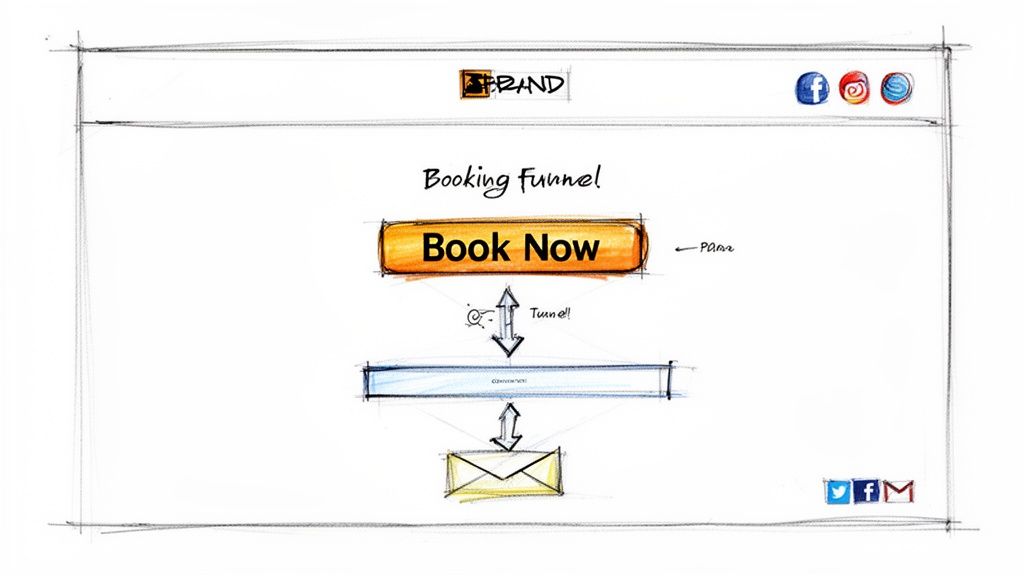
Relying completely on OTAs like Airbnb or Vrbo feels safe at first, but it’s a bit like building your dream house on rented land. Sure, they send you guests, but they also control your branding, your relationship with those guests, and most critically, a huge slice of your revenue. A smart business plan for a vacation rental must look beyond the OTAs and map out a powerful strategy for driving your own high-margin direct bookings.
Think of this as building your own engine. It puts you firmly in the driver's seat. You'll create a diversified sales funnel that slashes commission fees, builds real brand loyalty, and gives you ultimate control over your financial future. When you own your marketing channels, you can cultivate a base of repeat guests who come back to you, time and time again.
Establishing Your Unique Brand Identity
Before you even think about marketing, you need to know what you're actually selling. It's more than just a place to sleep. Your brand is the story you tell and the feeling guests have when they remember your rental. It’s what makes an experience memorable instead of just a transaction.
So, who are you? A "Rustic Mountain Hideaway for Adventurous Couples" or a "Chic Urban Loft for Business Travelers"? Nailing this down influences everything that follows:
- Your Property Name: Give it something memorable and evocative. It's always better than a generic "2-Bedroom Condo."
- Visual Style: Your logo, color palette, and the way you edit your photos need to be consistent everywhere.
- Voice and Tone: The language you use in descriptions and guest messages should reflect your brand’s personality.
A strong brand makes you instantly recognizable. It also attracts the exact kind of guest you love to host, which almost always leads to better reviews and fewer headaches.
Your Direct Booking Website: The Digital Storefront
Your website is the absolute heart of your direct booking strategy. It's your digital storefront, your 24/7 salesperson, and the one place online where you have complete control over the guest experience without being squeezed next to your competitors.
Having a professional, bookable website isn't a luxury; it's a critical asset. Direct bookings are a game-changer for your bottom line. I’ve seen operators boost their revenue by up to 50% just by cutting their reliance on OTAs, which can charge crippling 15-25% commissions.
Your website has to do more than just look pretty. It needs a dead-simple, mobile-friendly booking engine, stunning professional photos, and descriptions that sell the experience, not just the amenities. This is your chance to shine without the constraints of an OTA profile.
Driving Traffic and Nurturing Leads
Once your digital storefront is live, you need to get people in the door. A multi-channel marketing approach is the key to reaching potential guests at every stage of their travel planning. This is a long game, but the payoff is massive.
- Search Engine Optimization (SEO): This is all about getting found on Google when travelers are actively looking for a place like yours. By optimizing your site for keywords like "pet-friendly cabin in Asheville" or "Miami condo with ocean view," you attract highly motivated traffic for free.
- Email Marketing: Building an email list is one of the most valuable assets you can create. Collect emails from past guests and website visitors, then send them special offers, local travel tips, or last-minute availability deals. It’s the easiest way to drive repeat bookings.
- Social Media Engagement: Use platforms like Instagram and Facebook to let your property’s unique personality shine through. Post gorgeous photos, share content from happy guests, and run targeted ads to reach people who are already interested in visiting your area.
For a deeper look at the specific technologies that can seriously level up your efforts, check out our guide on 16 powerful tools to support direct bookings for your short-term rental business. It's a great overview of the software stack successful hosts are using right now.
The table below breaks down how different channels stack up, really highlighting why a direct booking strategy is a financial win.
Marketing Channel Cost Vs Potential ROI Comparison
| Marketing Channel | Typical Cost/Commission | Control Over Branding | Potential ROI | Best For |
|---|---|---|---|---|
| Direct Booking Website | 0-3% (Payment processing) | Complete Control | Very High | Building a sustainable, brand-loyal business and maximizing profit margins. |
| OTAs (e.g., Airbnb, Vrbo) | 15-25% (Commissions + fees) | Limited | Medium | Gaining initial visibility and filling occupancy gaps, especially for new listings. |
| Google Ads (SEM) | Variable (Pay-per-click) | High | High | Capturing high-intent travelers actively searching for accommodations in your area. |
| Social Media Ads | Variable (Pay-per-impression/click) | High | Medium-High | Building brand awareness and reaching specific demographics with targeted campaigns. |
| Email Marketing | Low (Subscription cost) | Complete Control | Highest | Driving repeat business from past guests and nurturing leads from your website. |
As you can see, while OTAs offer reach, the long-term profitability and brand control lie squarely with your direct channels.
Converting Lookers into Bookers
Getting traffic to your site is only half the battle. The real magic is in converting that interest into confirmed reservations. This is where a few smart tactics can make a huge difference to your bottom line.
One of the most powerful strategies is retargeting. Using ad platforms like Google or Facebook, you can show targeted ads to people who visited your website but left without booking. It’s a gentle nudge that keeps your property top-of-mind and brings a surprising number of those "almost" guests back to finalize their stay. This entire process—from brand to booking—is the foundation of a truly sustainable and profitable vacation rental business.
Designing Your Operations and Management Plan
That five-star review you’re chasing? It’s earned long before a guest ever steps through the door. It’s the direct result of a seamless, well-oiled operational plan that anticipates needs and solves problems before they even happen.
This section of your business plan for a vacation rental is where you pull back the curtain and detail the behind-the-scenes systems that create an exceptional guest experience, every single time. It’s where you prove you can deliver consistent quality, not just once, but as a scalable business. Think of it as mapping out the practical decisions that impact both guest satisfaction and your own sanity.
Crafting the Guest Journey
The guest's experience starts the second they hit "book" and doesn't end until well after they've checked out. Your operational plan needs to map out every single touchpoint to guarantee a smooth, professional journey that feels effortless for them and is manageable for you.
Start with the check-in process. Are you going for a personal meet-and-greet, or will you install a smart lock for keyless entry? Keyless entry is a game-changer for flexibility and scalability, letting guests arrive whenever works for them without you needing to be on-site. On the other hand, a personal welcome can add a high-touch, memorable element, especially if you're positioning your property at the luxury end of the market.
Then, you need to detail how you'll handle turnovers. This is all about creating a rock-solid cleaning and maintenance schedule that’s ruthlessly efficient. A detailed checklist for your cleaning team is non-negotiable. It ensures your high standards are met consistently, covering everything from restocking amenities to spotting minor damages before they become big problems.
Streamlining Guest Communications
Great communication is the absolute backbone of good hospitality. Your plan needs a smart strategy that blends automation with a personal touch. The idea is to use automation for the routine stuff, freeing you up to focus on the interactions that really count.
- Automated Messages: Set up triggers for booking confirmations, pre-arrival instructions (with the door code and Wi-Fi password), a quick mid-stay check-in, and a friendly checkout reminder.
- Personal Touch: Keep your direct involvement for resolving issues, answering unique questions, or offering personalized local recommendations. This is what builds a real connection.
Answering the same questions about the Wi-Fi password or trash day gets old, fast. A digital guidebook is a fantastic tool to centralize all property info—from appliance instructions to your favorite local coffee shops—which drastically cuts down on those repetitive questions.
This hybrid approach makes guests feel supported without eating up all your time. It shows investors and partners that you’re running a professional operation that values both efficiency and genuine hospitality.
Choosing Your Technology Stack
Trying to run a vacation rental today without the right tech is like trying to navigate a new city without a map. A well-chosen tech stack automates the boring stuff, gives you critical data, and ultimately helps you deliver a far superior guest experience.
As you build out your operational framework, picking the right software is a critical piece of the puzzle. A Property Management System (PMS) is the central nervous system of your business, pulling your calendars, bookings, and guest messages into a single dashboard. A great first step is researching the leading property management apps to see which features align with your specific goals.
At a minimum, your core tech stack should probably include:
- Property Management System (PMS): This is your command center for centralizing bookings, calendars, and guest messaging across platforms like Airbnb and Vrbo.
- Dynamic Pricing Tool: This automatically adjusts your nightly rates based on seasonality, local events, and what your competitors are doing. It's all about making sure you're not leaving money on the table.
- Guest Messaging Platform: This automates and schedules communications, so your guests always get timely information without you having to manually send every message.
A clearly defined operational plan, powered by a smart technology stack, is what turns a simple rental property into a thriving, scalable business. It proves you’ve thought through the nitty-gritty of consistently delivering a five-star experience.
Forecasting Your Financials and Proving Profitability
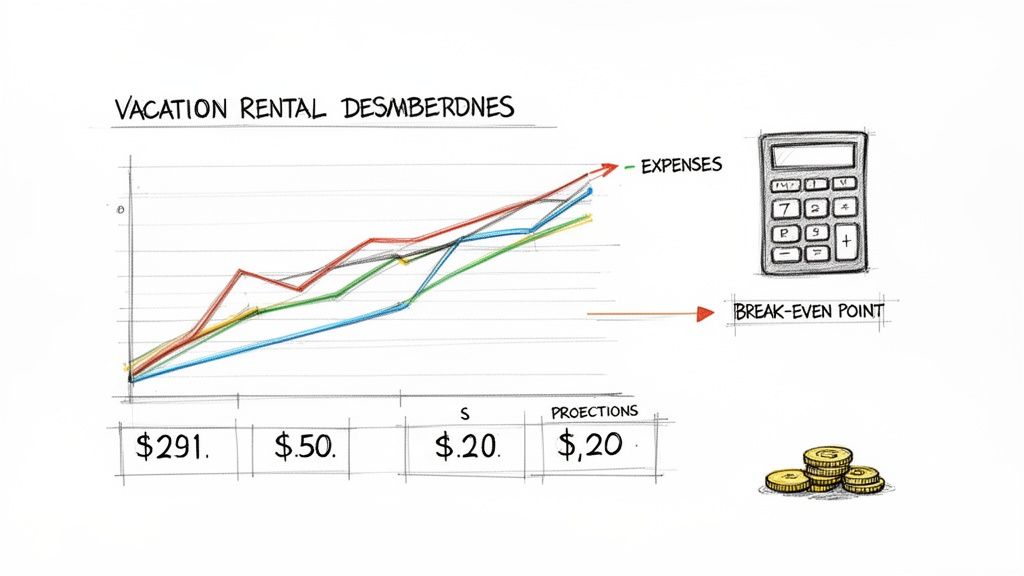
This is the moment of truth. It's where your business plan for a vacation rental shifts from a passionate idea into a cold, hard, viable enterprise. Your numbers have to tell a clear and convincing story—not just to investors or lenders, but to yourself.
Financial forecasts are the absolute backbone of your plan. They prove that your property isn't just a great concept; it's a profitable one.
A classic mistake I see all the time is getting swept up in optimistic revenue dreams without a firm grip on the actual costs. Let's avoid that. We're going to build a realistic financial roadmap from the ground up, starting with what you can legitimately expect to earn.
Projecting Your Revenue Realistically
Guessing your income is just a fast track to failure. Your revenue forecast needs to be anchored in solid market data. That means digging into local performance metrics to build a projection that can withstand scrutiny.
The core formula is simple enough: (Average Daily Rate) x (Occupancy Rate) x (Number of Nights).
But the real work is in finding accurate figures for that ADR and occupancy rate. You need to get your hands on data from sources like AirDNA or PriceLabs to see what comparable properties in your specific neighborhood are actually making.
And please, don't forget about seasonality. Your summer ADR is going to look wildly different from your slow season rates. A truly robust projection breaks this down month-by-month for at least the first year.
For a much deeper dive into optimizing your nightly rates and overall earnings, exploring advanced vacation rental revenue management strategies is a critical next step.
Outlining Startup and Operational Expenses
Profit is what’s left after every single bill is paid. A credible financial plan needs an exhaustive list of every conceivable cost, broken down into two essential categories.
First up are the One-Time Startup Costs. These are all the initial, non-recurring investments required to get your property guest-ready.
- Furniture and Decor: Everything from the big-ticket items like beds and sofas down to the artwork on the walls.
- Appliances and Housewares: All the kitchen supplies, linens, towels, and electronics.
- Professional Photography: This is non-negotiable. Great photos are what stop the scroll.
- Permits and Licensing Fees: The necessary evil of legally operating in your municipality.
- Initial Deep Clean: You have to start at a five-star standard from day one.
Next are your Recurring Operational Expenses. These are the ongoing costs you'll pay every month or year just to keep the lights on and the business running.
- Mortgage or Rent: Usually your biggest fixed cost.
- Utilities: Internet, electricity, water, gas, and trash service.
- Insurance: Don't skimp here. You need specific short-term rental insurance.
- Software Subscriptions: Your PMS, dynamic pricing tools, and guest messaging platforms.
- Consumable Supplies: Toilet paper, soap, coffee, welcome basket items—it all adds up.
- Professional Cleaning Fees: The cost per turnover between guests.
- Maintenance and Repairs: A good rule of thumb is to set aside 5-10% of your revenue for the unexpected.
- Marketing Spend: Budget for direct booking ads or other promotional efforts if that's part of your strategy.
Before we move on, let's look at a sample breakdown. This table gives you a clearer picture of how to separate those one-time hits from the monthly grind.
Sample Startup And Operational Expense Breakdown
| Expense Category | Example Items | Estimated Cost Range (One-Time) | Estimated Cost Range (Monthly) |
|---|---|---|---|
| Furnishings & Decor | Beds, sofa, tables, lighting, art, rugs | $5,000 - $15,000+ | $0 |
| Housewares | Linens, towels, kitchenware, small appliances | $1,000 - $3,000 | $50 - $150 (replacements) |
| Setup & Legal | Photography, licenses, initial deep clean | $500 - $2,000 | $0 |
| Property Costs | Mortgage/Rent, Property Taxes | Varies | $1,500 - $5,000+ |
| Utilities | Wi-Fi, electricity, water, gas, trash | $0 | $200 - $500 |
| Operations | Cleaning fees, supplies, software (PMS, etc.) | $0 | $400 - $1,000+ |
| Maintenance | Repairs, pest control, landscaping | $0 (Budget Reserve) | $150 - $400 (5-10% of revenue) |
| Insurance | Short-Term Rental Policy | Varies | $100 - $300 |
This is just an example, of course. Your actual numbers will depend heavily on your property size, location, and the level of luxury you're aiming for. The key is to be thorough.
By meticulously tracking these expenses, you create a clear picture of your financial obligations. To effectively forecast your financial future, learning how to create financial projections is a foundational skill for any business owner.
Key Financial Statements to Include
With your revenue and expenses mapped out, you can build the reports that actually prove your business model works. Your plan needs three core financial statements.
First, your Profit and Loss (P&L) Forecast. This shows your projected profitability over a specific period—usually the first three to five years. It simply subtracts your total projected expenses from your total projected revenue to show your net profit or loss.
Second is the Cash Flow Projection. This is absolutely vital for managing your bank account. It tracks the actual cash moving in and out of your business monthly. This statement is critical because it helps you anticipate and plan for slow seasons when expenses might outweigh income, ensuring you always have enough cash on hand to pay the bills.
Finally, a Break-Even Analysis calculates the exact point where your total revenue equals your total costs. It tells you the minimum occupancy rate you need to hit just to cover everything. This analysis is incredibly powerful for understanding your risk and setting realistic performance targets.
The vacation rental market in the United States is showing incredible strength. North America holds a commanding 36.7% global revenue share, and the US market alone is projected to hit USD 21.08 billion in revenue by 2025. This growth, climbing from USD 19.39 billion in 2023, cements its status as the world's top-grossing market. Your financial projections should show that you understand and are ready to capture a piece of this promising landscape.
Common Questions About Vacation Rental Business Plans
Crafting your first business plan for a vacation rental always kicks up a few crucial questions. Getting these right from the start can be the difference between a plan that gathers dust and one that actually guides your business to success.
Let's dive into the most common questions we hear from hosts who are just starting out.
How Detailed Should My Financial Projections Be?
If you're looking for money from a lender or investor, the short answer is: incredibly detailed. A vague, back-of-the-napkin forecast just won’t fly. You need to show them you have a rock-solid grasp on the financial reality of this business.
A good rule of thumb is to build out a three-to-five-year financial forecast. Your first year should be broken down month-by-month to really show how seasonality impacts your cash flow. After that, you can switch to annual projections.
Your projections absolutely must include:
- Startup Cost Summary: A full rundown of every single one-time expense, from furniture and photography to permits and your first big supply run.
- Projected P&L Statement: This is where you map out your expected revenue, all your expenses, and the resulting net profit over time.
- Cash Flow Forecast: This part is critical. It tracks the actual cash moving in and out of your bank account, which will highlight potential tight spots during the slow season.
And please, don't just pull numbers out of thin air. You need to justify your revenue projections with real-world data on occupancy rates and Average Daily Rates (ADR) from a trusted source like AirDNA. It's vital to show your work by clearly stating your assumptions, like "assuming a 65% average occupancy at a seasonal ADR of $250."
Pro Tip: Build out three financial scenarios in your plan—conservative, moderate, and optimistic. This shows investors you’ve thought through a range of outcomes and are ready for whatever the market throws at you. It adds a massive layer of credibility.
What Is The Biggest Mistake To Avoid In My Plan?
The single most common—and fatal—mistake is underestimating your expenses while getting way too optimistic about your revenue. It happens all the time. New hosts see the high nightly rates on Airbnb and get stars in their eyes, completely forgetting about the unglamorous, but very real, costs of running the show.
This oversight leads to a business plan built on a fantasy. You have to be brutally honest about your costs. That means digging deep and accounting for all the "hidden" expenses that can eat away at your profits faster than you can say "five-star review."
These are the costs people frequently forget:
- Replacing worn-out linens and towels—it happens more often than you think.
- Constantly restocking amenities like coffee, soap, and paper towels.
- Higher insurance premiums for a proper short-term rental policy.
- Monthly software fees for your property management system.
- Local lodging and tourism taxes you're responsible for paying.
- A buffer for unexpected repairs (because they will happen).
On the revenue side, assuming you'll be at 90% occupancy from day one is a recipe for disaster. A believable business plan uses realistic occupancy rates pulled from market data, factors in natural vacancy, and includes a contingency fund—usually 5-10% of your gross revenue—for surprises. A plan that honestly confronts real-world challenges is always more persuasive than one based on wishful thinking.
How Do I Make My Plan Stand Out To Investors?
Investors see a ton of these plans. To make yours jump out of the stack, you need to nail two things: your unique selling proposition (USP) and a clear, compelling strategy for driving high-margin direct bookings.
Investors are completely over seeing plans that just say, "I'll list on Airbnb." That’s a starting point, not a strategy. You need to show them what makes your property an experience, not just another place to sleep. What's your unique angle?
- Is it a themed getaway, like a "Wizard's Hollow"?
- Do you have a sharp focus on accessibility, with ramps and roll-in showers?
- Are you a luxury spot for pet lovers, complete with a dog run and welcome baskets for furry guests?
Once you've defined what makes you special, you need to detail your plan to build a brand and cut down your reliance on the big booking sites. This is how you prove you're a serious operator. Lay out your strategy for a direct booking website, an email list to bring back past guests, and a social media presence that builds a real community.
Highlighting your grasp of technology—like using dynamic pricing tools to maximize every night's rate or operational software to make your cleanings more efficient—shows you're focused on profitability, not just running a side hustle. This approach tells an investor you're not just buying a job; you're building a scalable, resilient business.
Ready to build a powerful direct booking engine that investors will love? hostAI creates intelligent websites and runs hands-free marketing campaigns designed to double your direct revenue. Learn how hostAI can help you take control of your bookings today.