
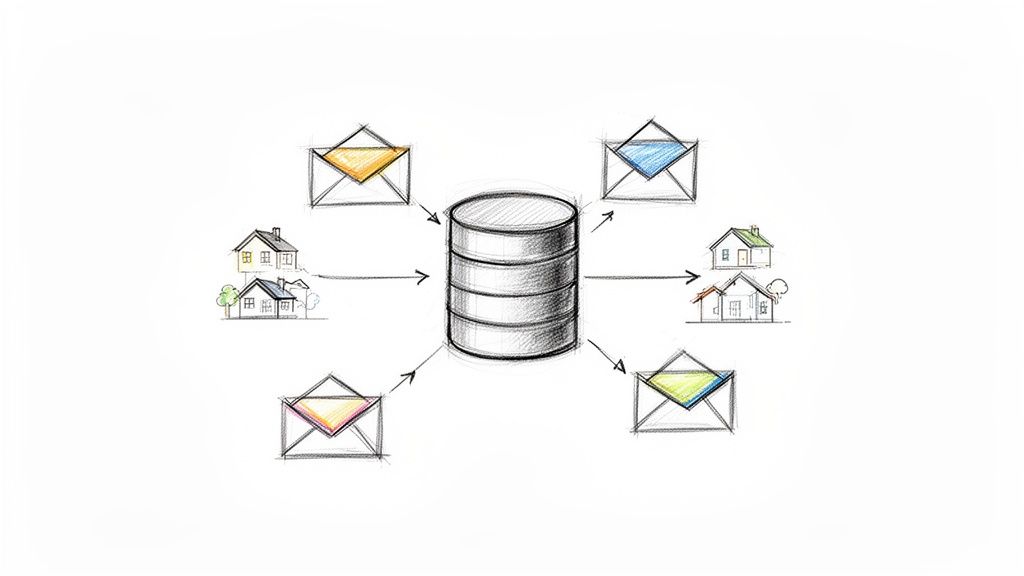
database email marketing
Database Email Marketing: A Guide for STR Managers
Posted on Jan 1, 2026
TL;DR: OTAs hand you a guest once, then keep the relationship. Database email marketing flips that — you use the guest data you already own (stay history, booking behavior, preferences) to send the right offer at the right moment, pull past OTA guests into your direct database, and turn one-time stays into repeat, full-margin bookings. Below: what to collect, how to segment, the automated sequences that run while you sleep, and the numbers that prove it worked.
Database email marketing is the practice of using your guest data — past stays, booking lead time, party size, property preferences — to send targeted, automated messages that drive direct bookings instead of generic blasts. For short-term rental operators, it's the most reliable way to do the one thing OTAs make almost impossible: own the guest relationship and earn the second stay.
Here's the reality check most operators learn the hard way. Industry benchmarks put vacation-rental repeat-guest rates at only about 15–30% of bookings (Hostaway) — meaning the clear majority of guests who stay with you once never book again. OTAs are brilliant at discovery and terrible at loyalty — by design. They captured the guest's email, payment, and trust, and they have no incentive to send that guest back to you. Your guest database is the one asset that lets you take it back.
Your Untapped Goldmine: What Database Email Marketing Actually Is
Think of your guest list not as a spreadsheet but as a record of intent. Every booking tells you something: when this guest travels, how far ahead they plan, who they bring, what kind of property they choose. A guest who booked a pet-friendly cabin last summer is a different person — commercially — than a couple who booked your downtown loft for an anniversary. Database email marketing is simply acting on that difference at scale.
This is a structural shift, not a tactic. The "one-size-fits-all newsletter" treats your hardest-won asset — a guest who already trusted you with their trip — like a stranger. A data-driven approach treats each segment like a conversation already in progress.
Why This Is the Direct-Booking Play, Not Just "Marketing"
The strategic point is this: discovery happens on OTAs; loyalty has to happen on your channels. Travel planning is famously fragmented — the average traveler runs 33 searches across 12 different travel sites (Bain) before booking. You will rarely win that first chaotic search against Airbnb's ad budget. But you don't have to. Once a guest has stayed with you, the next booking should never go through an OTA again — and email is how you make sure it doesn't.
- It recaptures margin. A repeat direct booking carries no OTA commission. The same guest, the same nightly rate — but you keep the 15–20% that used to leave the building.
- It compounds. Every clean booking adds to a database that gets more valuable every season, while OTA "audiences" reset to zero the moment you stop paying.
- It builds the brand. Guests who hear from you directly remember you — not the platform they happened to book through.
OTAs rent you a guest for one stay. Your database lets you own the relationship for every stay after that. That's the whole game.
Building Your Foundation with Quality Guest Data
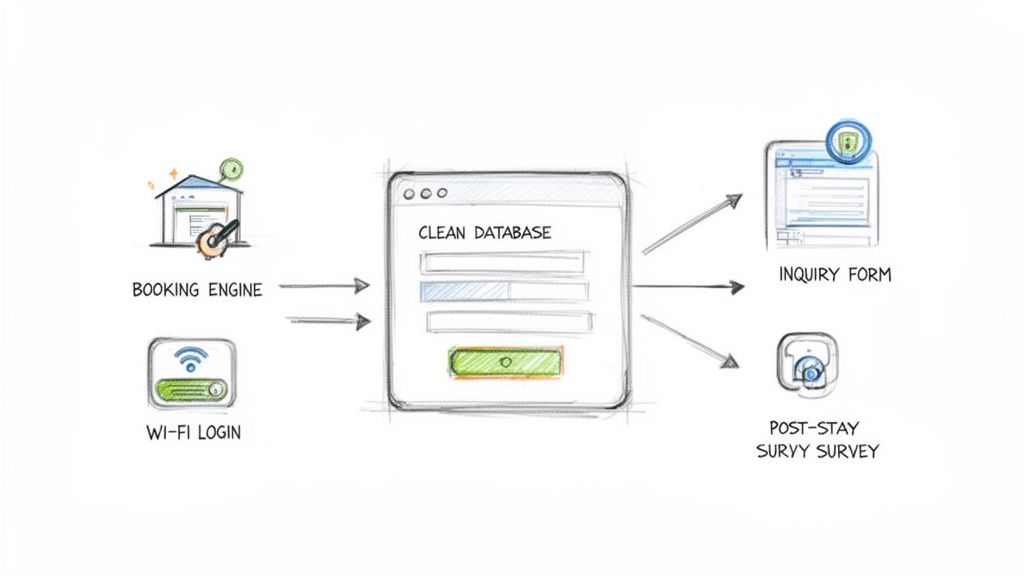
A database strategy is only as good as the data feeding it. Your direct booking engine is the obvious starting point — it captures the guest's real email and contact details at the point of sale, not the masked relay address an OTA gives you. That distinction matters more than anything else here: an OTA-relayed email is borrowed; a direct-booked email is yours.
Beyond the booking engine, every touchpoint is a chance to learn more: pre-stay questionnaires, inquiry forms, and even your in-property Wi-Fi login portal. The goal isn't to hoard data — it's to collect the few fields that actually change what you'd send someone.
Essential Guest Data Points for STR Managers
| Data Point | Source Example | Marketing Application |
|---|---|---|
| Stay History | Booking engine (CRM/PMS) | Welcome series for first-timers; loyalty perks for repeat guests. |
| Party Composition | Pre-stay questionnaire | Family-friendly offers vs. couples' getaway packages by group size. |
| Booking Lead Time | Booking engine data | Advance discounts for early planners; flash sales for last-minute bookers. |
| Property Preferences | Booking history | Pet-friendly booker → promote your other pet-friendly units. |
| Booking Channel | PMS / booking engine | Flag OTA-sourced guests for a "book direct next time" nurture. |
| Email Engagement | Email platform | Re-engage or suppress subscribers who've gone quiet. |
Data Hygiene: Boring, Non-Negotiable
Collecting data is half the job; keeping it clean is the other half. A list full of bounced addresses and dead contacts drags down deliverability, which means even your best campaigns quietly land in spam. Regularly prune inactive subscribers, fix bounces, and de-duplicate. If you run Mailchimp, our walkthrough on cleaning your email list covers the mechanics.
A clean list isn't admin busywork — it's what keeps your direct-booking offers in the inbox instead of the spam folder. Bad hygiene quietly taxes every campaign you'll ever send.
The Power of Precision: Audience Segmentation
Segmentation is where a clean database starts paying you back. The principle is simple: stop broadcasting, start matching the message to the guest. A skilled travel agent never hands every client the same brochure — they ask who's traveling and why first. Your email program should do the same, automatically.
The Segments That Move Direct Bookings
Booking history. Your highest-leverage split, full stop. At minimum: first-time guests, repeat guests, and lapsed guests (no booking in 12+ months). These three groups need completely different conversations.
Channel of first booking. The segment most operators miss. Guests who first came via an OTA are your single biggest recapture opportunity — they've stayed, they liked it, and right now the OTA owns the rebooking. A targeted "next time, book with us directly and save" sequence is how you convert them.
Booking lead time. "Early planners" want advance-booking discounts months out; "last-minute bookers" are your list for filling a sudden gap with a 48-hour flash offer.
Geography. Guests within driving distance are gold for off-season weekend-getaway offers.
A Worked Example: The Win-Back Math
Theory is cheap, so let's run real numbers. Say you manage 25 units and have hosted 800 unique guests over three years. Pull the lapsed segment — guests who stayed once and haven't booked in 12+ months. Since only a minority of vacation-rental guests ever rebook (industry benchmarks peg repeat guests at roughly 15–30% of bookings), this segment is usually the bulk of your list; for a conservative estimate, call it 500 lapsed guests.
You build one automated win-back sequence: a "we miss you" email with a modest direct-only incentive, a reminder a week later, and a final nudge with a soft deadline. A well-targeted win-back to a warm list of past guests doesn't need a heroic conversion rate to pay for itself. Suppose it reactivates a conservative 4%:
- 500 lapsed guests × 4% = 20 recovered bookings
- 20 bookings × an average stay value of $1,200 = $24,000 in recovered revenue
- And because those bookings came direct, you also avoid roughly $3,600–$4,800 in OTA commission you'd have paid had they rebooked on a platform (15–20%)
The sequence is built once and runs forever. Every new guest who goes quiet eventually drops into it automatically. (Your figures will differ — plug in your own guest count, ADR, and reactivation rate; the structure is what matters.) Compare that to a generic monthly newsletter to your whole list, and the case for segmentation makes itself.
For a deeper playbook on the highest-value sequence of all, read our guide to guest rebooking emails for short-term rental owners.
Automating the Guest Journey with Lifecycle Campaigns
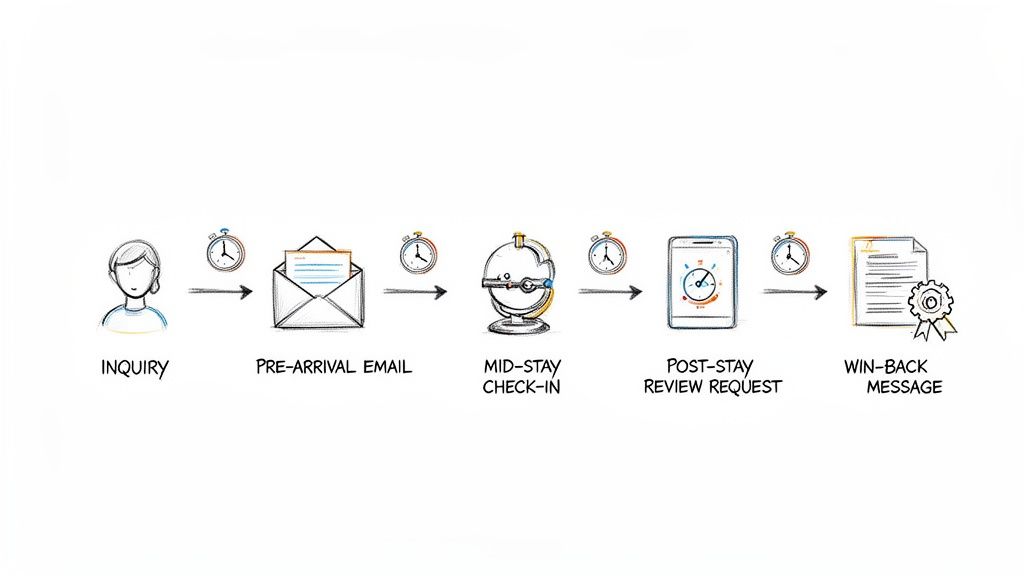
Once your segments exist, you stop sending emails by hand. Lifecycle campaigns are pre-built sequences that fire on a guest action or date — they turn your marketing into an always-on concierge that runs whether you're awake or not. The guest journey starts at inquiry and stretches long past checkout, and the best operators map a touchpoint to each stage.
The Must-Have Sequences
Pre-arrival series. Confirmation, payment reminders, and check-in details (codes, directions, house rules) timed a day or two before arrival. Sets the tone and cuts day-of support questions.
Mid-stay check-in. A simple day-two "how's everything going?" lets you fix a small problem before it becomes a one-star review.
Post-stay follow-up. Triggered the day after checkout — thank the guest, request a review with a direct link, and start the relationship that leads to the next direct booking.
The Revenue Sequences
OTA-to-direct recapture. The one tuned to the STR problem specifically. When a first-stay guest came via an OTA, an automated post-stay sequence introduces your direct site and a returning-guest perk — converting a platform's customer into yours.
Win-back. The lapsed-guest sequence from the example above, running on autopilot.
Anniversary / birthday. If you track a guest's first-stay date or birthday, a celebratory offer gives them a reason — and a deadline — to come back.
This is exactly where a purpose-built tool earns its keep. hostMail connects to your booking engine so these sequences trigger off real reservation data — meaning the OTA-recapture and rebooking flows fire automatically, and every repeat stay lands direct. (For the broader picture, see our guide on automating your short-term rental business.)
Automation isn't about sending more email. It's about making sure no guest — and no second booking — ever slips through the cracks while you're busy running properties.
Measuring Success with the Right KPIs
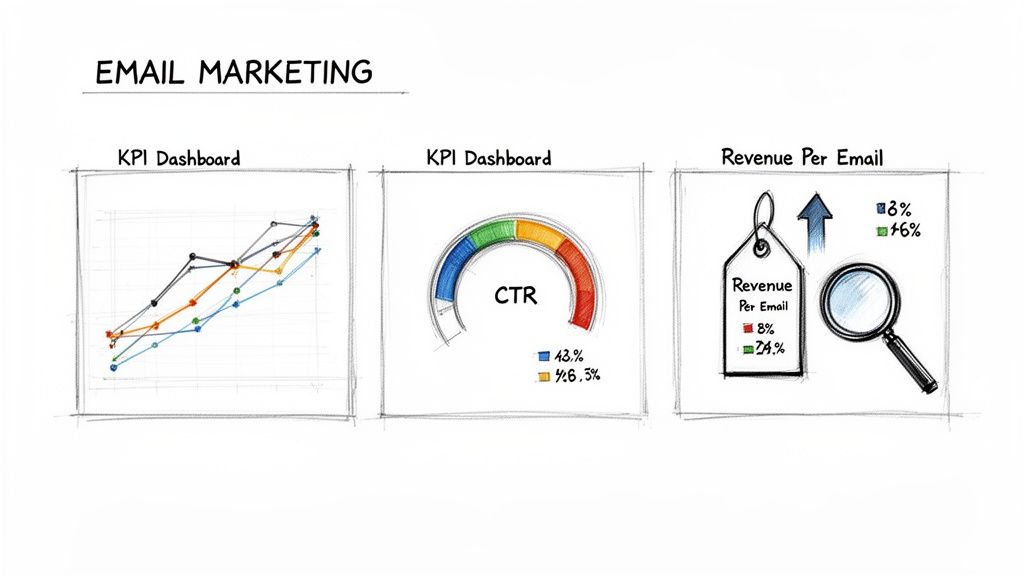
Open rates flatter you; they don't pay you. For STR operators, every email metric should ladder up to one question: did this drive a direct booking? Track these four:
Click-through rate (CTR). Did the offer land with the segment you targeted?
Direct-booking conversion rate. The real scoreboard — the share of recipients who booked direct off a campaign.
Repeat-guest / direct-booking ratio. The STR-specific north star: what percentage of your bookings now come direct versus OTA, and is email moving it month over month?
Revenue per email (RPE). Total campaign revenue ÷ emails sent. Tells you what each send is actually worth.
Staying Compliant — and Building Trust
Compliance isn't red tape; it's the floor of a guest-centric program. The core rules behind GDPR (EU) and CAN-SPAM (US) reduce to three things, all of which happen to make your list healthier:
- Explicit consent. Clear opt-in, no pre-checked boxes.
- An easy exit. A prominent unsubscribe link in every email.
- Honesty. Real sender identity, valid physical address, non-deceptive subject lines.
A guest who trusts you with their inbox is far more likely to trust you with their next trip. That's the whole point.
Got Questions? Answers for Busy Operators
How big does my email list need to be?
Smaller than you think. Quality beats quantity every time — a finely targeted campaign to 50–100 engaged past guests will out-earn a generic blast to 1,000 cold contacts. Start collecting from every booking and inquiry today; the list compounds on its own.
Isn't this just a newsletter?
No. A newsletter is a broadcast — the same message to everyone. Database email marketing is a one-to-one conversation at scale, driven by guest data (last stay, property booked, party size) so each message feels written for that guest. One gets ignored; the other gets booked.
How much time will this take to manage?
There's an upfront lift — connecting your data sources, cleaning the list, and building your first sequences takes a few focused days. After that, automation does the work 24/7. Your ongoing job shrinks to two things: a periodic glance at your KPIs, and the occasional one-off campaign (a holiday promo, a last-minute deal). The recurring time cost drops to near zero.
Your guest database is the one marketing asset OTAs can't take from you — but only if you put it to work. See how hostAI turns your guest data into automated, commission-free repeat bookings.