

google ads bidding strategies
A Practical Guide to Google Ads Bidding Strategies
Posted on Dec 7, 2025
Think of your Google Ads bidding strategy like the transmission in your car. Picking the right one means you'll cruise smoothly toward your goals. Picking the wrong one? You'll be stalled out on the side of the road, burning cash.
The best strategy always comes down to what you're trying to achieve, but they all fall into two main camps: manual bidding for when you want total control, and automated Smart Bidding for when you want to let Google's AI do the heavy lifting.
How to Choose Your Google Ads Bidding Strategy
This is where we cut through the jargon and figure out which bidding strategy actually makes sense for your vacation rental business. We're moving past just thinking about cost-per-click and looking at the two big-picture approaches.
One way is manual control—it’s like driving a stick shift. You're in complete command of every gear change, every decision. The other is automated Smart Bidding, which is more like a high-tech self-driving car that uses AI to navigate the complex digital highways for you.
Once you get the hang of how each one works, you can easily match your goal—whether that's just getting your brand name out there, generating leads, or driving direct bookings—to the right bidding engine.
Aligning Strategy with Business Goals
Before you touch a single setting in Google Ads, you have to answer one question: what does a "win" look like for this campaign? Are you just trying to get in front of as many eyeballs as possible? Or are you laser-focused on squeezing every last drop of profit out of your ad spend?
Each goal demands a completely different engine.
For instance, a brand-new vacation rental company just entering a market might pour its budget into a visibility-focused strategy to build awareness. On the other hand, an established property manager will almost certainly be obsessed with hitting a specific return on ad spend (ROAS) to keep the business profitable.
Choosing a bidding strategy isn't just a technicality; it's you telling Google's algorithm what matters most. It's your way of saying, "Hey Google, I care about clicks," or "I care about conversions," or "I only care about revenue."
Manual vs Automated Bidding
At the end of the day, your biggest choice is whether you want to be in the driver's seat or hand the keys over to Google's automation.
- Manual Bidding: This gives you pinpoint control. You can set a specific maximum bid for every single keyword. It's perfect for hands-on advertisers who love digging into the data and have the time to constantly tweak their campaigns.
- Automated Bidding: This uses machine learning to set bids for you in real-time, based on how likely a click is to turn into a booking. It's a massive time-saver and can factor in dozens of signals that a human just can't track.
For a deeper dive into this decision, it's worth exploring the nuances of choosing the right bidding strategy for your Google Ads campaign. Getting this foundational choice right is the first real step toward building a campaign that actually works.

The Shift from Manual Bids to Smart Automation
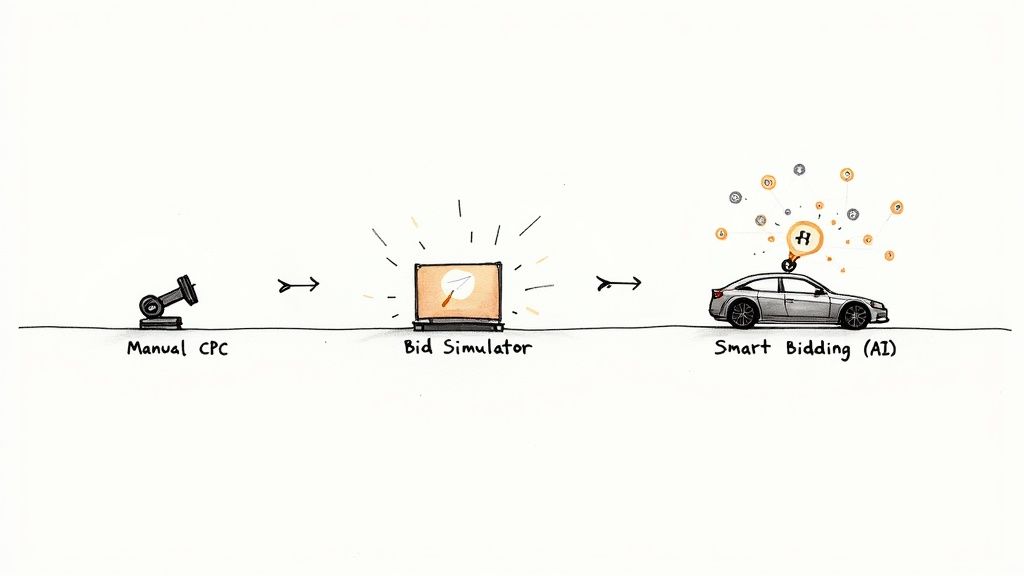
To really get a handle on today's Google Ads bidding strategies, it helps to see where they came from. For the longest time, the only game in town was Manual CPC (Cost-Per-Click) bidding. Think of it like being a day trader for your own ads—you had total control, setting the maximum price you were willing to pay for every single click on every single keyword.
This level of control was powerful, no doubt. But it was also incredibly time-consuming. Your success was completely tied to your ability to sit there, watch performance, and react to every little ripple in the market. If a competitor decided to bump their bids overnight, you had to be ready to respond or risk vanishing from the search results. For a busy STR manager, that kind of constant, manual oversight just wasn't sustainable.
The First Glimpse of Automation
Google saw this was a huge pain point. They started rolling out tools to help advertisers make smarter decisions without having to live inside a spreadsheet. One of the earliest and most important of these was the Bid Simulator.
This tool was our first real peek into a data-driven future. It would crunch past auction data—looking at things like your keyword Quality Scores and what competitors were doing—to estimate what might happen if you changed your manual bid. For example, it could project how many more clicks or impressions you might get by upping your bid by $0.25.
While we were all stuck using manual strategies like Max CPC, we were often just guessing how to spend our budgets to actually get bookings. The Bid Simulator was a game-changer because it used real auction data to show how a small bid change could impact clicks, costs, and conversions, nudging us toward smarter decisions. You can dive deeper into how Google generates these forecasts on their developer resources.
The Foundation of Smart Bidding
As helpful as it was, the Bid Simulator was still reactive. It gave you the intel, but you still had to go in and make the changes yourself. The real magic, though, was in the underlying logic: analyzing tons of data points in real time to predict an outcome. That became the blueprint for something much, much bigger.
The core principles of the Bid Simulator—analyzing competition, user signals, and quality scores—were the building blocks for the sophisticated, AI-driven Smart Bidding strategies we use today.
This move from manual tweaks to predictive automation is everything. It's the reason Google poured so much into machine learning. They took the painstaking process of analyzing data and making educated guesses and put it on autopilot at a massive scale. This shift completely changed how we run PPC campaigns, moving our focus from tedious bid management to high-level strategy. Understanding this journey is the key to mastering the powerful bidding tools you have at your fingertips now.
Comparing Your Automated and Smart Bidding Options
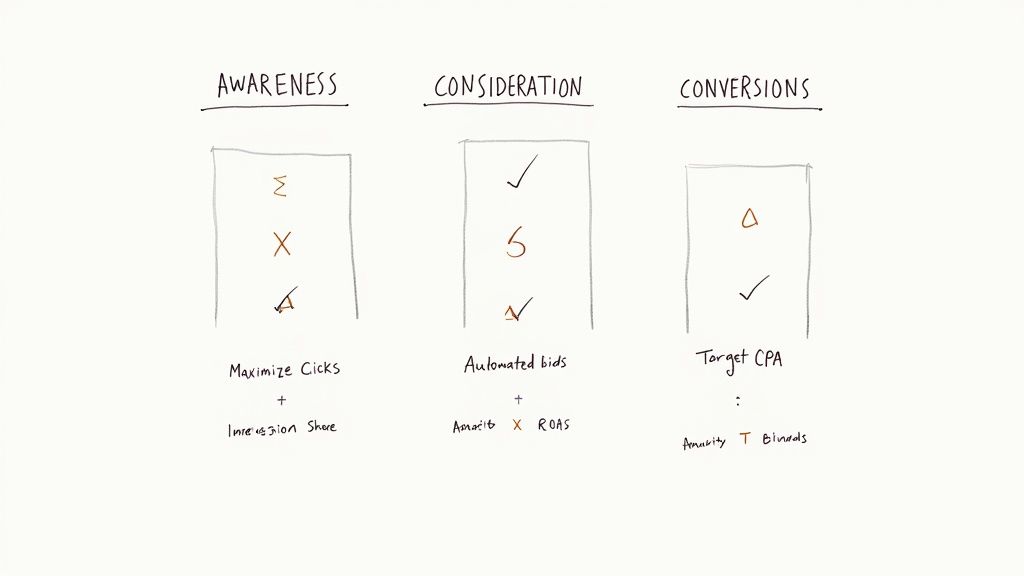
Diving into Google's bidding strategies can feel like staring at a restaurant menu with way too many options. To make sense of it all, let's break them down by what you're actually trying to accomplish: getting your name out there (awareness), getting people to your website (consideration), or locking in a booking (conversion).
Think of each strategy as a different tool in your toolbox. Some are like sledgehammers, great for making a big impact and getting seen. Others are more like surgical scalpels, designed for the precision work of maximizing profit from every single booking. The trick is always to match the right tool to the job at hand.
Bidding for Awareness
When your main goal is just to be seen, you’re playing the visibility game. These strategies are all about getting your ads in front of as many eyeballs as possible, prioritizing impressions above everything else.
- Target Impression Share: This one is as straightforward as it gets. You simply tell Google where on the search results page you want to show up—absolute top, near the top, or anywhere on the page—and it adjusts your bids to hit that goal. It’s perfect for brand awareness campaigns where the name of the game is simply being noticed.
Bidding for Consideration
Okay, so people know you exist. Now what? The next step is getting them to click through to your website and browse your properties. The strategies in this bucket are all about driving traffic.
- Maximize Clicks: The name says it all. This strategy tells Google to get you the most clicks it can for your daily budget. It’s a solid choice when you just need to drive traffic, maybe to build up an email list or to gather some initial campaign data before you have enough booking history to switch to a conversion-focused strategy. Just be sure to set a maximum CPC bid so you don't end up paying a fortune for a single click.
Bidding for Conversions
This is where the real power of Google's algorithm kicks in. Smart Bidding strategies use machine learning to chase valuable actions like direct bookings, not just empty clicks or impressions. These advanced strategies are the engine behind most modern campaigns and are a key part of the modern advertising toolkit. If you're interested in how AI is changing the game, it's worth exploring the best AI marketing tools that can work alongside these bidding efforts.
- Maximize Conversions: With this strategy, you're telling Google's algorithm to hunt down the highest number of bookings possible within your set budget. It crunches dozens of real-time signals—like the user's device, location, and search history—to predict which clicks are most likely to turn into a paying guest, and then it bids more aggressively for those people.
Smart Bidding has been one of the most impactful developments in Google Ads. Its ability to leverage machine learning for real-time bid optimization sets it apart from older automated strategies.
The shift to Smart Bidding has been a massive leap forward. Campaigns that switch to a strategy like Target CPA can see a huge lift, with some case studies reporting up to a 50% increase in total conversions. To really get the most out of it, understanding strategies like Target Cost Per Acquisition (CPA) is crucial.
Target CPA (Cost Per Acquisition): This is where you get more control. You tell Google the average amount you’re willing to spend to get a single booking. The algorithm then does its magic to bring in as many conversions as possible at or below that target cost. This is the go-to for vacation rental managers who know exactly what a new guest is worth to their bottom line.
Target ROAS (Return On Ad Spend): For many, this is the holy grail for direct-booking campaigns. Instead of setting a cost, you set a target return. For example, a target ROAS of 500% means you want to generate $5 in booking revenue for every $1 you spend on ads. It's a game-changer for businesses with properties at different price points, as it focuses purely on profitability.
To help you see how these powerful Smart Bidding strategies stack up against each other, we've put together a quick comparison table.
Comparing Google Ads Smart Bidding Strategies
This table gives you a side-by-side look at the main Smart Bidding options, their goals, and when you'd want to use them.
| Bidding Strategy | Primary Goal | Best For | Key Requirement |
|---|---|---|---|
| Maximize Conversions | Get the most conversions for your budget | Advertisers who want to maximize bookings and are comfortable letting Google set bids to achieve that volume. | Conversion tracking set up. |
| Target CPA | Get as many conversions as possible at a set cost | Businesses that have a clear cost-per-acquisition goal and need to maintain predictable costs for each booking. | Conversion tracking set up. |
| Target ROAS | Hit a specific return on ad spend target | E-commerce or STR businesses with varying booking values who want to optimize for overall profitability. | Conversion tracking with value. |
Choosing the right one really depends on your business goals. If you're starting out, Maximize Conversions is a great entry point. But as you get more data and a clearer picture of your unit economics, moving to Target CPA or Target ROAS will give you much more control over your profitability.
A Practical Framework for Selecting Your Strategy
Knowing all the different Google Ads bidding strategies is one thing. Actually picking the right one for your vacation rental business? That’s a whole different ball game.
Instead of throwing a dart at the board, let's walk through a simple framework built on three critical questions. Answering these honestly will point you straight to the best starting point for your campaigns, taking the guesswork out of the equation.
This approach grounds your decision in what actually matters for your business. It ensures the strategy you choose lines up perfectly with your goals and the data you have on hand, setting you up for success from day one.
Question 1: What Is Your Primary Campaign Goal?
First things first: what does a "win" actually look like for you?
Are you laser-focused on maximizing the sheer volume of bookings to fill up your calendar? Or is hitting the highest possible return on every dollar you spend the top priority? These two goals often demand very different approaches.
- For Maximum Booking Volume: If your main goal is to get heads in beds and you have a clear idea of what you can afford to pay for each booking, Target CPA is a fantastic choice.
- For Maximum Profitability: If you're all about profit margins and your booking values swing wildly (think a weekend studio vs. a week-long luxury villa), Target ROAS is the way to go. It optimizes for total revenue, not just the number of conversions.
Getting this distinction right is the most important first step. To see how this fits into your bigger financial picture, check out our guide on how to measure marketing ROI.
Question 2: How Mature Is Your Conversion Tracking?
Let’s be honest. Your bidding strategy is only as smart as the data you feed it.
Is your conversion tracking absolutely dialed in, capturing every single direct booking with its correct value? Or is it fresh out of the box and you're still kicking the tires?
If your tracking is brand new or you aren’t 100% confident in its accuracy, jumping straight into an advanced strategy like Target ROAS is asking for trouble. The algorithm could easily make some terrible decisions based on flawed data. It's much safer to start with a strategy that's less data-dependent while you build up a reliable history.
A powerful automated bidding strategy running on bad data is like a high-performance engine running on contaminated fuel. It won't get you where you need to go and will likely cause damage along the way.
Question 3: What Is Your Data Volume?
Finally, take a look at your campaign's history. Google's Smart Bidding algorithms are hungry for data—specifically, conversion data. They need it to learn.
As a rule of thumb, Google generally recommends having at least 15-30 conversions within the last 30 days before you hand the keys over to strategies like Target CPA or Target ROAS.
If your account is brand new and doesn't have that kind of track record, the algorithm has nothing to learn from. A great starting point in this case is Enhanced Cost-Per-Click (eCPC). Think of it as a hybrid approach—it blends your manual control with Google's automated adjustments. This lets you gather that crucial conversion data before you commit to full automation.
Best Practices for Implementing Your Bidding Strategy
Picking the right Google Ads bidding strategy is only half the battle. How you roll it out is where the real magic happens. Think of the initial setup not as flipping a switch, but as the start of a critical training period for Google's algorithm.
This is where you lay the foundation for a profitable campaign. So many managers rush this part and end up wasting ad spend on poor results. Treat it like you're carefully calibrating a high-performance engine before a long race—a little patience now will pay off big time down the road.

Nail Your Conversion Tracking First
Before you touch anything else, get your conversion tracking buttoned up. Seriously, this is non-negotiable for any campaign that’s supposed to drive bookings. Smart Bidding strategies are completely dependent on the data you feed them. If your tracking is off, you’re essentially giving the AI garbage to work with.
It’s like trying to find your way with a broken compass—you’re just going to get lost. For vacation rental brands, this means tracking every single direct booking with precision and, ideally, passing the actual booking value back into Google Ads.
Respect the Algorithm's Learning Period
Once you launch a new Smart Bidding strategy, Google's algorithm kicks into a learning period. This phase usually takes about 5-7 days. During this time, the system is frantically gathering data to figure out how to best bid for your goals.
It is absolutely crucial to avoid making any major changes to the campaign during this window. Tinkering with budgets, targets, or even ad copy can reset the entire learning process, forcing the algorithm to start from scratch. Patience is your best friend here.
Think of the learning period like training a new employee. You wouldn't change their entire job description on day two. Give the algorithm time and consistent data to learn its role effectively.
Set Realistic Initial Targets
When you're setting up strategies like Target CPA or Target ROAS, it’s tempting to get aggressive with your goals right out of the gate. This can backfire spectacularly by choking your campaign, preventing it from even entering enough auctions to gather the data it needs.
Start with a target that’s actually achievable based on your campaign's recent history. If your average cost-per-booking has been $50, don't set your initial Target CPA to $25. Instead, start somewhere close to your current average. You can gradually tighten the screws and make your target more aggressive once performance stabilizes. This slow-and-steady approach gives the algorithm the breathing room it needs to find its footing.
Fine-Tune Your Campaign Structure
Your campaign structure needs to support your bidding strategy, not fight against it. When you group keywords with similar goals and user intent, you make it much easier for the algorithm to optimize effectively.
And don't forget to use bid adjustments as helpful signals. While Smart Bidding automates the final bid, you can still guide it. Applying positive bid adjustments to high-value audiences (like people who have visited your booking site before) tells Google, "Hey, these people are important!"
Finally, make sure you have a robust negative keyword list in place to stop wasting money on irrelevant searches. If you need a starting point, check out our comprehensive list of negative keywords to help clean up your traffic.
Common Bidding Mistakes and How to Avoid Them
Even the most sophisticated bidding strategies can burn through your budget if you’re not careful. It happens all the time. Property managers make a few simple, avoidable mistakes that kill their campaigns before they ever have a chance to get off the ground.
Let's walk through the most common pitfalls so you can sidestep them and give your campaigns a real shot at success.
Setting Unrealistic Goals From Day One
One of the quickest ways to doom a campaign is to set overly aggressive targets right out of the gate.
For example, launching a new Target ROAS campaign with a sky-high goal will completely choke its volume. The algorithm looks at your target, realizes it can't possibly hit that number, and simply stops entering auctions. It never gets the data it needs to start learning and improving. You have to give it some runway to get going.
Micromanaging the Algorithm
Another classic mistake is making constant, knee-jerk adjustments. We get it, you want to see results now. But every time you make a significant change—like tweaking your CPA target or messing with the budget—you reset Google's crucial learning period.
This forces the system to start the learning process all over again. Your campaign gets trapped in a permanent state of learning instead of actually optimizing for performance.
Think of it like this: You can't judge a chef's final dish after they've only preheated the oven. Give the algorithm the full 5-7 days it needs to cook before you start tasting the results and making changes.
Relying on Messy Data
This is the big one. Smart Bidding is only as smart as the data you feed it.
If your conversion tracking is a mess, you’re essentially giving the algorithm a faulty map and telling it to fly your campaign. It will confidently and efficiently fly you straight into a mountain. Before you hand over the controls to any automated strategy, you absolutely must ensure your conversion tracking is flawless. Garbage in, garbage out.
Got Questions About Bidding? We've Got Answers.
Even the best-laid plans run into questions once you start digging into Google Ads. It’s completely normal. Let's tackle a few of the most common ones we hear, so you can launch your next campaign with total confidence.
How Long Does the "Learning Period" Actually Last?
Ah, the infamous learning period. Google's Smart Bidding algorithm needs about 5-7 days to get its bearings. Think of it like a new employee on their first week—it's busy gathering data, figuring out what works, and learning the ropes of your account.
During this critical window, the single most important thing you can do is... nothing. Seriously. Avoid the temptation to tweak your budget, change your targets, or swap out ad creative. Any major shift will hit the reset button, and the algorithm has to start learning all over again. Patience is the name of the game here.
Can I Still Use Bid Adjustments with Smart Bidding?
Yes, but their job description changes a bit. For strategies like Target CPA and Target ROAS, the algorithm is already handling device-level bidding, so manual adjustments are mostly redundant. That said, you can still set a device bid adjustment to -100% if you want to completely block traffic from phones, tablets, or desktops.
Where adjustments still pack a punch is with audiences. Think of them less as a strict command and more as a strong suggestion. By increasing the bid for a remarketing list, for example, you're signaling to Google that these users are extra valuable. The algorithm takes that hint and factors it into its own complex calculations to help you land those high-value guests.
How Much Conversion Data Do I Really Need to Start?
This is a big one. For strategies like Target CPA and Maximize Conversions, Google’s official line is a minimum of 15 conversions in the last 30 days.
But for Target ROAS, the bar is higher. You really want to see at least 50 conversions over the last 30 days. Why? Because the algorithm isn't just optimizing for any booking; it's optimizing for bookings of different values. It needs more data to understand the nuances.
Bottom line: the more relevant conversion history you can feed the machine, the faster and smarter it will learn.
Ready to stop guessing and start growing your direct bookings? The hostAI platform uses advanced AI to create and manage advertising campaigns that drive real results for your vacation rental brand.