
how to create email marketing campaigns
How to Build STR Email Campaigns That Convert
Posted on Feb 7, 2026
TL;DR: Email is the one guest channel you actually own — no algorithm, no OTA policy can take it from you. To build STR email campaigns that convert, do four things in order: (1) set one revenue goal per campaign, (2) segment guests using data already sitting in your PMS, (3) automate the full pre-stay → during-stay → post-stay journey, and (4) measure open, click, and conversion rates so each send beats the last. Done right, email turns one-time OTA guests into repeat direct bookers.
Building Your Direct Booking Email Strategy
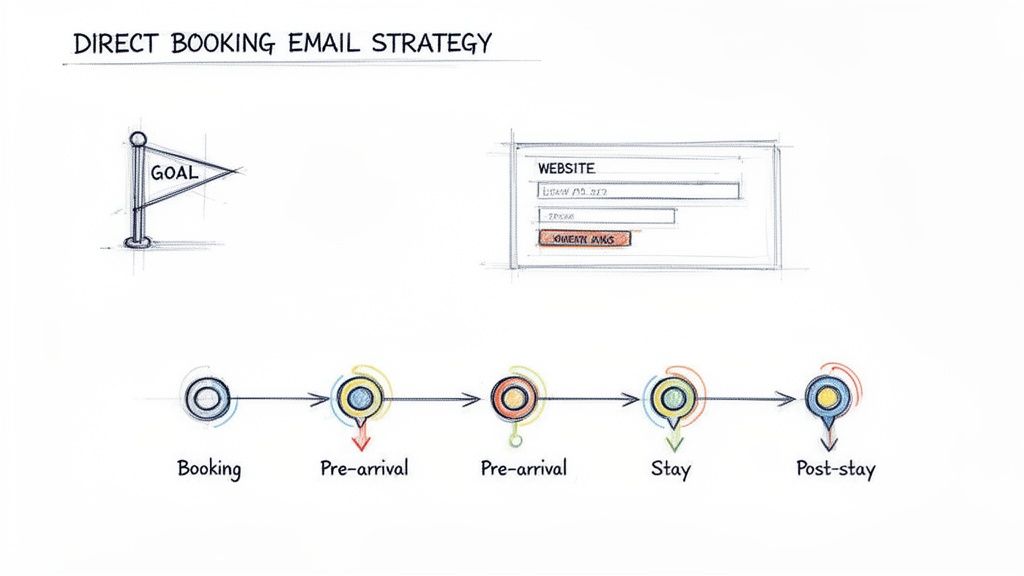
Before you write a single subject line, you need a thesis: your email list is the only marketing channel you fully own. Social reach gets throttled overnight, OTA terms change without your input, and every direct booking an OTA intercepts costs you 15-25% in commission. Your guest email list sits outside all of that. It's a direct line to people who have already paid to stay with you — which makes it the cheapest, highest-intent channel on your books.
The economics back this up. Across industries, email returns an average of $36 for every $1 spent (Litmus). For an STR operator, that ROI doesn't come from blasting a monthly newsletter — it comes from a small number of well-timed, segmented campaigns aimed at one outcome: more direct bookings.
Establish One Goal Per Campaign
Every campaign should drive one measurable result. Without a goal, you're sending email into the void and you'll never know if it worked. Pick the objective first; it dictates your audience, your content, and the metric you'll judge it by.
- More repeat bookings? Send a "welcome back" offer to past guests with a discount code that only works on your direct site.
- Fill off-season gaps? Promote shoulder-season rates or a local event to guests within driving distance.
- Win more reviews? Trigger a post-stay email that nudges happy guests to a review link while the trip is still fresh.
- Lift ADR with upsells? Use pre-arrival emails for early check-in, a stocked welcome basket, or a local-experience add-on.
Your email list is the only marketing channel you truly own. Algorithms and OTA policies change overnight — your direct line to guests doesn't. That's stability and total control over your brand's story.
Map the Guest Journey First
With your goal set, map the journey from booking to long after checkout, and mark the moments where a well-timed email earns its keep: the confirmation, the pre-arrival window, the morning after night one, the checkout follow-up. Each touchpoint is a chance to build the relationship and plant the seed for a direct rebooking. We'll turn that map into automated sequences below.
Segmenting Your Guests for Personalized Campaigns
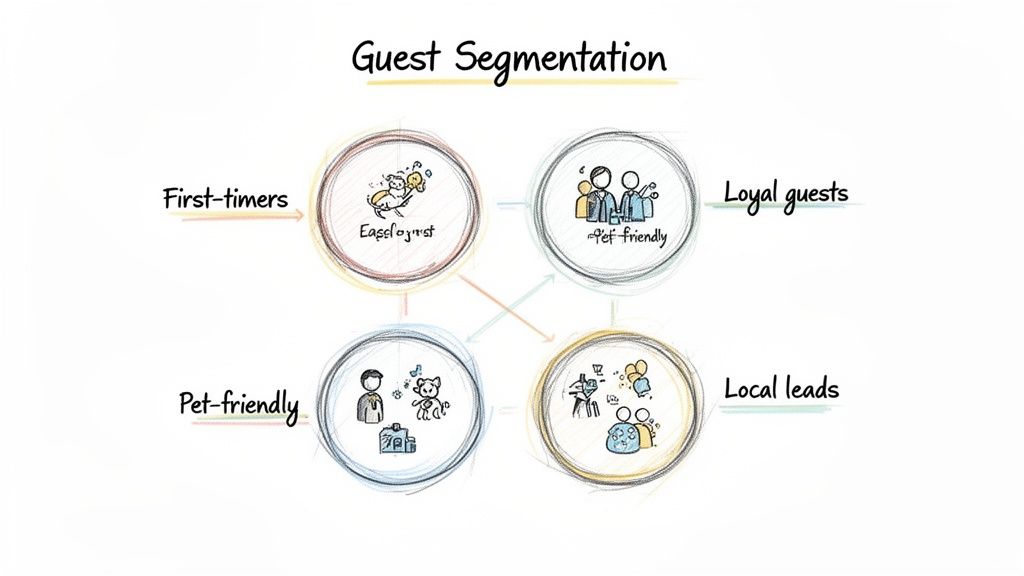
Sending one generic email to your whole list is the fastest way to the spam folder. The conversions come from sending the right message to the right guest at the right moment — and that starts with segmentation: dividing your audience into focused groups based on what you already know about them.
You wouldn't pitch a quiet romantic cabin to a family of six chasing a beach week. Your email shouldn't either. Segment, and you stop shouting into a crowded room and start having one-on-one conversations that book.
Start With the Data You Already Have
You don't need a data team. The most valuable signals are already in your PMS and booking records. Every field is a potential segment:
- Booking history: First stay or fifth? A first-timer needs a warm welcome; a returning guest earns a loyalty offer.
- Property preference: Always books the mountain cabins, never the beach condos? Match the offers to what they already choose.
- Lead source: Came in through an OTA or booked direct? OTA guests are your single biggest conversion opportunity — they're already proven buyers paying someone else's commission.
- Traveler type: Pet on the reservation? Large group? Segment for pet-friendly promos or family packages.
- Drive market: Guests within a 2-3 hour drive are your last-minute gap-fillers. Build a "drive-market" segment for weekend deals when you have an unsold night.
Build Your First Two Segments
Start small. A "Repeat Guests" segment is your VIP list — set up an automated "welcome back" offer six months after their last checkout, when they're starting to think about the next trip. A "Pet Owners" segment, built from anyone who paid a pet fee, lets you fire a "bring the dog" campaign the moment a pet-friendly property has a slow week.
Both segments lean on a clean guest database, so it's worth building a solid email database before you scale up the segmentation.
Pro tip: Don't overcomplicate it. Two or three segments — say "First-Time Guests" and "Drive-Market Subscribers" — will out-convert a single generic list immediately. Add complexity later, once the basics are paying off.
Guest Segmentation Strategies for STR Operators
| Segmentation Criteria | Description | Example Campaign Idea |
|---|---|---|
| Booking History | First-timers vs. repeat guests, based on past behavior. | A "Welcome Back" email with a direct-only loyalty rate for anyone who's stayed more than once. |
| Property Type | Grouping by the property style they book (beachfront condo, mountain cabin, city loft). | Announce a new beachfront listing first to guests who've booked similar rentals. |
| Traveler Type | Who they travel with — families, couples, pet owners. | A pet-friendly promo targeting guests who've paid a pet fee before. |
| Drive Market | Guests close enough to drive in for a last-minute weekend. | A "Weekend Getaway" deal to subscribers within a 3-hour drive when you have a gap to fill. |
| Lead Source | OTA bookers vs. direct bookers. | A campaign for OTA guests showing the savings and perks of booking direct next time. |
| Length of Stay | Long-stay (7+ nights) vs. short weekend trips. | An "Extend Your Stay" offer with weekly or monthly rates for frequent long-stay guests. |
Automating the Entire Guest Journey
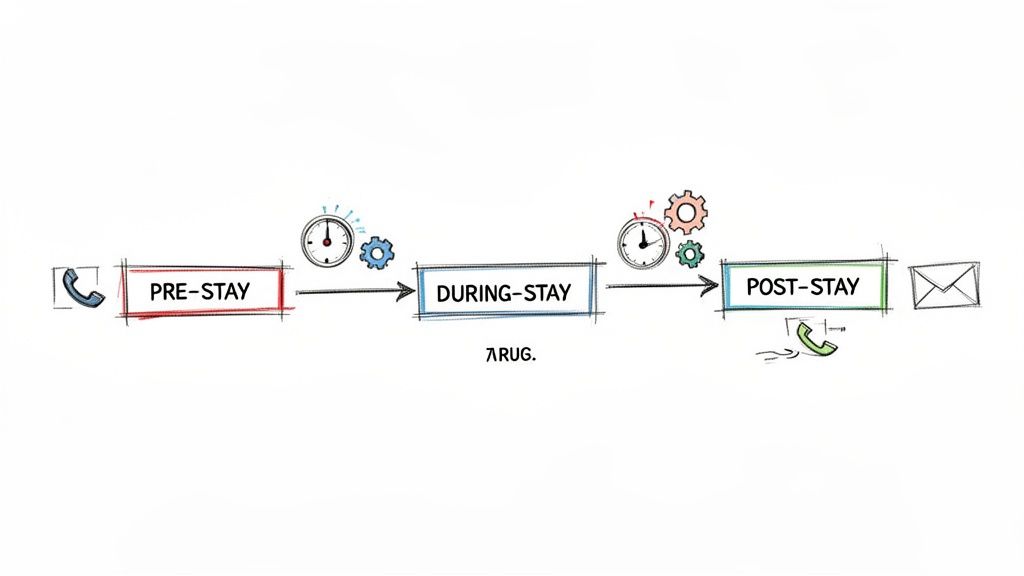
If you want a five-star experience at scale without burning out, automation is how you get there. The point isn't robotic mass sends — it's mapping the journey once, then letting triggered sequences fire off booking data, check-in dates, and guest actions so no guest ever slips through the cracks. A tool like hostAI's hostMail handles that triggering for you, so you're managing the strategy instead of sending hundreds of one-off messages.
The Pre-Stay Sequence
The window between booking and arrival is pure upside: build anticipation, prove you're a pro, and earn some incremental ADR. A cadence that works:
- 14 days out: A "Get ready for your trip" email. Be the local expert — share your favorite coffee shops, restaurants, and a hidden gem or two.
- 7 days out: The upsell window. Offer early check-in, a mid-stay clean, or a curated welcome basket — framed as an upgrade, not a hard sell.
- 3 days out: The logistics. Address, access codes, Wi-Fi, and a link to your digital guidebook, so they arrive confident and prepared.
The During-Stay Check-In
One automated email the morning after night one — subject line "How is everything at [Property Name]?" — catches small problems before they become one-star reviews. Keep it short: did they settle in, is there anything they need? It gives guests an easy, private channel to raise a minor issue with you instead of in public.
The Post-Stay Follow-Up (Your Direct-Booking Engine)
This is the most important sequence you'll build, because it's where one-time guests become repeat direct bookers. Move fast — response rates drop sharply once the trip fades. For the mechanics behind triggered sends, see our guide on what email marketing automation is.
- 1 day after checkout: Thank them and ask for a public review, with a direct link. This is the social proof that converts your next guest.
- 3 days after checkout: If no review yet, a gentle reminder — and ask for private feedback in the same email, giving anyone with a minor gripe a path to you instead of to a public review.
- 7 days after checkout: The rebooking play. A "thank you" email with a direct-only discount code, and be explicit: the best price is always on your own site. This is how you train guests to skip the OTA next time.
Designing Emails Guests Actually Open
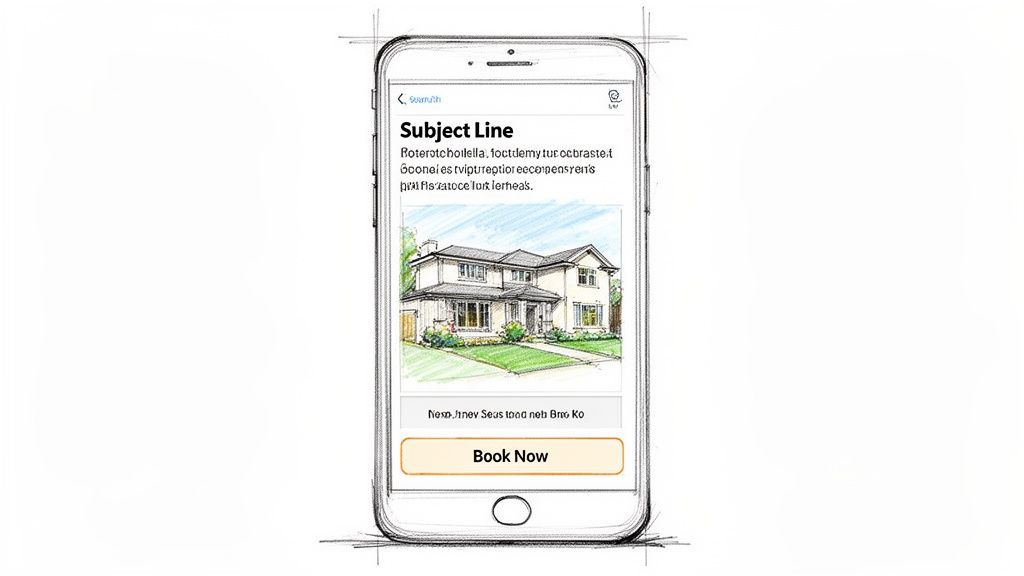
The slickest automation is worthless if your emails never get opened. The battle is in the inbox, and winning means content that feels valuable, looks clean on a phone, and speaks to the guest directly.
Subject Lines That Earn the Click
Your subject line is the gatekeeper — the single biggest driver of whether an email gets opened. Aim for specific, personal, and benefit-forward, without tipping into spammy clickbait. Instead of "Monthly Newsletter," try:
- Local event: "Don't miss the Mountain Folk Festival next month 🎸"
- Last-minute deal: "A spontaneous beach getaway, open this weekend"
- Repeat-guest offer: "Your 'welcome back' offer is inside, Jane"
Each gives a concrete reason to open. For more, see our guide on email subject lines that get opened.
Design Mobile-First
Most guests check email on their phone, so build for the small screen first:
- Single-column layout so content flows and scrolls cleanly on any device.
- Short, punchy text — break up paragraphs, use bullets and bold to make key info pop.
- One unmissable CTA — a "Book Now" or "View Property" button big and bright enough for a thumb.
First impressions are everything: welcome emails average an 83.63% open rate versus 39.64% across all email types (GetResponse 2024 Email Marketing Benchmarks). The moment a guest joins your list is the moment they're most likely to read you — don't waste it.
Match the Design to the Job
Not every email needs to be a glossy spread. Transactional emails — confirmations, check-in instructions — should be clean and text-forward so the critical info lands fast. Save the high-quality photography for promotions, and shoot the experience, not just the space: guests around the fire pit, coffee on the balcony. That's what sells the dream and earns the click.
Measuring Performance and Optimizing
Launching is the start, not the finish. The growth that moves your direct-booking number comes from a simple loop: send, measure, improve. You don't need to become a data scientist — you need a handful of metrics and the discipline to act on them.
The KPIs That Matter for STR
| Metric (KPI) | What It Measures | Action to Improve |
|---|---|---|
| Open Rate | Share of recipients who opened. | Test subject lines, personalize with the guest's name, experiment with send times. |
| Click-Through Rate | Share of openers who clicked a link. | Sharpen the CTA, use compelling property photos, make the offer clear and valuable. |
| Conversion Rate | Share of clickers who booked. | Simplify checkout, match landing pages to the email's promise, A/B test the offer. |
| Unsubscribe Rate | Share who opted out. | Segment for relevance, review frequency, lead with value instead of selling. |
| Bounce Rate | Share that couldn't be delivered. | Clean the list regularly, use double opt-in for new subscribers. |
A/B Test to Find What Works
The fastest way to improve those numbers is A/B testing. Create two versions of one email — A and B — send each to a small slice of your list, and let the winner take the rest. The rule: change one variable at a time, so you know what caused the lift.
- Subject lines: "Your mountain getaway awaits" vs. "Last-minute: 20% off your cabin stay."
- CTA buttons: "Book your stay" vs. "See availability."
- Images: Cozy living room vs. the deck view.
- Offers: A percentage discount vs. a free night.
Pro tip: Don't chase open rate for its own sake. A huge open rate with a tiny click rate means your subject line promised something the email didn't deliver. The goal is getting the right guests to click.
Integrating Email Into Your Whole Marketing System
Email is strong alone and unstoppable when it's the hub. Your social profiles, your booking site, and your in-property touchpoints should all do one job: feed the email list. That creates a cycle — capture leads everywhere, nurture them into repeat direct bookers who wouldn't think of booking elsewhere.
Connect Your Channels
Your direct-booking site is ground zero: a simple pop-up offering 5% off a first direct booking in exchange for an email is a classic because it works. Then widen the net:
- Social: Run an Instagram giveaway that requires a newsletter signup to enter — cheap, and it pulls in high-intent people.
- In-property: A QR code linking to your digital guidebook or Wi-Fi page, gated by an email address, captures guests who came in via OTA.
- Blog: If you write local guides, add a "subscribe for insider tips" CTA on every post.
Once someone signs up, drop them straight into an automated welcome series — your best shot at a first impression, given how high welcome-email engagement runs.
Don't treat your channels like separate islands. Instagram points to the list, the email links to the blog, the blog drives the booking site. One connected ecosystem, built to earn trust and direct revenue.
The list also becomes a launchpad: give subscribers 24-hour early access to a seasonal promo before it hits social. That small exclusivity makes them feel like VIPs and sparks urgency to book first.
Frequently Asked Questions
How often should I send emails to guests?
There's no magic number. A monthly newsletter — property news, local events, seasonal travel ideas — is a safe baseline. Promotional emails need a lighter touch, timed around key booking seasons. Your automated sequences (pre-stay, post-stay) aren't on a calendar at all; they fire off guest behavior. Let your data guide frequency: if open rates fall or unsubscribes climb, pull back.
If I could only perfect one email, which should it be?
The post-stay feedback and rebooking email, sent a day or two after checkout while the trip is still fresh. It pulls triple duty: it asks for a public review (social proof that books your next guest), gathers private feedback (honest insight you can act on), and offers a direct-only discount for the next stay (the hook that converts a one-time OTA guest into a repeat direct booker).
Can I build an email list if I only get bookings from OTAs?
Yes — and you should. Platforms like Airbnb and Vrbo restrict direct contact before the stay, but once the guest is in your property, the relationship is yours to win. Place a QR code somewhere obvious — linked to your guidebook, Wi-Fi login, or a late-checkout request — and ask for an email in exchange for that value. With consent, you can market to them directly for every future stay and steadily pull them out of the OTA ecosystem and into your own.
Ready to stop strategizing and start automating? hostAI's hostMail triggers the right email at the right moment across the full guest journey, so repeat direct bookings happen on autopilot. See how it can help you win more direct bookings.