
rental business plan
Rental Business Plan: Secure Funding and Grow Your STR
Posted on Feb 4, 2026
A solid rental business plan is more than just a document; it's the strategic roadmap that turns a piece of real estate into a thriving, profitable business. Think of it as your playbook for outlining goals, dialing in operations, and projecting finances. It’s what helps you make smart decisions and stay ahead of market shifts, rather than just reacting to them.
Defining Your Vision and Brand Identity

Before you even think about spreadsheets and logistics, you need to build the heart of your business. This is where you get crystal clear on why your rental business exists and who you're here to serve. A strong vision acts as your North Star, guiding every single decision you make—from the properties you choose to the brand of coffee you leave for your guests.
Your mission statement is your purpose, boiled down to a single, powerful sentence. It’s not just about “providing a place to stay.” It’s about the experience you’re creating. For instance, a mission might be: "To offer traveling families a safe, comfortable, and memorable home-away-from-home experience." Right away, that clarifies your focus.
Your vision, on the other hand, is the big picture—the long-term impact you want to make. It’s aspirational. A vision could be: "To become the most sought-after provider of boutique family-friendly rentals in the region."
Pinpoint Your Ideal Guest
Forget broad demographics. Simply targeting "families" isn't enough. You need to drill down and create a specific guest persona. Are you catering to young families with toddlers who need cribs and high chairs? Or are you aiming for multi-generational families on vacation who need accessible amenities and big, open spaces to gather?
Understanding their motivations is everything. A business traveler’s priorities (fast Wi-Fi, a dedicated workspace) are worlds apart from a honeymooning couple's (privacy, romantic ambiance).
Your ideal guest profile dictates it all—your marketing copy, the amenities you invest in, and even your pricing strategy. When you try to appeal to everyone, you often end up connecting with no one.
Craft a Unique Value Proposition
Your Unique Value Proposition (UVP) is the simple, compelling answer to one critical question every potential guest has: "Why should I book with you instead of the dozens of other options?" It’s what makes you stand out in a sea of listings.
Your UVP can be built on a few different things:
- Unique Amenities: Do you have a private hot tub, a decked-out game room, or a pet-friendly space with a fenced-in yard?
- Exceptional Service: Maybe you provide a personalized welcome basket with local goodies or offer 24/7 concierge-style support.
- Thematic Experience: Is your property a "skier's paradise" with ski-in/ski-out access or a "writer's retreat" complete with a library and inspiring views?
This value proposition is the cornerstone of your brand. And building a recognizable brand is about so much more than a logo; it’s about delivering a consistent, memorable experience every single time. If you want to go deeper on this, check out our guide on how to build brand awareness for your rental business.
Finally, you need to set some real, measurable business goals. Don't just aim to "make a profit." Get specific with objectives you can actually track, like achieving an 85% occupancy rate during peak season, maintaining a 4.9-star average guest rating, or securing 20% of bookings directly through your website within the first year. These goals give your plan concrete targets to shoot for.
Decoding Your Market and Sizing Up the Competition
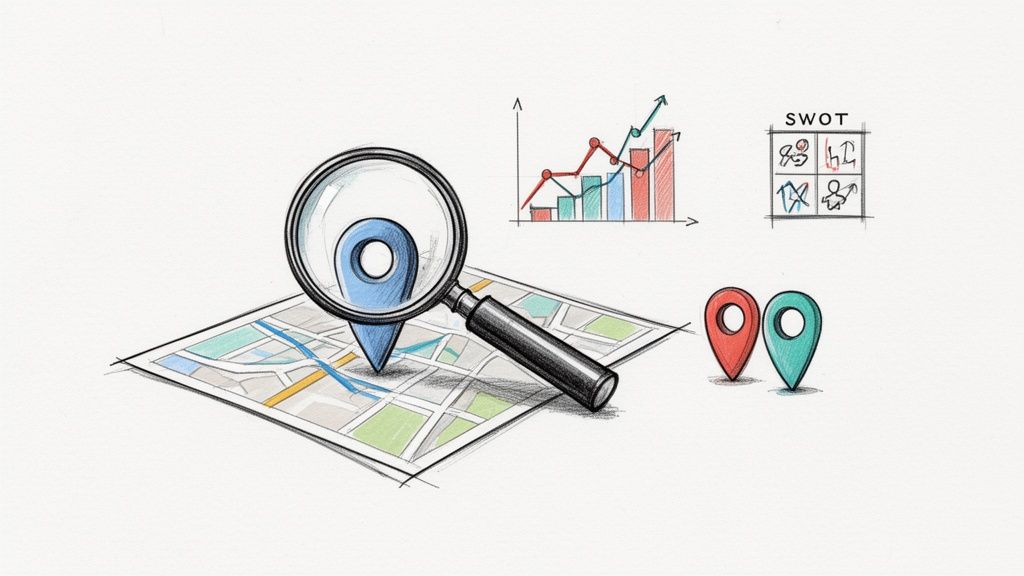
A powerful rental business plan is built on a foundation of hard data, not just hopeful assumptions. This is the part where you stop dreaming and start validating—proving your vision has real-world potential. Getting this analysis right gives you the clarity to make smart, strategic moves instead of costly guesses down the road.
First, let's look at the bigger picture. The short-term rental market has shown incredible resilience. Global occupancy rates tell a compelling story, with recent figures showing Oceania leading at 59%, followed closely by Europe at 56% and North America at 51%. This isn't just about filled beds; strong demand has pushed up average daily rates (ADR) in mature markets, proving that travelers are willing to pay a premium for the right experience.
This macro view is your jumping-off point. Now, it’s time to zoom in on your specific location.
Pinpoint Local Trends and Demand Drivers
Every market has its own unique rhythm. Understanding this pulse is absolutely critical if you want your financial forecasts and marketing to hit the mark. Don't just settle for a year-round occupancy number; you need to break it down.
Seasonality: Is your area a summer beach town, a winter ski destination, or a city with steady business travel? Map out your high, low, and shoulder seasons. This is the bedrock of your dynamic pricing strategy, helping you cash in during peak times and still attract bookings when things quiet down.
Local Events: Get a calendar and circle the big annual events—festivals, conferences, university graduations. These are predictable demand spikes just waiting for you to capitalize on them. For many hosts, these weekends are a goldmine.
Traveler Personas: Who is actually visiting? Are they digital nomads who need blazing-fast Wi-Fi for extended stays? Families looking for kid-friendly amenities? Or couples hunting for a romantic weekend escape? The target guest you defined earlier needs to match the reality of who's booking in your market.
To build a data-driven strategy, you need to know what to look for and where to find it. This table breaks down the key metrics for your market analysis.
Key Market Analysis Metrics for Your Business Plan
| Metric | What It Tells You | Where to Find Data |
|---|---|---|
| Average Daily Rate (ADR) | The average rental income per occupied day. Crucial for revenue projections. | AirDNA, PriceLabs, Mashvisor, competitor listings |
| Occupancy Rate | The percentage of available nights that are booked. Shows overall demand. | Local tourism boards, AirDNA, Transparent |
| Revenue Per Available Room (RevPAR) | ADR multiplied by Occupancy Rate. The single best metric for financial health. | Calculate it yourself (ADR x Occupancy) or find on data platforms |
| Booking Window | How far in advance guests are booking. Helps with pricing and marketing timing. | Your PMS data, AirDNA, PriceLabs |
| Length of Stay (LOS) | The average number of nights guests book. Informs your turnover strategy. | Your PMS data, competitor listing rules |
| Local Regulations | The legal framework for STRs in your area (permits, taxes, zoning). | City/county government websites, local host associations |
Gathering this data isn't just busywork; it's the intelligence that will shape every other part of your business plan, from financial forecasts to marketing campaigns.
Conduct a Practical SWOT Analysis
A SWOT analysis is a simple but incredibly powerful framework for getting a handle on your position. It stands for Strengths, Weaknesses, Opportunities, and Threats. Be brutally honest here—a clear-eyed view now prevents nasty surprises later.
A SWOT analysis isn't just a business school exercise. It’s a strategic snapshot that forces you to see your rental business from all angles—the good, the bad, and the unexpected. This clarity is what separates proactive owners from reactive ones.
For instance, a Strength could be your property's killer view or that brand-new hot tub. A Weakness might be its distance from the main attractions. An Opportunity could be a new music festival coming to town, while a Threat might be the city council discussing new rental regulations.
Laying this out helps you lean into your advantages, shore up your weak spots, jump on market openings, and build defenses against potential risks. It’s a core step in understanding what makes a good rental property for investors and ensuring your plan is grounded in reality.
Analyze Your Direct Competitors
Once you understand the market's pulse, it's time to size up the competition. This isn't about copying what they do; it's about finding the gaps you can brilliantly fill. Your goal is to identify 3-5 direct competitors—properties that are a similar size and quality, targeting the exact same type of guest.
Then, you put on your detective hat and dive into their listings:
Pricing and Occupancy: What are their nightly rates for weekdays, weekends, and upcoming holidays? Check their calendars. How booked are they? This gives you a real-time feel for demand and what the market will bear.
Guest Reviews: Read their reviews obsessively, especially the 3- and 4-star ones. What do guests consistently rave about? What are the common complaints? These comments are a free, unfiltered guide to what travelers in your market truly value and where other hosts are dropping the ball.
Amenities and Marketing: What are they highlighting? Self-check-in? A dedicated workspace? Pet-friendly policies? Scrutinize their photos and listing descriptions. Where are they strong, and where could you offer something better?
This deep dive into your market and competition is non-negotiable. It's what arms you with the data-driven insights to price your rental strategically, market it effectively, and create an experience that stands out for all the right reasons.
Designing Your Operations and Management Blueprint
A brilliant idea for a rental business can quickly fall apart without a solid plan for how things will actually run day-to-day. This is where you build the engine of your business—the part of your rental business plan that ensures every single guest stay is smooth, professional, and repeatable. Think of this as the blueprint for turning your vision into a well-oiled machine.
One of the first, and most important, structural decisions is your legal entity. While you can operate as a sole proprietor, most seasoned hosts will tell you to form a Limited Liability Company (LLC). Why? An LLC creates a crucial legal barrier between your personal assets (like your home and savings) and your business liabilities. If a guest ever has an accident on your property, this separation offers essential protection.
Beyond the legal shield, it also professionalizes your finances. It simplifies setting up a business bank account, cleanly tracking expenses, and getting ready for tax season. Yes, there are some setup and maintenance fees, but the peace of mind and protection it offers as you grow is worth every penny.
Building Your A-Team
You can't do it all yourself, especially if you plan to scale. Your team is a direct reflection of your brand, and when it comes to short-term rentals, reliability is everything. The two most critical roles you’ll need to lock down are cleaning and maintenance.
Cleaners: Let's be blunt: your cleaning crew is probably the most important part of your on-the-ground team. One bad cleaning can tank your ratings. You need experienced, detail-obsessed cleaners who get the specific demands of a rental turnover—it’s far more intense than a standard house cleaning.
Maintenance: A leaky faucet at midnight or spotty Wi-Fi can absolutely ruin a guest's trip. Have a go-to handyman, a plumber, and an HVAC specialist you can call anytime. These shouldn't be the cheapest options you find on a whim; they need to be trusted pros you can count on for fast, professional service.
Whether you hire them as employees or work with them as independent contractors, vet everyone thoroughly. Always check references, look at their past work, and make sure they carry their own insurance. A dependable team is the secret to running a stress-free operation.
Mapping the Complete Guest Journey
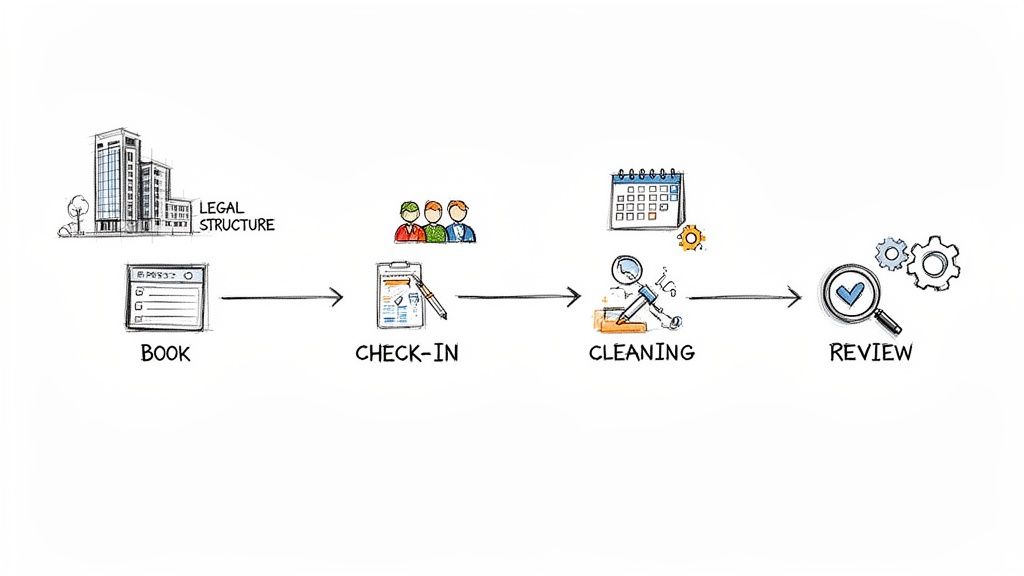
To consistently earn five-star reviews, you have to obsess over every single interaction a guest has with your business. By mapping out this journey from start to finish, you'll spot opportunities to automate the mundane and personalize the meaningful. It's all about finding that perfect balance between efficiency and genuine hospitality.
Break the journey down into distinct phases:
- Discovery & Booking: How are guests finding you? What's the key piece of information that makes them click "book"?
- Pre-Arrival: This is the time between booking and check-in. It’s your chance to build excitement and deliver all the need-to-know info.
- Check-In: This is their first real impression of the property. Is it seamless and welcoming or clunky and confusing?
- During the Stay: How do you handle questions or unexpected issues? Are you responsive?
- Check-Out: The process should be simple and crystal clear.
- Post-Stay: Now's your chance to lock in that glowing review and encourage them to come back.
When you break it down like this, you can see exactly where to make an impact. For instance, you can automate sending pre-arrival messages with check-in codes, but then add a personal touch with a handwritten welcome note left on the counter.
A well-mapped guest journey allows you to systematize excellence. It ensures every guest receives the same high standard of communication and care, removing guesswork and preventing mistakes that lead to bad reviews.
Assembling Your Essential Tech Stack
Technology is the force multiplier that lets you manage more properties with less effort. A smart, integrated tech stack handles the repetitive stuff, boosts your revenue, and frees up your time to focus on growing the business.
Here are the non-negotiable tools for any modern rental operator:
- Property Management System (PMS): This is your mission control. A PMS like Uplisting or Guesty acts as the central hub, syncing your calendars across all channels (like Airbnb and Vrbo), handling reservations, and automating guest messages.
- Dynamic Pricing Tool: Stop guessing your nightly rates. Tools like PriceLabs or Wheelhouse analyze real-time market data—local events, demand, competitor rates—to automatically set the optimal price. This single tool ensures you're never leaving money on the table.
- Smart Home Technology: Smart locks are an absolute game-changer. They allow for secure, keyless entry with unique codes for each guest, which completely eliminates the headache of key handoffs. You might also consider noise monitoring devices to protect your property without ever invading guest privacy.
Your operations blueprint is the practical, step-by-step guide to delivering on the promises your brand makes. It’s what drives consistency, quality, and, ultimately, profitability.
Building Your Direct Booking and Marketing Engine
Relying 100% on OTAs for bookings is like building your dream house on rented land. Sure, they get you in front of a lot of eyeballs, but the commissions, unpredictable algorithm changes, and lack of a direct line to your guests can seriously cap your growth. The sharpest operators I know treat their rental business plan as a declaration of independence, with a clear focus on building a marketing engine that pulls in high-margin direct bookings.
This is about more than just dodging OTA fees. It’s about owning your brand, controlling the entire guest experience, and creating a business that can stand on its own two feet. Your goal should be a multi-channel strategy where OTAs are just one stream of traffic, not the only one. This gives you the resilience to handle market swings and build a brand that guests actively search for.
Launching Your Digital Hub
Your direct booking website is ground zero for all your marketing. It’s your digital storefront, the one place online where you control the entire story, showcase your properties without any competitors breathing down your neck, and capture priceless guest data. Let's be honest, in today's market, a slow, clunky website just won't fly. Guests expect a booking experience that’s smooth, secure, and looks great.
This is where AI-powered tools are changing the game. A platform like hostAI’s hostFront can spin up an intelligent, conversion-focused website for you in minutes. It's not just another template. It builds a site that’s not only beautifully branded but also optimized for search engines from day one through programmatic SEO. That means you start pulling in organic traffic from guests searching for rentals in your area almost immediately.
Your website is more than a booking portal; it's your brand's home base. It’s where you tell your story, highlight what makes your properties unique, and build the trust that turns a first-time visitor into a loyal, repeat guest.
The opportunity here is just massive. The global short-term rental market is on track to hit an incredible USD 408.63 billion by 2035, growing at an 11.3% compound annual growth rate. The online and platform-based segment is expected to grab a 65.50% share, driven by AI features like secure payments and personalized recommendations—exactly what hostAI's tools deliver. With North America holding a 40.50% market share, a strong digital presence isn't just nice to have; it's non-negotiable. You can dive into the full short-term rental market growth research to see just how big this is.
Automating Guest Relationships with Email
The moment you get a guest's email—whether from a direct booking or a pre-arrival form—you have a direct line of communication that belongs to you, forever. Email marketing remains one of the most cost-effective ways to drive repeat business and build a dedicated following.
But who has time to send manual emails? An automated system like hostMail completely transforms this process. It lets you set up personalized, automated email campaigns that feel genuinely helpful, not robotic.
Here are a few high-impact campaigns you can put on autopilot:
- Pre-Arrival Hype: Send a series of emails with local tips, restaurant recommendations, and check-in details to get them excited for their trip.
- Post-Stay Follow-Up: Automatically send a request for a review and include a special discount code for their next direct booking.
- Seasonal Promotions: Target past guests with deals for holidays or your slower season to fill up those empty calendar nights.
This kind of targeted communication keeps the relationship going long after checkout, making it far more likely they'll book directly with you next time around.
Smart Advertising and Distribution
To really crank up your direct bookings, you need to get in front of potential guests wherever they are online. This means running targeted ads, but that can feel like a huge task without a big budget or a marketing team.
Tools like hostDistro take the complexity out of it by managing the advertising for you. It uses smart retargeting to show your ads to people who visited your website but didn't book, gently reminding them of your amazing property. This is a powerful tactic because you're talking to a "warm" audience that's already shown interest.
A truly effective marketing engine pulls all these pieces together into one seamless strategy:
- Attract: Use the programmatic SEO on your hostFront website and your strategic OTA listings to bring in new visitors.
- Convert: Offer a polished, trustworthy booking experience on your direct site that makes it easy for them to say yes.
- Engage: Use hostMail to build a real relationship with guests before, during, and after their stay.
- Retarget: Bring back those indecisive visitors with hostDistro to close the deal.
When you bake these strategies into your rental business plan, you’re not just getting more bookings. You're building a marketing machine that boosts your bottom line and gives you the control and freedom to succeed for years to come. For even more ideas, check out our guide on the 16 powerful tools to support direct bookings for your short-term rental business.
Forecasting Your Financials and Securing Funding

This is where the rubber really meets the road. A strong brand and a smart operational plan are great, but the numbers are what tell the true story of your rental business plan. Lenders and investors need more than passion; they need to see a clear, data-driven path to profitability. This section is all about building a financial model that’s both ambitious and, more importantly, believable.
Think of your financial forecast as the ultimate test of all your research. It’s where your market analysis—your ADR, occupancy rates, and seasonality—collides with your real-world operational costs. A vague or wildly optimistic projection is a massive red flag for anyone looking at your plan.
Calculating Your Startup Costs
Before you can even dream about profits, you need an exact, line-by-line understanding of what it will cost just to get the doors open. Don't ballpark this. Get quotes and make a detailed list, because one-time startup costs are almost always more than new hosts expect.
You’ll need to account for everything, from the obvious big-ticket items down to the smallest details:
- Property Acquisition: This could be down payments, closing costs, or the first and last month's rent and security deposit.
- Furnishings and Decor: Every single thing, from the sofa and mattresses to the art on the walls and the spoons in the drawer.
- Linens and Towels: Budget for at least three complete sets per bed and bath. This is non-negotiable for ensuring smooth, fast turnovers.
- Kitchen Supplies: Stocking a kitchen for paying guests is a whole different ballgame than stocking your own. Don't skimp.
- Professional Photography: This isn't a "nice-to-have," it's a critical investment that has a direct impact on your booking rate from day one.
- Licenses and Permits: Check with your local municipality for the required fees to operate legally.
- Initial Tech Setup: Think about the costs for smart locks, your PMS subscription, and getting a direct booking website built.
Add it all up, and you’ll have your initial capital requirement—the magic number you need to secure before that first guest ever checks in.
Your financial plan isn’t just a formality for the bank. It's your personal guide for making smart spending decisions, proving you understand the economic engine of your business inside and out.
Building Your Operating Budget
Once you're up and running, your focus shifts from one-time costs to ongoing expenses. The best way to manage these is to break them into two categories: fixed and variable. Making this distinction is key to figuring out your break-even point and managing your cash flow.
Fixed Costs (Consistent Every Month)
- Mortgage or rent payments
- Property and liability insurance
- Internet and cable bills
- Software subscriptions (PMS, pricing tools, etc.)
- Property taxes
Variable Costs (Fluctuate with Occupancy)
- Cleaning fees
- Restocking guest supplies (coffee, soap, paper towels)
- Utilities (electricity, water, and gas will all go up with more guests)
- OTA commissions and credit card processing fees
- Maintenance and unexpected repairs
Tracking these expenses like a hawk is the only way to generate accurate profit and loss statements. For a deeper dive into your income potential, check out our guide on using a short-term rental income calculator.
Projecting Revenue and Profitability
Now for the fun part. With your costs clearly defined, you can build a realistic revenue forecast. Use the ADR and occupancy rates from your market analysis to project your income month-by-month for at least the next three years. And don’t forget seasonality! Your revenue in January will likely look completely different from your revenue in July.
This data feeds directly into your key financial statements:
- Profit and Loss (P&L) Statement: This is a simple equation—revenues minus expenses—that shows your net profit or loss over a specific period.
- Cash Flow Statement: This tracks the actual cash moving in and out of your business, which is critical for knowing if you can pay your bills on time.
The good news is you're entering a robust market. The global vacation rental industry is projected to hit USD 134.26 billion by 2034, and the US market alone is growing at 4.12% annually. Online bookings are dominant, making up 59.4% of the market. By late 2025, Gen Z and millennials are expected to represent 75% of Airbnb's user base—and they are actively seeking the authentic, unique stays you can offer.
Securing the Right Funding
Armed with a comprehensive financial plan, you’re finally ready to approach lenders or investors. They will absolutely scrutinize your projections, so be prepared to defend every assumption with the market data you’ve gathered.
Different funding sources have different priorities:
- Traditional Bank Loans: These typically require a strong personal credit history and a meticulously detailed business plan.
- SBA Loans: Government-backed loans can sometimes offer more favorable terms, but often come with more paperwork.
- Private Investors or Partners: They will be laser-focused on one thing: your potential return on their investment (ROI).
To get your numbers in order and present them professionally, this practical guide to budgeting and forecasting is an excellent resource for any service-based business. This is where all your thorough preparation pays off. You're not just selling an idea; you're proving you have a profitable venture built on a solid financial foundation.
Got Questions About Your Rental Business Plan?
Even with the best template, putting together a solid rental business plan for the first time can bring up a lot of questions. Let's tackle some of the most common ones I hear from property managers so you can finalize your strategy with confidence.
How Often Should I Update My Business Plan?
Think of your business plan as a living, breathing document—not something you write once, stick in a drawer, and forget about. It's a tool you should be using regularly to guide your decisions.
A quick quarterly review is a great rhythm to get into. This is your chance to check in on your progress against the goals you set and make small tactical shifts. Maybe you need to adjust your marketing spend or tweak cleaning schedules based on what the last few months of data are telling you.
Then, once a year, it's time for a major overhaul. This is when you'll completely re-evaluate your market analysis, build out fresh financial forecasts for the upcoming year, and lock in new strategic goals. The rental market never sits still—new local regulations can pop up, your competitors might slash their prices, or guest expectations can shift. An annual refresh keeps your plan sharp, relevant, and powerful.
Your rental business plan is your strategic compass. Reviewing it quarterly and updating it annually keeps you pointed in the right direction, helping you navigate changes proactively instead of just reacting to them.
Which Section Is Most Important for Attracting Investors?
If you're looking to bring in outside money, every part of your plan matters. But let's be honest, investors and lenders almost always flip straight to the Financial Projections section first. It's the moment of truth.
This is where your entire strategy—your market research, your operational plan, and your marketing ideas—gets translated into cold, hard numbers. They need to see that your vision isn't just a great idea, but a profitable one.
Investors are looking for realistic, data-backed forecasts that prove you have a handle on your costs, revenue streams, and potential return on investment (ROI). A rock-solid financial section, complete with a detailed profit and loss statement, cash flow projection, and a clear break-even analysis, screams that you've done your homework. It tells them your business is a sound, well-researched investment, not just a shot in the dark.
To make the biggest impact, make sure your financials are supported by a punchy Executive Summary right at the beginning. This is your thirty-second pitch to grab their attention and convince them the rest of the document is worth a deep dive.
Can I Really Create a Business Plan for Just One Property?
Absolutely. And you should. A business plan is just as critical for a single property as it is for a fifty-unit portfolio. In some ways, it's even more valuable for a solo operator.
Why? Because the process forces you to stop thinking like a "host" and start acting like a "business owner."
Building a plan for one property makes you:
- Go deep on your niche market. You'll get to know your specific neighborhood and direct competitors on a truly granular level.
- Define your ideal guest with laser precision. This focus lets you craft marketing and amenities that really hit the mark.
- Track your profitability down to the dollar. You’ll know your exact margins, which helps you make smarter decisions about pricing, upgrades, and when to expand.
It provides the structure you need to run your operation smoothly, plan for future expenses like a new roof or updated furniture, and set clear goals for growth. A solid plan turns your single rental from a side hustle into a real, scalable business.
Ready to turn that strategic plan into more direct bookings and higher revenue? hostAI gives you the toolkit to make it happen. Build an intelligent website with hostFront, automate your guest messaging with hostMail, and run hands-free advertising with hostDistro. Discover how hostAI can double your direct revenue.