
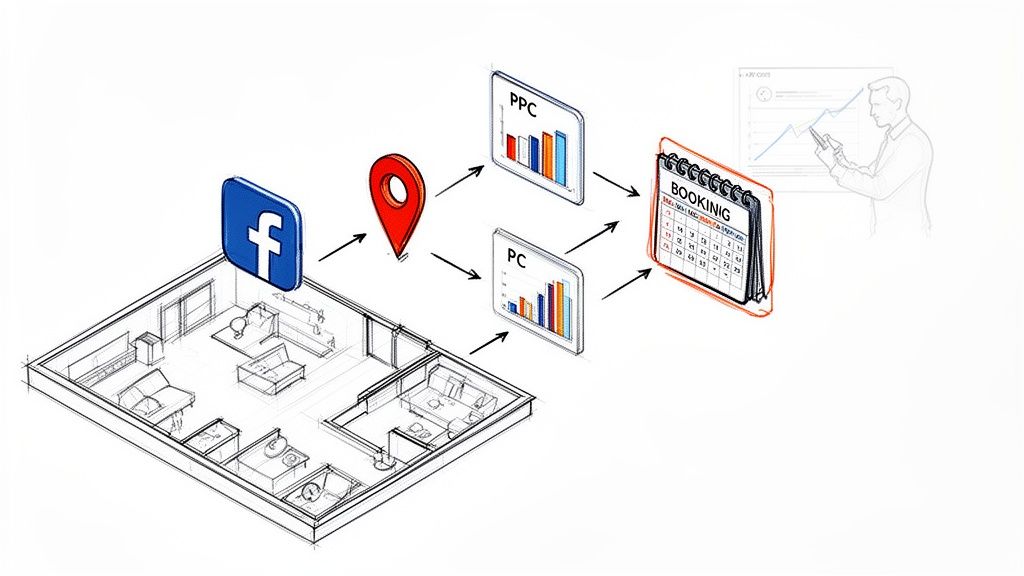
room rental advertising
Mastering Room Rental Advertising for Direct Bookings
Posted on Dec 25, 2025
Effective room rental advertising isn't just about throwing a listing online and hoping for the best. It’s a deliberate process: defining your goals, figuring out exactly who your ideal guest is, and then launching a multi-channel plan to bring them to your door. When done right, advertising stops being an expense and becomes a predictable engine for revenue, helping you stand out and keep your rooms full.
Building Your Modern Room Rental Advertising Strategy
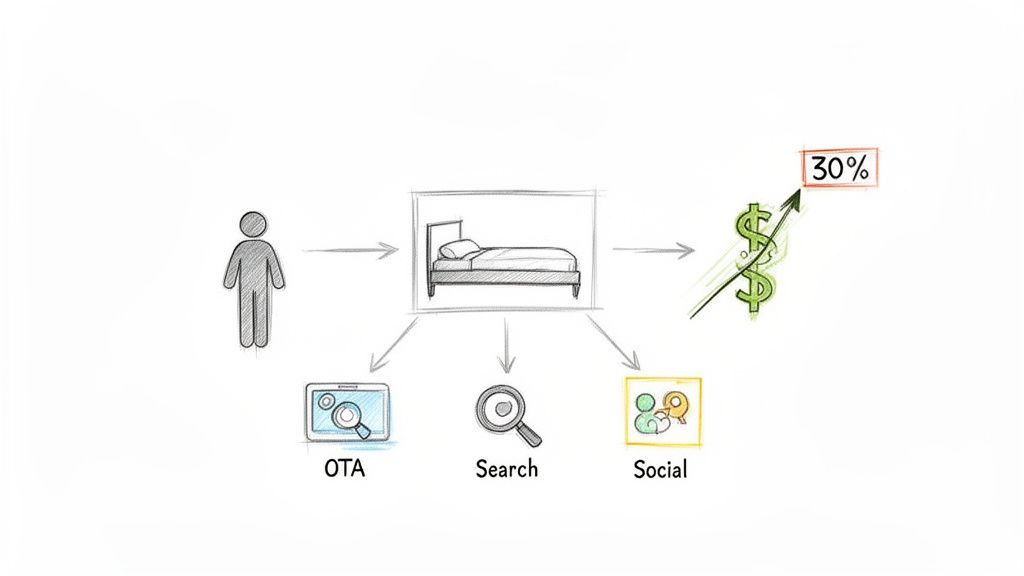
Before you spend a single dollar, you have to lay the groundwork. A successful advertising strategy starts with a strong foundation, which means moving beyond a vague goal like "get more bookings" and setting specific, measurable objectives instead. Having a clear target sharpens your focus and makes every decision that follows way easier and more impactful.
For example, instead of just wanting more guests, you might set a goal to increase direct bookings by 30% over the next quarter. This immediately gives you a clear purpose: reducing your reliance on OTA commissions. Or maybe your objective is to fill those tricky shoulder-season vacancies by targeting a completely new demographic, like remote workers looking for quiet mid-week stays.
Defining Your Goals and Audience
Once your objective is crystal clear, the next step is to pinpoint exactly who you're trying to reach. This is where creating a detailed "guest persona" is absolutely critical. Don't just think "travelers"—get granular.
Are you really targeting:
- Digital Nomads: Professionals who need a place for a month, with rock-solid Wi-Fi and a real workspace being non-negotiable.
- Weekend Adventurers: Couples or small groups who just need a convenient home base for local activities, prioritizing location and a hassle-free check-in.
- Budget-Conscious Students: Individuals looking for affordable, short-term housing near a university, where price and public transit access are everything.
Understanding what motivates your audience, what their pain points are, and their booking habits will dictate everything—from the channels you use to the words in your ads. A message that gets a weekend adventurer excited will likely fall completely flat with a digital nomad.
Your advertising strategy is only as strong as your understanding of the guest. The more you know about their needs and where they spend their time online, the more efficiently you can deploy your budget.
Understanding the Market Opportunity
The sheer size of the vacation rental market is precisely why a thoughtful advertising plan is so valuable. The global market was valued somewhere between $97.85 billion to $105.7 billion in 2025, which is a massive opportunity for anyone running targeted campaigns.
Of course, that immense market also fuels intense competition. This makes a smart, direct-booking-focused advertising strategy not just a nice-to-have, but an essential tool for carving out your piece of the pie. To really build a robust foundation, it pays to explore proven PPC Advertising Strategies That Actually Scale. The more you understand the market dynamics, the better prepared you'll be.
Choosing the Right Channels to Reach Your Guests
Figuring out where to spend your ad budget is one of the most critical decisions you'll make in your room rental advertising plan. The right channels put you squarely in front of your ideal guests. The wrong ones? They can burn through your budget with almost nothing to show for it.
The goal is to create a smart, balanced mix of channels that work together to grab attention and, most importantly, drive bookings. Your strategy will almost certainly involve a combination of Online Travel Agencies (OTAs) and a direct paid advertising push, as each plays a very different role in a guest's journey to booking a stay with you.
The Power of OTAs and the Billboard Effect
For most property managers, listing on major OTAs like Airbnb, Vrbo, and Booking.com is simply non-negotiable. These platforms are essentially massive search engines for accommodations, and they give you instant access to a global audience that is actively looking to book right now. Think of them as your primary channels for capturing existing demand.
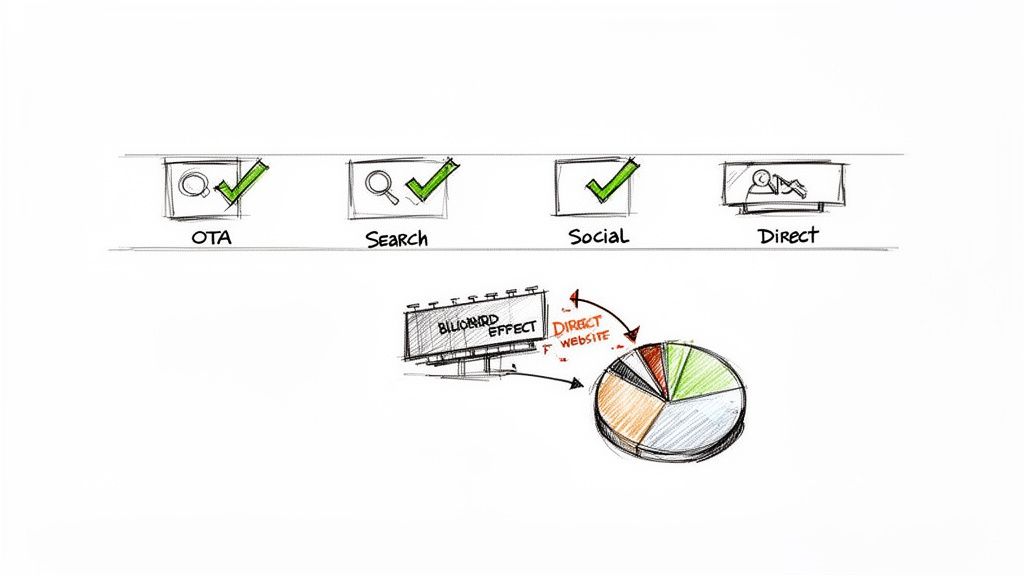
But their value goes way beyond the direct reservations they generate. This is where the “billboard effect” kicks in.
It's a common traveler habit: they discover a great-looking property on an OTA, then immediately open a new tab and search for it on Google. Why? They're hoping to find a direct booking website, often looking for a slightly better deal, more photos, or just more information about the host. Your OTA listing acts like a massive digital billboard, driving highly qualified traffic straight to your own site.
This creates a powerful hybrid approach. Recent 2024-2025 industry analyses confirm this dynamic, showing that while OTAs still drive the most reservations, their visibility gives a huge boost to direct website traffic. By maintaining a strong OTA presence, you capture that initial interest and can then use targeted ads and a great website to convert those lookers into commission-free direct bookers. You can see more on how the market is shifting in these comprehensive industry statistics.
Paid Advertising Channels for Direct Bookings
While OTAs build broad awareness, paid channels are where you capitalize on it and go out to find new guests yourself. These platforms give you incredible control over targeting and messaging, letting you zero in on specific guest personas with surgical precision.
Here’s a quick rundown of the top paid channels you should be looking at:
Google Ads: This is your go-to for capturing high-intent travelers. When someone types "cabin with hot tub near Aspen" into Google, you can be the very first result they see. It’s perfect for reaching people who are deep in the planning and booking phase.
Facebook & Instagram Ads: These platforms are all about demand generation. You can target people based on their interests (like hiking or skiing), major life events (like an upcoming anniversary), or specific demographics. They are fantastic for visually showcasing your property and planting the seed for a vacation people didn't even know they needed yet.
Retargeting Platforms: Retargeting is absolutely essential. It allows you to show ads specifically to people who have already visited your website but left without booking. This simple tactic keeps your property top-of-mind and nudges them back to finish their reservation. To dive deeper, check out our guide on the best retargeting platforms and learn how to recapture this incredibly valuable traffic.
The most effective room rental advertising strategies don't just pick one channel and hope for the best. They integrate the wide visibility from OTAs with hyper-targeted paid campaigns, creating a powerful system that both generates new leads and converts existing ones into profitable direct bookings.
Picking the right channel depends entirely on your goals, budget, and who you're trying to reach. Here’s a simple comparison to help you decide where to focus your efforts.
Room Rental Advertising Channel Comparison
| Channel | Best For | Key Challenge | hostAI Integration |
|---|---|---|---|
| OTAs (Airbnb, Vrbo) | Mass visibility and capturing existing booking intent. | High commission fees and limited control over guest communication. | Syncs with your listings to ensure your direct channels are always up-to-date. |
| Google Ads (PPC) | Reaching travelers with high booking intent ("bottom of funnel"). | Can be competitive and expensive if not managed properly. | hostDistro automates and optimizes Google Ads campaigns for you. |
| Social Media (Facebook, Insta) | Building brand awareness and reaching niche audiences ("top of funnel"). | Requires compelling visual creative and can be hard to attribute direct bookings. | Creates targeted ad copy and visuals based on your property's unique features. |
| Retargeting | Re-engaging website visitors who didn't book. | Smaller audience size; requires initial traffic to your website. | Manages retargeting campaigns to bring back lost leads across platforms. |
Ultimately, a multi-channel approach is almost always the winner. By leveraging the strengths of each platform, you create a marketing engine that consistently attracts and converts guests, filling your calendar and boosting your bottom line.
Creating Ads That Actually Convert
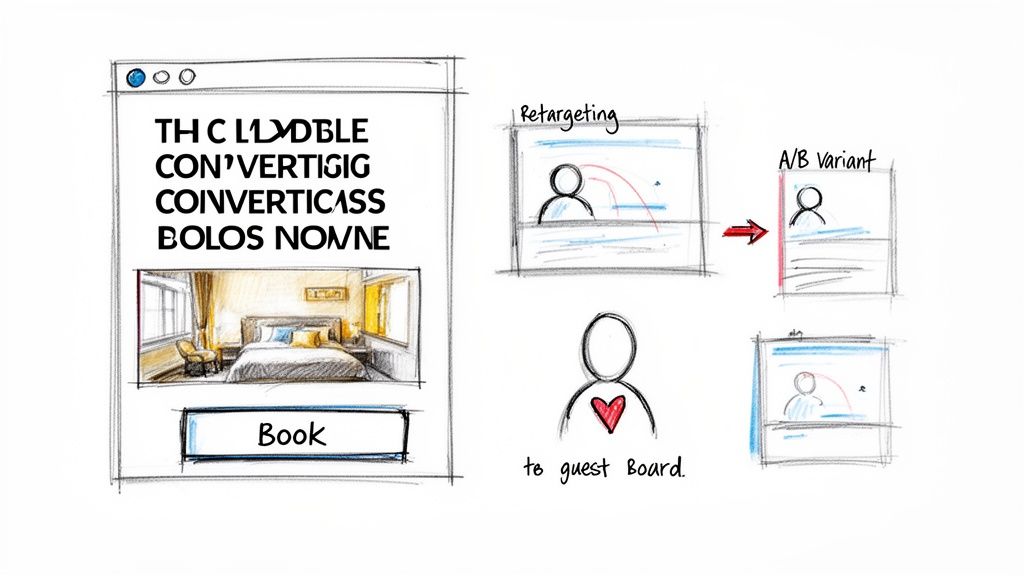
Alright, you’ve picked your channels. Now comes the fun part: making ads that actually get people to click and book. This is where your deep understanding of your ideal guest really shines. It's how you stop the scroll and turn a casual glance into a serious consideration.
Every single part of your ad—the headline, the photo, the call-to-action—needs to connect with what your target audience wants or what problems they're trying to solve. You're not just renting a room; you're selling an experience. A memory. A solution.
Writing Headlines and Descriptions That Sell
The headline is your digital handshake. It’s often your only shot to get noticed. It needs to be punchy, benefit-driven, and smart about the platform it's on.
For a Google Ads campaign, you'd want something direct and keyword-focused, like "Quiet King Suite Near Downtown." But for a Facebook ad, you can be more evocative: "Your Private Oasis for That Long Weekend You Deserve." One is for search intent, the other is for sparking desire.
Your ad description is where you bring the space to life. Don't just list features—translate them into tangible benefits for your guest.
- Instead of: "Fast Wi-Fi."
- Try this: "Blazing-fast Wi-Fi, perfect for remote work or streaming your favorite shows after a day of exploring."
Use language that helps people picture themselves there. Talk about the morning sun hitting the balcony, the comfy armchair perfect for a good book, or the fact that the best local coffee shop is just a 30-second walk away.
Your ad copy should do more than inform; it must inspire. Focus on the feelings and experiences your property enables—relaxation, adventure, productivity—and you'll create a connection that a simple list of amenities never could.
Choosing Visuals That Make an Impact
In room rental advertising, your photos are everything. They are your single most powerful sales tool. They need to be professional and well-lit, sure, but they also have to tell a story.
Show the perfectly made bed, but don't forget the shot of the incredible view from the window next to it. Capture the sparkling clean bathroom, but also show the cozy patio where they'll be sipping their morning coffee. You're selling the whole vibe, not just the furniture.
Zeroing In with Advanced Targeting
Amazing creative is a total waste if the wrong people see it. Powerful targeting is what puts your ads in front of travelers who are actually looking for a place like yours. On platforms like Facebook and Instagram, you can get incredibly specific.
Think about targeting users based on:
- Demographics: Simple stuff like age, location, and language.
- Interests: People who follow pages about travel, hiking, specific destinations, or even your competitors.
- Behaviors: Users identified by the platform as "frequent travelers" or who have recently returned from a trip.
But the real game-changer? Retargeting.
This lets you show ads specifically to people who have already visited your website or your listing on an OTA. In a market with over 7.7 million active Airbnb listings globally as of 2025, retargeting is how you stay top-of-mind. As we're seeing booking windows get shorter, reconnecting with these high-intent visitors is often the final nudge they need to book with you instead of someone else. You can discover more insights about these Airbnb market trends here.
Managing Your Ad Budget and Measuring What Matters
Effective room rental advertising isn't about having the biggest budget. It's about making every single dollar pull its weight. If you're spending money without a clear financial plan and a solid way to measure what’s working, you're just gambling. A structured approach to your budget and tracking, however, turns that ad spend from a risky expense into a reliable, booking-generating investment.
So, where do you start? First, you need a realistic budget. A pretty standard benchmark for small businesses is dedicating about 5-10% of total revenue to marketing efforts. Of course, if you're just getting started or heading into a super competitive season, you might need to nudge that number higher to get some initial momentum and, just as importantly, gather performance data.
Once you have your number, you have to decide how you’ll pay for your ads. This is where bidding strategies come in, and picking the right one is all about what you want to achieve with your campaign.
Smart Bidding and Budget Allocation
The two most common ways to pay for ads are Cost-Per-Click (CPC) and Cost-Per-Acquisition (CPA).
Think of CPC as your go-to for driving traffic. You pay every time someone clicks on your ad, making it perfect for building brand awareness or filling up your retargeting audiences with people who have already shown interest.
A CPA model, on the other hand, is laser-focused on results. You tell the ad platform exactly what you're willing to pay for a specific action, like a completed booking. The upfront cost per interaction might look higher, but you're directly tying your spend to actual revenue. This makes it an incredibly powerful strategy for direct-booking campaigns where every dollar has to justify itself.
Your budget is a tool, not just a limit. Double down on channels that prove their worth with a strong return, and don't hesitate to pull back from the ones that aren't delivering. It's a constant cycle of testing and optimizing.
Here’s a practical way to think about splitting up your budget when you’re starting out:
- 70% to high-intent channels: Put the bulk of your funds where people are actively looking for places to stay, like Google Ads.
- 30% to awareness and retargeting: Use the rest for social media campaigns to find new audiences and for retargeting ads that bring previous visitors back to finish booking.
Tracking What Truly Drives Bookings
Let's be blunt: you can't manage what you don't measure. Setting up rock-solid tracking is the single most important step in making your advertising profitable. This means you have to look past vanity metrics like clicks and impressions and zero in on what really matters: direct bookings and revenue.
Conversion tracking is non-negotiable. It's a small piece of code you place on your booking confirmation page that tells you exactly which ads, keywords, and channels are bringing in actual reservations. This data is the key to unlocking your most critical metric: Return On Ad Spend (ROAS).
ROAS tells you exactly how much money you’re making for every dollar you spend. Simple as that. If you spend $100 on a campaign and it generates $500 in direct bookings, your ROAS is 5x.
For most rental businesses, aiming for a ROAS of 4x or higher is a great benchmark for solid profitability. This entire process is the core of any successful ad campaign, and our Google Ads optimization checklist gives you a fantastic framework for refining your approach. By meticulously tracking these metrics, you stop guessing and start building a predictable revenue engine.
Automating Your Advertising with hostAI
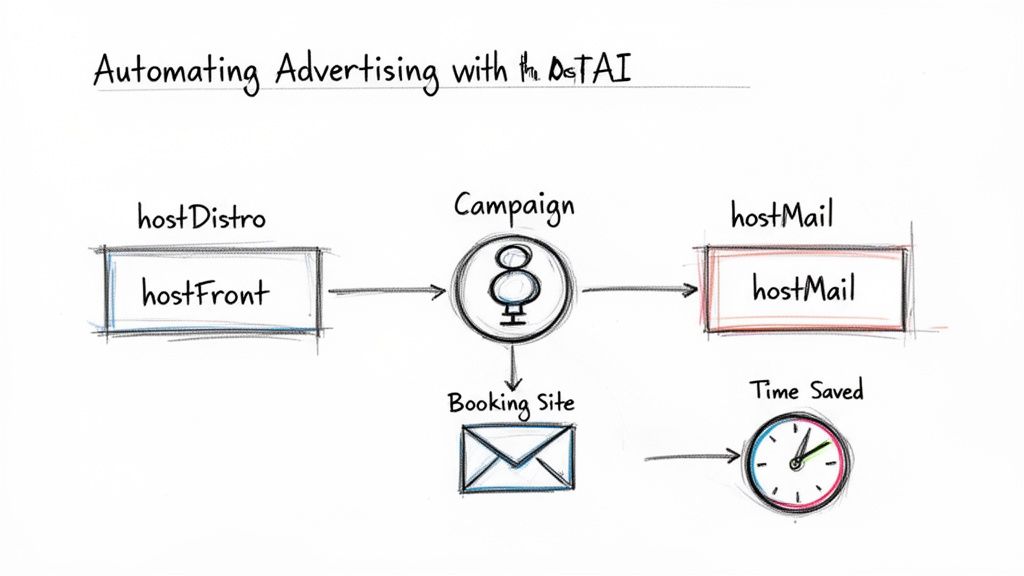
Running a successful multi-channel room rental advertising strategy is a game-changer, but let's be honest—it's also an incredible time suck. Trying to juggle campaigns across Google, Facebook, and all the different OTAs can feel like a full-time job in itself.
This is where automation stops being a "nice-to-have" and becomes your most powerful tool. It's how you scale your marketing efforts without having to scale your workload.
Instead of burning hours manually tweaking bids or refreshing ad copy, you can set up smart systems to do the heavy lifting. This frees you up to focus on the things that really move the needle, like improving the guest experience or scouting your next property. The entire hostAI product suite was built from the ground up to make this happen.
Streamlining Campaign Management with hostDistro
Think of hostDistro as your always-on, automated ad manager. It’s designed to pull the guesswork and manual grind out of running paid campaigns. It plugs directly into your property info to automatically build and run hyper-targeted ads where they’ll be most effective.
This isn't just about setting and forgetting. The platform handles the mission-critical tasks that eat up your day:
- Automated Bidding: It constantly adjusts your bids in real-time to get the best possible return on ad spend (ROAS), making sure you never overpay for clicks.
- Dynamic Ad Creation: It spins up compelling ad copy and visuals specifically for each platform and audience you’re trying to reach.
- Cross-Channel Optimization: It smartly shifts your budget to the channels that are actually delivering, pulling money from underperformers and doubling down on what works.
With this level of automation, your advertising is always optimizing, even when you’re asleep. To really push your visuals to the next level across these campaigns, it's worth looking into dynamic image generation, which keeps your ads looking fresh and relevant for every person who sees them.
Capturing Leads with hostFront Websites
All the traffic in the world won't do you any good if your website can't turn visitors into guests. That’s exactly what hostFront is for. It builds sharp, professional websites with one goal: driving direct bookings.
Your hostFront site becomes the central hub for all your advertising. It’s a destination you own completely, where you can send traffic and control the entire guest journey. These sites come loaded with conversion-focused features like dead-simple booking engines, beautiful photo galleries, and social proof from guest reviews. It’s all about creating the smoothest possible path from ad click to confirmed booking.
An automated advertising system is an ecosystem. The ads generate the traffic, the website converts the leads, and automated follow-ups nurture the relationship. Each piece strengthens the others, creating a powerful engine for direct revenue.
Nurturing Guests with hostMail
The final piece of the puzzle is turning one-time bookers into loyal, repeat guests—and nudging those leads who didn't book right away. hostMail automates your email marketing, taking care of everything from pre-arrival info and check-in instructions to post-stay feedback requests and special offers.
By putting these communications on autopilot, you're building stronger relationships with your guests and creating a dependable stream of future revenue without lifting a finger. If you want to go deeper on this, our guide on how to use AI to automate your short-term rental business is a great next step.
When you integrate these tools, you transform your advertising from a mess of manual tasks into a smooth, self-running system that consistently drives results.
Your Room Rental Advertising Questions Answered
Jumping into room rental advertising can feel like you're staring at a giant, confusing map with no compass. I get it. Let's tackle some of the most common questions and sticking points property managers run into, so you can start moving forward with a clear plan.
How Much Should I Budget for Advertising?
There’s no single magic number here, but a good rule of thumb is to earmark 5% to 10% of your total revenue for marketing. If you’re pushing for growth or heading into a make-or-break season, you might want to bump that up temporarily to grab market share and, just as importantly, gather some solid performance data.
But don't just think of it as a fixed cost you have to pay. A much smarter way to look at it is to build your budget around your goals. Start by figuring out your target Cost Per Acquisition (CPA)—basically, what are you willing to spend to get one direct booking? Once you have that number, you can work backward to build a budget. This simple shift in mindset changes your ad spend from an expense into an investment in predictable, profitable bookings.
Which Ad Channel Is Most Effective?
The "best" channel is the one that aligns with your specific goal right now. Honestly, there isn't a single winner; the smartest strategies use a mix of channels that work together.
- For high-intent travelers: You can't beat Google Ads. You're getting in front of people who are literally typing "cabin rental near me" into a search bar. They're ready to book.
- For building awareness: Facebook and Instagram are fantastic for visual storytelling. You can showcase your property's best features and reach niche audiences who might not even know they need a vacation yet.
- For maximizing conversions: Retargeting is non-negotiable. It’s your secret weapon for bringing back those window shoppers who visited your site but didn't book. This is often where you'll see the highest return on ad spend (ROAS).
A great starting point is to use Google Ads to capture the demand that's already out there. Then, layer in social media to create new interest and use retargeting to seal the deal with anyone who showed interest.
The most powerful advertising strategies don’t rely on a single channel. They create an ecosystem where Google finds ready-to-book guests, social media introduces your property to new audiences, and retargeting ensures you never lose a warm lead.
How Long Until I See Real Results?
Patience is a virtue in advertising, but you should see some early signs of life pretty quickly. Expect to see traffic and clicks rolling in from your paid ad campaigns almost immediately—we're talking within the first 24-48 hours.
However, getting a consistent flow of profitable bookings takes a bit more time. You should give any new campaign at least 90 days to really find its footing. This gives the ad platforms enough runway to collect data, learn who your ideal guest is, and start optimizing for actual conversions. During this initial period, you’ll be in the driver's seat, actively tweaking your ads, adjusting bids, and refining your targeting to steadily improve performance and bring down that cost per booking.
Ready to stop guessing and start automating your advertising for predictable growth? hostAI provides the complete toolkit to manage campaigns, build high-converting websites, and nurture guest relationships—all on autopilot. Discover how hostAI can double your direct bookings today.