

vacation rental ads
Winning Vacation Rental Ads That Drive Direct Bookings
Posted on Dec 12, 2025
Before you even think about launching your first vacation rental ad, you need to lay the groundwork. This is the strategic foundation that separates the ads that drain your bank account from the ones that fill your calendar. It means getting crystal clear on your goals, zeroing in on your ideal guests, and knowing exactly what your competition is up to.
Without this clarity, you're just throwing money at the wall and hoping something sticks. A solid plan ensures every dollar you spend is a smart one, targeting the right people with a message that actually works.
Building Your Foundation for Profitable Ads
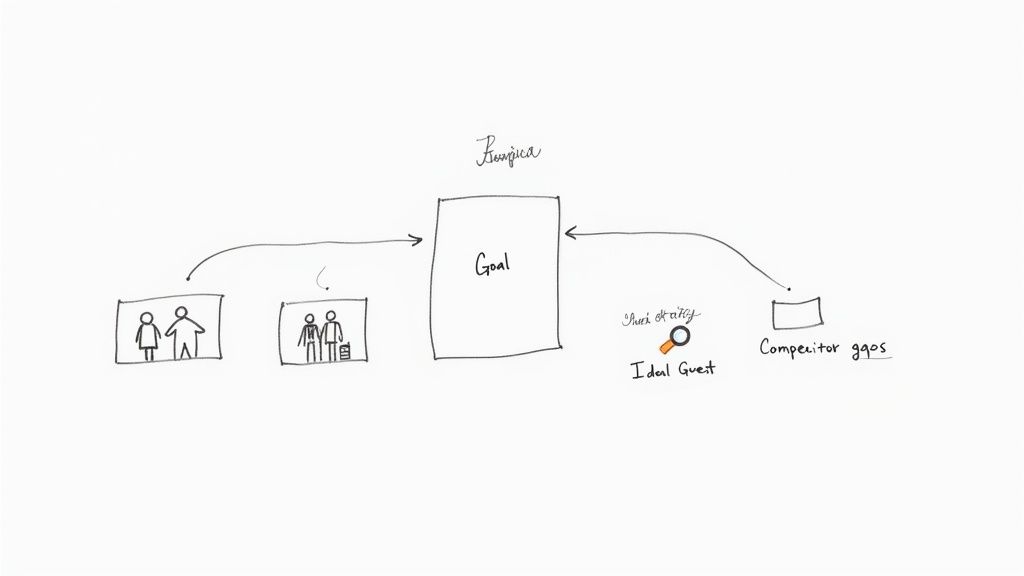
Diving straight into ad creation without a strategy is like starting a road trip without a map. Sure, you'll burn through a tank of gas, but you probably won't end up anywhere you want to be. The most successful ad campaigns I've ever seen were built on a rock-solid understanding of their goals, audience, and market position. Trust me, this preliminary work isn't optional if you want a positive return.
First things first: what does a "win" actually look like for your business? Are you desperately trying to fill last-minute vacancies in the slow season? Or is the goal to lock in high-value bookings for your peak season months ahead of time? Each objective demands a completely different advertising playbook.
Pinpoint Your Ideal Guest
So, who are you really trying to attract? "Travelers" is way too generic. You need to get specific and build out a detailed guest persona. Think about what they truly need, what they're dreaming of, and what problems you can solve for them.
- Families on a Budget: This group is all about space, kid-friendly gear (think high chairs and pack-n-plays), and being close to family attractions. Your ads need to show kids having a blast in your rental and scream "great value."
- Digital Nomads: They're non-negotiable on blazing-fast Wi-Fi, a real workspace (not just the kitchen table), and flexible check-in times. Your ads have to sell the "work-from-paradise" dream, complete with a shot of a laptop overlooking a stunning view.
- Luxury Seekers: These guests are swayed by high-end finishes, exclusive perks like a private hot tub or a chef's kitchen, and the promise of five-star service. Everything about your ads, from the photos to the language, needs to feel sophisticated and exclusive.
By deeply understanding who you're talking to, you can craft messaging that resonates on an emotional level, making your property seem like the only logical choice for their trip.
Analyze the Competitive Landscape
Next up, you have to know what your competition is doing. This isn't about copying them—it's about finding their blind spots and outsmarting them. Scope out the ads for similar properties in your area. What are their main selling points? Who are they trying to target?
This recon mission will help you find a way to stand out. If every other ad is bragging about being "steps from the beach," maybe you can highlight your property's quiet, secluded garden or its impeccable interior design. In a crowded market, finding your unique angle is everything.
The opportunity here is massive. The global vacation rental market hit $174.84 billion in 2024 and is expected to rocket to $396.93 billion by 2032. This incredible growth spells huge potential for property managers who can nail their advertising and grab traveler attention. You can dig into more of these market growth insights on fortunebusinessinsights.com.
Choosing Your Best Advertising Platforms
Choosing where to spend your ad budget is just as important as the ad itself. A fantastic ad on the wrong platform is like setting up a beautiful billboard in the middle of the desert—plenty of effort, zero results. You've got to meet your ideal guests where they already are, whether they're actively planning a trip or just scrolling for their next dream vacation.
This means you can't just throw all your money at one platform and hope for the best. The real magic happens when you build a smart, diversified strategy. The two undisputed giants in this space are Google Ads and Meta (which covers Facebook and Instagram), and they play very different roles in a traveler's booking journey.
Think of them as partners, not competitors for your ad dollars.
Advertising Platform Comparison for Vacation Rentals
Before we dive deep into Google and Meta, it helps to see how they stack up against each other and other potential platforms. Every channel has its own unique flavor—from the high-intent searches on Google to the visual storytelling on Instagram. This table breaks down the main players so you can see where your properties might fit best.
| Platform | Best For | Audience Intent | Ad Formats | Typical Cost |
|---|---|---|---|---|
| Google Ads | Capturing active demand, driving direct bookings | High - Actively searching for accommodations | Search, Display, Video, Performance Max | CPC (Cost-Per-Click), CPM (Cost-Per-Mille) |
| Meta (FB/IG) | Building brand awareness, inspiration, retargeting | Low to Medium - Passive browsing, discovery | Image, Video, Carousel, Stories, Reels | CPC, CPM, CPA (Cost-Per-Action) |
| Reaching planners and dreamers, visual discovery | Medium - Gathering ideas, planning future trips | Promoted Pins, Video Pins, Carousel Pins | CPC, CPM | |
| TikTok | Engaging a younger demographic with short-form video | Low - Entertainment, trend discovery | In-Feed Ads, TopView, Branded Effects | CPM, CPC |
| Microsoft Ads | Reaching an older, often higher-income demographic | High - Actively searching (on Bing, etc.) | Search, Audience Ads, Shopping | CPC |
Ultimately, a strong strategy will likely blend the high-intent capture of Google with the brand-building and retargeting power of Meta. Let’s break down exactly how to do that.
Meet Travelers with High Intent on Google Ads
When someone types "beachfront condo in Miami with a pool" into Google, they aren't just daydreaming. They have a credit card in hand and are ready to book. This is what we call high-intent traffic, and it’s precisely why Google Ads is a non-negotiable for any serious vacation rental manager.
These users have already decided where they want to go and what they need. Your job is to show up as the perfect solution.
For instance, a family deep in the planning stages for a summer getaway is far more likely to be on Google than Instagram. By running a Search campaign targeting specific keywords like "3-bedroom rental near Disney," you place your property directly in their path at the exact moment of decision.
The Google Ads dashboard is your command center for these high-stakes campaigns. It’s where you connect your properties with travelers who know what they want and are actively looking to book it.
This high-intent environment is also where a solid SEO game really shines. When your paid ads work in tandem with strong organic search rankings, you create a powerful one-two punch that dominates the search results page. If you really want to maximize your visibility and drive more direct bookings, you need to understand how SEO and PPC can work together.
Inspire and Retarget on Facebook and Instagram
While Google is all about capturing existing demand, Meta's platforms are where you create it. On Facebook and Instagram, you’re not just selling a rental; you're selling the dream. People are in a discovery mindset, scrolling through their feeds looking for inspiration. Your job is to stop their scroll.
This is where your most visually stunning content belongs. Think cinematic video tours, vibrant photos of your property’s best amenities, and ad copy that evokes a feeling. You're not just listing features; you're painting a picture of an unforgettable experience.
Pro Tip: Don't just show the space; show the experience. An image of two people clinking wine glasses on the balcony as the sun sets is infinitely more compelling than a photo of an empty balcony.
Beyond inspiration, Meta’s platforms are absolute beasts for retargeting. This is your chance to bring back people who showed interest but didn't pull the trigger. You can serve highly specific ads to users who have:
- Visited your direct booking site but left without booking.
- Liked, commented on, or saved one of your Facebook or Instagram posts.
- Watched 50% or more of your property’s video tour.
This follow-up allows you to stay top-of-mind with warm leads, gently nudging them back toward your booking page. When you combine the intent-driven power of Google with the inspirational and retargeting muscle of Meta, you build a complete funnel that engages travelers at every single stage of their journey.
Crafting Ad Copy and Visuals That Convert
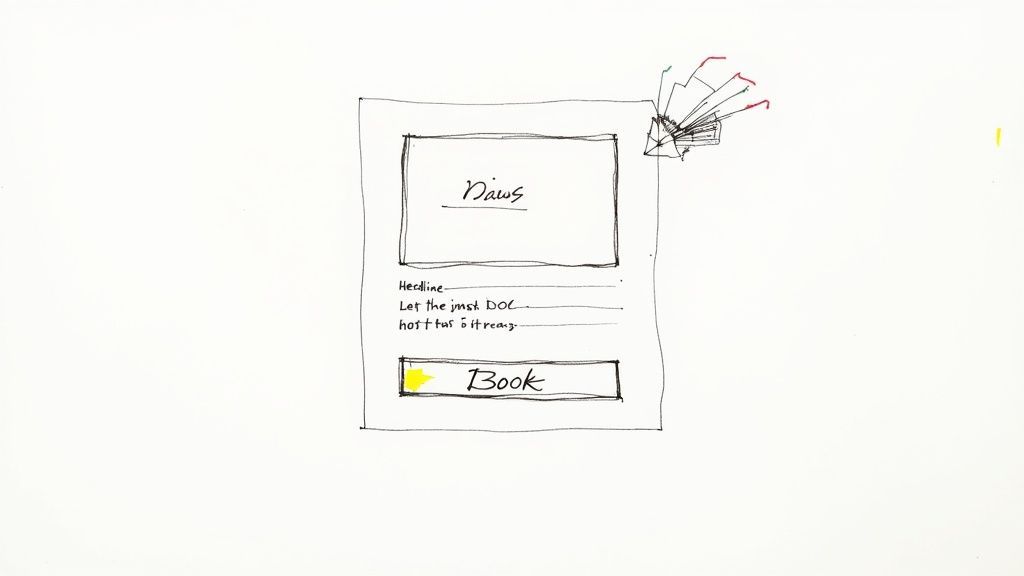
You’ve got maybe two seconds to grab a traveler's attention as they scroll through their feed. Two seconds. That's where killer ad creative isn't just nice to have—it's everything. The goal is simple: stop the scroll, make them curious, and convince them your property is the one for their next trip.
Great ad creative doesn't just show a clean room; it sells an entire experience. It’s about weaving together words and visuals so powerful that potential guests can practically feel the sun on their face or hear the crackle of the fireplace before they've even clicked "book."
Writing Headlines and Copy That Sells the Experience
Think of your ad copy as your best salesperson, working 24/7. It needs to be persuasive, sharp, and laser-focused on what the guest really wants. A classic mistake I see all the time is leading with features like the number of beds and baths. That's just data, not a dream.
Start with a headline that packs a punch by focusing on your unique selling point (USP). Ditch "3-Bedroom Cabin for Rent" and try something like, "Your Private Hot Tub Under the Stars Awaits." See the difference? We've shifted from a simple fact to an irresistible feeling.
The best ad copy answers the silent questions guests are asking: "Will I relax here?" "Will my kids have fun?" "Is this the special escape I've been looking for?" Frame your descriptions to answer these emotional needs.
Your description should then deliver on that headline's promise. Use a little storytelling to paint a picture of what a day at your rental actually feels like.
- Instead of: "The kitchen has new appliances."
- Try: "Whip up gourmet meals in a chef's kitchen with brand-new appliances—perfect for those family dinners after a long day on the slopes."
This simple tweak helps guests imagine themselves in the space, forging an emotional connection that makes clicking "Book Now" feel like the natural next step. If you're looking for more inspiration, we've got a whole guide full of great vacation rental description examples.
Choosing Visuals That Stop the Scroll
Let's be honest: visuals are the heart and soul of vacation rental ads. People dream with their eyes, and one knockout photo can do more heavy lifting than a thousand words of copy. Your first job is to pick a "hero" image that is absolutely impossible to ignore.
This hero shot has to be your property's showstopper. It could be the jaw-dropping view from the deck, a beautifully styled living room drenched in morning light, or the inviting glow of the poolside lounge at dusk. This is the image that makes someone slam the brakes on their endless scrolling.
The global vacation rental market is on track to hit $105.71 billion by 2025, and visuals are the main reason a user base of 1.07 billion people (by 2029) will click "book." You absolutely need top-notch photos and videos to get your piece of that pie.
Once your hero image has them hooked, use a carousel or a quick video to show off the rest of the goods.
- Give them a peek at the primary bedroom and bathroom.
- Show off the fun stuff—a game room, a fire pit, or a dedicated workspace.
- Include shots of the exterior and any outdoor spaces.
- If you've got a killer view, make sure it gets plenty of screen time.
If you want to get really creative and authentic with your visuals, it's worth looking into how AI-powered UGC ads can bring a fresh, guest-centric perspective to your campaigns. When you nail the combination of a magnetic headline, evocative copy, and stunning visuals, you won't just get attention—you'll get the high-quality bookings you're after.
Finding Your Ideal Guests & Getting the Most From Your Ad Spend
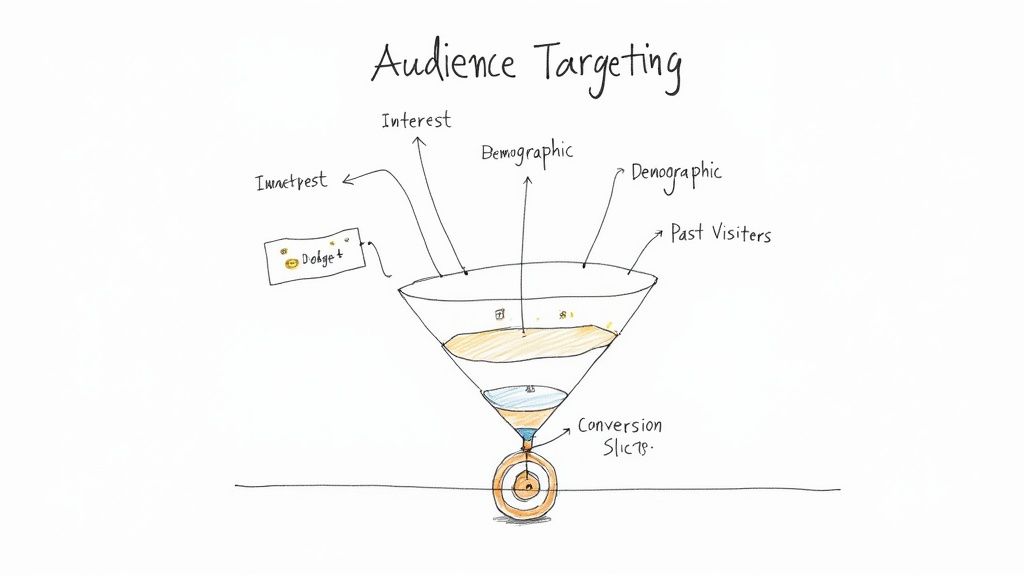
You can have the most beautiful ad in the world, but if you show it to the wrong person, you're just burning through your budget with nothing to show for it. I've seen it happen time and time again. True success with vacation rental ads comes down to precision targeting—getting your property in front of travelers who are not just browsing, but are ready to book.
This means we have to move beyond casting a wide, generic net. The first step is to get crystal clear on who you're actually trying to reach. To really nail your campaigns, you have to create buyer personas that feel like real people, not just data points. This exercise transforms abstract numbers into relatable profiles, making it so much easier to write ad copy that actually connects.
The market is huge and only getting bigger. We're looking at 1.07 billion people using vacation rentals globally by 2029, with nearly 60% of all bookings happening online. A massive driver behind this is younger travelers; millennials and Gen Z are on track to make up 75% of Airbnb's customer base by the end of 2025. These aren't your parents' vacationers—they crave unique experiences and live online, which makes sharp, digital targeting an absolute must.
Building Audiences That Actually Convert
Think of your ad platforms as treasure troves of data. You can build incredibly powerful custom audiences by layering different targeting options. The magic happens when you start combining demographics with specific, travel-related interests and recent behaviors.
- Demographics: Go beyond just age and location. Target based on family status (like "parents with young children") or even household income to make sure your property's price point aligns with their budget.
- Interests: This is a goldmine. Hone in on users who have shown a clear interest in things like "beach vacations," "ski resorts," or "adventure travel." You can even target interest in specific destinations.
- Behaviors: Look for signals of intent. Target "frequent travelers" or people who have recently used travel apps or searched for flights and hotels.
But the real power move? Retargeting. This is where you create an audience of people who have already interacted with your brand in some way—maybe they visited your website and looked at a specific property but didn't book. These are warm leads, and they are dramatically more likely to convert than cold traffic.
Here’s a pro tip that many managers overlook: use negative keywords. By telling the platform to exclude searches containing words like "cheap," "long-term lease," or "for sale," you stop wasting money on clicks from people who were never going to book anyway.
Nailing Your Budget and Bidding Strategy
Once you know who you're targeting, you need to decide how much you're willing to pay to reach them. This is where your bidding strategy comes into play. For vacation rentals, it usually boils down to two main options: Cost-Per-Click (CPC) and Cost-Per-Acquisition (CPA).
- CPC (Cost-Per-Click): Simple and straightforward. You pay every time someone clicks on your ad. This is fantastic for driving traffic to your site and getting your name out there, but it doesn't guarantee you'll get a booking from that click.
- CPA (Cost-Per-Acquisition): This is a bit more advanced. You tell the ad platform your target cost for a confirmed booking, and its algorithm goes to work finding the users most likely to convert at that price. It's a strategy focused purely on ROI.
If you're just starting out, I almost always recommend beginning with a CPC model. It's easier to manage and gives you a baseline for performance. As you start to collect more booking data, you can then switch to a target CPA strategy to make your spending far more efficient.
And don't forget to filter out that unqualified traffic. To get a head start, check out our comprehensive list of negative keywords to protect your ad spend from day one. Managing your budget isn't just about setting a daily limit; it’s about making smart, data-driven adjustments based on seasonality and performance to ensure every single dollar is working for you.
Looking at the Numbers to Make Your Campaigns Better
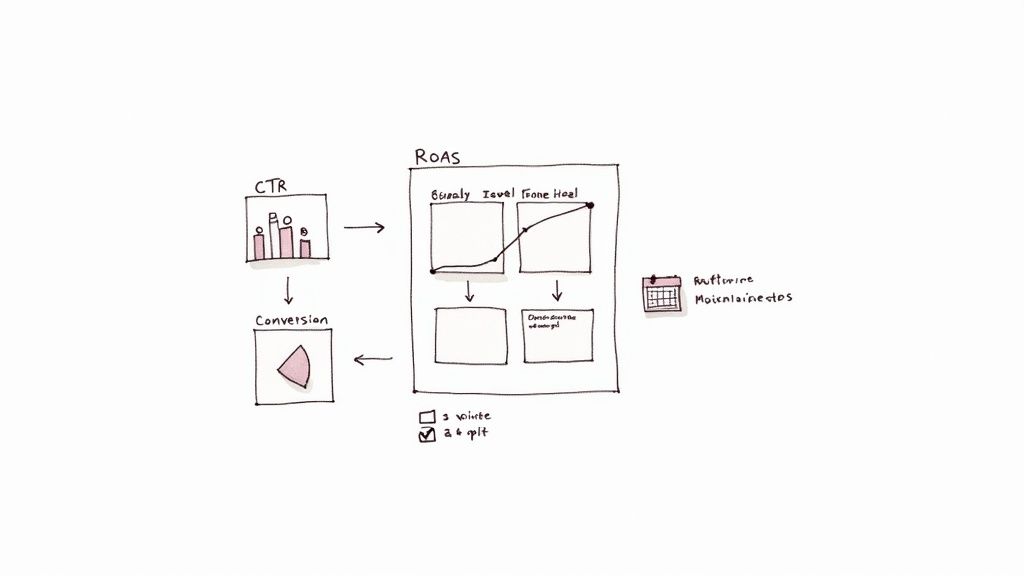
Here’s the thing about running vacation rental ads: launching them is the easy part. It’s just the starting line. The real money is made in the follow-through—when you start digging into the data and making smart adjustments. This is how your ad spend goes from being just another business expense to a predictable investment.
If you ignore your campaign data, you're essentially flying blind. Sure, you might be getting clicks, but are they the right clicks? Are those clicks actually turning into paying guests? You have to get into the numbers to see what’s really going on.
Key Metrics That Actually Move the Needle
It's easy to get distracted by flashy numbers like impressions or reach. And while it's nice to see a lot of eyeballs on your ads, those metrics don't put money in your bank account. Instead, you need to zero in on the numbers that directly impact your bottom line.
- Click-Through Rate (CTR): This tells you the percentage of people who see your ad and are compelled enough to click it. A low CTR is a massive red flag. It’s a sign that your ad creative, your headline, or maybe both, just aren't connecting with your target audience.
- Conversion Rate: This is the big one. Of all the people who clicked, what percentage actually completed a booking? This metric is the ultimate report card for your booking page and how well it seals the deal.
- Return On Ad Spend (ROAS): This is the holy grail. For every single dollar you put into your ads, how many dollars in booking revenue are you getting back? A ROAS of 5:1 means you're generating $5 in revenue for every $1 you spend.
Honestly, tracking these KPIs isn't optional. Think of them as the vital signs of your campaign's health. They tell you exactly where you need to focus your energy to make things better.
The Not-So-Secret Weapon: A/B Testing
So, how do you actually improve those numbers? Simple. You test. A/B testing, or split testing, is just running two slightly different versions of an ad to see which one performs better. It's a straightforward practice that takes all the guesswork out of the equation.
You're no longer just going with your gut on what you think will work. You’re letting real-world data tell you what actually works. It's the most powerful tool you have for consistently improving your results.
The key is to start with small, isolated changes. If you change the headline, the image, and the call-to-action all at once, you’ll have no clue which change actually made the difference. Keep it simple to get clean data.
Here are a few easy A/B tests you can run right away:
- Test Your Hero Image: Try a photo of that incredible mountain view against a shot of your cozy, styled living room.
- Test Your Headline: Pit a benefit-focused headline ("Your Private Hot Tub Under the Stars") against one that's all about location ("Luxury Cabin 5 Mins from Downtown").
- Test Your Call-to-Action: Does "Book Your Escape" get more clicks than a more direct "Check Availability"? Only one way to find out.
By constantly testing and tweaking, you turn your ad campaigns from a shot in the dark into a finely tuned engine that reliably churns out bookings. This disciplined approach is what separates the amateurs from the pros who build scalable, successful businesses.
Got Questions? We've Got Answers
Even the best-laid plans run into questions once you're in the thick of managing your ads. Let's tackle some of the most common ones we hear from property managers. Think of this as your go-to cheat sheet for navigating those tricky first few weeks.
What’s a Realistic Starting Budget for My Ads?
There's no magic number here, but a great place to start is somewhere in the ballpark of $15 to $30 a day for each platform you're on, whether that's Google or Meta. This is usually just enough to get the ball rolling and start collecting some real-world data without betting the farm.
Think of that initial spend as buying information, not just clicks. You're learning what messages resonate, which audiences are actually interested, and what a click even costs in your specific market. Once you find a campaign that's actually making you money, you can start pouring more fuel on the fire.
The real goal isn't just to spend money—it's to spend it wisely. Start small, prove you can get a positive Return On Ad Spend (ROAS), and only then should you scale up.
How Long Until I Know if an Ad Is Working?
This is where so many people trip up. You have to be patient. The ad platform algorithms need time to learn and data to optimize—they're not magic. As a solid rule of thumb, let any new campaign run for at least 7 to 14 days before you even think about making big changes or pulling the plug.
That two-week window gives you enough time to see past the weird daily ups and downs and spot a real performance trend. The classic rookie mistake is freaking out after a bad day or two and killing a campaign that might have been a winner. Don't do it.
Which Is Better: Google or Facebook Ads?
Ah, the million-dollar question. The honest answer? It's not an either/or situation. You really need both, because they do completely different jobs.
Google Ads is all about capturing hot leads. These are people actively typing "cabin rental in Asheville" into the search bar. They have their credit card out and are ready to book right now. You're basically catching people who are already looking for you.
Facebook & Instagram Ads are for creating future demand and staying top-of-mind. You're showing up in someone's feed, planting the seed for their next vacation, or reminding that person who visited your site last week that your beautiful beach house is still available.
Our advice? Start with Google Ads to snag that low-hanging fruit—the active searchers. Then, layer in Meta ads to build your brand and run retargeting campaigns to bring back all those "almost-bookers" who just needed a little nudge.
Ready to stop guessing and start driving consistent, profitable direct bookings? hostAI provides the tools you need to launch and manage powerful advertising campaigns, create stunning direct booking websites, and automate your guest communication. See how hostAI can double your direct revenue.