

vacation rental business plan
Crafting Your Vacation Rental Business Plan for Maximum Profit
Posted on Jan 6, 2026
A vacation rental business plan isn't just a document for a bank loan; it's your strategic roadmap. It’s what transforms your property from a side hustle into a scalable, professional hospitality business, guiding every decision from pricing to the way you talk to your guests.
Building Your Foundation for a Modern Rental Business
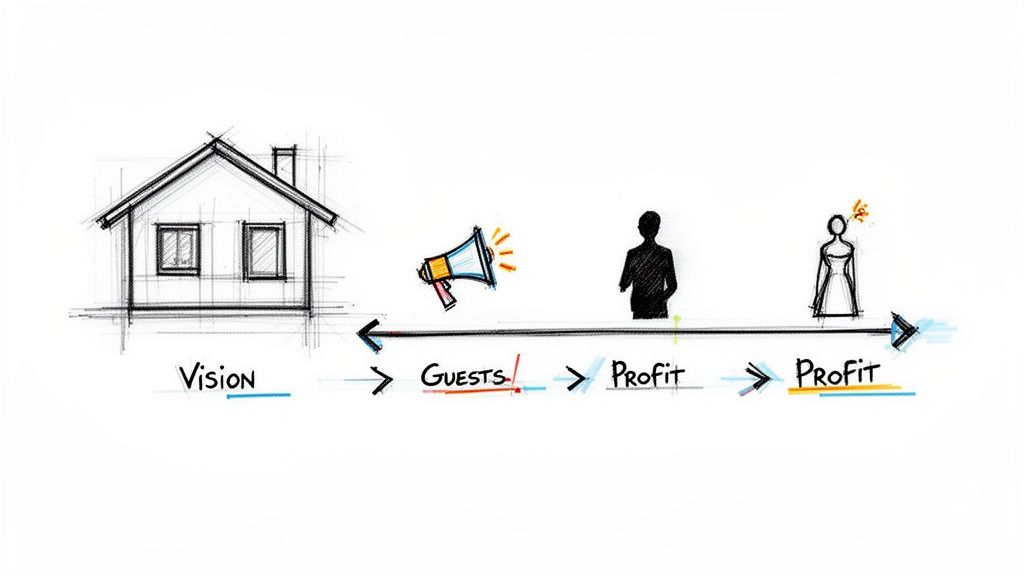
Forget the dusty, fifty-page binders of the past. A modern vacation rental business plan is a living, breathing guide that helps you navigate the crowded short-term rental market. It’s less about formality and more about focus—a tool to nail down your unique value proposition and make it crystal clear why a guest should book with you over hundreds of other options.
This plan forces you to answer the tough questions before you sink significant time and money into your venture. It's the difference between treating your rental like a hobby and running it like a real business. A solid plan ensures you're proactively building a brand that pulls in your ideal guest, not just scrambling to fill empty nights.
Key Components of a Modern STR Business Plan
To thrive, your plan needs to evolve beyond the basics. It must integrate technology and a forward-thinking mindset to not just compete, but lead. Here’s a quick look at how the core elements of a business plan have changed.
| Core Component | Traditional Focus | Modern Approach (with AI) |
|---|---|---|
| Market Analysis | General demographics, tourism stats | Hyper-local demand data, niche guest personas, real-time competitor benchmarking |
| Marketing Plan | Basic OTA listings, some social media | Multi-channel distribution, SEO-driven direct booking site, targeted ad campaigns |
| Financials | Static annual projections | Dynamic pricing models, variable expense forecasting, LTV and CAC analysis |
| Operations | Manual cleaning schedules, guest messaging | Automated workflows, AI-powered guest comms, predictive maintenance scheduling |
| KPIs & Goals | Occupancy, ADR | RevPAR, direct booking ratio, guest sentiment scores, repeat guest rate |
This shift from static to dynamic planning is crucial. It’s about being agile, data-driven, and ready to adapt to market changes on the fly.
Define Your Vision and Unique Selling Proposition
Before you even think about a spreadsheet, start with the "why." What kind of experience are you creating? A budget-friendly basecamp for families? A luxe escape for couples? A high-tech haven for digital nomads? Your answer is your Unique Selling Proposition (USP)—the one thing that makes your property stand out.
Your USP is the thread that ties everything together:
- Property Decor: A "luxury retreat" needs high-end furnishings, not hand-me-downs.
- Amenities: A "digital nomad" spot is a no-go without lightning-fast Wi-Fi and a proper workspace.
- Guest Communication: Your tone should match the brand, whether it's warm and bubbly or sleek and professional.
For a deeper dive into these foundational steps, check out our complete guide on starting a vacation rental business. It’s packed with checklists to make sure you've covered all your bases.
A strong business plan is your North Star. It keeps you focused on your target guest and prevents you from making costly decisions based on fleeting trends or what the competition is doing. It’s about building a sustainable business, not just filling your calendar for next month.
Set Clear and Measurable Goals
With your vision locked in, it’s time to get specific. Vague goals like "make more money" don't cut it. You need tangible, measurable targets—often called SMART goals (Specific, Measurable, Achievable, Relevant, and Time-bound). This gives you clear benchmarks to aim for and a real way to track your progress.
Here’s what that looks like in a vacation rental business plan:
- Achieve a 65% occupancy rate within the first six months.
- Secure 20% of all bookings directly through our website by the end of year one.
- Maintain an average guest rating of 4.9 stars or higher across all platforms.
These metrics are more than just numbers on a page; they're the vital signs of your business. They tell you if your pricing is right, if your marketing is hitting the mark, and if your guest experience is truly living up to the promise you made.
Conducting a Winning Market and Competitive Analysis

Let’s be honest: success in the short-term rental game isn't just about having the nicest property on the block. It’s about having the right property in the right market, at the right time. Your market analysis is arguably the most crucial piece of your entire vacation rental business plan. This is where you prove—to yourself and any potential investors—that a real, sustainable demand exists for what you offer.
This isn’t about just pulling a few high-level tourism stats and calling it a day. A winning analysis means getting your hands dirty and digging into the granular details. You need to intimately understand the unique rhythm of your specific neighborhood and what actually brings visitors to your front door.
Digging Deep into Your Local Market
First things first, you need to define your market's personality. Is it a sleepy beach town that absolutely explodes in the summer? Or is it a downtown core that hums with business travelers all year long? Grasping this fundamental rhythm is the key to everything from forecasting revenue to simply managing cash flow without pulling your hair out.
Next, start hunting for the key demand drivers. These are the magnets that pull people into your area. We’re talking about anything from major convention centers and universities to popular hiking trails or the headquarters of a Fortune 500 company. Nailing these down helps you build a crystal-clear picture of your ideal guest, which makes marketing a whole lot easier.
Here's what you need to be researching:
- Seasonality and Demand Shifts: Get a real feel for the occupancy rates throughout the year. When are the absolute peak seasons, the shoulder months, and the dead-of-winter low seasons? Knowing this helps you plan for everything from dynamic pricing to scheduling that big renovation project.
- Local Regulations: This one is non-negotiable, folks. You absolutely have to investigate your city or county’s specific rules on short-term rentals. This includes licensing, occupancy taxes, and any weird zoning restrictions. Ignoring this step can get your business shut down before you even host your first guest.
- Tourism Trends: Check out the data from local tourism boards. Are they seeing a surge in "bleisure" travel? Is there a new wave of demand for pet-friendly places? Aligning your property with these emerging trends can give you a massive leg up.
Analyzing Your Direct Competition
Okay, once you've got the big picture, it’s time to zoom in on your direct competitors. I’m talking about identifying 5-10 properties that are the most similar to yours—think location, size, and the number of heads they can have in beds. You’re not just peeking at their nightly rates; you’re performing a full-on dissection of their entire business model.
When you’re sizing up the competition, ask yourself these questions:
- What's their pricing strategy? Do their rates jump for weekends, holidays, or that big annual festival? There are tools out there that can help you track these fluctuations so you can get a sense of their dynamic pricing model.
- What amenities are standard? If every single one of your comps offers a hot tub or a slick dedicated workspace, you’re at a serious disadvantage without one. On the flip side, offering a unique perk—like high-end coffee gear or a Peloton bike—can become a killer selling point.
- How sharp is their marketing? Take a hard look at their listing photos, the quality of their descriptions, and what guests are saying in the reviews. Do they have their own direct booking website or a strong Instagram presence? This is where you’ll spot the gaps in their strategy that you can drive a truck through.
Your goal isn't to just copy what your competitors are doing. It's to find your unique, defensible position in the market. If everyone else is chasing families, maybe you can become the go-to spot for romantic getaways by creating a completely different experience.
Performing a Property-Specific SWOT Analysis
With all that rich market and competitor data in hand, it’s time to pull it all together with a SWOT analysis. It’s a simple but powerful framework for organizing your findings and turning them into a real, actionable strategy. It stands for Strengths, Weaknesses, Opportunities, and Threats.
Now is the time for brutal honesty. A weakness isn't a failure; it's just a problem you need to solve or an area you need to improve.
| Category | Description & Example |
|---|---|
| Strengths | Internal positives you can control. Example: "Our property has a newly renovated kitchen and is within walking distance of the downtown area." |
| Weaknesses | Internal negatives you can control. Example: "The property has limited parking, which could be a deterrent for guests with multiple vehicles." |
| Opportunities | External factors you can capitalize on. Example: "A new convention center is opening next year, which will increase demand for business travel lodging." |
| Threats | External factors that could harm your business. Example: "The city council is considering new regulations that could limit the number of days we can rent per year." |
This analysis is a cornerstone of your vacation rental business plan. It's what takes you from being a passive information collector to an active strategist. For instance, knowing your parking is limited (Weakness) but a new event venue is opening nearby (Opportunity), you might proactively partner with a local parking garage to offer discounted rates for your guests.
Just like that, you've turned a potential negative into a thoughtful, guest-focused solution. This is exactly how deep analysis translates directly into a real-world competitive advantage.
Crafting Realistic Financial Projections and Pricing
This is where the rubber meets the road in your vacation rental business plan. Your vision is exciting, but it's the bottom line that makes it real. Solid financial projections aren't just for convincing a lender; they're your personal reality check. They ensure your business is built on a foundation of actual profitability, not just passion and a prayer.
To get this right, you have to move beyond wishful thinking. It's time to dig into the cold, hard numbers that will ultimately define whether you sink or swim.
The whole process kicks off with a brutally honest look at every single dollar it'll take to get your property guest-ready, plus every recurring expense that will drain your bank account month after month. A detailed breakdown here saves you from nasty surprises down the line and helps you pinpoint your break-even point with real confidence.

Breaking Down Your Startup and Operational Costs
Before you can even think about the money coming in, you need a crystal-clear picture of the money going out. It’s easy to remember the big-ticket items, but it's the small, recurring costs that often catch unprepared hosts off guard and slowly bleed them dry.
Let's split these costs into two buckets.
First up are your one-time startup costs. These are the initial investments to get the doors open. They can vary wildly depending on your property, but the list usually includes:
- Furnishings and Decor: Literally everything from the king-sized bed down to the saltshakers.
- Professional Photography: This isn't optional. It’s a make-or-break expense for attracting your first guests.
- Linens and Towels: My rule of thumb is to budget for at least three full sets per bed. It's a lifesaver for quick turnovers.
- Initial Deep Clean: You need to get the property to a five-star standard from day one.
- Licensing and Permit Fees: Don't forget the costs tied to your local short-term rental regulations.
Next, you've got the ongoing operational expenses. These are the bills you'll pay every single month, whether you're fully booked or completely empty.
- Mortgage or Rent: Typically your biggest fixed cost.
- Utilities: Internet, electricity, water, gas, trash—it all adds up.
- Software Subscriptions: Think channel managers, dynamic pricing tools, and guest communication platforms like hostAI.
- Cleaning and Restocking Fees: This is the per-stay cost for your turnover team.
- Insurance: You absolutely need specific short-term rental insurance, not just a standard homeowner's policy.
The single most important financial exercise you can do is create a detailed spreadsheet with every startup and monthly operational cost. This gives you a clear baseline for your pricing and tells you exactly how many nights you need to book just to break even.
Forecasting Revenue with Key Metrics
Once you have a firm handle on your costs, you can shift your focus to the fun part: revenue. But guesswork is your worst enemy here. Your projections must be based on industry-standard metrics and real-world data from your specific market.
These are the three most important metrics for your vacation rental business plan:
- Average Daily Rate (ADR): This is your average rental income per night booked. To forecast this, you need to analyze the ADR of truly comparable properties in your immediate area using market data tools.
- Occupancy Rate: This is the percentage of available nights your property is actually booked. Check out the seasonal occupancy rates for your direct competitors to build a realistic monthly forecast. Whatever you do, don't assume you'll hit 100% occupancy in your first year.
- Revenue Per Available Room (RevPAR): You get this by multiplying ADR x Occupancy Rate. This metric provides the most accurate picture of your property's real earning potential.
For any new property, it's smart to build three financial scenarios into your business plan: a conservative one (think lower occupancy, lower ADR), a realistic one (hitting market averages), and an optimistic one (if you manage to outperform the competition). This shows you’ve thought through the range of possible outcomes.
Building a Dynamic Pricing Strategy
The biggest mistake I see new hosts make is setting one nightly rate and just letting it sit there for months on end. This "set-it-and-forget-it" approach leaves a shocking amount of money on the table.
A dynamic pricing strategy, where your rates adjust automatically based on real-time supply and demand, is the only way to truly maximize your revenue.
Your pricing should instantly adapt to several factors:
- Seasonality: Higher rates during your peak season, and lower rates in the off-season to keep the bookings coming.
- Local Events: That big music festival or annual conference creates a huge demand spike. Capitalize on it.
- Day of the Week: Weekend rates should almost always be higher than weekday rates.
- Lead Time: Offer a small discount for last-minute bookings to fill those awkward gaps in your calendar.
Trying to track all these variables manually is a fool's errand. This is where smart tools become non-negotiable. A good dynamic pricing engine analyzes millions of data points to recommend the perfect price for every single night of the year, making sure you never leave money on the table.
For a complete playbook on this, check out our guide on creating a winning vacation rental pricing strategy. It’ll help you shift from being a passive price-taker to an active, strategic revenue manager.
Designing Your Direct Booking and Marketing Strategy
Relying solely on platforms like Airbnb and Vrbo for bookings is like building a beautiful house on rented land. Sure, it’s convenient at first, but you're always subject to their whims—their algorithms, commission hikes, and rule changes. A truly robust vacation rental business plan has to include a smart marketing strategy that puts you back in the driver's seat by funneling in high-margin, direct bookings.
Making this shift isn't an overnight fix. It's about methodically building a brand that guests actually remember and trust. The goal is to turn those one-time visitors into repeat customers who book with you directly, which saves both of you money in the long run. You're essentially creating your own sustainable booking ecosystem, cutting down your reliance on OTAs and seriously boosting your profitability.
Building Your Digital Storefront
Think of your direct booking website as your digital storefront—it's the one piece of online real estate you completely own. This is your space to tell your story, show off your property with stunning, high-res photos, and build a unique brand identity without being crammed into a generic OTA template.
But a successful direct booking site has to be more than just a pretty photo album. It needs to be engineered to convert visitors into guests.
- Effortless Booking Engine: The path from checking dates to making a payment must be dead simple, secure, and work flawlessly on a phone. Any hiccup or clunky step will send potential guests running right back to the familiar OTAs.
- Compelling Visuals: Don't skimp here. Invest in professional photography and maybe even a video tour that truly captures the vibe and experience of staying at your property.
- Clear Value Proposition: Right away, your site needs to answer the visitor's main question: "Why should I book here?" Showcase your best amenities, your killer location, and whatever it is that makes your place special.
Building a powerful website is more accessible than you might think. Platforms like hostFront use AI to build intelligent, conversion-focused sites specifically for vacation rental managers. It keeps your branding tight and professional, which is key to earning the trust you need to land that direct booking.
The Power of Email Marketing and Retargeting
Once a guest checks out, they're no longer just a booking ID on a platform; they are your customer. That relationship shouldn't just end. A simple but incredibly effective email marketing strategy is your ticket to unlocking a goldmine of repeat business.
Start by collecting guest emails (with their permission, of course!). From there, you can set up automated campaigns to stay top-of-mind, offering exclusive discounts for future stays or sending a friendly reminder when a popular local event is on the horizon.
Direct bookings are the holy grail for vacation rental pros. Recent surveys show that 32% of travelers favor unique stays, which drives demand for tech-savvy hosts who can cut out the middlemen. The growth in this sector highlights why tools that automate marketing are essential for scaling your business.
This is where automation becomes your secret weapon. A platform like hostMail can take this completely off your plate, sending personalized, well-timed emails that nurture relationships with past guests and nudge them to book direct for their next trip.
Automating Your Advertising with Precision
Beyond bringing back past guests, you need a plan to attract new ones. This is where smart, automated advertising enters the picture. Instead of just blindly boosting a post on social media and hoping for the best, you can run highly targeted campaigns to reach your ideal guest.
One of the most effective tactics is retargeting. This means showing your ads to people who have already visited your website but left without booking. It’s a gentle nudge that keeps your property on their radar as they’re making their final decision.
- Pixel Tracking: Install tracking pixels on your website to identify visitors.
- Audience Segmentation: Group visitors into specific audiences, like "people who viewed the booking page but didn't complete."
- Targeted Ads: Run campaigns on platforms like Facebook and Google that show compelling ads specifically to these warm leads.
Managing all this can feel like a full-time job, but tools like hostDistro automate the whole shebang. It creates and manages hands-free ad campaigns, ensuring your marketing budget is spent effectively to bring high-intent travelers back to your site to seal the deal. For a deeper dive into these tactics, our guide for vacation rental marketers offers more actionable strategies.
Driving Traffic with SEO
To really make your direct booking strategy fly, you have to get a handle on search engine optimization. Your website needs to pop up when potential guests search for things like "cabin rental in [Your Town]." A solid SEO foundation is what makes your direct booking site discoverable in the first place. This practical guide to search engine optimisation has some great insights to get you started. By optimizing your site, you're building a sustainable pipeline of free, high-quality traffic for years to come.
Streamlining Your Operations for a Five-Star Experience
An unforgettable guest experience isn't just a nice-to-have; it's your single most powerful marketing asset. It’s also a critical piece of your vacation rental business plan. Happy guests leave glowing five-star reviews, which is the fuel that drives more bookings. This is all about building the operational systems to deliver those top-tier stays, consistently and at scale.

The goal here is to create a repeatable process that cuts down on your hands-on workload while absolutely delighting your guests. This isn't about cutting corners. It's about being smarter with your time and resources so you can zero in on the high-impact details that really count. Think of it as building a well-oiled machine that runs smoothly behind the scenes.
Standardizing Cleaning and Maintenance Protocols
Consistency is the absolute bedrock of a five-star rating. A guest should walk into the same impeccably clean, well-maintained space whether they're your first visitor or your hundredth. That's simply impossible without standardized, documented procedures for your team.
Start by creating a detailed turnover checklist. This needs to be more than a simple to-do list; it’s your quality control bible.
- Photo-Based Guides: Don't just write "stage the living room." Show it. Include pictures of how each room should look, right down to how the towels are folded and where the throw pillows go.
- Restocking Inventory: Be specific. List the exact quantities for consumables like coffee pods, toilet paper, and soap. This small step prevents those frustrating shortages that can sour a guest's stay.
- Maintenance Checks: Make this mandatory. Your team should test key items during every turnover—Wi-Fi speed, TV remotes, and smart lock batteries. Catching a problem before the guest does is a game-changer.
To really get your processes locked in and keep tabs on every little task, it's worth looking into dedicated property management maintenance software. This ensures nothing falls through the cracks, from a leaky faucet a guest mentioned to scheduled HVAC filter changes.
The global vacation rental market has seen massive growth, hitting an estimated USD 97.85 billion. This boom highlights the huge opportunity for operators who run a tight ship. In the U.S. alone, revenues are on track to hit USD 21.08 billion, with private homes making up a 49% share of accommodations. The demand for quality stays has never been higher.
Implementing a Seamless Guest Journey
Today’s traveler expects a smooth, tech-forward experience from the moment they book to the second they check out. Your operational plan needs to map out this entire journey, looking for every opportunity to remove friction and add moments of delight through smart automation.
A clunky check-in process is a non-starter. Making a guest wait around for a key hand-off feels painfully outdated and inconvenient.
A seamless arrival sets the tone for the entire stay. Investing in smart locks and clear, automated check-in instructions is one of the highest-ROI operational decisions you can make. It immediately shows guests you value their time and independence.
Think through your entire guest communication flow. Sure, personalized messages are great, but are you still manually answering the same questions about the Wi-Fi password or trash day? That's a massive time sink. This is exactly where automation platforms prove their worth.
Leveraging Technology for Operational Excellence
Technology is the engine that powers a scalable and efficient vacation rental business. By automating the routine stuff, you free yourself up to focus on strategic growth and providing that exceptional hospitality where it truly matters.
Here are the essential technologies to build into your operational plan:
| Technology Tool | Key Function | Impact on Guest Experience |
|---|---|---|
| Smart Locks | Provides keyless entry via unique codes | Eliminates key handoffs, increases security, and allows for flexible check-in times. |
| Guest Comms Platform | Automates sending of routine messages | Ensures timely info (check-in details, house rules) is delivered without fail. |
| Digital Guidebooks | Centralizes property info and local tips | Offers guests a one-stop-shop for answers, reducing repetitive questions. |
| Noise & Occupancy Monitors | Alerts you to potential parties or issues | Protects your property and neighborhood peace without invading guest privacy. |
Putting these tools in place is a foundational step in your vacation rental business plan. Don't think of them as expenses; they are investments in efficiency, guest satisfaction, and the long-term health of your business. By building a robust operational framework, you create a business that runs effectively, whether you're managing one property or one hundred.
Answering Your Top Vacation Rental Business Plan Questions
Putting together a solid vacation rental business plan always sparks a few key questions. It's totally normal to wonder where you should really be putting your energy to get the best results.
Nailing these core areas can be the difference between a plan that just sits in a drawer and one that actually steers your business toward growth. Let's tackle these common sticking points head-on so you can build your strategy on a rock-solid foundation.
What Are the Most Critical Parts of a Vacation Rental Business Plan?
Look, every part of your plan matters, but if you get three specific areas right, the rest just seems to fall into place. The strategic heart of your plan beats in your market analysis, financial projections, and marketing strategy.
Your market analysis is essentially your proof of concept. It’s where you show you've done your homework on the local scene and prove there’s a real, sustainable demand for what you're offering. This isn't just about quoting tourism stats; it's about digging into your competitors, finding their weak spots, and carving out a profitable niche you can absolutely dominate.
Think of your financial projections as your reality check. This is where you prove to investors—and, just as importantly, to yourself—that you have a tight grip on every single cost and a data-backed forecast for revenue. It’s the section that shows your business is more than just a great idea; it's financially viable.
Finally, a well-thought-out marketing plan, especially one that leans heavily into direct bookings, is your roadmap to profitability. It proves you’re not just tossing another listing onto the pile. You’re building a brand and a sustainable business asset that won't live or die by the whims of third-party platforms.
How Do I Accurately Forecast Revenue for a New Property?
Accurate forecasting comes from data, not wishful thinking. The most dependable way to project your revenue is to get hyper-local and analyze comparable properties to establish a baseline you can trust.
Get your hands on market data tools like AirDNA or PriceLabs. Don't settle for city-wide averages. You need to find your direct competition—the properties that look and feel like yours in your immediate area—and dissect their performance.
Here’s what you need to zero in on:
- Seasonal Occupancy Rates: Go month by month and map out what you can realistically expect. Be brutally honest about the slow seasons.
- Average Daily Rates (ADR): See how the ADR for your comps swings between weekdays, weekends, holidays, and any local special events.
- Ramp-Up Period: This is a big one. Always build in a three to six-month "ramp-up" period. Your occupancy is going to be lower out of the gate while you're gathering those first crucial reviews and gaining traction on the booking sites.
A pro tip: build out three different financial scenarios in your business plan. Create a conservative forecast (assuming lower ADR and occupancy), a realistic one (hitting the market averages), and an optimistic one (where you're outperforming the competition). This shows you've thought through all the possibilities and are ready for anything.
Why Is a Direct Booking Strategy So Important?
Making direct bookings a cornerstone of your vacation rental business plan is a massive signal. It shows you're shifting from just being a host to becoming a strategic business owner. The most obvious win? It massively boosts your profit margins by letting you sidestep OTA commissions, which can easily eat up 15% or more of your revenue.
But it’s about so much more than the money. A direct booking strategy puts you in the driver's seat of the entire guest relationship. You control the conversation, which lets you build a brand people recognize and create a loyal following of repeat guests.
Maybe most importantly, it lets you build your most valuable asset: your customer list. That email database of past guests is gold. You can market to them directly for future stays, creating a dependable pipeline of repeat business that slashes your marketing costs over time. To an investor, this demonstrates you’re building a resilient, long-term business, not just a fragile listing at the mercy of an algorithm.
Ready to put your plan into motion? hostAI gives you the tools to execute your strategy with precision. Build a high-converting direct booking site in minutes with hostFront, or automate your guest marketing with hostMail. We’re here to help you build a more profitable and sustainable vacation rental business. Find out more at https://gethostai.com.