

vacation rental marketers
A Vacation Rental Marketers Guide to Driving Direct Bookings
Posted on Dec 29, 2025
In the hyper-competitive world of short-term rentals, vacation rental marketers are the ones steering the ship toward profitability and brand independence. They're not just running ads; they're the architects of the entire digital guest journey, and their most critical mission is clear: break free from the grip of OTAs and build a direct booking machine that thrives on its own.
The New Playbook for Vacation Rental Marketers
The job description for a modern vacation rental marketer has changed—a lot. Just a few years back, the role was mostly about crafting pretty listings on Airbnb or Vrbo and keeping an eye on reviews. Today, that’s barely scratching the surface. The new playbook is all about strategic, long-term thinking to build a business that can stand on its own two feet.
Think of it this way: relying only on Online Travel Agencies (OTAs) is like renting a kiosk in someone else’s mall. Sure, you get some foot traffic, but you're paying steep rent (commissions), you have zero control over the customer relationship, and you’re constantly at the mercy of the mall owner’s rules. The modern marketer’s job is to build your own flagship store on a prime street—your direct booking website.
This isn't just about dodging commission fees, which can siphon off a hefty 15-25% of your revenue. It's about securing the long-term health and resilience of your brand.
Owning the Guest Relationship
When a booking comes through an OTA, the platform holds all the cards. They own the guest's data and they mediate the entire conversation. This makes it nearly impossible to foster loyalty or bring guests back for a second stay.
Direct bookings, on the other hand, put you in complete control. You get the guest's email, you see their booking history, and you can talk to them whenever you want. This opens up a world of possibilities:
- Build a priceless email list for future marketing pushes.
- Drive repeat bookings with exclusive deals and personalized outreach.
- Upsell valuable extras like early check-ins, mid-stay cleanings, or local experiences.
- Get honest feedback to improve your service, without a platform filter.
This direct channel is the bedrock of a loyal customer base—the kind of guests who search for your brand first, no matter who else is listed on the OTAs.
Becoming the Architect of Growth
The most effective vacation rental marketers today are a hybrid of creative vision and data-driven strategy. They're not just checking off tasks; they are designing and fine-tuning a complex growth engine. Their domain has expanded to cover everything from technical SEO and content creation to email automation and deep-dive performance analytics.
The ultimate goal is to create a predictable and scalable stream of direct revenue. This transforms a property management company from a simple operator into a powerful, independent hospitality brand.
This guide will lay out the actionable playbook to get there. We'll cover the high-impact strategies, the best team structures, and the must-have tools that define success in today's market.
High-Impact Strategies to Drive Direct Bookings
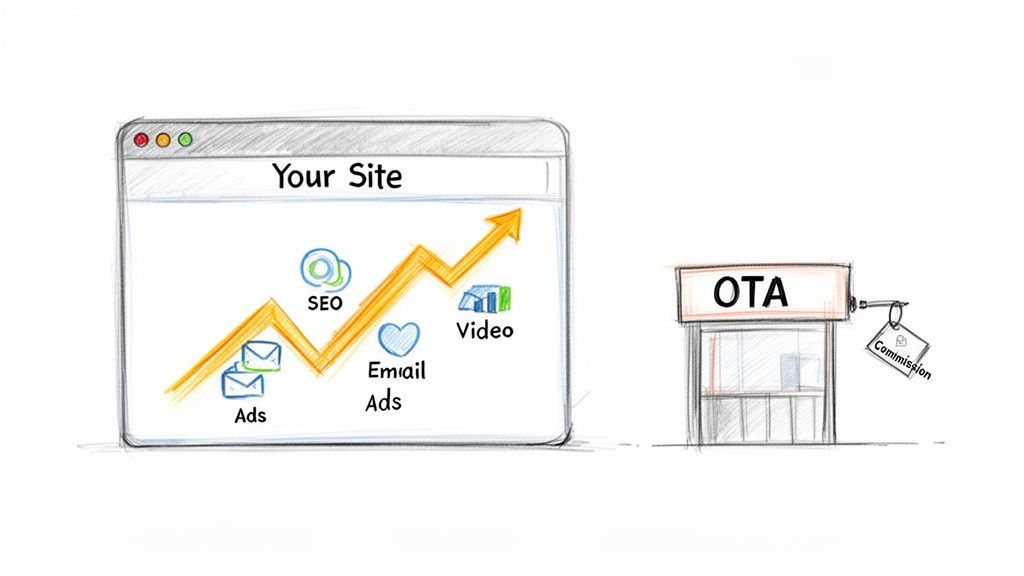
The best vacation rental marketers don't just see a direct booking website as an online brochure. They see it for what it is: a powerful, revenue-generating machine. While OTAs give you a stage, they're essentially renting you a booth in a crowded, noisy marketplace. Your direct booking site is the storefront you own, control, and can grow indefinitely.
That distinction is everything. In a world where OTAs can account for 80–95% of all bookings, many managers are dangerously dependent. Sure, it provides reach, but it comes at the cost of steep commissions and, crucially, your guest data. That’s why a laser focus on direct bookings isn't just a nice-to-have; it's a core strategy for survival and long-term profit.
The end game is a multi-channel machine that consistently brings in guests who book with you directly, again and again.
Build a Foundation with Programmatic SEO
Think of it this way: traditional SEO is like planting a single, giant oak tree. It’s impressive, but it takes ages to provide any real shade. Programmatic SEO, on the other hand, is like planting an entire forest of fast-growing bamboo. It uses data and smart automation to create hundreds, sometimes thousands, of hyper-specific pages targeting very niche, "long-tail" keywords.
For a vacation rental brand, this means creating landing pages that answer a traveler's exact search query:
- "Pet-friendly cabin with a hot tub near [Local Hiking Trail]"
- "Three-bedroom rental for [Annual Music Festival] attendees"
- "Oceanfront condo with a workspace in [Specific Neighborhood]"
Each page is a perfect match for what someone is looking for, which massively boosts its chances of ranking on Google. This strategy doesn't just get you traffic; it gets you the right traffic—people who already know what they want and are ready to book. It's how you build a scalable, organic source of bookings that doesn't disappear when you turn off your ad budget.
Recapture Interest with Intelligent Retargeting
We all know the dance. A traveler finds your site, browses a few properties, checks availability… and then vanishes to compare prices elsewhere. The average traveler visits a ton of websites before pulling the trigger. Intelligent retargeting is your secret weapon to bring them back home.
This strategy uses tracking pixels to follow users who've visited your site and show them targeted ads as they browse social media or other websites. For instance, if someone looked at your "Seaside Cottage" but didn't book, you can pop an ad for that exact property into their Instagram feed a day later.
By reminding them of the beautiful property they almost booked, you stay top-of-mind and give them a gentle nudge to complete their reservation. This tactic is incredibly cost-effective because you're only advertising to a warm audience that has already shown interest.
A smart retargeting campaign can make a huge difference in your conversion rates. To really nail this, check out our guide on creating effective vacation rental ads.
Nurture Loyalty with Automated Email Marketing
Your list of past guests isn't just a list; it's a goldmine. These are people who have already stayed with you, trusted you, and liked the experience. Automated email marketing is the single best way to turn those one-time stays into loyal, repeat customers. This isn't about blasting out generic newsletters. It's about sending the right message at the right time, completely on autopilot.
Imagine setting up email sequences like these:
- The "Welcome Back" Offer: Six months after a guest checks out, an automated email hits their inbox with a 10% discount for their next trip.
- The Anniversary Nudge: A year after their stay, a friendly email reminds them of the great memories they made and invites them back.
- The Local Event Alert: Got a popular festival coming up? Email guests who stayed during that time last year, giving them a heads-up and first dibs on booking.
And don't stop at digital. For bigger brands with bigger budgets, even channels like TV advertising for vacation rentals can amplify your message and drive more direct traffic. When these strategies work in concert, they create a powerful, resilient direct booking engine that puts you firmly in control of your brand and your bottom line.
How To Structure Your Marketing Team
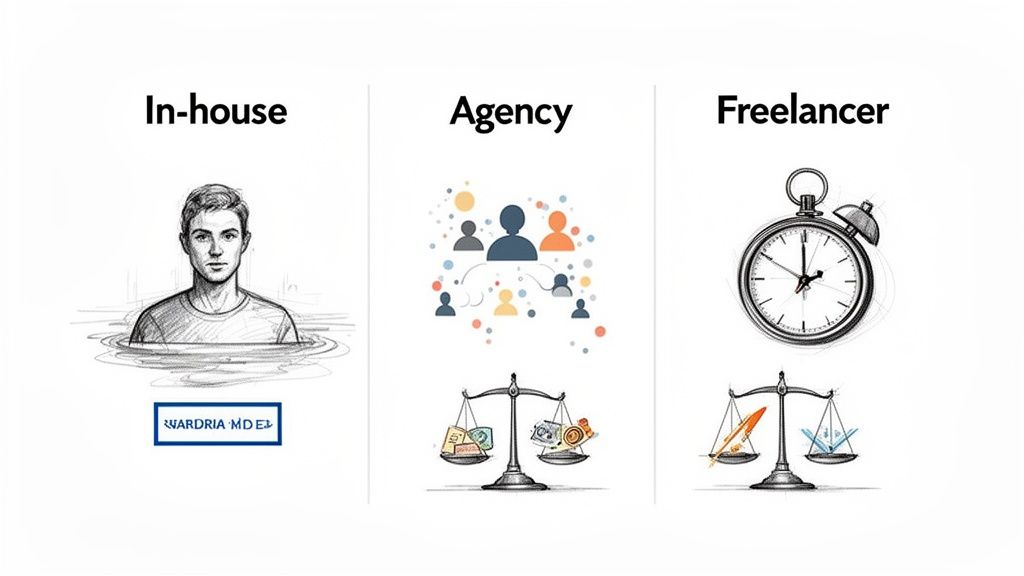
A brilliant marketing strategy is only as good as the people running it. Building the right team is a huge decision that directly shapes your growth, your budget, and how guests see your brand. Deciding between hiring an in-house expert, partnering with an agency, or bringing on freelancers isn't just a staffing choice—it’s a strategic one.
Each option comes with its own set of trade-offs in cost, expertise, control, and how quickly you can scale up or down. Think of it like picking a vehicle for a road trip.
An in-house marketer is like owning a custom-built camper van. It’s perfectly suited to your needs and always ready to go, but it demands a big upfront investment and ongoing maintenance. An agency is like a luxury tour bus—you get a professional driver and a whole crew with specialized skills, but you're sharing the ride with other passengers. And a freelancer? That’s your high-performance rental car, perfect for a specific leg of the journey when you need specialized power without the long-term commitment.
Which one is right for you depends entirely on where you're headed, your budget, and your travel style.
The In-House Marketing Expert
Bringing a marketer onto your payroll gives you one massive advantage: total dedication. This person lives and breathes your brand every single day. They get to know your properties, your ideal guest, and your company culture on a level that no outsider can easily match.
An in-house hire becomes a true stakeholder in your success, which means their goals are perfectly aligned with yours. But this model also comes with the highest fixed costs, including salary, benefits, and tools, which can run anywhere from $60,000 to over $100,000 annually. You're also betting on one person's skill set, which might not cover every marketing discipline you need as you grow.
The Specialized Marketing Agency
When you partner with an agency that knows the vacation rental space, you get instant access to a full team of experts. Suddenly you have a strategist, a copywriter, an SEO specialist, and a paid ads manager all working for you for a single monthly retainer, which typically ranges from $3,000 to $10,000+.
This model gives you a breadth of knowledge and experience that’s nearly impossible to find in a single person. The main trade-off is that their attention is divided among multiple clients. While they bring valuable industry-wide insights, they might lack the deep, nuanced understanding of your specific brand that an in-house employee would have.
Key Insight: The right choice often comes down to your immediate goals. If you need rapid growth and broad expertise across multiple channels, an agency is a powerful accelerator. If your priority is building a deep, lasting brand identity from the inside out, an in-house hire may be the better long-term investment.
No matter which path you take, getting everyone on the same page is essential. For great ideas on getting your team pulling in the same direction, check out these strategies for team alignment that work for any business model.
The Flexible Freelance Marketer
Working with freelance vacation rental marketers offers the ultimate flexibility. Need an expert for a three-month SEO project or a specialist to run a seasonal ad campaign? A freelancer provides targeted expertise without the long-term financial commitment of a full-time hire. Their rates often fall between $50 and $150 per hour.
This pay-as-you-go model is perfect for businesses with changing needs or tighter budgets. The main challenges are managing their availability and getting them fully integrated. A great freelancer is often juggling several projects, and it can take more effort on your part to bring them into your team's workflow and culture. It's also critical to track the return on these variable expenses—for a clear framework, our guide on how to measure marketing ROI breaks it down for any team structure.
Marketing Team Structure Comparison In-House vs Agency vs Freelancer
To make the decision a bit easier, here’s a side-by-side look at how these three models stack up across the factors that matter most to your vacation rental business.
| Factor | In-House Marketer | Marketing Agency | Freelance Marketer |
|---|---|---|---|
| Cost | High fixed cost (salary, benefits). $60k-$100k+/year. | Moderate to high monthly retainer. $3k-$10k+/month. | Variable cost (hourly/project-based). $50-$150/hour. |
| Expertise | Deep expertise in your brand, but limited to one person's skill set. | Broad access to a team of specialists (SEO, ads, content, etc.). | Deep expertise in a specific niche (e.g., email marketing, PPC). |
| Dedication | 100% dedicated to your business and its success. | Attention is shared among multiple clients. | Focus is project-based; may have multiple clients at once. |
| Control | Full control over workflow, priorities, and brand voice. | Less direct control; you manage the relationship, they manage the work. | High control over the specific project, but less over their schedule. |
| Scalability | Slow to scale. Hiring and training take time. | Easy to scale up or down based on your retainer and needs. | Very easy to scale by adding or removing freelancers for projects. |
| Integration | Fully integrated into your company culture and daily operations. | Acts as an external partner; integration can be a challenge. | Requires conscious effort to integrate into team communications. |
Ultimately, there's no single "best" answer—only what's best for your business right now. Many growing companies even use a hybrid model, combining an in-house marketing lead with freelancers or an agency to fill specific skill gaps. The key is to be clear on your goals, know your budget, and choose the structure that will get you where you want to go.
Hiring the Right Vacation Rental Marketer
Finding the right marketer is probably the single most important move you'll make to turn your direct booking dreams into actual revenue. A great marketer isn't just a task-doer; they're a strategic partner who gets the unique rhythm of the vacation rental world.
Hiring the wrong person burns through your ad budget and leaves you stuck. But the right person? They can completely change the trajectory of your business.
This means you have to look beyond a generic marketing resume. You need someone who can blend the art of hospitality storytelling with the hard science of digital performance. Nailing that combo is the key to unlocking a steady stream of commission-free bookings.
Defining the Must-Have Skills
A top-tier vacation rental marketer brings a mix of hard and soft skills to the table. Think of hard skills as the technical chops needed to actually run the campaigns, while soft skills are the strategic mindset that makes those campaigns work. Both are non-negotiable.
First, your candidate needs to be fluent in the technical side of the job. They should be comfortable navigating the tools that power modern marketing and know how to turn raw data into smart decisions.
Essential Hard Skills:
- Search Engine Optimization (SEO): A deep understanding of how to get your property pages and local guides ranking on Google, driving that sweet, free organic traffic.
- Google Analytics: The ability to go beyond just reading reports. Can they interpret user behavior, track where your bookings come from, and pinpoint exactly where your website can improve?
- Email Automation: Skill in setting up automated email sequences that nurture potential guests, bring back people who abandoned their booking, and encourage past guests to return.
- Paid Advertising: Real experience with platforms like Google Ads and Meta Ads, covering everything from campaign setup and budget management to A/B testing creative.
Just as important are the soft skills. These are tougher to measure on a resume but are often what separates a good marketer from a truly great one.
Crucial Soft Skills:
- Strategic Thinking: The ability to see the big picture. They need to connect every marketing action—every email, every ad—directly to your business goals, like boosting direct bookings or increasing guest lifetime value.
- Data-Driven Creativity: They use performance data to guide their creative choices. Instead of just guessing what works, they test ad copy, imagery, and messaging to find what actually resonates.
- Guest Empathy: A genuine feel for the traveler's journey and what they're looking for. This allows them to create marketing that connects on an emotional level, not just a transactional one.
Crafting a Job Description That Attracts Talent
A vague job description is a magnet for unqualified applicants. If you want a pro, your posting needs to be crystal clear about the challenges and expectations of the role. This clarity not only helps you attract the right people but also sets you both up for success from day one.
Pro Tip: Write the job description around outcomes, not just a list of tasks. Instead of saying "Manage social media," try "Grow our Instagram following and drive website traffic by creating engaging content that showcases our unique guest experience."
Feel free to use this template as a starting point. Make sure to tweak it so it fits your brand and your specific goals.
Job Description Template: Vacation Rental Marketing Manager
- Role: Vacation Rental Marketing Manager
- Mission: To build and execute a multi-channel marketing strategy that hammers one primary goal: increasing direct bookings. This means building our brand, fostering loyalty, and cutting down our reliance on the OTAs.
- Key Responsibilities:
- Own and optimize our direct booking website, focusing on on-page SEO and improving our conversion rate.
- Develop and manage targeted paid ad campaigns on Google and social media.
- Create and run automated email marketing flows to nurture leads and drive repeat bookings from past guests.
- Analyze marketing performance using Google Analytics and deliver straightforward reports on our main KPIs.
- Work closely with the operations team to make sure our brand message is consistent at every single guest touchpoint.
- Qualifications:
- 3+ years of hands-on digital marketing experience, ideally in the hospitality or travel space.
- A proven track record of driving direct online revenue and managing a marketing budget effectively.
- Expert-level skills in SEO, Google Analytics, email marketing, and paid social media.
Asking Interview Questions That Reveal True Expertise
The interview is your chance to see if they can walk the walk. Ditch the generic questions like "What are your strengths?" and dig in with questions that force candidates to show you their real-world experience and how they solve problems.
Powerful Interview Questions to Ask:
- "Walk me through a successful campaign you ran to increase direct bookings. What were the specific strategies you used, and what KPIs told you it was working?"
- "Let's say our direct bookings have been flat for three months. What's the very first thing you would look at to figure out why, and what steps would you take to fix it?"
- "Tell me about a time you used guest data or feedback to make a major change to a marketing campaign. What was the insight, what did you change, and what was the result?"
Questions like these make it impossible to hide behind buzzwords. Their answers will give you a clear look at their strategic thinking and tell you if they're the results-driven marketer your business needs.
Building Your Essential Marketing Tech Stack
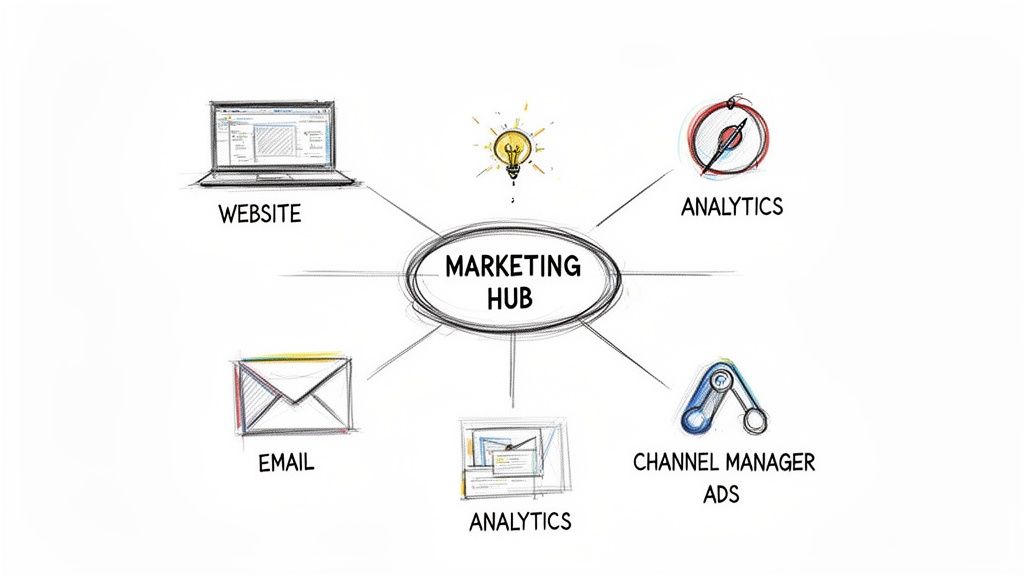
Even the most brilliant marketing plan will fall flat without the right tools to bring it to life. For modern vacation rental marketers, a hand-picked technology stack isn't some nice-to-have luxury; it's the central nervous system for the entire operation. It handles the tedious work, serves up critical data, and ultimately, drives more direct revenue.
Think of your tech stack as a highly skilled, digital pit crew for your business. Each tool has a very specific job—from building the race car (your website) to fueling it with leads (email marketing) and analyzing its performance on the track (analytics). When these tools work together in perfect harmony, they create a powerful, efficient system that frees you up to focus on the big picture instead of getting bogged down in manual tasks.
The idea isn't to just collect a random pile of software. The goal is to build a unified ecosystem where data flows smoothly between platforms, giving you a single, crystal-clear view of the entire guest journey.
Core Components of a Winning Tech Stack
Building a tech stack from the ground up can feel a bit daunting, but most successful marketing operations are built on a few core pillars. These are the non-negotiable tools that every serious property manager needs to compete and grow their direct booking channel.
- Website & Booking Engine: This is your digital storefront, the absolute heart of your direct booking strategy. A platform like hostFront uses AI to build smart, high-converting websites that are ready for SEO from day one.
- Email Automation Platform: This is your engine for creating loyal guests and driving repeat business. Tools such as hostMail let you set up automated email sequences that re-engage past guests with personalized offers, saving you countless hours.
- Analytics Dashboard: This is your command center. It tracks where your website traffic and bookings are coming from and what your conversion rates look like, telling you exactly what's working so you know where to invest your marketing dollars.
- Channel Manager: This handy tool syncs your calendars and rates across all your listings—from the OTAs to your own direct site—preventing the nightmare of double bookings and saving you from a world of administrative headaches.
With the global vacation rental market estimated to be worth between USD 98 billion and USD 175 billion, the opportunity is massive. A cohesive tech stack gives marketers the leverage to push direct booking initiatives like SEO and email automation, protecting their profit margins no matter how the market twists and turns. You can dig deeper into this growing market in this in-depth industry analysis.
The Power of an Integrated AI Platform
While you can certainly piece together individual tools, the real magic happens when you use an integrated, AI-driven platform. When your website, email, and advertising tools are all part of the same system, they talk to each other, sharing data to create a smarter, more personal experience for your guests.
For instance, an integrated system can automatically launch a retargeting ad campaign with a tool like hostDistro the second a potential guest leaves your website without booking. It can then follow up with a personalized email a few days later, all without you having to lift a finger.
This level of automation and intelligence is what separates the market leaders from everyone else. It allows you to run sophisticated, personalized marketing campaigns at a scale that used to be possible only for massive hotel chains.
By unifying these functions, you save time, reduce the chance of data errors, and get a complete picture of your marketing performance. You can explore more options by checking out our complete list of the best direct booking tools available today.
This integrated approach doesn't just make your life easier; it has a direct impact on your bottom line. By optimizing every touchpoint and personalizing every interaction, a unified AI-powered stack like hostAI is built to help property managers double their direct revenue and build a more resilient, profitable business.
Common Questions About Vacation Rental Marketing
Stepping into the world of vacation rental marketing can feel a little like drinking from a firehose. There are always new strategies, new tools, and new opinions popping up. To cut through the noise, we've rounded up some of the most common questions we hear from property managers and answered them, expert to expert.
Think of this as your quick-reference guide. We’re here to reinforce the core ideas from this guide and give you the clarity to move forward with confidence. Let's tackle the questions that are probably on your mind right now.
How Much Should I Budget for Vacation Rental Marketing?
This is the big one, isn't it? The honest answer is: it depends. There’s no magic number, but figuring out a solid budget comes down to your team structure and what you're trying to achieve.
A full-time, in-house marketer is a serious investment, with a salary that can easily run from $60,000 to over $100,000 a year plus benefits. On the other hand, a specialized agency might charge a $3,000 to $10,000+ monthly retainer, giving you a whole team of experts without the HR overhead. Freelancers offer the most flexibility, usually billing between $50 and $150 per hour for specific tasks.
As a general rule of thumb, setting aside 5-10% of your projected annual revenue for all your marketing efforts is a smart starting point. That bucket should cover everything—salaries, agency fees, ad spend, and your software subscriptions.
But the best way to budget is to work backward from your goals. Start by defining what success looks like—for example, "increase direct bookings by 30% in the next year." From there, you can figure out what you’ll need to invest in ads, content, and people to make that happen. This way, every dollar you spend has a clear job to do.
What Is the Most Important Metric to Track for Success?
While there are tons of KPIs you could track, if you only focus on one, make it the Direct Booking Ratio. This is your north star. It cuts right to the heart of your marketing's performance by telling you what percentage of your bookings come straight from your own channels—your website, email list, and social media—instead of the OTAs.
When your Direct Booking Ratio is climbing, it’s the clearest sign that your brand is getting stronger and your marketing dollars are working. It's proof you're finally breaking free from relying on the big listing sites.
But here’s how you make that metric even more powerful: track it alongside your Cost Per Acquisition (CPA) for those direct bookings. Knowing exactly what it costs you to get a guest to book direct allows you to compare it apples-to-apples with the commission you'd be paying an OTA.
The goal is beautifully simple: keep pushing your Direct Booking Ratio up while making sure your direct CPA stays well below what you’d pay in OTA commissions. Nail that balance, and you’ve got a profitable, sustainable marketing machine.
Can I Do My Own Marketing Without a Professional?
Absolutely. You can definitely handle your own marketing, especially if you’re just starting out or have a smaller portfolio. But—and this is a big but—it requires a serious commitment. You have to be ready to constantly learn and put in the work.
The reality is, modern marketing isn't just about posting pretty pictures on Instagram. It’s become a technical game involving SEO, data analysis, and automation, and those skills take real time to develop.
While you can manage the basics like social media updates or a monthly newsletter, a professional brings the specialized knowledge needed for predictable growth. They live and breathe the nuances of things like programmatic SEO, smart ad retargeting, and complex email sequences—the kind of stuff that gives you a real edge over the competition.
For property managers going the DIY route, an AI-driven platform can be a game-changer. It acts as a force multiplier, automating the complex and time-sucking tasks like website optimization, personalized email campaigns, and running ad campaigns. It lets you punch above your weight and get professional-level results without a professional on the payroll.
How Long Does It Take to See Results from SEO?
When it comes to Search Engine Optimization, patience isn't just a virtue; it's a requirement. SEO is a marathon, not a sprint. Setting the right expectations from day one is critical, because unlike paid ads which give you instant visibility, organic search is all about building momentum over time.
Generally, you can expect to see some initial movement for less competitive, long-tail keywords within 3 to 4 months of consistent work. But for the more valuable keywords that drive significant, steady traffic, you’re typically looking at a 6 to 12-month timeline.
A few things can speed up or slow down that process:
- Market Competitiveness: Trying to rank in a place like Orlando is a different beast than a smaller, less saturated destination.
- Website Quality: Your site's technical health, speed, and overall user experience are huge factors for Google.
- Content Consistency: You have to consistently publish high-quality, relevant content like blog posts and neighborhood guides. It's non-negotiable.
- Backlink Building: Getting links from other reputable websites is like getting a vote of confidence in Google's eyes, and it can really accelerate your results.
Newer strategies like Programmatic SEO can help speed things up by quickly generating lots of hyper-local pages that target niche search terms. But even with the slickest tactics, the secret to long-term SEO success is just a sustained, methodical effort.
Ready to stop relying on OTAs and start building a powerful direct booking engine? hostAI provides an all-in-one marketing platform that uses advanced AI to create intelligent websites, automate guest communication, and run hands-free advertising campaigns. Discover how leading property managers are doubling their direct revenue at https://gethostai.com.