
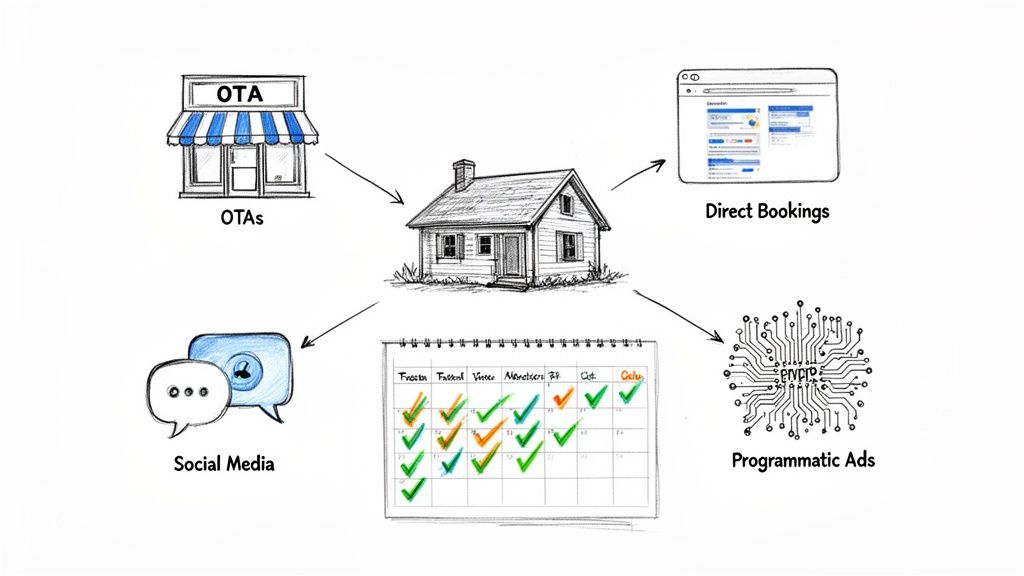
vacation rentals advertising
Vacation Rentals Advertising: Fill Your Calendar with Proven Booking Strategies
Posted on Jan 7, 2026
So, what exactly is vacation rentals advertising? At its core, it's the art and science of promoting your short-term rental properties to catch the eye of potential guests and, most importantly, secure those bookings. This isn't just about one channel; it's a mix of everything from major players like Airbnb to your own direct booking website and social media campaigns, all working together to boost your visibility and drive revenue in a seriously crowded market.
Why Your Old Advertising Playbook Is Obsolete
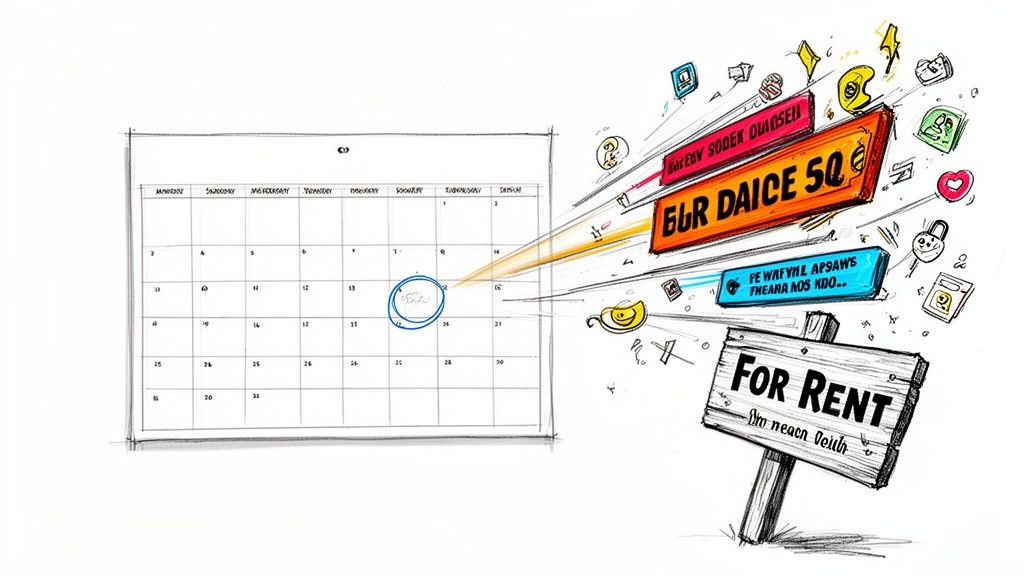
There’s nothing more frustrating for a property manager than staring at a blank booking calendar. If you're still stuck in the old "list it and forget it" mindset, you're practically giving money away. That passive approach just doesn't cut it anymore—the market is simply too packed.
Think about it this way: your property used to be on a quiet neighborhood street where a simple "For Rent" sign was all it took. Today, that street has morphed into a chaotic downtown intersection, and your sign is completely lost in a sea of flashing lights and noise. Effective vacation rentals advertising is no longer just about showing up; it's about being seen and heard above the deafening roar of your competition.
Moving Beyond Basic Listings
Just having a listing on Airbnb or Vrbo isn’t a strategy—it's the bare minimum, the absolute starting line. The competition is intense, and travelers have an overwhelming number of choices. Price isn't the only thing on their minds, either. In fact, a staggering 75% of consumers say they'd willingly pay more for a rental with better customer reviews. Your advertising has to do more than just list features; it needs to build trust and sell the unique experience you offer.
A modern game plan requires a multi-channel attack, blending the massive reach of OTAs with the higher profit margins of direct bookings. This guide is your roadmap to get there. We'll show you how to:
- Master Major Platforms: Learn to fine-tune your listings on OTAs like Airbnb and Vrbo so they actually stand out from the crowd.
- Build a Direct Booking Engine: Create your own high-profit channel where you control the entire guest experience and pocket more of the revenue.
- Use Smart Automation: Discover the tools that can put your marketing on autopilot, freeing you up to focus on what matters—hospitality.
The real goal here is to shift your advertising from being a necessary evil into your most powerful engine for growth. It’s about getting in front of the right guests, at the right time, with a message that resonates.
The Rise of Intelligent Automation
The next leap forward isn't just about juggling listings on different sites. It’s about building a seamless, automated system that nurtures potential guests and drives bookings without you having to manually pull every lever. This is where AI in advertising really starts to shine, helping you personalize messages and optimize campaigns with almost zero effort.
As you start piecing together your own strategy, understanding the future of travel booking and how AI is making direct bookings the default is critical if you want to stay ahead of the curve. This guide will walk you through building a resilient, modern advertising plan that brings in more guests and pushes your revenue to new heights.
Understanding Your Core Advertising Channels
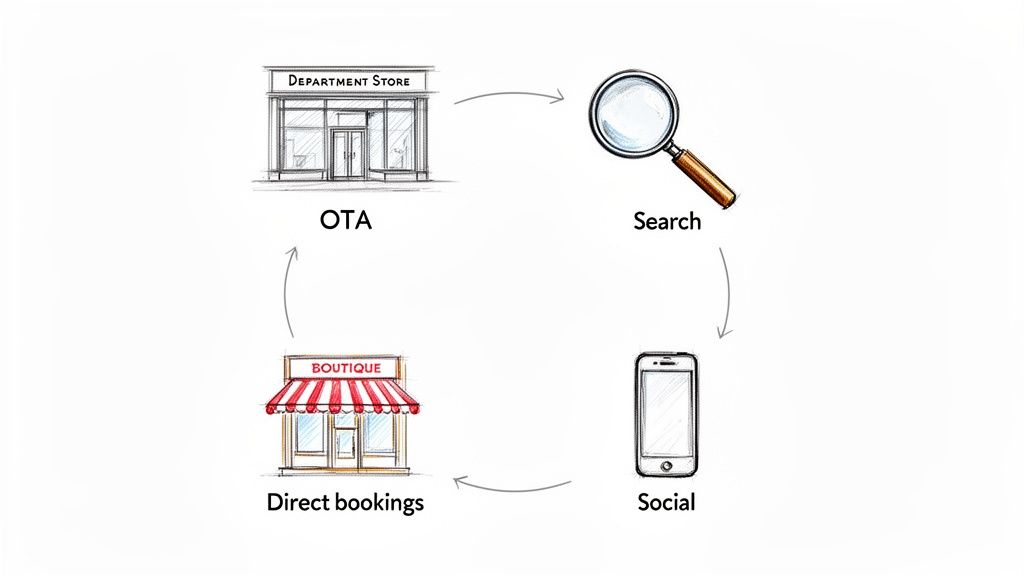
To build an advertising plan that actually fills your calendar, you first need to get a handle on your toolkit. Think of these advertising channels like a chef's kitchen—every knife and pan has a specific job. The real magic happens when you know which tool to grab and how to combine them to cook up a masterpiece.
Our goal is to weave these channels into a seamless strategy that attracts guests at every stage of their travel planning. Let’s break down the essentials, starting with the massive marketplaces and moving all the way to your own branded storefront.
The Giants: Online Travel Agencies
Online Travel Agencies (OTAs) like Airbnb, Booking.com, and Vrbo are the giant department stores of the travel world. They spend billions of dollars on advertising to ensure a constant flood of shoppers—your potential guests. By listing your property, you get instant access to this enormous audience without spending a dime upfront.
The business model is simple: you only pay a commission when you get a booking, making it a low-risk way to get started. The global vacation rental market is on track to pull in a staggering $105.7 billion in revenue, which shows you just how much demand these platforms capture. But with that growth comes fierce competition. Savvy managers are diversifying, with exclusive Airbnb properties dropping by 11.05% while Booking.com exclusives jumped 10.6%. You can dig into more vacation rental market statistics here to see how these trends shape channel strategy.
A fantastic side effect of being on OTAs is what's known as the "Billboard Effect." Many travelers discover a property on a platform like Airbnb, then pop over to Google to find the direct website, hoping for a better deal. Your OTA listing essentially becomes a free ad for your own brand.
Your Most Profitable Channel: Direct Bookings
If OTAs are the big-box department stores, your direct booking website is your own exclusive boutique. This is your turf. You control the entire guest experience, you own the relationship, and best of all, you keep every dollar of revenue without forking over hefty commissions.
Building a strong direct booking channel is a long game, but it’s one that pays off in spades. It’s all about creating a brand that guests learn to trust and come back to, year after year. This requires a focused advertising effort to drive traffic straight to your site using a few key methods:
- Search Engine Optimization (SEO): This is the art of getting your website to rank high in Google for searches like “pet-friendly cabin in Asheville.” It’s a slow burn, but it delivers a steady stream of highly motivated, free traffic over time.
- Paid Search (PPC): Paid ads on Google let you jump to the very top of the search results for specific keywords. You pay each time someone clicks, making it a fast and effective way to get in front of travelers who are actively looking to book.
- Social Media Marketing: Platforms like Instagram and Facebook are visual playgrounds, perfect for showcasing your property's unique charm and telling its story. You can build a loyal following and market to them directly, turning followers into guests.
When you get these channels working in concert, the results are powerful. For a deeper look, check out our guide on how SEO and PPC work together to drive direct bookings.
Expanding Your Reach Further
Beyond the OTAs and your own website, a few other channels can round out your strategy and help you find guests in new and interesting places.
Advertising Channel Comparison for Vacation Rentals
Choosing where to spend your time and money can feel overwhelming. Each channel has its own personality, with distinct advantages and drawbacks. This table breaks down the big players to help you decide which mix is right for your business.
| Channel | Primary Benefit | Key Challenge | Best For |
|---|---|---|---|
| OTAs | Massive, ready-to-book audience with zero upfront cost. | High commissions, lack of brand control, intense competition. | New managers, filling unsold nights, and gaining initial visibility. |
| Direct (SEO/PPC) | 100% revenue, full guest data ownership, brand building. | Requires long-term investment in time and/or money to build traffic. | Established managers looking to maximize profitability and build a loyal guest base. |
| Meta-Search | Captures high-intent travelers comparing prices across all channels. | Can be complex to set up; requires competitive pricing to win the click. | Managers with a direct booking site who want to compete on price against OTAs. |
| Social Media | Excellent for visual storytelling and building a community. | Can be difficult to attribute direct bookings; requires consistent content creation. | Properties with strong visual appeal and managers who enjoy engaging with guests online. |
Ultimately, the strongest strategies don't rely on just one channel. They create a flywheel where visibility on one platform (like an OTA) fuels traffic to another (your direct site), creating a sustainable booking engine.
Meta-Search Engines
Think of meta-search engines like Google Vacation Rentals, Kayak, or Trivago as powerful price-comparison shoppers. They pull in listings from both OTAs and direct booking sites, letting travelers see all their options in one place. Being visible here is critical for snagging guests who are laser-focused on finding the best deal.
Programmatic Advertising
This is a more advanced play, but it's incredibly powerful. Programmatic advertising uses automated systems to buy ad space across the internet, targeting hyper-specific user profiles. For instance, you could show ads for your family-friendly ski chalet only to people who have recently been searching for ski gear or reading articles about family winter vacations. It’s a surgically precise and efficient way to reach your ideal guest.
Building a Strategy That Delivers Bookings
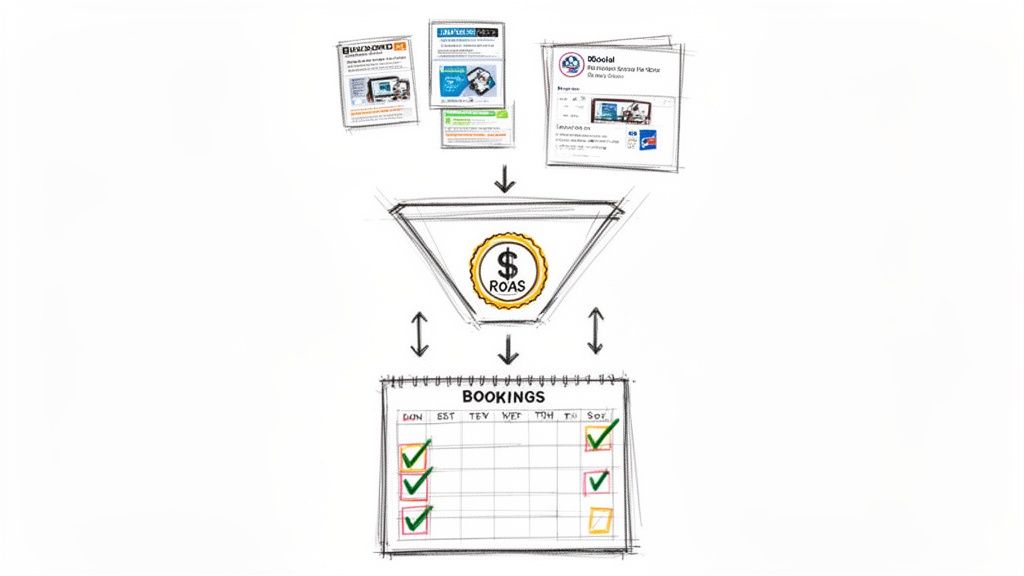
Knowing your advertising channels is like having a kitchen full of top-notch ingredients. But ingredients alone don't make a Michelin-star meal. You need a recipe—a clear, deliberate plan that turns those separate elements into something incredible.
That's where your advertising strategy comes in. It’s the playbook that shifts your focus from just using different platforms to winning on them, consistently filling your calendar with high-value bookings.
A winning strategy isn’t about just throwing money at every channel and crossing your fingers. It’s about making smart, targeted choices that line up your budget, your message, and your ultimate goals. It means getting crystal clear on who your ideal guest is, figuring out what they really want, and then reaching them with a story that makes them choose your property over all the others.
Demystifying Your Advertising Budget
The first question I always hear from managers is, "Okay, so how much should I actually be spending?" There's no single magic number, but there is a magic metric: Return On Ad Spend (ROAS).
Think of ROAS like a simple vending machine. If you put $1 in (your ad spend) and get $5 out (in booking revenue), your ROAS is 5x. This number is the North Star for your entire advertising budget.
Your job is to relentlessly hunt for the channels that deliver the highest ROAS for your unique properties. A critical part of this is maximizing ROI for real estate marketing budget by ensuring every dollar reaches guests who are genuinely ready to book.
For instance, a brand-new property might need to spend heavily on OTAs just to get on the map, accepting a lower initial ROAS in exchange for crucial visibility. In contrast, an established brand might pour more into Google Ads for their direct booking site, where they can aim for a much healthier return.
Crafting Ads That Actually Convert
Once you know how much you're spending, you need ads that stop people mid-scroll. Here’s the secret: effective vacation rentals advertising is less about listing features and more about selling a feeling.
Instead of saying "3-bedroom cabin with Wi-Fi," you need to tell a story. Try something like, "Unplug and reconnect in our cozy mountain cabin, where the only thing you’ll hear is the crackling fire." See the difference? That kind of messaging transforms a property into an experience.
Your photos and videos are your most powerful storytelling tools. They need to be professional, aspirational, and capture the unique vibe guests will get when they stay with you. For a deeper dive, our guide for the top vacation rental marketers is packed with actionable tips for creating campaigns that connect.
A great ad campaign doesn't just show a property; it sells a future memory. Your creative should help potential guests picture themselves laughing by the pool, sipping coffee on the balcony, or making s'mores over the fire pit.
Tracking What Truly Matters
You can't improve what you don't measure. While ROAS is your headline number, a few other Key Performance Indicators (KPIs) tell the real story of whether your strategy is working. Think of these metrics as the dashboard for your business—they show you exactly what’s driving success and where you might be leaking oil.
Here are the vital signs for your advertising health:
- Booking Rate: What percentage of people who see your ad actually end up booking?
- Cost Per Acquisition (CPA): How much are you paying, on average, to get one booking over the line?
- Occupancy Rate: Is your ad spend helping you fill more nights on the calendar?
- Average Daily Rate (ADR): Are your ads creating enough demand that you can command higher prices?
The proof is in the numbers. Recently, 40% of operators successfully boosted both their occupancy and their ADR, while 37.5% grew direct bookings by focusing on building their brand. This shows that a smart, multi-channel approach is the key to unlocking maximum revenue.
By keeping a close eye on these KPIs, you can confidently steer your strategy, doubling down on what’s working and cutting what isn't.
Using Advanced Tactics to Outsmart Your Competition
Once you’ve got a solid strategy locked in, it’s time to really pull ahead of the pack. The jump from running basic campaigns to deploying more advanced methods is what separates the most successful property managers from everyone else. And these tactics aren't just for the big brands with massive budgets; they are accessible tools that can give you a serious competitive edge.
This next level of vacation rentals advertising is all about getting a much deeper read on guest behavior and using technology to your advantage. It’s about being smarter with your budget, not just spending more. Let's dive into the techniques professional marketers use to turn casual browsers into confirmed bookings and squeeze the most value out of every single dollar.
The Power of the Second Chance with Retargeting
Have you ever looked at a pair of shoes online, only to see ads for those exact shoes following you around the internet for the next few days? That’s retargeting, and it’s one of the most powerful tools in your advertising arsenal. It’s your digital second chance to win over a guest who showed interest but didn't quite make it over the finish line.
Think of it like a friendly concierge. A potential guest lands on your direct booking site, browses your stunning beachfront property, maybe even checks the availability calendar... but then the kids start screaming, the dog needs to go out, and they leave. Retargeting lets you gently remind them of that amazing vacation they were planning by showing them beautiful ads of that same property on platforms like Facebook, Instagram, or across Google’s network.
This works so well because you're not advertising to a cold audience. You're speaking directly to someone who has already raised their hand. They know your brand and have shown clear intent, making them far more likely to convert than a brand-new visitor.
Understanding the Full Guest Journey with Attribution
As your advertising gets more complex, a new challenge pops up: how do you know which ad really led to a booking? A guest might see your ad on Facebook, later search for you on Google, and finally book after clicking a link in your newsletter. So, who gets the credit? This is the puzzle of multi-channel attribution.
Without a good handle on this, you might mistakenly slash the budget for a Facebook ad that played a crucial early role, all because it wasn't the "last click" before the booking.
Multi-channel attribution is like watching the game tape after a big win. It shows you every pass, every move, and every assist that led to the final goal—not just the person who kicked the ball into the net. This complete picture helps you see which channels are your star players and which are the unsung heroes.
Modern analytics tools can help you map out these complex journeys, giving you a much clearer picture of your true ROAS for each channel. This insight allows you to invest your budget with confidence, knowing you’re fueling the channels that work together to drive bookings. To genuinely outsmart your competition, you need to go beyond basic campaign setup; mastering how to optimize Google Ads for maximum ROI provides a significant competitive advantage.
Putting Your Marketing on Autopilot with AI
The most significant leap forward in vacation rentals advertising is the rise of AI and automation. These are no longer futuristic concepts from a sci-fi movie; they are practical, hands-on tools that can handle repetitive marketing tasks, freeing you up to focus on delivering exceptional hospitality.
Imagine a system that automatically sends personalized follow-up emails to guests who abandon a booking, or dynamically shifts your ad spend toward the campaigns that are performing best in real-time. This is exactly what modern platforms like hostAI are built to do. AI can:
- Personalize Outreach: Craft unique messages tailored to different guest segments.
- Optimize Ad Bidding: Automatically adjust bids to maximize your ROAS without you lifting a finger.
- Automate Reporting: Deliver clear, actionable insights without hours of manual data-pulling.
These tools don’t replace your strategy; they supercharge it. By handling the complex, data-driven tasks, AI allows you to operate with the efficiency and precision of a much larger team, leveling the playing field and helping you secure more of those valuable direct bookings.
Actionable Playbooks for Your Business Size
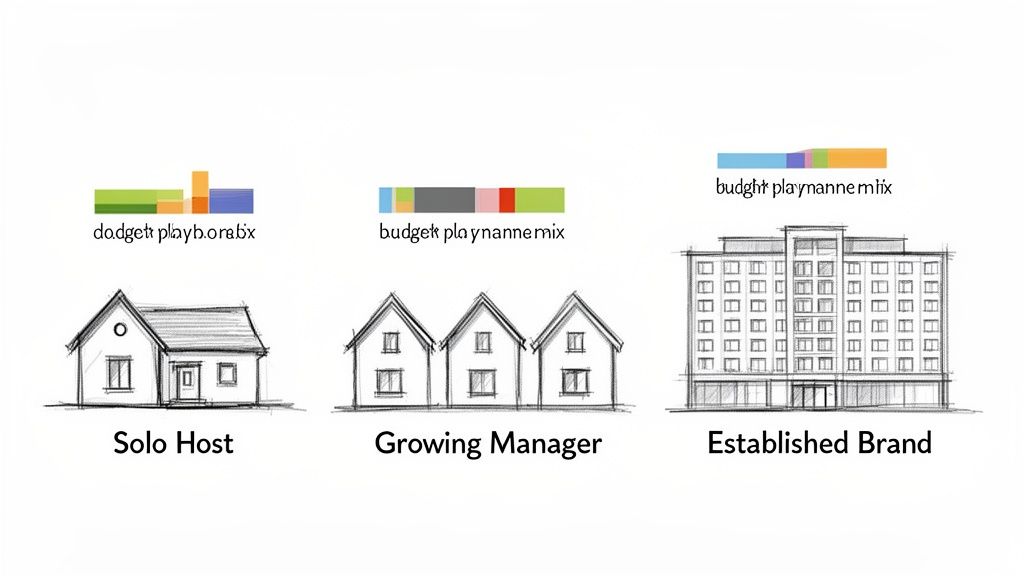
Theory gives you the map, but a good playbook shows you the exact route. The best vacation rentals advertising strategy isn't one-size-fits-all; it has everything to do with your scale, your budget, and what you're trying to achieve. Where you are in your business journey dictates which channels you should pour your energy into and which numbers actually matter.
A solo host juggling one property has a completely different set of needs—and resources—than an established brand managing a hundred. So, let's get practical. Here are three concrete blueprints, one for each stage of the game, designed to put these ideas into practice right away.
Playbook 1: The Solo Host (1-3 Properties)
As a solo host, you have two secret weapons: you're nimble, and you can offer a personal touch that big companies can't. Your budget is probably tight, so every single dollar has to pull its weight. The goal here is to get the most eyeballs on your property for the least amount of cash, focusing on channels that deliver bookings without a huge upfront investment.
The heart and soul of your strategy is OTA mastery. Think of your listings on Airbnb, Vrbo, and Booking.com as your digital storefronts. You need to obsess over every detail—from getting professional photos to writing keyword-rich descriptions and a headline that grabs attention. Actively chase down reviews and respond to every single one; a staggering 85% of consumers say they're more likely to book a place with a history of great service.
Your superpower is making a personal connection. Use your listing to tell a story. What’s special about the property? What unique experience are you offering? This is how you stand out when you can’t possibly outspend the competition.
Recommended Channel & Budget Mix:
- OTAs (80% Focus): This is your main engine. Since commissions are your biggest cost, your "spend" is all about the time and effort you put into optimizing your listings to rank higher and convert better.
- Hyper-Local Social Media (15% Focus): Set up a simple Facebook or Instagram page. Post beautiful photos and run tiny, super-targeted ad campaigns. A $50 budget can go a long way if you aim it at people in drive-to markets who have shown an interest in travel.
- Word-of-Mouth (5% Focus): Never underestimate the power of a happy guest. Encourage them to share their experience. A simple postcard sent after their stay with a small discount for their next trip can generate invaluable repeat business.
Key Metrics to Watch: Your bread and butter are your Occupancy Rate, Average Daily Rate, and Guest Review Score.
Playbook 2: The Growing Manager (4-15 Properties)
You've made it past the starting line. You have a solid foundation and some revenue you can reinvest back into the business. The big challenge now? Breaking free from total OTA dependency and building a more profitable, sustainable brand of your own. It’s time to capture those amazing direct bookings.
Your focus needs to shift toward creating a direct booking website. This will become the central hub for your brand, the destination for all the traffic you'll soon be generating from paid search and social media. You'll still need to keep your OTA listings polished, but start thinking of them as a billboard—a way to drive awareness that ultimately points people back to your own site.
Recommended Channel & Budget Mix:
- OTAs (50% Focus): They're still a critical source of bookings, but now they serve a dual purpose: filling your calendar and feeding your direct channel.
- Direct Bookings - SEO & Website (25% Focus): Invest in a professional, mobile-friendly website. Start a consistent blog or a local SEO campaign to start ranking for valuable search terms like "family-friendly rentals in [your city]."
- Paid Search & Social Ads (25% Focus): Earmark a modest monthly budget ($200-$500) for Google Ads targeting your brand name and specific, long-tail keywords. On social media, run retargeting campaigns to bring back website visitors who browsed but didn't book.
Key Metrics to Watch: Start tracking your Direct Booking Percentage, Cost Per Acquisition (CPA), and Website Conversion Rate.
Playbook 3: The Established Hospitality Brand (15+ Properties)
At this level, the game is all about scale, efficiency, and market dominance. You have a real budget to work with and a team to execute a much more complex advertising strategy. The goal is to build a powerful, multi-channel booking engine that blends broad brand marketing with surgical, data-driven performance campaigns.
Your strategy now has layers. At the top of the funnel, things like programmatic ads and bigger social campaigns build brand awareness. In the middle, SEO and content marketing capture travelers who are actively researching. And at the bottom, retargeting and paid search convert high-intent prospects into paying guests. This diverse approach is essential in a global market projected to hit $195.45 billion. Operators are finding success by diversifying; in fact, 37.5% of operators recently boosted direct bookings by investing in their websites and SEO. You can explore more data on the expanding vacation rental market here.
Recommended Channel & Budget Mix:
- Direct Bookings - SEO, PPC, Email (50% Focus): This is your most profitable channel, and it deserves the lion's share of your investment. You should have a dedicated team or agency managing a robust SEO strategy, a scaled Google Ads account, and an automated email marketing program to bring back past guests.
- OTAs & Meta-Search (30% Focus): Use OTAs strategically to fill occupancy gaps and get exposure in new markets. Start competing directly on meta-search engines like Google Vacation Rentals to capture travelers comparing prices.
- Programmatic & Brand Advertising (20% Focus): Run awareness campaigns on display networks and video platforms. The goal is to reach your ideal guest profile before they even begin their search, making your brand the first one they think of.
Key Metrics to Watch: The big numbers you care about now are Return On Ad Spend (ROAS), Lifetime Value of a Guest (LTV), and your overall Market Share.
Your Top Advertising Questions, Answered
Jumping into vacation rental advertising can feel like trying to order coffee in a foreign country. You’re hit with a barrage of acronyms, conflicting advice, and the constant pressure to keep your calendar full. Let's cut through the noise and tackle the real-world questions that keep property managers up at night.
Our goal here isn’t to drown you in jargon. It's to give you clear, straightforward answers so you can make smarter decisions, whether you're managing one property or one hundred.
How Much Should I Realistically Spend on Ads?
This is the million-dollar question, but the answer isn't a magic number—it's a mindset shift. Instead of asking, "How much should I spend?" the real question is, "What return do I need to see?" The smartest way to think about your budget is as a percentage of your booking revenue.
A solid starting point for most growing managers is to earmark 5% to 10% of total booking revenue for advertising. So, if your business brings in $100,000 a year, you’re looking at an ad budget of $5,000 to $10,000.
But this isn't a set-it-and-forget-it rule. It’s a flexible guideline that needs to adapt to your goals and the season:
- Launching a New Property: Got a new listing with zero reviews? You'll need to be more aggressive, maybe pushing closer to 15%, to get those first crucial bookings and build some social proof.
- Peak Season: When demand is through the roof, you can often pull back. Organic bookings will be flowing in, so you don't need to force it.
- Off-Season: During those quiet months, a strategic ad spend is your best friend. It can be the key to filling those need-to-fill dates and keeping the lights on.
The trick is to view your budget as an investment, not an expense. Start small, track your Return On Ad Spend (ROAS) like a hawk, and double down on what’s working.
How Can I Compete With Big Companies in My Market?
It’s easy to get discouraged when you see the big regional players throwing what looks like endless money at advertising. But as a smaller operator, you have a secret weapon they can't easily copy: authenticity and a personal touch. You can’t outspend them. You have to outsmart them.
Your entire strategy should lean into your unique strengths. While they're chasing scale, you can focus on creating a memorable, niche experience. More and more guests are looking for unique stays, and that’s your way in.
Big brands often feel corporate and impersonal. Your advertising needs to tell the story of your property, your neighborhood, and the specific memories a guest can create there. That personal connection is something they can't fake.
Concentrate your fire on a few key areas where you have the home-field advantage:
- Hyper-Niche Targeting: Forget advertising to "travelers." Go after "foodie couples looking for a romantic weekend getaway" or "families with young kids who need a pet-friendly space." The more specific you get, the better.
- Exceptional Hospitality: Amazing service is your most powerful marketing tool. A staggering 85% of consumers say they're more likely to book a rental that consistently delivers excellent service. Actively encourage reviews and plaster those glowing testimonials all over your ads.
- Local Expertise: Become the go-to local guide. Create content—a blog post, an Instagram story, a TikTok video—about the best hidden coffee shops, the prettiest hiking trails, or the can't-miss taco spot. This builds trust and positions you as an authority, not just another landlord.
What Is the Easiest Way to Start Tracking ROI?
If you're new to this, the thought of setting up complex analytics can be paralyzing. Don't worry. You can start with a simple, effective approach that doesn't require a degree in data science. The easiest place to begin is by tracking your Cost Per Acquisition (CPA) for each channel.
Here’s a dead-simple way to get started:
- For Direct Bookings (from Google Ads): Set up conversion tracking in your Google Ads account. It’s designed to do exactly this—it will tell you precisely which ads are generating bookings and what each of those bookings cost you.
- For Social Media: When you run an ad on Facebook or Instagram, use a unique link with a UTM code. You can create these for free with Google's Campaign URL Builder. This lets you log into Google Analytics and see exactly how many bookings came from that specific ad.
- For Everything Else: Never underestimate the power of asking, "How did you hear about us?" Add it as an optional field to your booking or inquiry form. The data isn't perfect, but it provides priceless insight into which channels are actually creating awareness.
Pick one channel to start. Get comfortable tracking its performance, and then expand from there. The goal is progress, not perfection.
Ready to stop guessing and start growing your direct bookings? The team at hostAI uses smart automation and powerful advertising tools to help property managers fill their calendars and increase revenue. Learn how hostAI can supercharge your advertising strategy.