
email database marketing
Grow with email database marketing to boost direct bookings today
Posted on Jan 8, 2026
Relying solely on the big online travel agencies (OTAs) is a precarious game for any short-term rental manager. One day you're riding high, the next an algorithm change tanks your visibility. Add in fluctuating commissions and the inability to speak directly to your guests, and you've got a recipe for a very vulnerable business.
This is exactly why building your own audience through email database marketing has shifted from a "nice-to-have" to an absolute necessity. It's your single most powerful tool for creating a resilient, profitable, and independent rental business.
Why Your Email List Is Your Most Valuable Asset
For those of us in the STR game, the line between thriving and just surviving often boils down to one simple thing: control. When you're entirely dependent on platforms like Airbnb or Vrbo, you don't actually own your audience—you're just renting it. An email list, on the other hand, is an asset you own outright. It’s a direct, unfiltered line to the people who matter most: your past and potential guests.
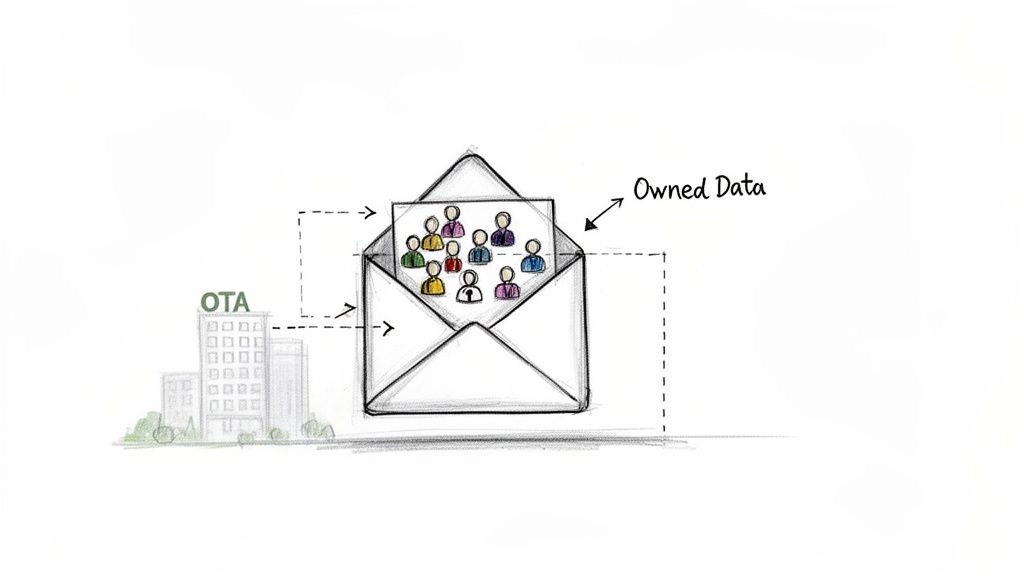
This direct channel completely changes the game. It transforms your marketing from a frustrating cost center into a predictable revenue engine. Instead of forking over commissions on every single booking, you can drive repeat stays and upsell extras at a tiny fraction of the cost.
Building a Resilient Direct Booking Engine
Think of your email database as the concrete foundation for your entire direct booking strategy. Every single email you collect is another brick in the wall separating you from total reliance on third-party platforms. This isn't just about dodging fees; it's about forging genuine, lasting relationships that the OTAs are structurally incapable of building.
A healthy email list gives you the power to:
- Drive Repeat Business: Send tempting, targeted offers to past guests, making it a no-brainer for them to book directly with you for their next trip.
- Increase Guest Lifetime Value: Promote valuable add-ons like late check-outs, local tours, or special amenity packages to an audience that already knows and trusts you.
- Build Real Brand Loyalty: Share useful content, property updates, and insider local tips that keep your brand at the top of their mind when they think about travel.
Owning your guest data is your ultimate insurance policy. It insulates your business from market volatility and gives you the power to create a sustainable booking pipeline that you control, not some faceless third-party algorithm.
Email marketing has proven itself to be one of the most cost-effective channels out there, consistently outperforming many paid ad strategies in the long run. And as privacy regulations around third-party cookies continue to tighten, the ability to nurture your own email database becomes a massive strategic advantage. Any hospitality brand serious about securing its direct booking future needs to be all-in on email.
Ultimately, taking this proactive approach puts you firmly in the driver's seat. For a more detailed playbook, check out our complete guide on database email marketing to learn how to turn that guest list into your most powerful asset.
How to Build Your Guest Email List Authentically
A powerful direct booking strategy isn't built on the biggest email list; it's built on the best one. Forget those annoying, generic pop-ups that just get in the way. The real goal of your email database marketing is to build a list of people who actually want to hear from you. That means you need to be smart, authentic, and offer genuine value in exchange for that coveted email address.
This all starts on your direct booking website—your most valuable piece of digital real estate. Instead of a lazy "Join Our Newsletter" box, give people a real reason to sign up. This is your chance to show off your hospitality and local expertise before they even think about booking.
Here are a few website opt-in strategies that just plain work:
- Offer a Free Local Guide: Put together a slick PDF with your personal Top 5 restaurant recommendations, favorite hidden gems, or a guide to family-friendly activities. It's an instant value-add.
- Provide an Exclusive Discount: A code for 5-10% off their first direct booking is a powerful, immediate incentive. Who doesn't love saving money?
- Grant Early Access: Create a bit of buzz by offering early access to seasonal deals or notifications for last-minute openings. A little exclusivity goes a long way.
Capturing Emails In-Property
Your chance to grow that list doesn’t stop after the booking confirmation. The in-property experience is a golden opportunity to get emails from the entire travel party, not just the person who paid. The key is to be modern and non-intrusive.
One of the simplest, most effective tactics I've seen is using a QR code for Wi-Fi access. Instead of just taping the password to the fridge, create a simple capture page. Guests scan the code, pop in their email to get the network details, and can opt-in to your marketing list with a single click. It's brilliant.
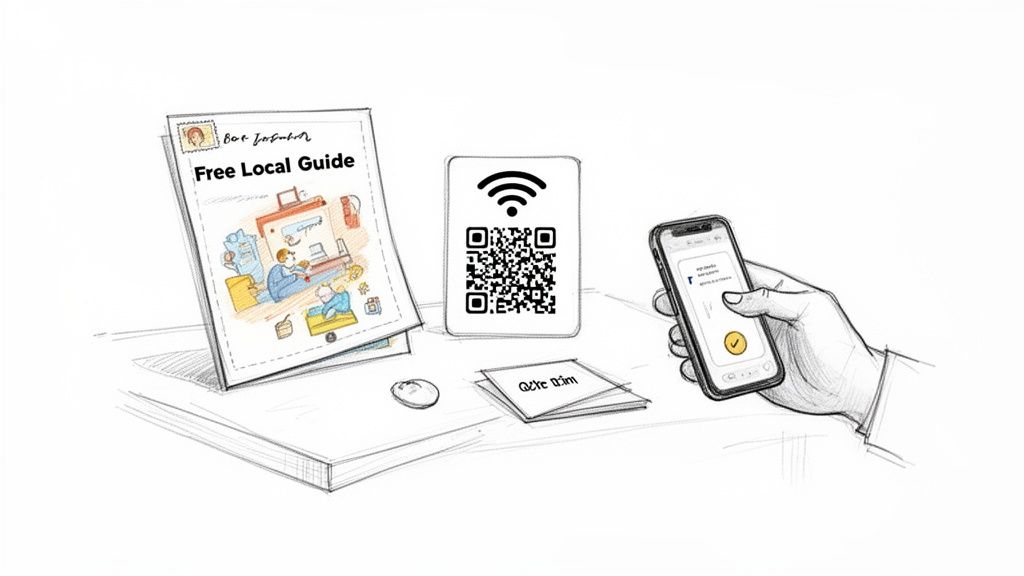
The trick is to make the process completely seamless and beneficial for the guest. You aren't forcing a sign-up; you're just offering a convenient way to get online while gently inviting them into your community. This small touch can easily double your email collection rate for every single stay.
Staying Compliant and Building Trust
Building your email list the right way also means doing it legally and ethically. Understanding consent isn't just a good idea—it's non-negotiable. Regulations like GDPR in Europe and the CAN-SPAM Act in the US require you to have explicit permission before you send a single marketing email.
This means you absolutely must:
- Use Clear Opt-In Language: Your sign-up forms have to spell out that the user is agreeing to get marketing communications from you. No pre-checked boxes allowed.
- Provide an Easy Unsubscribe: Every single email has to include a clear, one-click unsubscribe link. And you have to honor those requests immediately.
This is where dedicated platforms really shine. Tools like hostMail, which is part of the hostAI suite, are built with compliance baked in. They help you manage consents automatically and build your database responsibly, so you don't have to sweat the details.
By focusing on value and being transparent, you end up with a list of engaged, happy followers who are far more likely to book direct with you again and again. That's the list you want.
Using Guest Segmentation for Smarter Marketing
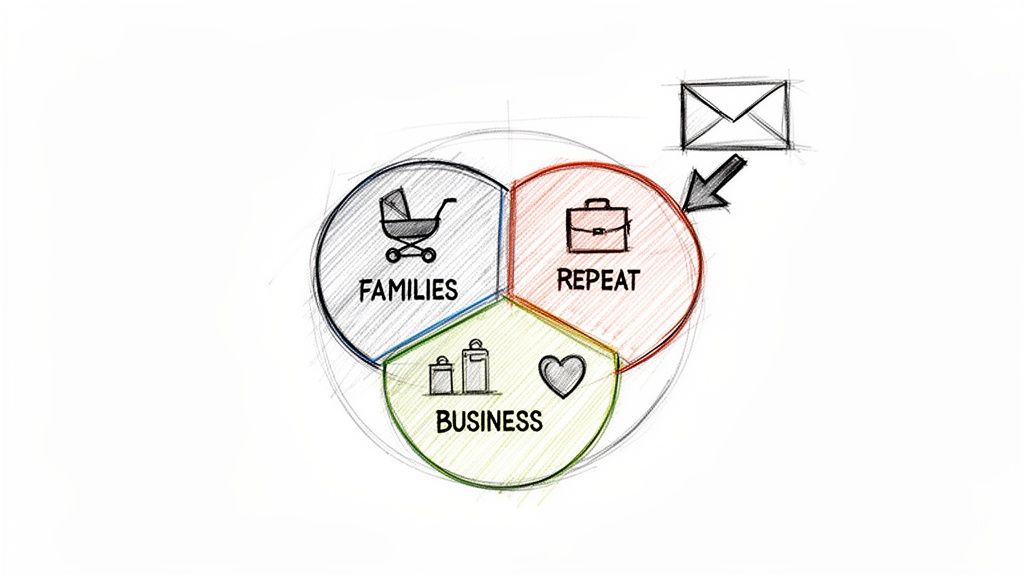
Sending the same exact email to every single guest is like trying to use one key for every door—it just doesn't work. This is where the real power of email database marketing comes alive: guest segmentation. It’s the art of turning a generic list into a collection of individuals, each with their own unique needs and booking history.
By sorting your guests into distinct groups, you can stop shouting into the void and start having real conversations. This goes way beyond just sticking a first name in the subject line; it's about sending the right message to the right person at the perfect time.
Why Guest Segmentation Is a Non-Negotiable
Just think about the different guests you host. A business traveler on a solo trip has a completely different set of priorities than a family of five looking for a summer vacation spot. Sending them both an email about your "romantic getaway package" is a surefire way to get ignored or, worse, trigger an unsubscribe.
Segmentation prevents this by letting you tailor your offers and content. The result? Higher engagement, stronger guest loyalty, and a serious boost to your direct booking revenue. It’s the difference between being a genuinely helpful host and just becoming more noise in their inbox.
Common Ways to Segment Your Guest List
Getting started with segmentation doesn't have to be some complex, data-science project. You already have all the data you need. The trick is to organize it into groups you can actually act on. For an even deeper dive, you can check out our detailed guide on https://gethostai.com/blog/how-to-segment-email-lists.
Here are a few of the most impactful segments for STR managers to start with:
- Booking History: This is the easiest place to start. Separate your guests into 'First-Time Stays' and 'Repeat Guests.' A first-timer might get a warm welcome sequence, while a repeat guest could receive an exclusive "welcome back" discount for their loyalty.
- Booking Source: Create segments for 'Direct Bookers' and 'OTA Bookers.' You can then run a targeted campaign for your OTA folks with a "Book Direct & Save" offer, clearly showing them the financial perks of cutting out the middleman next time.
- Guest Persona: Group guests based on their travel style. Common personas include 'Families with Kids,' 'Couples,' and 'Business Travelers.' This allows you to highlight the property features that matter most to them, like a fully-equipped kitchen for families or high-speed Wi-Fi for your business travelers.
The goal isn't just to divide your list; it's to understand it. When you know who you're talking to, you can craft messages that resonate on a personal level, making your guests feel seen and valued. This simple shift in perspective can transform your entire marketing approach.
This level of personalization really pays off. Research shows that email marketing can generate an impressive return of $36–€42 for every dollar spent. But the real magic happens when you segment. According to Emailchef, marketers have seen revenue jump by as much as 760% from segmented campaigns compared to generic blasts.
The numbers don't lie. A well-structured, segmented guest database isn't just a "nice-to-have"—it's a direct path to sustained revenue.
Segmented vs. Non-Segmented Campaign Performance
Seeing the difference in black and white makes the value of segmentation crystal clear. Here’s a typical comparison of how a generic "blast" email performs against a targeted, segmented campaign for a direct booking offer.
| Metric | Non-Segmented Campaign (Example) | Segmented Campaign (Example) | Performance Lift |
|---|---|---|---|
| Open Rate | 18% | 41% | +128% |
| Click-Through Rate (CTR) | 2.5% | 9.8% | +292% |
| Conversion Rate | 0.5% | 3.1% | +520% |
| Unsubscribe Rate | 1.2% | 0.3% | -75% |
As the table illustrates, sending a targeted message to a smaller, more relevant group drastically improves every key metric while significantly reducing the number of people who opt out. It’s proof that speaking directly to your guests’ needs is far more effective than a one-size-fits-all approach.
Automating Your Guest Communication with Email Flows
What if you could deliver a five-star communication experience to every single guest without lifting a finger? That's not a fantasy; it's the power of automation in your email marketing. By setting up automated email flows, you can create a seamless, professional, and profitable guest journey that runs from the moment they book to long after they've checked out.
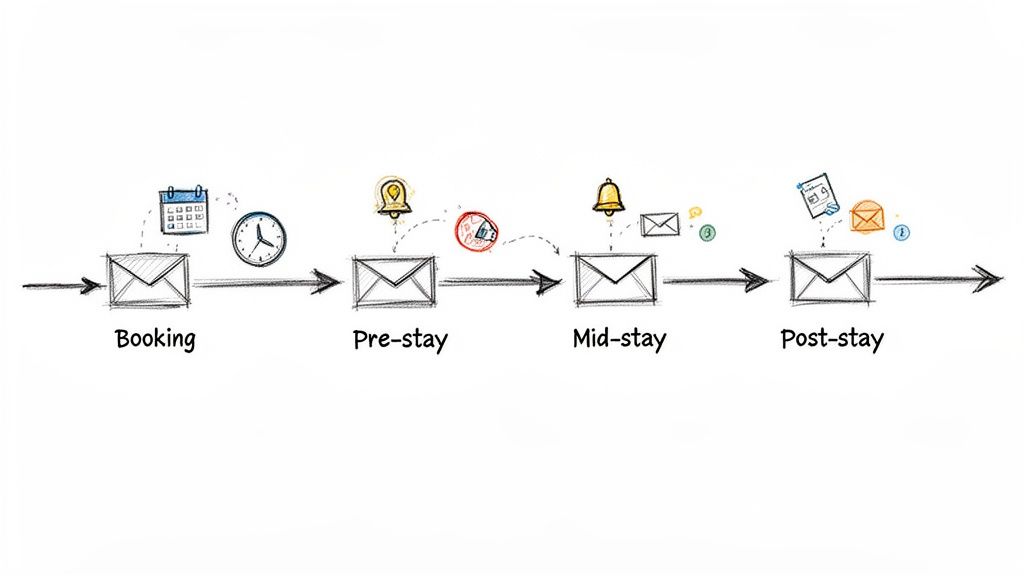
This isn't about blasting your guests with spam. It's about delivering the right information at exactly the right time. These automated flows—sometimes called sequences—are just pre-built series of emails triggered by specific guest actions or dates, like a new booking confirmation or an upcoming check-in. They work for you 24/7, making sure your communication is always timely and genuinely helpful.
Mapping the Pre-Stay Guest Journey
The time between booking and arrival is your golden opportunity. This is where you build trust, generate excitement, and set the stage for a flawless stay. Your mission here is to provide all the essential information your guest needs while maybe even making an upsell or two.
Here’s what your pre-stay flow should look like:
- Instant Booking Confirmation: The second a booking is made, this email should hit their inbox. It confirms the critical details—dates, property, total cost—and gives the guest immediate peace of mind that their reservation is locked in.
- The "Getting Excited" Email (7-14 Days Before Arrival): Now's the time to build anticipation. Send them a beautifully designed guide to your local area. Highlight your favorite restaurants, hidden gems, or upcoming local events. This adds huge value and instantly positions you as a clued-in local expert.
- Final Arrival Instructions (2-3 Days Before Arrival): This is arguably the most important email you'll send. It needs to be crystal clear. Include the property address, check-in instructions, key codes, Wi-Fi password, and anything else they need for a smooth arrival.
A well-structured pre-stay sequence dramatically reduces guest anxiety and cuts down on those repetitive, last-minute questions. When guests feel informed and prepared, they arrive happier and are far more likely to leave that glowing five-star review.
The travel and hospitality industry is quickly shifting to AI-driven, database-centric email programs to manage these relationships. Projections suggest that around 75% of email strategy operations could be fully AI-driven in the next few years. In fact, surveys already show about 77.5% of business executives use AI for personalized marketing emails, and over half of marketers rate AI-powered approaches as more effective. As an STR manager, an AI platform can turn your booking data into perfectly timed sequences for check-ins, review requests, and re-engagement offers.
Engaging Guests During and After Their Stay
Your job isn't done when the guest walks through the door. Mid-stay and post-stay automations are where you can drive extra revenue and lock in future bookings. To keep these flows fresh and engaging, it's smart to implement some simple content repurposing strategies.
Here are the essential flows to get in place:
- Mid-Stay Check-In: Send an automated email the morning after they arrive asking, "Is everything perfect?" This simple gesture shows you care and gives you a chance to fix any small issues before they become big problems.
- The Upsell Offer: About halfway through their trip, send an email offering a paid late check-out. It’s an incredibly low-effort way to generate more revenue from guests who are already loving their stay and don't want to leave.
- Post-Stay Thank You & Review Request: This should go out the day after check-out. Thank them for staying and—most importantly—provide a direct, one-click link to leave a review on your most important platform. You have to make it easy for them.
- The Rebooking Offer (7-30 Days Post-Stay): Don't let past guests drift away. A few weeks after their stay, hit their inbox with an exclusive "welcome back" discount for their next direct booking. It’s a simple but incredibly powerful way to build a loyal crew of repeat visitors.
Automated flows are the engine of any successful direct booking strategy. Our guide on what is email marketing automation is packed with more ideas for building these out. By thoughtfully mapping out these touchpoints, you'll save yourself countless hours while delivering a superior guest experience that drives revenue and builds loyalty.
Here's the rewritten section, designed to sound like it was written by an experienced human expert in the short-term rental industry.
How to Measure and Improve Your Email Campaigns
You can't improve what you don't measure. Getting your automated email flows up and running is a huge first step, but the real magic—the part that drives sustainable growth in direct bookings—happens when you start digging into the data. It’s the only way to know what’s resonating with your guests and what’s just noise.
So many hosts get hung up on vanity metrics like the open rate. Sure, it feels good to see a high open rate, but it doesn't pay the bills. It tells you your subject line worked, but it doesn't tell you if your message actually convinced anyone to book.
An impressive open rate means absolutely nothing if no one clicks that "Book Now" button. To get a real sense of your campaign's health, you have to look at the numbers that are directly tied to your bottom line.
Metrics That Actually Matter
For a short-term rental business, success isn't about likes or opens; it's about revenue. Let's ditch the vanity metrics and focus on the Key Performance Indicators (KPIs) that show a true return on your time and investment.
These are the core metrics you should have on your dashboard:
- Click-Through Rate (CTR): This is the percentage of people who actually clicked on a link inside your email. A healthy CTR is a great sign that your content, images, and call-to-action were compelling enough to make someone take the next step.
- Conversion Rate: This is the big one. It tracks the percentage of recipients who clicked a link and completed the goal—in our world, that means making a direct booking. This metric draws a straight line from your email to your bank account.
- Unsubscribe Rate: Pay close attention to this number. It tells you how many people are opting out after receiving an email. A sudden spike is a major red flag that your content isn't hitting the mark, you're sending emails too often, or you've targeted the wrong guest segment.
Tracking these core metrics transforms your email marketing from a guessing game into a data-driven strategy. It allows you to pinpoint exactly where your campaigns are succeeding and where they need improvement, giving you a clear path to generating more direct bookings.
A Practical Guide to Email KPIs
To really get a handle on performance, you need to understand what each metric is telling you and what levers you can pull to improve it. Here’s a quick-glance table to help you diagnose and optimize your campaigns.
Key Email Marketing Metrics and How to Improve Them
| Metric (KPI) | What It Measures | Actionable Tip for Improvement |
|---|---|---|
| Open Rate | Percentage of recipients who opened your email. | A/B test your subject lines. Try a direct offer ("15% Off Your Next Stay") vs. a curiosity-driven one ("A surprise for our favorite guests..."). Also, check your send times. |
| Click-Through Rate (CTR) | Percentage of recipients who clicked a link in your email. | Make your call-to-action (CTA) impossible to miss. Use a brightly colored button and clear, action-oriented text like "Book Your Mountain Escape" instead of a generic "Click Here." |
| Conversion Rate | Percentage of recipients who completed a booking after clicking. | Simplify the path to booking. Make sure the link from your email goes directly to the booking page for that specific property or offer, with dates and prices easy to select. Reduce friction! |
| Unsubscribe Rate | Percentage of recipients who opted out of your email list. | Check your email frequency and segmentation. If the rate is high, you might be emailing too often or sending irrelevant offers. Ensure your content matches the segment's interests. |
| List Growth Rate | The rate at which your email list is growing. | Promote your email list everywhere. Add a sign-up form to your website, include a link in your social media bio, and use a tool like StayFi to capture guest emails via your Wi-Fi. |
By keeping an eye on these numbers, you’re no longer just sending emails—you’re running a strategic marketing channel that you can fine-tune for better results over time.
How to Continuously Improve Performance
Data is only useful if you act on it. The final piece of the puzzle is using these insights to systematically test and refine your emails. This is where you can see dramatic improvements in your results.
One of the most powerful tools in your arsenal is A/B testing. It sounds technical, but the concept is dead simple: you send two slightly different versions of an email to a small slice of your audience to see which one performs better. For instance, you could test two different subject lines to see which gets more opens.
Here’s a simple testing plan you can start using right away:
- Test Your Subject Lines: See if a direct offer like "20% Off a Summer Getaway" works better than a more intriguing one like "Your Perfect Summer Escape is Waiting..."
- Optimize Your CTAs: Experiment with the button text. Does "Book Your Getaway" outperform "Check Availability"? Small word changes can make a big difference.
- Refine Your Imagery: Pit a stunning hero shot of your property’s view against a cozy, detailed shot of the living room fireplace. See which one gets more clicks.
By constantly testing, measuring the results, and applying what you learn, you create a powerful feedback loop. This iterative process is what ensures your email database marketing gets smarter, more effective, and more profitable with every single email you send.
Got Questions About Email Marketing? We've Got Answers.
Jumping into email marketing can feel like opening a can of worms. How often is too often? What’s the best way to win back a guest who hasn’t booked in a year? Let's clear up some of the most common questions STR managers wrestle with.
How Often Should I Email My Guests?
This is probably the biggest one we hear. While there's no single magic number, the best rule of thumb is to prioritize value over volume. Don't just send emails to send them.
Aim for one high-quality, genuinely interesting email per month. You can sprinkle in a few extra sends for major holidays or those tempting last-minute deals. The key is consistency, not constant contact. You want guests to look forward to your emails, not dread them.
How Do I Re-Engage Past Guests Who've Gone Quiet?
Another common puzzle is what to do about guests on your list who haven't opened an email or booked in over a year. A generic discount probably won’t be enough to get their attention.
Instead, try a targeted "We Miss You" campaign. But don't just say you miss them—give them a reason to come back. Highlight something new and exciting, like a recently renovated kitchen, a new hot tub, or a cool local attraction that just opened up. Make the offer compelling, something like "25% off your next stay," to make it truly worth their while.
When Is the Best Time to Send My Emails?
Timing can make a huge difference in your open rates. While every audience has its own rhythm, general data points to mid-week mornings (between 9 AM and 11 AM) as a sweet spot. A lot of people check their personal emails before diving into the workday grind. We've found it's usually best to avoid sending on weekends when inboxes are just too crowded and chaotic.
But here’s the real secret: the best approach is to test it yourself. Send one campaign on a Tuesday morning and your next one on a Thursday afternoon. Your own data will always be the most reliable guide to what works for your specific guests.
Ultimately, great email marketing is just about being a thoughtful host, even when you're in their inbox. If you're looking to broaden your approach beyond just email and keep your properties booked, it's worth exploring some comprehensive strategies for marketing rental properties.
Ready to turn these insights into a powerful direct booking engine? hostAI provides the tools you need to automate your guest communication and drive more revenue. Discover how hostAI can transform your email marketing at https://gethostai.com.