
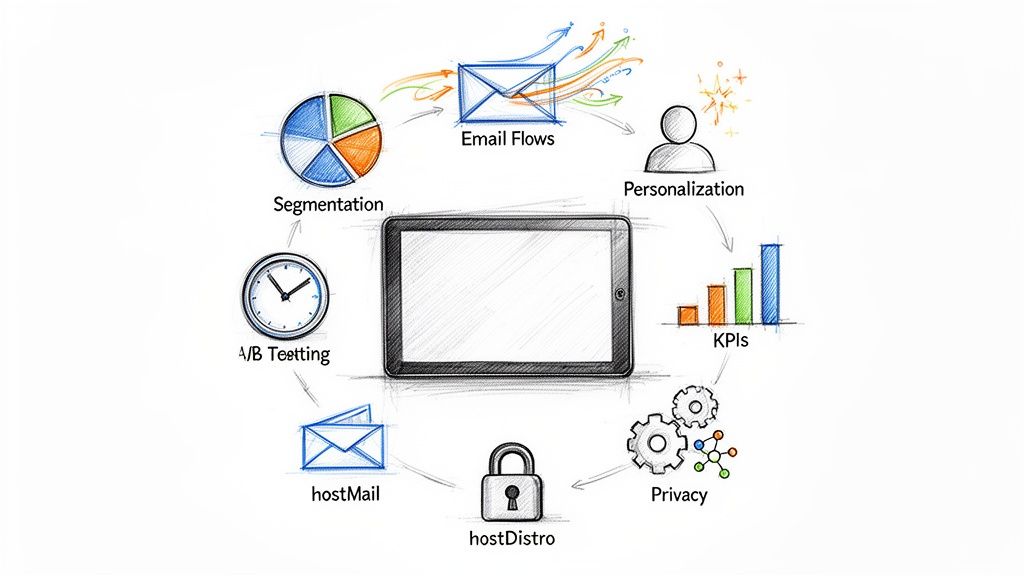
marketing automation
STR Marketing Automation: 10 Best Practices for 2026
Posted on Jan 18, 2026
TL;DR: Marketing automation is how a professional STR operator turns scattered, manual outreach into a system that wins direct bookings on autopilot. The 10 practices below — from guest segmentation to triggered lifecycle campaigns to conversion testing — are ordered by impact-to-effort so you can start where it pays off fastest. The thesis is simple: you don't need to do more marketing, you need your marketing to run without you, every hour the OTAs are quietly renting you your own guests back.
Here's the gap worth closing. Top hotel brands secure 75–80% of their bookings directly; vacation rental managers often sit in the single digits, and even a tech-forward operator like Vacasa reported just 35% of booking value direct. That spread is the prize. Automation is the lever that lets a lean team capture it without hiring a marketing department.
What is STR marketing automation?
STR marketing automation is the use of software to trigger guest communications, pricing moves, and ad campaigns automatically — based on guest behavior and booking lifecycle stage — so that a short-term rental operator can grow direct bookings and repeat stays without sending every message by hand. In practice it means a new booking fires off its own confirmation and pre-arrival sequence, a checked-out guest gets a rebooking nudge 30 days later, and an abandoned inquiry gets followed up — all without you touching your inbox.
Below are the ten practices that matter most for an operator running a real portfolio. We'll show concrete STR scenarios for each, not generic SaaS theory.
1. Segment your guest list (stop sending one email to everyone)
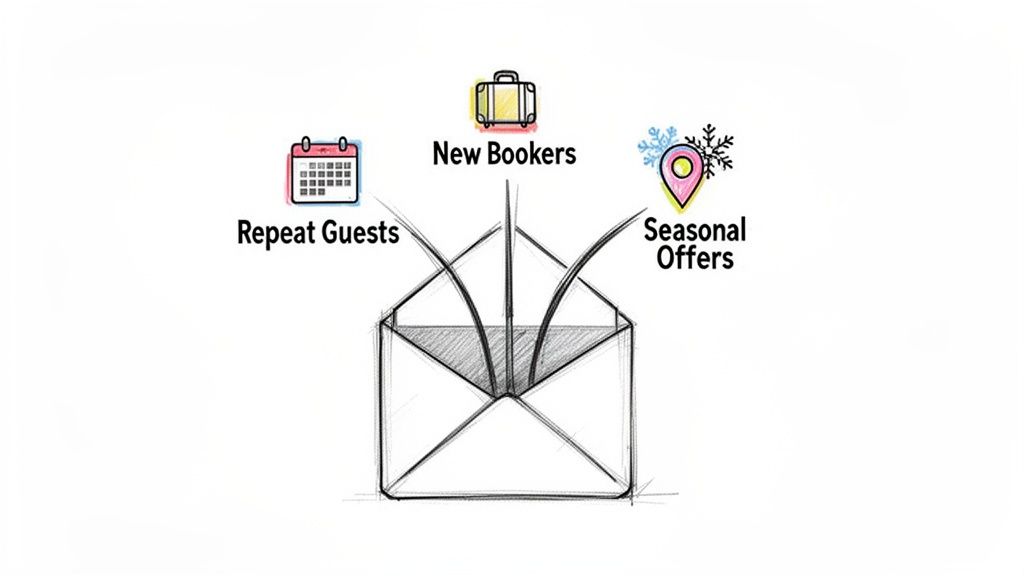
The single highest-leverage move is to stop blasting one "Book Now!" email to your whole list. Segmentation splits your contacts into groups that share something real — property type stayed, season, repeat vs. first-time, length of stay — so the message actually fits the reader.
Picture your own list. A guest who booked a mountain cabin last February doesn't want the same email as a family that did a week at the beach. Send the cabin guest an early-bird ski-season offer in October; send the beach family a "your spot" summer reminder in March. Same effort to set up, dramatically different open and conversion rates because each guest feels remembered.
Start here
Don't build twelve segments on day one. Start with three: repeat guests, first-time guests, and guests by property type/region. Master those before adding corporate travelers, anniversary triggers, or length-of-stay tiers. For the full playbook, see how to segment your email lists.
2. Build triggered, lifecycle campaigns
Segmentation tells you who; lifecycle automation handles when. Instead of manually sending booking confirmations and follow-ups, you build sequences that fire off a guest action — a booking, a checkout, an abandoned inquiry — and run 24/7 without you.
The three that earn their keep fastest for an STR operator:
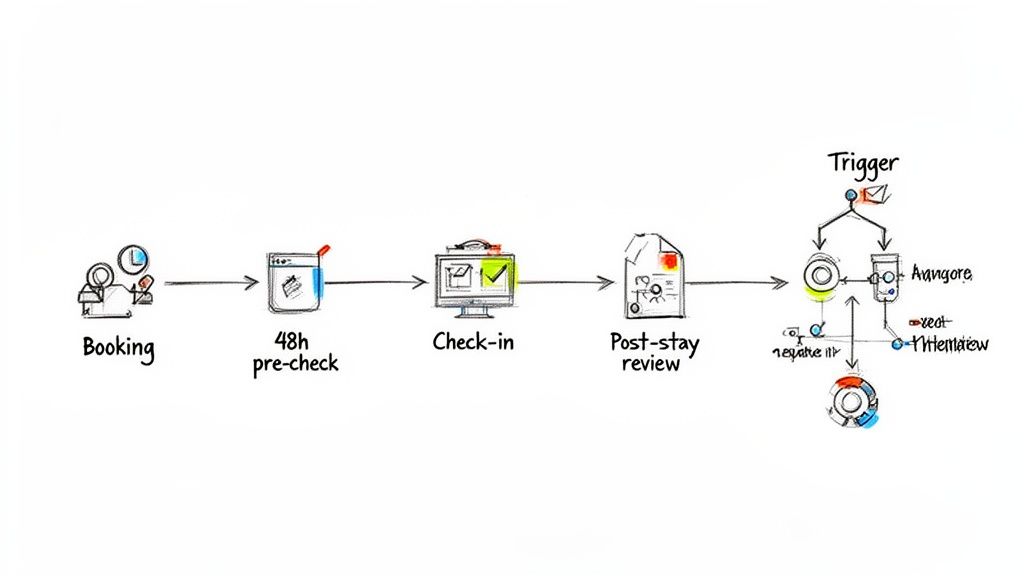
- Post-booking sequence: instant confirmation → local-recommendations email 7 days before arrival → access codes and check-in instructions 24 hours out. This alone removes most of your "what's the WiFi password?" inbound.
- Abandoned-inquiry follow-up: a guest starts a booking on your site and doesn't finish. An immediate gentle nudge, a reminder at 24 hours, a soft offer at 48. This is direct revenue you were otherwise handing back to the OTA they'll re-find you on.
- Post-stay rebooking: a thank-you and review request 2 days after checkout, then a return offer ~30 days later. This is the one that compounds.
Why this matters more than any other line in this guide: most first-time guests never come back on their own — repeat-booking rates in vacation rental tend to cluster in the mid-teens annually, which means roughly four in five guests are one-and-done unless you actively bring them back. The OTA drove the discovery; if you don't own the follow-up, you're renting that guest from Airbnb again next time. A lifecycle sequence is how you convert a one-time stay into a repeat booking that pays you no commission.
Pro Tip: Map the guest journey on a whiteboard before you build anything. Ship the three workflows above first. Win-back and anniversary campaigns can wait until those are running clean.
3. Score your leads so you know where to spend attention
Not every site visitor is ready to book. Lead scoring assigns points to behaviors so your hottest prospects surface automatically — and you stop treating a tire-kicker like a guest with dates in hand.
For an STR operator, the signals are specific and easy to weight: viewing the booking calendar is worth far more than viewing the "about us" page. A reasonable starter model: +20 for opening the booking widget, +10 for viewing a property gallery, +25 for starting (not finishing) an inquiry, +15 for a corporate email domain on a mid-week extended-stay search. When a contact crosses your threshold, trigger the right sequence — corporate rates for the business traveler, an urgency nudge for the date-searcher.
Pro Tip: Start with 5–7 behavioral signals, weight recent actions more heavily than old ones, and recalibrate quarterly against which actions actually correlated with bookings.
4. Use programmatic SEO to scale long-tail property pages
You can't hand-write a unique page for every property, city, and amenity combination at portfolio scale. Programmatic SEO uses a template plus your property data to generate hundreds of search-optimized pages automatically — capturing long-tail, high-intent queries that a generic homepage never ranks for.
Concretely: instead of one "Florida beach rentals" page, you generate "3-bedroom beachfront villa in Miami with private pool" and "pet-friendly condo in Clearwater Beach." Those phrases convert because the searcher already knows what they want. Travel research is rarely impulsive — roughly one in three travelers start on search engines — and long-tail pages are where a small brand can out-rank an OTA that's only optimizing for the head terms.
Pro Tip: Start with your highest-value combinations — your most-booked property types in your biggest markets. Use canonical tags so search engines know the primary version of each page, and add schema markup so listings render richly in results.
5. Automate dynamic, demand-based pricing
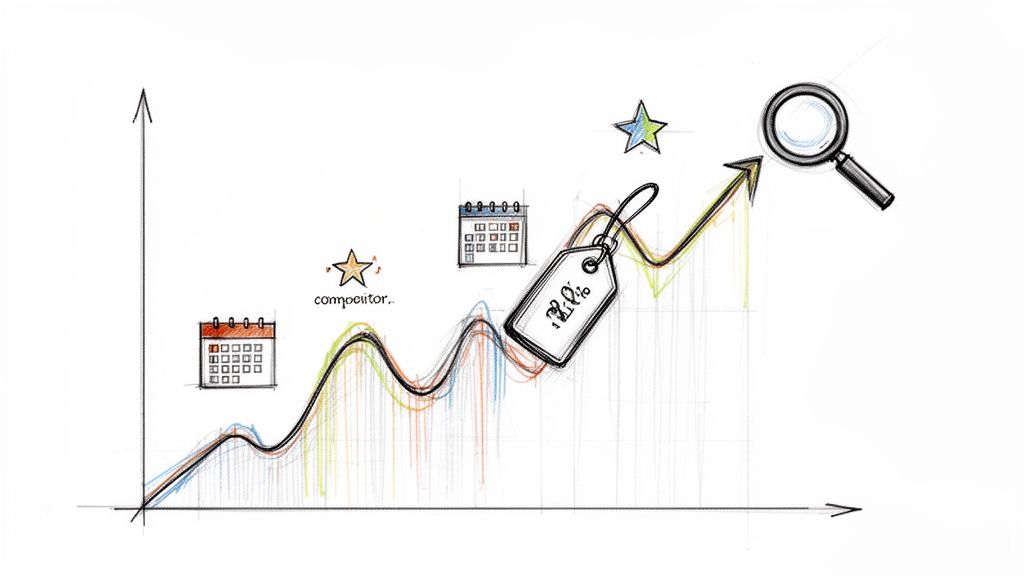
Pricing is marketing. The rate a guest sees is the offer. Demand-based pricing uses booking history, competitor rates, local events, and seasonality to set the optimal nightly rate automatically — raising rates for a festival weekend, trimming them to fill a gap inside the booking window.
The operator move that pairs best with automation: when a property is still open seven days out, auto-apply a modest discount and push it to your "last-minute deals" email segment in the same motion. You're filling the night and using your owned channel to do it, instead of dropping the price on the OTA and paying commission on the recovery.
Pro Tip: Always set price floors and ceilings in your rules. Automation should flex within a band you define — never below a profitable floor, never so high it cheapens the brand.
6. Connect your channels into one journey (omnichannel)
Email, ads, your direct site, and SMS shouldn't operate as four strangers. Omnichannel integration means a guest who clicks an Instagram ad, browses two listings, and leaves gets a follow-up email featuring the exact properties they viewed — then sees a matching retargeting ad the next day. Same brand, same offer, one continuous conversation.
The point isn't "be everywhere." It's that data from one channel should inform the next. A booking abandonment on your site should be able to trigger an email; a review request that goes unanswered should be able to escalate to a single SMS. That hand-off between channels is what most operators are missing.
Pro Tip: Map one journey end-to-end — first site visit to booking — and get the branding, imagery, and core message aligned at every touchpoint before you expand to a second journey.
7. Retarget visitors who didn't book
Most visitors don't book on the first visit. Retargeting keeps your brand in front of people who already showed intent — far cheaper than prospecting cold, because you're re-engaging a warm audience.
Make it behavioral, not generic. Someone who viewed your 3-bedroom beachfront villas should see those exact properties in a carousel ad. Someone who abandoned checkout should see a single benefit-led nudge — "flexible cancellation" or "book direct and save" — not a wall of every listing you own.
Pro Tip: Cap frequency at 3–5 impressions per user per week so you don't fatigue (and annoy) prospects, and exclude anyone who already converted so you're not paying to advertise to people who've booked. More tactics in our guide to the best retargeting platforms for STR managers.
8. Optimize the booking page itself (CRO)
Driving traffic to your direct site is half the job; converting it is the other half. Conversion rate optimization is the systematic, test-driven work of removing friction from the booking flow — and it lifts direct bookings without spending another dollar on traffic.
Test high-impact elements one at a time: the primary CTA ("Book Now" vs. "Reserve Your Stay"), the placement of reviews and trust badges relative to the booking form, the hero image on your top properties (does the ocean view or the fireplace-lit living room convert better?). Run one test at a time so you can actually attribute the lift.
Pro Tip: Start with the headline, the primary CTA, and the lead photo — the elements every visitor sees. See our full conversion optimization best practices.
9. Unify your guest data into one profile
Real personalization needs a 360-degree view of each guest. Unified data management — often via a Customer Data Platform — consolidates booking engine, website, email, and support data into a single guest profile, so you can segment on behavior, not just booking dates.
The payoff is sharper triggers. You can build a segment of guests who've booked your luxury properties twice, open most of your emails, and recently viewed your add-on services page — and send them an offer no generic blast could match. Or spot guests who repeatedly browse pet-friendly listings without booking and send a targeted "bring your pet" offer.
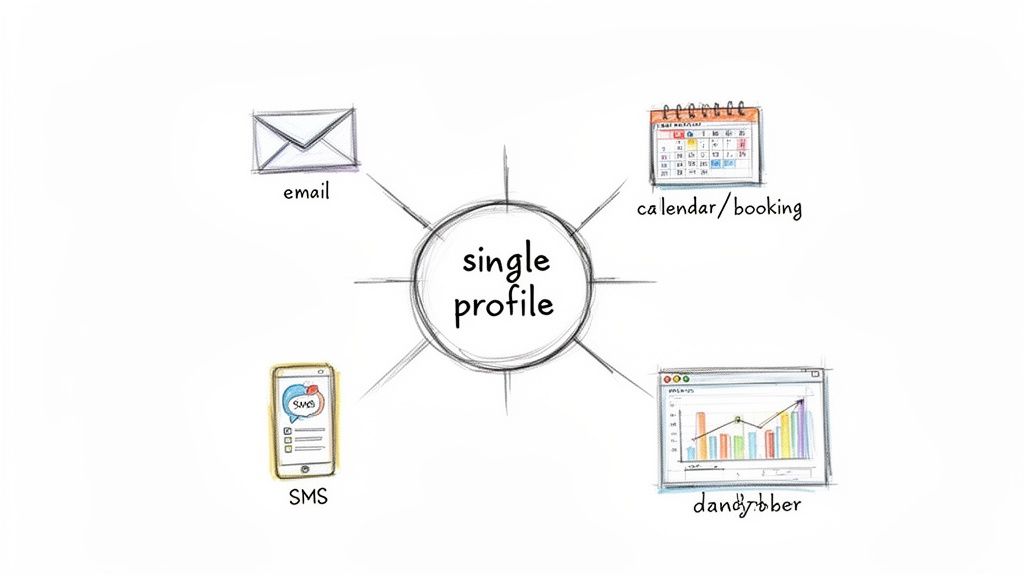
Pro Tip: Don't boil the ocean. Integrate your three most important sources first — your PMS, your email platform, and your website analytics — and master those insights before adding messaging or review data.
10. Keep your brand consistent across every automated touchpoint
Automation isn't just sending messages — it's delivering one coherent, trustworthy brand at every step. When your ad, your booking site, and your confirmation email share the same look, voice, and trust signals, you reduce booking friction and signal that you're a professional operator, not a one-off listing.
For an STR brand that's building direct distribution, this consistency is what converts an OTA-discovered guest into a direct booker: they recognize you, they trust you, and the booking feels safe. Bake your logo, palette, and review widgets into your templates once, and every automated message inherits them.
Pro Tip: Write a one-page brand guide — primary colors, logo usage, three voice adjectives — and reference it whenever you set up a new template. Consistency is cheaper to maintain than to retrofit.
How these 10 practices compare
Use this to sequence your rollout by effort, not to chase headline numbers. (We've deliberately left out the inflated "X% lift" figures that float around generic marketing blogs — the honest answer is that results vary by portfolio, market, and how clean your data is.)
| Practice | Setup effort | What it needs | Best for |
|---|---|---|---|
| 1. Segmentation | Moderate | Clean guest/booking data, email tool with dynamic content | Relevant offers; repeat vs. new; seasonal promos |
| 2. Triggered lifecycle campaigns | High | Automation platform + PMS/booking integration | Confirmations, pre-arrival, post-stay rebooking, abandoned inquiries |
| 3. Lead scoring | Moderate–High | Behavior data, ongoing calibration | Prioritizing high-intent and corporate inquiries |
| 4. Programmatic SEO | High | Templates, property data, canonical/SEO setup | Scaling long-tail location and property pages |
| 5. Dynamic pricing | High | Booking history, competitor and event data | Event/seasonal pricing, filling last-minute gaps |
| 6. Omnichannel integration | High | Unified data/connectors across channels | Coordinated email + web + ads + SMS journeys |
| 7. Retargeting | Moderate | Ad platform, pixel, creative, traffic + budget | Recovering abandoned bookings; re-engaging visitors |
| 8. Landing page / CRO | Moderate | A/B testing tool, enough traffic for significance | Property pages, booking forms, promo pages |
| 9. Unified data / CDP | Very high | Integrations, identity resolution, governance | Multi-channel operators needing deep personalization |
| 10. Brand consistency | Moderate | Brand guidelines, shared templates | Every channel where trust drives conversion |
Your phased rollout
Don't attempt all ten at once. The operators who win do it in waves, banking compounding gains:
- Phase 1 — Foundation: Stand up the post-booking sequence (#2) and a basic retargeting campaign for non-bookers (#7). This immediately closes the two biggest leaks: weak post-booking engagement and abandoned bookings.
- Phase 2 — Expansion: Add segmentation (#1) and a post-stay rebooking campaign, then build optimized landing pages for your key promotions and test them (#8).
- Phase 3 — Optimization: Layer in programmatic SEO (#4) to grow organic long-tail traffic, unify your guest data (#9), and turn on demand-based pricing (#5). At this stage you're refining a system, not building from scratch.
Where hostAI fits
Most of the above is achievable with a stack of point tools wired together. The trade-off is that you become the integration layer — the person keeping the PMS, the email tool, the ad pixels, and the website talking to each other. hostFront, our direct-booking website, is built so an STR operator's site, programmatic SEO pages, lifecycle emails, and retargeting share one guest profile out of the box — so these practices run as one engine instead of ten apps you babysit. If you'd rather spend your time on hospitality than on plumbing, that's the case for an integrated platform.
FAQ
What's the first marketing automation a vacation rental should set up?
Start with a post-booking email sequence (confirmation → pre-arrival guide → check-in details) and a simple retargeting campaign for visitors who didn't book. These close the two biggest revenue leaks for most operators and require no advanced data work.
How much can automation actually move direct bookings?
The benchmark worth chasing is the gap between hotels — which book 75–80% direct — and most vacation rental managers in the single digits. Automation is the mechanism for closing that gap, but the rate depends on your market, your data quality, and how consistently you run the sequences. Treat the practices above as the system; measure your own lift rather than trusting headline percentages from generic blogs.
Do I need a CDP to start?
No. A CDP (#9) is a later-stage move. Begin with clean PMS data and an email platform; unify data only once your lifecycle campaigns and segmentation are running well.
Why does automation help direct bookings specifically, not just bookings overall?
Because the channel that follows up owns the guest. Most first-time guests don't return on their own — without active follow-up, the repeat stay either doesn't happen or happens back on the OTA. OTAs drive first-time discovery, but if your automated rebooking and lifecycle sequences run on your owned channels, the repeat stay happens on your site — commission-free — instead of back on the OTA. That's where direct distribution compounds.
Bottom line: You don't win direct bookings by working harder on marketing — you win by building a system that runs while you sleep, then refining it. Sequence these ten practices, start with the post-booking and abandoned-inquiry workflows, and keep measuring. Ready to run them as one engine instead of a pile of disconnected tools? See how hostFront brings your site, SEO, and guest lifecycle together.