
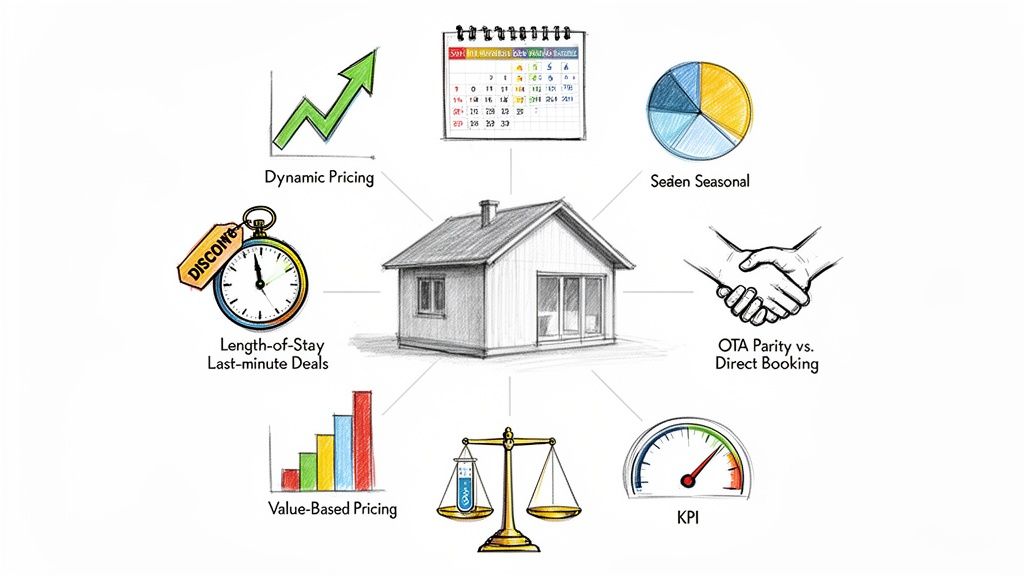
pricing strategies for small businesses
10 Essential Pricing Strategies for Small Businesses in the STR Market 2026
Posted on Feb 8, 2026
In the highly competitive vacation rental market, setting the right price is more than just covering costs-it’s the engine that drives your revenue, occupancy, and long-term success. Get it right, and you'll see bookings soar and profits climb. Get it wrong, and you risk leaving money on the table or, worse, struggling with vacant properties. This is a common challenge for hospitality brands, but it’s solvable. The key lies in moving beyond guesswork and implementing proven, data-driven pricing strategies for small businesses tailored specifically to the unique demands of the short-term rental industry.
This comprehensive guide will walk you through 10 essential strategies, from maximizing peak-season revenue with dynamic pricing to reclaiming profit from OTAs with direct-booking incentives. While many pricing principles overlap across industries, the nuances of hospitality require a specialized approach. To truly master your approach to setting prices, exploring a complete guide to Ecommerce Pricing Strategies can provide invaluable insights from a parallel field, but this article is built for you: the vacation rental manager.
We'll provide actionable steps, real-world examples, and show you how leveraging AI tools can transform your pricing from a daily chore into a strategic advantage. You will learn not just what to do but how to implement these models effectively. This ensures every night is priced for maximum value, turning your properties into consistently high-performing assets. Let's dive in and unlock your property's true earning potential.
1. Dynamic Pricing Strategy
Dynamic pricing is a flexible approach where rates change in real time based on fluctuating market conditions. Instead of a fixed nightly rate, this strategy uses data to adjust prices based on supply and demand, seasonality, competitor rates, local events, and even day-of-the-week trends. For short-term rental managers, it’s one of the most effective pricing strategies for small businesses looking to maximize revenue and occupancy simultaneously.
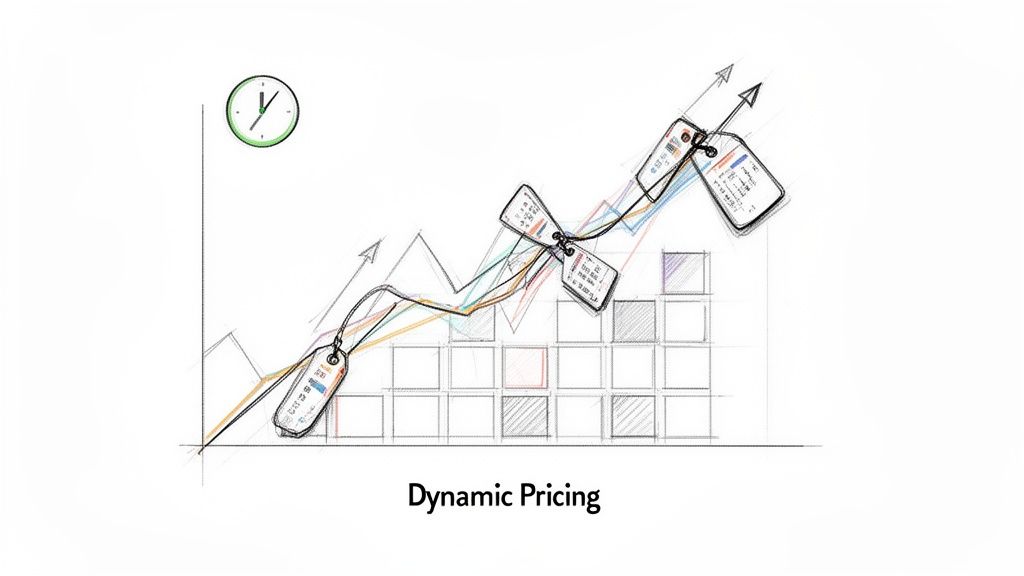
The goal is to charge the optimal price at any given moment, attracting guests during slow periods with competitive rates while capitalizing on high demand during peak times. This is the same model used by airlines and hotels to ensure they sell as much inventory as possible at the highest price the market will support.
How to Implement Dynamic Pricing
Implementing this strategy effectively requires a data-driven approach. While manual adjustments are possible, most successful managers use automated tools.
- Set Baselines: Establish a minimum acceptable rate (price floor) to protect your profit margins and a maximum rate (price ceiling) to avoid alienating potential guests.
- Leverage Technology: Use AI-powered tools like PriceLabs, Beyond, or the personalized pricing feature within hostAI. These platforms analyze billions of data points to automate adjustments, saving you time and eliminating guesswork.
- Monitor Local Events: Stay informed about concerts, festivals, conferences, and holidays in your area. These events create demand spikes that justify significant rate increases.
- Analyze Historical Data: Review your past booking performance to identify patterns. Which seasons consistently sell out? When do you typically see last-minute bookings? Use these insights to inform your future pricing rules.
Key Insight: Dynamic pricing isn't just about raising prices during high season; it's about finding the perfect equilibrium to boost occupancy and revenue year-round. An empty property earns nothing, so strategic price drops during lulls are just as important as increases during peaks.
By continuously adapting to the market, you ensure your listings remain competitive and profitable. To explore this concept further, you can learn more about what is dynamic pricing and how it reshapes revenue management.
2. Value-Based Pricing
Value-based pricing is a strategy that sets rates based on the perceived value and unique benefits a property offers to a guest, rather than focusing solely on costs or competitor pricing. For vacation rental managers, this means you can command premium rates for exceptional amenities, a prime location, a strong brand reputation, or a unique guest experience. This approach aligns your pricing directly with what guests are willing to pay for the high-quality experience you provide.
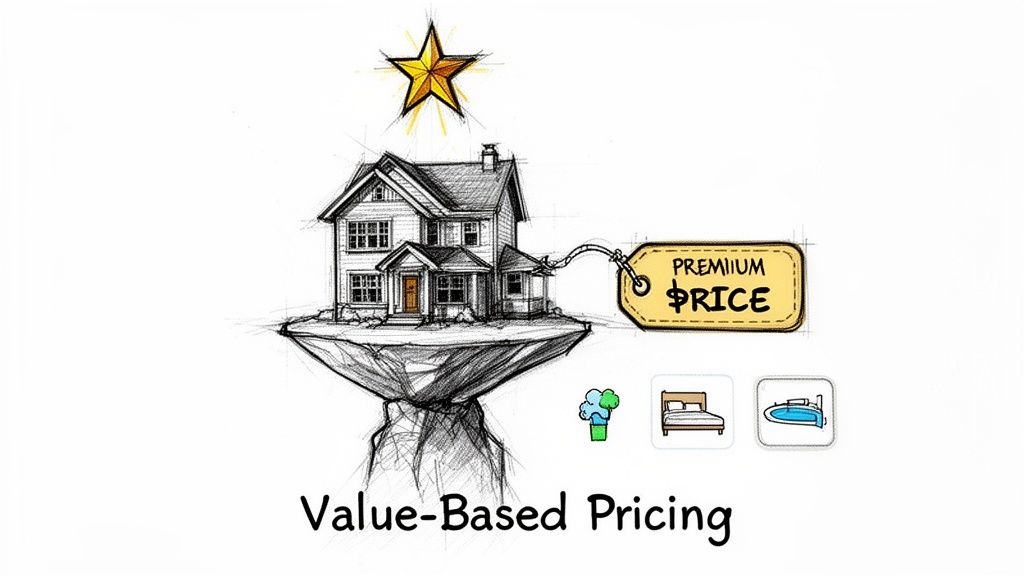
The goal is to move the conversation from "how much does it cost?" to "what amazing experience will I get?" By successfully communicating your property's value, you can attract guests who are less price-sensitive and more focused on quality. This strategy is popular among luxury hospitality brands and unique properties like treehouses or beachfront villas that offer something truly special.
How to Implement Value-Based Pricing
Effectively implementing this strategy requires you to clearly define, showcase, and deliver superior value. It’s about building a premium brand experience from the first click to checkout.
- Showcase Your Value: Invest in professional photography and videography to visually communicate what makes your property special. Highlight unique features, high-end finishes, and stunning views.
- Craft Compelling Descriptions: Write detailed property descriptions that tell a story. Focus on the experience and benefits, such as "wake up to panoramic ocean views" or "unwind in your private hot tub under the stars."
- Emphasize Exceptional Service: Go beyond the standard. Offer concierge services, personalized welcome baskets, or local guides to enhance the guest experience and justify a higher price point.
- Build Social Proof: Actively gather and display five-star reviews and testimonials that reinforce the value you deliver. Positive guest feedback is one of your most powerful marketing assets.
Key Insight: Value-based pricing is not about being the most expensive option; it's about being the best value for a specific type of guest. When you successfully communicate why your property is worth more, guests are happy to pay a premium for a guaranteed exceptional stay.
3. Penetration Pricing Strategy
Penetration pricing is a strategic approach where a business sets an intentionally low initial price for a new product or service. The goal is to quickly attract a large customer base, "penetrate" the market, and rapidly build brand awareness. Once a strong foothold and positive reputation are established, prices are gradually increased. For new short-term rental properties or those entering a saturated market, this is one of the most effective pricing strategies for small businesses to build momentum.
This strategy sacrifices short-term profit for long-term market share. For a new vacation rental, the initial low rates act as a powerful incentive for first-time guests, helping you secure those crucial first bookings and positive reviews. This early traction creates social proof and improves your listing’s ranking on OTAs, setting the stage for future profitability.
How to Implement Penetration Pricing
A successful penetration strategy requires a clear plan for transitioning to higher rates. It’s not just about offering a discount; it's a phased launch.
- Set Clear Benchmarks: Define the exit criteria for your introductory offer. This could be a time limit (e.g., the first 90 days) or a volume target (e.g., after the first 15 bookings).
- Communicate Value: As you prepare to increase rates, justify the change by highlighting improvements or showcasing the outstanding reviews you’ve earned. This helps early guests feel they got a great deal and new guests understand the current value.
- Perfect Operations: Use the initial, lower-priced period to refine your check-in process, guest communication, and cleaning protocols. Working out any operational kinks ensures that when you raise prices, the guest experience matches the premium rate.
- Build Your Brand: While rates are low, focus on building organic visibility. Use this period to implement programmatic SEO for your direct booking site, so you have a strong traffic foundation when you transition to higher pricing.
Key Insight: Penetration pricing is a launch tactic, not a long-term plan. Its primary purpose is to overcome the challenge of being a new, unproven listing. By quickly generating reviews and booking history, you build the credibility needed to compete at a higher price point.
4. Premium/Skimming Pricing Strategy
Premium pricing, often called price skimming, involves launching a new or highly unique property at a high initial price point. This strategy targets early adopters and guests seeking an exclusive, top-tier experience. Over time, as the initial novelty fades or market competition increases, the price is gradually lowered to attract a broader audience. It's one of the most effective pricing strategies for small businesses with a truly differentiated, high-end product.
This approach is ideal for properties that stand out due to their luxury amenities, unique design, or prime location. By starting high, you maximize revenue from the guests who are willing to pay a premium for "the best" or "the newest" offering on the market. It capitalizes on the initial buzz and perceived exclusivity of a new listing.
How to Implement Premium/Skimming Pricing
Success with this strategy hinges on creating a powerful brand narrative and justifying the high price tag from day one.
- Build a Strong Brand Story: Your marketing should focus on what makes the property exceptional. Use professional photography, virtual tours, and compelling descriptions to highlight its unique features and create a sense of exclusivity.
- Justify the Premium: Back up your high rates with tangible value. This could be through award-winning architecture, media features in travel publications, or unparalleled amenities like a private chef or infinity pool. For example, a newly renovated luxury villa could command a 40-60% premium over comparable local properties.
- Create Scarcity: Use messaging that emphasizes limited availability or exclusive access. This reinforces the idea that guests are paying for a rare opportunity, which helps justify the cost.
- Plan Your Price Reduction: Don't wait for bookings to slow down to think about lowering the price. Have a clear plan for when and how you will adjust rates as the market matures or the initial launch excitement wanes. This ensures a graceful transition to a more mainstream pricing model.
Key Insight: Premium pricing is not just about being expensive; it's about communicating exceptional value and creating a perception of exclusivity. The goal is to capture maximum profit during the initial high-demand phase before settling into a long-term competitive rate.
5. Competitive Pricing Strategy
Competitive pricing is a market-driven approach where you set your rates based on what your direct competitors are charging for similar properties. Instead of looking inward at your costs, this strategy looks outward to the market, positioning your rental to attract guests by matching or slightly undercutting competitor prices. It is one of the most straightforward pricing strategies for small businesses, especially in highly saturated markets where guests frequently compare options.
The primary goal is to remain attractive to potential guests who are price-shopping. By aligning your rates with the market average, you avoid pricing yourself out of consideration while ensuring your rates are sustainable. This method is particularly effective for properties that don’t have significant differentiating features and must compete directly on price and perceived value.
How to Implement Competitive Pricing
A successful competitive pricing strategy requires diligent market research and a clear understanding of your property's position relative to others.
- Identify True Competitors: Your competition isn't every listing in your city. Focus on properties that are similar in size, location, amenity level, and guest capacity. A two-bedroom condo with a pool should be compared to other two-bedroom condos with pools, not a five-bedroom luxury home.
- Monitor Competitor Rates: Regularly track the prices of your key competitors. This can be done manually by checking listings on OTAs or more efficiently using automated tools that scrape competitor data. Weekly monitoring is a good starting point.
- Differentiate Beyond Price: Since you are matching rates, you must find other ways to stand out. Emphasize superior guest service, unique amenities (like a hot tub or a high-end coffee machine), professional photography, or glowing reviews to justify a booking over a similarly priced competitor.
- Use as a Baseline: Don't just copy competitor prices blindly. Use them as a baseline and then adjust based on your property's unique value proposition. If your reviews are significantly better, you may be able to justify a rate that is 5-10% higher.
Key Insight: Competitive pricing isn't about being the cheapest; it's about being the smartest. Understand what the market will bear, then use your unique strengths in service, marketing, and amenities to win the booking at a comparable price point.
By keeping a close eye on the competition, you ensure your property remains a viable and attractive option for travelers. This strategy helps maintain steady occupancy by staying in lockstep with market expectations.
6. Psychological Pricing Strategy
Psychological pricing is a strategy that uses price points to influence a customer's perception and purchasing decisions. Rather than relying solely on cost or market value, it taps into the subconscious thought processes of potential guests, making rates appear more attractive, reasonable, or urgent. This approach is one of the most subtle yet effective pricing strategies for small businesses in the hospitality sector.
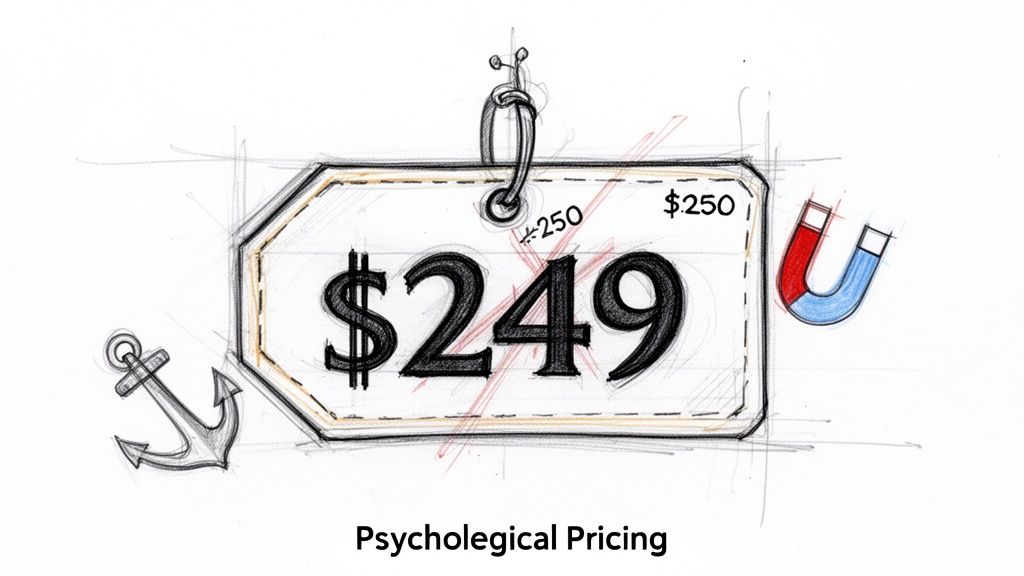
The core idea is that certain prices have a greater psychological impact than others, even when the numerical difference is minimal. For a short-term rental, a rate of $299 per night feels significantly cheaper than $300, a phenomenon known as "charm pricing." This strategy is about framing your price to make it more appealing and justifiable in the guest's mind.
How to Implement Psychological Pricing
Successfully applying this strategy involves more than just ending your prices in the number nine. It requires a thoughtful approach to how you present value.
- Use Charm Pricing: Price your nightly rates just below a round number (e.g., $199 instead of $200). This "left-digit effect" makes the price seem lower at a glance, reducing friction during the booking process.
- Frame Prices Effectively: Instead of just showing a total, break it down. Displaying a rate as "$150 per night for a 4-night stay" can seem more manageable than a single lump sum of "$600."
- Create Anchors: When presenting different options or packages, show a higher-priced premium option first. This "price anchoring" makes your standard rates appear more reasonable by comparison.
- Bundle Amenities: Include popular add-ons like late check-out or a welcome basket in a slightly higher rate. This frames the price as a value-packed deal rather than just a higher cost.
Key Insight: Psychological pricing isn't about tricking guests; it's about aligning your price presentation with human cognitive biases. The goal is to reduce decision-making friction and make guests feel confident they are getting a good deal, which encourages faster, more frequent bookings.
7. Seasonal and Event-Based Pricing Strategy
Seasonal and event-based pricing is a proactive strategy that adjusts rates based on predictable shifts in demand throughout the year. Rather than a flat annual rate, this approach involves forecasting and setting different prices for high seasons (like summer vacation), low seasons, and special one-off events like festivals or conferences. For short-term rental managers, it's a foundational element of a smart revenue plan, allowing them to capitalize on peak demand and stimulate bookings during slower periods.
This strategy hinges on understanding the annual rhythm of your market. A beach house will naturally command a premium in July, while a mountain cabin near a ski resort will see its highest demand in January. By planning for these fluctuations, you can strategically align your pricing with guest expectations and market value, making it one of the most reliable pricing strategies for small businesses in hospitality.
How to Implement Seasonal and Event-Based Pricing
A successful seasonal strategy is built on research and forward-planning. It requires creating a pricing calendar that reflects your market's unique demand drivers.
- Create a 12-Month Pricing Calendar: Map out the entire year, highlighting peak seasons, shoulder seasons (the periods between peak and off-peak), and low seasons based on historical booking data.
- Research Local Events: Identify all major local events that attract visitors. This includes annual festivals, major concerts, sporting events, and large conferences. Mark these dates on your calendar as high-demand periods that can support significant rate increases.
- Analyze School and Holiday Schedules: Use school vacation calendars (spring break, summer, winter break) and national holidays to inform your seasonal tiers. These are often the most predictable drivers of family travel.
- Set Seasonal Baselines: Establish distinct base rates, minimum stay requirements, and pricing rules for each defined season. For example, your summer peak season might have a 50% higher base rate and a 7-night minimum, while your winter low season has a lower rate and a 2-night minimum to encourage bookings.
Key Insight: Don't just focus on the big holidays. Shoulder seasons offer a major opportunity. By setting attractive, intermediate rates for these periods, you can smooth out occupancy lulls and create a more consistent revenue stream between your busiest and slowest times.
8. Tiered/Package Pricing Strategy
A tiered or package pricing strategy involves offering multiple service levels at different price points, allowing guests to select the option that best fits their budget and preferences. Instead of a one-size-fits-all rate, you create distinct packages with varying amenities, services, or access levels. For vacation rental managers, this is one of the most effective pricing strategies for small businesses aiming to capture a wider range of customer segments.
This approach transforms a single property into a flexible offering. For example, a basic tier might include just the stay, while a premium tier could bundle in perks like a stocked pantry, weekly housekeeping, or access to exclusive local experiences. The goal is to appeal to different types of travelers, from budget-conscious families to luxury-seeking couples, all within the same property.
How to Implement Tiered/Package Pricing
Successfully implementing a tiered model requires clear differentiation between your offerings and a deep understanding of what your guests value most.
- Define Your Tiers: Create at least three distinct packages: a basic, standard, and premium option. For instance, a "Budget" tier could be self-service, a "Comfort" tier might add weekly cleaning, and a "Luxury" tier could include a personal concierge service.
- Create Meaningful Value: Ensure the benefits of upgrading are clear and substantial. The difference shouldn't just be minor add-ons; it should offer a tangible improvement in the guest experience, justifying the higher price.
- Anchor the Middle Tier: Price your middle or "Standard" tier as the best value proposition. Most customers gravitate toward the middle option, so make it the most appealing and profitable choice for your business.
- Communicate Clearly: Highlight the benefits of each package directly in your property listings, booking engine, and pre-arrival communications. Use comparison tables to make it easy for guests to see what they get with each option.
Key Insight: Tiered pricing is not just about unbundling services; it's about creating perceived value and giving guests control over their spending. By offering choices, you cater to a broader audience and can significantly boost your overall revenue.
This strategy naturally leads to upselling opportunities. Once a pricing strategy is in place, implementing tactics that encourage customers to purchase more can significantly boost revenue. Understanding how to increase average order value is key to maximizing profitability from each booking.
9. Occupancy-Based Pricing Strategy
Occupancy-based pricing is a reactive strategy that adjusts nightly rates based on the real-time booking status of your property or portfolio. It operates on the principles of scarcity and urgency: as occupancy increases for a specific period, prices rise to capitalize on high demand. Conversely, when a property has low occupancy for upcoming dates, rates are lowered to attract bookings and avoid vacant nights.
The goal is to create a self-regulating pricing model that maximizes revenue by selling your remaining inventory at the optimal price point. For instance, a property manager might offer a 20% discount for a week with less than 50% occupancy, while applying a 25% premium when occupancy for a holiday weekend surpasses 90%. This approach ensures you are always responding directly to your property’s specific demand signals.
How to Implement Occupancy-Based Pricing
A successful occupancy-based strategy relies on setting clear rules and automating their execution. This prevents emotional decision-making and ensures consistent application.
- Establish Occupancy Tiers: Define specific occupancy percentage thresholds that trigger price changes. For example, 0-40% occupancy might trigger a 15% discount, while 80%+ occupancy could trigger a 20% price increase.
- Use Automated Rules: Implement this strategy using property management software or a dynamic pricing tool. Set up rules that automatically adjust rates as bookings come in, saving you from constant manual monitoring.
- Combine with Time-Based Rules: Enhance this strategy by adding a time component. Offer strategic last-minute deals for unbooked nights within a 7-day or 14-day window to capture late bookers.
- Offer Early-Bird Premiums: You can also reward planners and secure revenue far in advance. Consider a premium for bookings made 60+ days out when you anticipate high demand for those dates.
Key Insight: The most profitable occupancy level is not always 100%. Sometimes, selling 90% of your nights at a premium rate generates more revenue than selling 100% with last-minute discounts. Track your revenue per available room (RevPAR) to find your sweet spot.
By directly linking price to availability, this is one of the most intuitive pricing strategies for small businesses to implement. To effectively apply these rules, you must first master how to calculate occupancy rate accurately across your portfolio.
10. Direct Booking Premium Strategy
The direct booking premium strategy involves offering superior value, often in the form of a discounted rate, to guests who book directly through your website instead of an Online Travel Agency (OTA) like Airbnb or Booking.com. This approach incentivizes guests to bypass third-party platforms, which allows you to avoid hefty commission fees, build direct guest relationships, and increase long-term profitability. For property managers, it's one of the most powerful pricing strategies for small businesses to gain control over their revenue and brand.
The core goal is to make booking direct the most attractive option for the guest. By offering a 10-15% discount, you can pass some of your OTA commission savings directly to the customer, creating a win-win scenario. This also enables you to capture guest data for future marketing, fostering repeat business and building a loyal customer base that isn't dependent on external channels.
How to Implement a Direct Booking Premium Strategy
A successful direct booking strategy requires a professional online presence and a clear value proposition for the guest. The experience must be as seamless and appealing as booking on a major OTA.
- Create a Professional Website: Your direct booking site must be user-friendly, mobile-optimized, and secure. Tools like hostFront can help you launch a polished, conversion-focused website quickly.
- Clearly State the Benefit: Prominently display the discount or added value on your website and marketing materials. Use banners like "Book Direct & Save 10%" to immediately capture attention.
- Offer Meaningful Incentives: Beyond a simple discount, consider offering a complimentary welcome basket, a voucher for a local experience, or early check-in for direct bookers. These perks enhance the perceived value.
- Leverage Email Marketing: Use tools like hostMail to send exclusive offers to past guests, encouraging them to book directly for their next trip. A personalized email with a special rate is a highly effective tactic.
- Simplify the Booking Process: Ensure your booking engine is simple and efficient. A complicated or clunky checkout process will push potential guests back to the convenience of OTAs.
Key Insight: The convenience of OTAs is a major draw for travelers. Your direct booking incentive must be compelling enough to overcome that convenience factor. A significant discount combined with a smooth, trustworthy booking experience is the key to converting OTA-loyal guests into direct customers.
By driving more direct reservations, you not only boost your profit margins on each booking but also build a more resilient and sustainable business. You can explore the advantages of direct bookings for small vacation rental businesses to better understand how this strategy impacts your bottom line.
Top 10 Small-Business Pricing Strategies Compared
| Strategy | Implementation complexity | Resource requirements | Expected outcomes | Ideal use cases | Key advantages | Key drawbacks |
|---|---|---|---|---|---|---|
| Dynamic Pricing Strategy | Medium–High — needs tooling and integration | Real-time data feeds, pricing software/AI, analytics | Maximize revenue; optimized occupancy across demand shifts | Managers with multiple properties or variable-demand listings | Automated, data-driven rate optimization; responds to real-time demand | Requires clean data and tools; can alienate guests if perceived as volatile |
| Value-Based Pricing | Medium — requires brand & experience work | Investment in amenities, marketing, premium positioning | Higher margins; attracts quality, less price-sensitive guests | Distinctive or premium properties with unique features | Captures willingness-to-pay; supports strong brand positioning | Needs significant investment and time to build perceived value |
| Penetration Pricing Strategy | Low–Medium — straightforward price cuts then raises | Short-term revenue tolerance, marketing to boost visibility | Rapid occupancy and review accumulation; faster market entry | New listings or properties entering saturated markets | Quickly builds reviews/market share and social proof | Low initial revenue; may attract only price-sensitive guests; hard to increase later |
| Premium/Skimming Pricing Strategy | Medium — needs strong marketing and positioning | High-end furnishings, professional content, targeted outreach | High early margins; premium brand image during launch | Newly launched luxury or highly unique rentals | Maximizes early revenue; creates exclusivity and prestige | Low initial bookings; limited market size; risky if price cuts needed |
| Competitive Pricing Strategy | Low — largely monitoring and matching | Market monitoring tools or manual checks | Stable market positioning; predictable booking rates | Markets with many comparable properties | Easy to implement; prevents underpricing vs peers | Can trigger margin erosion and commoditization; reactive approach |
| Psychological Pricing Strategy | Low — presentation and framing changes | Marketing/content tweaks, A/B testing for price points | Improved conversions without lowering headline rates | Listings aiming to boost bookings or conversion rates | Increases perceived value and conversions at low cost | May appear manipulative; effects can diminish with familiarity |
| Seasonal & Event-Based Pricing Strategy | Low–Medium — calendar planning and triggers | Historical occupancy data, event research, seasonal rules | Captures peak-period revenue; maintains occupancy off-season | Properties with clear seasonality or event-driven demand | Simple to plan; aligns rates with predictable demand cycles | Forecast errors risk; less responsive to real-time spikes |
| Tiered/Package Pricing Strategy | Medium — requires operational differentiation | Systems for add-ons, staff training, clear marketing | Higher average booking value; broader market capture | Properties offering varied services or amenity bundles | Captures multiple segments; upsell opportunities | Operational complexity; risk of cannibalization or guest confusion |
| Occupancy-Based Pricing Strategy | Medium — needs occupancy-linked automation | Real-time occupancy data, automation tools, monitoring | Fills vacancies; captures premiums during high demand | Properties with fluctuating occupancy or gap-filling needs | Optimizes occupancy and revenue simultaneously | Needs constant monitoring; perceived unfairness for last-minute discounts |
| Direct Booking Premium Strategy | Medium — requires direct-sales infrastructure | Direct-booking website, email/SEO/retargeting, CRM | More direct revenue, lower commission costs, repeat guests | Established properties with existing guest lists | Reduces OTA commissions; builds guest relationships and LTV | Requires marketing investment; may reduce OTA visibility; platform limits |
From Strategy to Execution: Making Your Pricing Work for You
We've journeyed through a comprehensive landscape of pricing strategies for small businesses, each offering a unique lens through which to view your short-term rental's value. From the real-time agility of Dynamic Pricing to the perception-shaping power of Psychological Pricing, the key takeaway is clear: static, "set-it-and-forget-it" pricing is no longer a viable path to growth. The most profitable rental managers treat pricing not as a one-time decision, but as a continuous, strategic discipline.
The strategies we've detailed, such as Value-Based, Tiered, and Seasonal Pricing, are not mutually exclusive. Instead, they are ingredients in a recipe for success. Your optimal approach will likely be a sophisticated blend, tailored to your unique properties, market conditions, and business goals. The secret lies in moving from theory to practice, from knowing these strategies to actively implementing and refining them.
Your Actionable Roadmap to Pricing Mastery
Mastering pricing is a process of iterative improvement. It requires a commitment to testing, learning, and adapting. To turn the insights from this article into tangible results, focus on these critical next steps:
- Audit Your Current Approach: Before you can chart a new course, you need to know where you stand. Analyze your past 12 months of pricing data. Identify patterns, high-performing periods, and missed opportunities. Are you leaving money on the table during peak season or struggling with occupancy during shoulder months?
- Select Your "Test" Strategy: Don't try to implement everything at once. Choose one or two strategies that feel most aligned with your immediate goals. If your primary objective is to boost occupancy, perhaps an Occupancy-Based or a targeted Penetration Pricing strategy for new listings is the right place to start. If you're looking to enhance your brand's premium feel, focus on a Value-Based or Direct Booking Premium strategy.
- Define Success Metrics (KPIs): How will you know if your new strategy is working? Establish clear Key Performance Indicators (KPIs) before you begin. These should go beyond just revenue and include metrics like Average Daily Rate (ADR), Revenue Per Available Room (RevPAR), Occupancy Rate, and Direct Booking Percentage.
- Embrace Technology as Your Co-Pilot: Manually tracking competitor rates, analyzing market demand signals, and updating prices across multiple channels is an overwhelming and inefficient task. This is where technology becomes an indispensable partner. Leveraging a dedicated platform automates the heavy lifting, allowing you to focus on high-level strategy and guest experience.
The True Value of Strategic Pricing
Ultimately, a sophisticated pricing strategy does more than just increase your revenue; it transforms your business. It allows you to attract your ideal guest, communicate the true value of your offering, and build a resilient, brand-forward business that relies less on third-party OTAs. By strategically pricing your properties, you gain control over your financial destiny and carve out a competitive advantage in a crowded market. The journey from a reactive price-setter to a proactive revenue strategist begins now, with the decision to take one small, intentional step forward.
Ready to automate your pricing and double your direct bookings? hostAI provides the intelligent tools you need to implement these advanced pricing strategies for small businesses with precision and ease. Stop guessing and start optimizing by leveraging AI-powered pricing, programmatic SEO, and smart retargeting at hostAI.