

vacation rentals ads
Vacation: vacation rentals ads that convert guests into direct bookings
Posted on Jan 9, 2026
Effective vacation rentals ads are the crucial link between an empty calendar and a fully booked season. Think of them as strategic, paid campaigns designed to put your property directly in front of the right travelers at the right time. This is how you drive direct bookings and push your revenue far beyond what you can achieve with organic OTA listings alone.
Building Your Foundation for Profitable Ads
Before you even think about launching a paid ad, you need to have a solid foundation in place. Trust me, pouring money into ads without a clear strategy is the fastest way to burn through your budget with absolutely nothing to show for it. Real success starts with knowing exactly who you're trying to reach and making sure you have the perfect place to send them once you've caught their attention.
Define Your Ideal Guest Persona
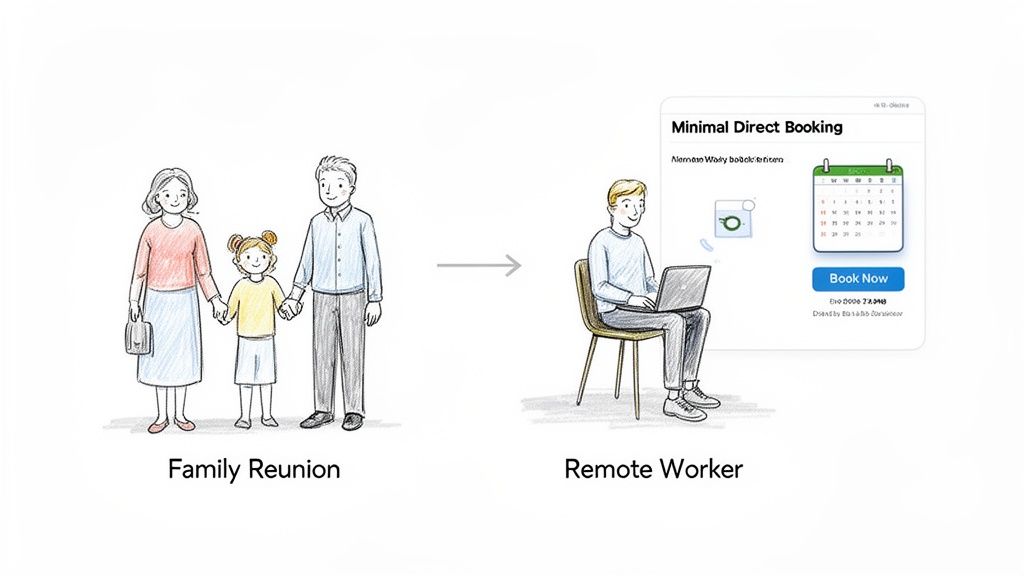
Generic marketing gets you generic guests—or worse, no guests at all. To create ads that actually connect and convert, you have to go deeper than broad categories like "families" or "couples." You need to build out detailed guest personas that bring your target audience to life. A huge piece of this puzzle is truly understanding how to create buyer personas that let you get inside your ideal guest's head.
Let's get specific. Think about the real motivations and pain points of different travelers. Are you targeting:
- The Multi-Generational Family Reunion: This group is looking for space, lots of it. They need kid-friendly amenities, a huge kitchen for chaotic family meals, and maybe some accessible features for grandma and grandpa. Their biggest headache? Finding one property that makes everyone happy and fits them all comfortably.
- The Scenic-Seeking Remote Worker: This isn't a vacation; it's a "workcation." They're hunting for screaming-fast Wi-Fi, a dedicated workspace (bonus points for a view!), and easy access to coffee shops or hiking trails for when they clock out. Productivity and inspiration are their goals.
- The Luxury Weekend Group: These travelers want the "wow" factor. We're talking high-end finishes, a hot tub, unique design, and maybe even concierge-style services. They are more than willing to pay a premium for an exclusive, totally Instagrammable experience.
When you define these personas, you can shape every single part of your ad—from the photos you choose to the words you write—to speak directly to what they want.
Key Takeaway: Stop marketing to everyone. A laser-focused ad campaign aimed at a well-defined guest persona will always, always outperform a generic ad. Specificity is what drives bookings.
Optimize Your Direct Booking Website
So, you've grabbed a potential guest's attention with a perfectly targeted ad. Now what? Where do you send them? The answer, every single time, should be your own high-converting, easy-to-use direct booking website. Funneling that valuable ad traffic to an OTA listing means you're still forking over commissions and giving up control of the guest relationship.
Your website is the final destination for your ad traffic, and it has to offer a seamless path from "Ooh, that looks nice" to "Booked!" A clunky, confusing site will absolutely tank your conversion rates, no matter how amazing your ads are. For a complete roadmap on building a site that actually converts, check out our guide on vacation rental web design: https://gethostai.com/blog/vacation-rental-web-design.
A website built to get bookings needs a few non-negotiables:
- Professional, High-Quality Photos: Your property’s visuals are everything. Show off its best angles with stunning photography.
- A Simple, Intuitive Booking Process: Get rid of extra steps. Make it incredibly easy for guests to check dates and confirm their stay in just a few clicks.
- Mobile-First Design: A huge number of travelers are researching and booking on their phones. Your site must work flawlessly on any screen size.
- Clear Calls-to-Action (CTAs): Don't make them guess. Use big, obvious buttons like "Book Now" or "Check Availability" to guide them to the next step.
Your website isn't just a digital brochure; it's your most important sales tool. When you optimize it for conversions, you make sure that every dollar you spend on ads has the best possible chance of turning into a profitable, commission-free booking.
Choosing the Right Advertising Channels to Reach Guests
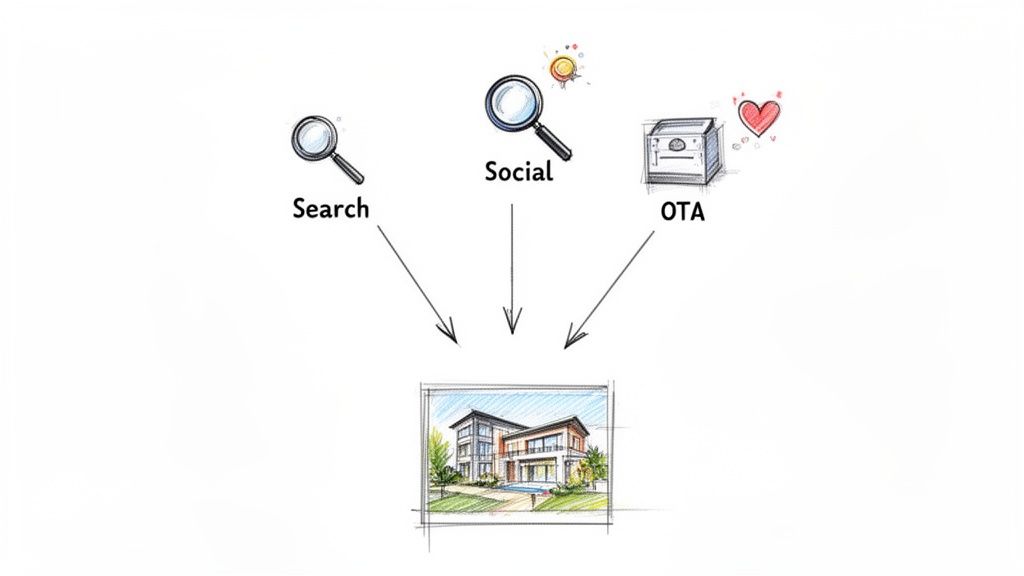
So you know who you’re targeting. The next massive question is: where do they actually spend their time online?
Launching your vacation rentals ads on the wrong platform is like setting up a brilliant billboard in the middle of a desert. The goal isn’t to be everywhere; it’s to be everywhere that matters to your ideal guest. Building a smart, multi-channel strategy is all about picking the right tool for the right job.
Some channels are perfect for grabbing travelers who are actively hunting for their next stay. Others are better for planting the seed of wanderlust long before they've even thought about a destination. Your job is to make these platforms work in concert, creating a seamless journey from that first spark of an idea to the final click on "Book Now."
High-Intent Channels for Capturing Active Searchers
When a traveler types "lakefront cabin with a hot tub" into Google, they aren't just window shopping. They've got a credit card ready and are looking to book. These are what we call high-intent users, and getting in front of them is the fastest path to filling your calendar.
This is where Google Ads reigns supreme. It lets you put your property right at the very top of the search results for the exact terms people are using. You're essentially paying to be the first and best answer to a traveler’s direct question.
Here's a real-world scenario: A group is planning a bachelorette weekend in Scottsdale. Their search? "Scottsdale rental with pool for 10 guests." If your Google Ad pops up, showing off your gorgeous property that fits the bill, you’ve just leapfrogged the competition and landed directly in their path.
Pro Tip: Don't waste your budget on broad terms like "vacation rental." Get hyper-specific. Long-tail keywords that highlight your property's unique selling points—like "pet-friendly Outer Banks rental oceanfront" or "ski-in ski-out cabin Breckenridge"—will lower your competition and bring in much more qualified leads.
Social and Discovery Platforms for Building Awareness
What about the travelers who don't even know they want to visit your location yet? This is where social media platforms truly shine. Think of them as discovery engines, perfect for sparking inspiration with beautiful visuals and compelling stories.
Facebook & Instagram: These platforms are a visual goldmine for vacation rentals. You can run highly targeted ad campaigns featuring your most stunning property photos and videos. The targeting is incredible—you can reach users based on interests (like hiking or family travel), life events (like "recently engaged"), and even their online browsing habits. For anyone who has visited your website but didn't book, you should also look into the best retargeting platforms to bring them back.
Pinterest: Travelers use Pinterest as a digital scrapbook to plan their dream trips, creating boards for destinations and accommodations. An ad showing your "swoon-worthy A-frame cabin" can easily get pinned to a user's "Future Getaways" board, keeping your property top-of-mind for months.
These channels are less about the immediate booking and more about building a brand and creating demand. You're not just selling a stay; you're selling the experience, the dream, the future memories.
Leveraging OTAs and Niche Listing Sites
While driving direct bookings is the ultimate goal, you simply can't ignore the massive audience on Online Travel Agencies (OTAs). Platforms like Airbnb and Vrbo have their own built-in promotional tools that can help you stand out from the crowd. Using their sponsored listings gives you a crucial visibility boost during peak season or when you desperately need to fill last-minute vacancies.
However, it's not just about the big guys anymore. The advertising landscape is always shifting. While giants like Booking.com and Airbnb are still booking powerhouses, we're seeing specialist channels like HomeToGo and fast-growing regional players like Agoda deliver incredibly strong reservation-to-property ratios.
This isn't just a hunch; it's a measurable performance strategy. Diversifying your channels is proven to get more heads in beds.
To help you decide where to start, here’s a quick breakdown of the major channels and what they're best used for in the vacation rental space.
Advertising Channel Comparison for Vacation Rentals
| Channel | Primary Goal | Best For Targeting | Example Use Case |
|---|---|---|---|
| Google Ads | Direct Bookings | High-intent searchers using specific keywords (e.g., "3-bedroom cabin in Asheville"). | Capturing a family actively searching for a rental that matches your property's exact features. |
| Social Media Ads | Awareness & Inspiration | Users based on demographics, interests (travel, skiing), and life events (anniversaries). | Running a video ad on Instagram showcasing your beachfront property to users interested in "beach vacations." |
| OTA Sponsored Listings | Increased Visibility | Travelers already searching for accommodations in your specific market on that platform. | Promoting your listing on Vrbo to appear higher in search results during a major local festival. |
| Programmatic Display | Retargeting & Reach | Past website visitors or users who fit a very specific demographic and behavioral profile. | Showing an ad for your ski condo to someone who previously viewed it but didn't book. |
Choosing the right mix comes down to understanding your specific goals for each campaign. Are you trying to fill a last-minute opening or build a brand that attracts guests for years to come? The answer will guide your channel selection and, ultimately, your success.
Crafting Ad Copy and Creative That Captures Attention
Let's be honest, the vacation rental marketplace is noisy. Your ads aren't just competing with other rentals; they're competing with everything else in a potential guest's social feed. If your ad looks and sounds like everyone else's, it’s basically invisible.
To really win bookings, your vacation rentals ads have to stop the scroll. They need to spark a little bit of daydreaming and make someone feel like your place is the spot for their next trip. This is where sharp, persuasive copy and killer visuals come into play. You're selling an experience, not just a roof over their head.

Writing Headlines That Speak to Guest Motivations
Your headline is your first impression—and sometimes your only one. It has to connect instantly by tapping into what a guest is actually looking for. A headline like "Beautiful 3-Bedroom Home" is forgettable because it's what hundreds of other listings say.
Instead, think about the person you're trying to attract and what problem you solve for them. Frame your property as the answer to their vacation dreams. This simple shift from describing features to highlighting benefits can make a huge difference in your click-through rates.
Check out these examples that target specific guest types:
- For the Family Reunion: "Finally, a Cabin Big Enough for the Whole Family (Sleeps 14!)"
- For the Remote Worker: "Your Scenic Work-from-the-Mountains Office Awaits (With Blazing-Fast Wi-Fi)"
- For the Luxury Group: "The Ultimate Bachelorette Pad: Scottsdale Home w/ Heated Pool & Outdoor Bar"
See the difference? These headlines work because they don't just state a fact; they solve a problem or fulfill a desire, creating an immediate connection with the right people.
The Power of Visual Storytelling
High-quality photos and videos aren't just nice to have; they are absolutely essential. People book with their eyes first, and professional, compelling visuals are the fastest way to communicate the vibe and quality of your property.
But it goes beyond just taking a few well-lit pictures. Your visuals need to tell a story. Don't just show a clean kitchen; show a beautiful charcuterie board and a bottle of wine on the counter. Don't just show an empty patio; show it at sunset with the fire pit going. You're selling the moments they'll have there.
Your visuals should make potential guests picture themselves in the space, creating an emotional pull that gets them to book. It’s the difference between showing a house and selling a home away from home.
Crafting Persuasive Descriptions and Clear CTAs
Once your headline and photos have them hooked, your property description is what reels them in. This is your chance to use storytelling to make the rental feel real and inviting. Use language that appeals to the senses.
Instead of saying "large deck," try something like, "Sip your morning coffee on the expansive deck as you listen to the birds and watch the sun rise over the valley." You're painting a picture they can step into.
Finally, every ad needs a clear, impossible-to-miss Call-to-Action (CTA). Don't make people guess what to do next. Use strong, action-focused phrases that guide them forward.
A few solid CTA examples:
- Book Your Mountain Escape Now
- Check Availability & Rates
- Claim Your Summer Dates Before They're Gone
A little bit of urgency can be effective, but keep it classy. The goal is to make booking feel like the natural, exciting next step. Your ad copy and creative are the one-two punch that turns a casual browser into your next confirmed guest.
Mastering Your Ad Budget and Bidding Strategy
Let's be blunt: running vacation rental ads without a solid financial strategy is the fastest way to burn through your cash. Tossing money at campaigns without a clear map of how you'll get it back isn't marketing; it's just gambling.
So, let's break down how to set a smart budget and then squeeze every drop of value out of it by choosing the right bidding strategy. This isn't about pulling a number out of thin air. It's about a calculated, data-backed decision that ties your ad spend directly to your revenue goals.
Setting a Realistic Ad Budget
Where do you even begin? A great starting point is to peg your ad budget to a percentage of your projected booking revenue. From what I've seen, most successful property managers dedicate somewhere between 5-10% of their target revenue to advertising.
Let's say your goal is to hit $100,000 in direct bookings this year. A healthy ad budget would land somewhere between $5,000 and $10,000. This approach keeps your spending grounded in your growth ambitions, making it a scalable and logical way to operate.
Key Insight: Never set your budget in stone for the entire year. The vacation rental market is anything but static. You need the flexibility to ramp up spending during peak booking season and dial it back when things slow down. This lets you react to demand in real time.
If you're launching a campaign from scratch, start small. Think of it as a test run. An initial budget of $500 to $1,000 for the first month is usually plenty to start collecting the data you need. This trial phase tells you which channels and ads are actually pulling their weight before you go all-in, which seriously cuts down your risk.
Understanding Core Bidding Models
Okay, you have a budget. Now you have to decide how to spend it. Your bidding strategy dictates how you pay for your ads, and getting this right is crucial for a positive return. For vacation rental managers, the two big ones you need to know are CPC and ROAS.
- Cost-Per-Click (CPC): This one's pretty straightforward. You pay a fee every single time someone clicks on your ad. It’s fantastic for getting eyeballs on your direct booking site, but you have to keep a close watch on whether that traffic is actually turning into bookings. A sky-high click rate with zero bookings is a massive red flag that something's off with your website or your targeting.
- Return On Ad Spend (ROAS): This strategy is all about the bottom line: revenue. With ROAS bidding, you basically tell the ad platform (like Google) what you want back for every dollar you put in. For example, if you set a 5x ROAS target, you're telling the system you want to generate $5 in booking revenue for every $1 you spend on ads.
These are just the basics, of course. Platforms like Google have a whole menu of automated options. To really get into the weeds, check out our guide on Google Ads bidding strategies for a more detailed breakdown: https://gethostai.com/blog/google-ads-bidding-strategies
Dynamic Bidding and AI-Powered Optimization
The most advanced ad strategies out there are dynamic—they're not a "set it and forget it" kind of deal. They use technology to tweak your bids in real time based on all sorts of signals.
AI-driven tools can analyze factors like:
- Seasonality: Automatically pushing bids higher during that crucial summer booking window and pulling them back in the slow season.
- Competitor Actions: Reacting instantly when a competitor in your market launches an aggressive sale.
- User Behavior: Bidding more for someone who's already visited your site and looked at a specific property three times.
This is where things get really efficient. Instead of you having to manually fiddle with bids every day, you can let an algorithm make thousands of tiny adjustments on the fly. It ensures your ads are being shown to the most valuable potential guests at the best possible price. This is how you make every single dollar work as hard as it possibly can to fill your calendar.
Measuring Ad Performance to Fuel Growth
Launching your ads is just the starting line. The real work—and the real money—is in what comes next: digging into the data to see what’s actually working, what’s a complete waste of your budget, and where your next big opportunity is hiding.
If you aren't measuring, you're just guessing. This is how you stop guessing and start making decisions that directly fuel your growth.
This data-driven approach has never been more critical. The global vacation rental market is enormous, valued somewhere between $90–$98 billion from 2023 to 2025 and projected to hit an eye-watering $134.26 billion by 2034.
But here’s the catch: in Q1 2025, U.S. occupancy actually dipped a bit even as total guest nights went up. What does that mean? The supply of rentals is exploding, making the competition for every single booking more intense than ever. Efficient, data-backed advertising isn't just a nice-to-have; it's your key to survival and growth. You can dive deeper into these trends and other vacation rental statistics on StayFi.
Setting Up Your Tracking Foundation
First things first: you can’t measure what you can’t see. Before you even think about KPIs, you need to get your tracking pixels installed on your direct booking website. Think of a pixel as a tiny digital detective that follows a user from your ad to your site and reports back on everything they do.
At a bare minimum, you need these two:
- The Meta Pixel (for Facebook & Instagram): This is essential for understanding how your social ads perform. It tells you who clicked, who viewed a specific property, who started the booking process, and most importantly, who actually paid you.
- Google Ads Conversion Tracking Tag: This does the exact same job but for your search and display ads on Google's network. It's the only way to directly connect your ad spend to the revenue it generates.
Getting these set up properly is your non-negotiable first step. It's what allows you to map out the entire guest journey, from the first ad they saw to the moment they hit "confirm reservation."
Core Metrics That Actually Matter
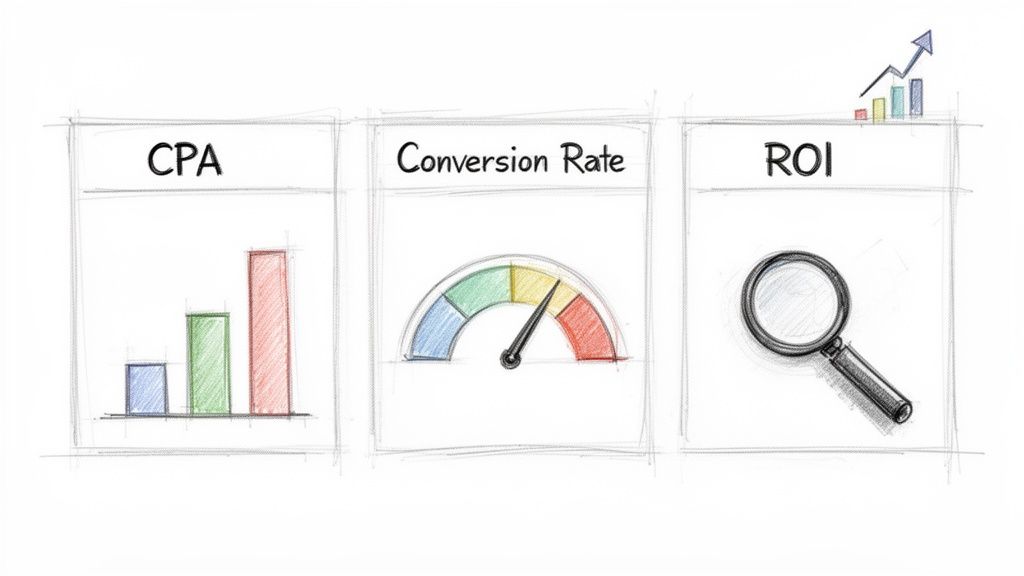
It's incredibly easy to get distracted by "vanity metrics" like impressions, likes, or clicks. They might look good in a report, but they don't pay the bills. For vacation rental managers, only a handful of key performance indicators (KPIs) truly tell the story of your success.
- Cost Per Acquisition (CPA): How much does it cost to get a confirmed booking? Simple as that. If you spent $500 on a campaign and got 5 bookings, your CPA is $100. This number tells you exactly how efficient your advertising is at its primary job.
- Conversion Rate: What percentage of people who click your ad actually end up booking? If 1,000 people clicked your ad and 20 of them completed a reservation, your conversion rate is 2%. A low conversion rate is often a red flag that something is wrong with your website experience, not necessarily the ad itself.
- Return on Ad Spend (ROAS): This is the big one—the ultimate measure of profitability. For every dollar you put into ads, how many dollars in booking revenue do you get back? If you spent $1,000 and generated $7,000 in bookings, your ROAS is 7x.
Forget everything else until you have a solid grasp on these three. They give you a clear, brutally honest picture of how your campaigns are performing.
The A/B Testing Framework for Continuous Improvement
Once your tracking is humming along, the real fun begins: optimization. The most effective way to do this is through A/B testing, where you run two slightly different versions of an ad to see which one performs better. This is how you let the data, not your gut, guide your strategy.
Key Takeaway: Never assume you know what will work best. The market will always surprise you. A/B testing is your way of letting potential guests vote with their clicks, telling you exactly what they want to see.
Here’s a simple framework to get you started:
- Isolate One Variable: This is the golden rule. Only change one thing at a time. If you test a new headline, a new image, and new ad copy all at once, you'll have no idea which change actually made the difference.
- Test High-Impact Elements First: Don't waste time testing the color of a button on your landing page. Start with the big movers: the ad headline, the primary image or video, and your call-to-action (CTA).
- Run the Test Long Enough: You need enough data for the results to be meaningful. Don't call a winner after just a day or two. Let the test run for at least a week, or until each ad version has racked up a few hundred clicks.
- Implement the Winner and Test Again: Once you have a clear winner, that ad becomes your new "control" version. Then, it's time to form a new hypothesis and start the next test.
For instance, you could pit a headline focused on luxury ("Your Private Mountain Oasis Awaits") against one focused on family value ("A Cabin Big Enough for the Whole Crew"). By constantly testing and iterating, you ensure your vacation rentals ads get smarter and more profitable over time, turning your ad budget into a reliable engine for growth.
Your Top Questions About Vacation Rental Ads, Answered
Jumping into the world of vacation rental ads can feel like opening a can of worms. There are a lot of questions. Where do you even start? How much should you spend? What actually moves the needle? It's totally normal to feel a bit lost.
Let's cut through the noise and tackle the most common questions I hear from property managers. My goal is to give you clear, straightforward answers so you can start marketing with confidence.
How Much Should I Actually Budget for My Ads?
There's no single magic number here, but a great rule of thumb is to earmark 5-10% of your projected booking revenue for ads. So, if your goal is to pull in $80,000 in direct bookings this year, setting aside between $4,000 and $8,000 is a very realistic starting point. This keeps your ad spend tied directly to your growth goals.
Now, if you're launching a brand-new campaign from scratch, I always advise starting smaller. A test budget of $500-$1,000 for the first month is usually plenty. That's enough to gather the initial data you need to see what's working and what’s a complete dud.
From there, you can look at your Cost Per Acquisition (CPA) and, more importantly, your Return On Ad Spend (ROAS). If you see a specific channel consistently delivering a 5x ROAS, that's a green light. You know it's safe to start scaling up your investment there.
The real key is to stay flexible. Don't get locked into a rigid annual budget. You'll be much more successful thinking in quarterly or even monthly sprints, adjusting your spend based on real-time performance, seasonality, and your current occupancy needs.
What’s the Biggest Mistake People Make in Vacation Rental Advertising?
Easy. The single most common—and most expensive—mistake I see is sending paid ad traffic to a generic homepage. It drives me crazy.
Every single ad campaign you run needs its own dedicated, high-converting landing page. That page has to be a perfect mirror of the ad's specific message, visuals, and offer. It's about creating a seamless, logical path for the user that just makes sense.
Think about it this way: you run a great Facebook ad promoting your "pet-friendly mountain cabin with a fenced yard." When someone clicks that ad, they should land directly on a page that is all about that specific property. That page needs photos of happy dogs enjoying the space, a clear list of all your pet-friendly amenities, and a massive "Book Your Pet-Friendly Getaway" button.
If you send that highly targeted traffic to your main homepage, you're forcing them to start their search all over again. That extra friction is a conversion killer. You're basically throwing away your ad spend.
Should I Use Google Ads or Social Media Ads?
This isn't an either/or situation. The real answer is you should use both. They play completely different, yet complementary, roles in a guest's journey to booking with you.
- Google Ads are for capturing travelers with high intent. These are the people actively typing searches like "beachfront rental in Miami for New Year's" into Google. They are at the bottom of the funnel and are often ready to book right now.
- Social Media Ads (on platforms like Instagram or Facebook) are all about discovery and inspiration. You can target users based on their interests—like "hiking" or "luxury travel"—and introduce them to your amazing properties before they've even started a serious search. This is top-of-funnel marketing at its best.
A truly balanced strategy uses social media to build awareness and create demand. Then, your Google Ads are waiting in the wings to capture that demand when those users are finally ready to book.
If you absolutely have to start with just one, pick the platform where your ideal guest persona spends the most time. But your long-term goal should always be a multi-channel approach. It builds a much more resilient booking pipeline.
Ready to stop guessing and start growing your direct bookings with powerful, hands-free advertising? hostAI uses advanced AI to create and manage campaigns that put your properties in front of the right guests at the right time. Discover how we can help you double your direct revenue at https://gethostai.com.