

vacation rentals marketing
A Modern Guide to Vacation Rentals Marketing
Posted on Dec 6, 2025
When we talk about vacation rental marketing, we’re really talking about a strategic mix of things: building a brand that people remember, creating a killer direct booking website, and using smart online tactics to bring in guests so you're not just another listing on a third-party site.
The whole point is to own your guest relationships. This is how you build a business that's not just profitable, but resilient. It means you keep more of your revenue and, just as importantly, you get to control your own story.
Building Your Direct Booking Foundation
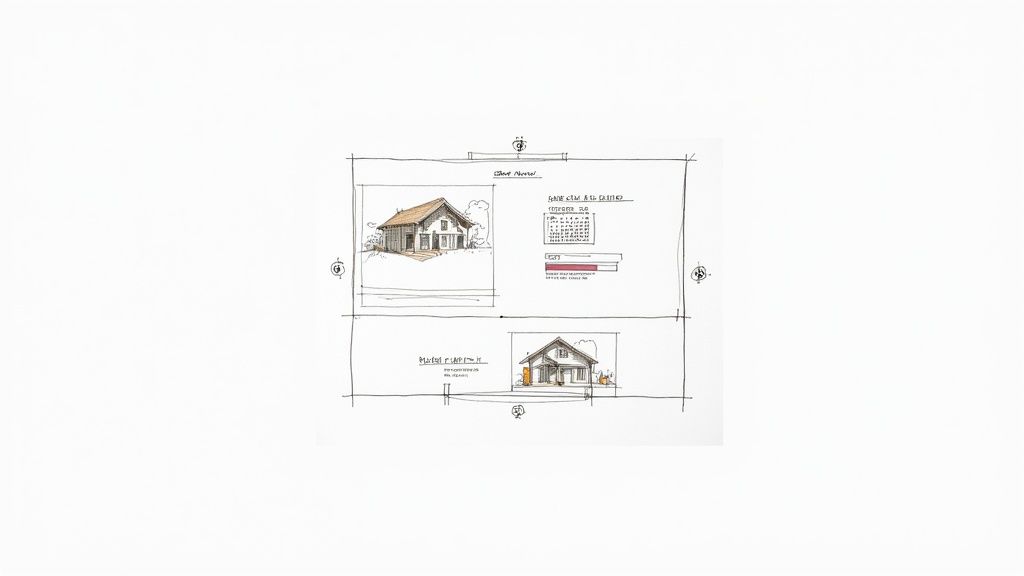
Before you even think about putting a single dollar into paid ads, you have to get your foundation right. It’s like building a house—you wouldn't start picking out furniture before the walls are even up, right? For us, that essential framework is your direct booking website. This is the move that takes you from being a listing to being a brand.
The vacation rental market is absolutely exploding. Projections show it hitting $97.85 billion in 2025 and climbing to a potential $134.26 billion by 2034. This isn't some tiny niche anymore; it makes up about 12% of all lodging income. That’s a massive opportunity for managers who build a strong, independent presence.
To really nail your marketing, you need to understand the proven strategies for marketing rental properties that fill vacancies fast. And it all starts with moving beyond the walls of the OTAs.
Define Your Unique Brand Identity
Your brand is so much more than a logo. It's the promise you make to every single guest. It’s that feeling they get when they see your photos online and the experience they can't stop talking about after they check out. So, what makes your properties different?
- Niche Focus: Are you the go-to for families with kids, travelers with pets, or digital nomads looking for a perfect workspace?
- Unique Selling Proposition (USP): Is it your killer interior design, those exclusive amenities no one else has, or your unbeatable location?
- Guest Experience: What’s the story you want your guests telling their friends about their stay?
Answering these questions is how you carve out your own space in a very crowded market. A strong brand identity becomes your north star, guiding everything from your website design to the tone of your emails. It makes all your marketing efforts click.
Your brand is what people say about you when you're not in the room. In the vacation rental world, it’s the combination of your property’s promise, the guest experience you deliver, and the story people share afterward.
Create Your Ideal Guest Persona
Once you know who you are, you need to figure out who you're talking to. This is where an ideal guest persona comes in. It's basically a super-detailed profile of your perfect customer. We're not just talking about age and income here; you need to get inside their heads and understand their motivations, their pain points, and what they truly want from a vacation.
For instance, you might have a "Family Adventurer" persona. This person probably cares about a fully-stocked kitchen, being close to kid-friendly activities, and having a dead-simple check-in process.
Knowing this lets you write property descriptions and marketing messages that actually connect with them. You're showing them exactly how your rental solves their specific travel needs. Our deep dive on how to build a vacation rental website shows you how to bake these personas right into your site's content. A good persona turns generic marketing into a personal conversation.
Attracting High-Intent Guests with SEO
So, your direct booking website is live. That's a huge step. But now comes the real challenge: getting the right people to find it. This is where you move beyond relying on the OTAs and start competing for high-value traffic from search engines.
Effective marketing for vacation rentals is all about capturing guests who are actively searching for a place to stay. Search Engine Optimization (SEO) is your single most powerful tool to make that happen.
This isn't about chasing generic keywords. The real magic is in targeting those super-specific, long-tail phrases that tell you someone is ready to pull out their credit card and book.
Uncovering What Your Guests Actually Search For
The bedrock of any solid SEO strategy is getting inside your guests' heads and understanding the exact words they use. You've got to think beyond just "vacation rental in [Your City]." Real travelers, especially those close to booking, get way more specific.
This hunt for valuable search terms is called keyword research. The goal is to unearth phrases like:
- "pet-friendly cabin with a hot tub near Asheville"
- "3-bedroom beachfront condo with a pool in Destin"
- "ski-in/ski-out rental for 8 people in Breckenridge"
These are "long-tail keywords." Sure, they have lower search volume, but their conversion rates are through the roof because they signal a very specific need. If a guest is searching for that exact thing and you offer it, you’ve found your perfect match. To really get a leg up, it's worth learning how to optimize your Airbnb listing for SEO, as many of the same principles apply.
A Programmatic Approach to SEO Content
Let's be realistic: you can't manually build a unique page for every single keyword combination. It's just not possible. That’s where a programmatic SEO approach changes the game.
This strategy involves creating smart page templates that automatically pull in data about your properties, amenities, and locations. The result? Dozens, or even hundreds, of highly specific landing pages generated at scale.
For instance, you might create a template for "[Amenity] rentals in [Neighborhood]." From that one template, you could automatically generate pages like:
- "Rentals with a private pool in Scottsdale"
- "Rentals with a game room in Gatlinburg"
- "Rentals with an ocean view in Malibu"
Suddenly, each of these pages becomes a unique asset that can rank for a specific long-tail keyword, massively expanding your digital footprint. Tools like hostAI can even help generate unique, quality descriptions for these pages, making them valuable for both search engines and your potential guests.
Key Takeaway: Programmatic SEO isn't about churning out spammy, low-quality pages. It's a strategic way to scale your content to match the thousands of ways potential guests are looking for rentals just like yours, meeting their exact needs the moment they search.
Mastering On-Page and Local SEO
Once you know your target keywords and have a content plan, it's time to optimize your website itself. This is what we call on-page SEO.
It’s all about weaving your keywords naturally into key spots on each page, including:
- Page Titles: The main headline that shows up in Google search results.
- Meta Descriptions: That little snippet of text under the title in search results.
- Headings (H1, H2, H3): The titles and subtitles that structure your page content.
- Image Alt Text: The descriptions you give your images, which help both search engines and visually impaired users.
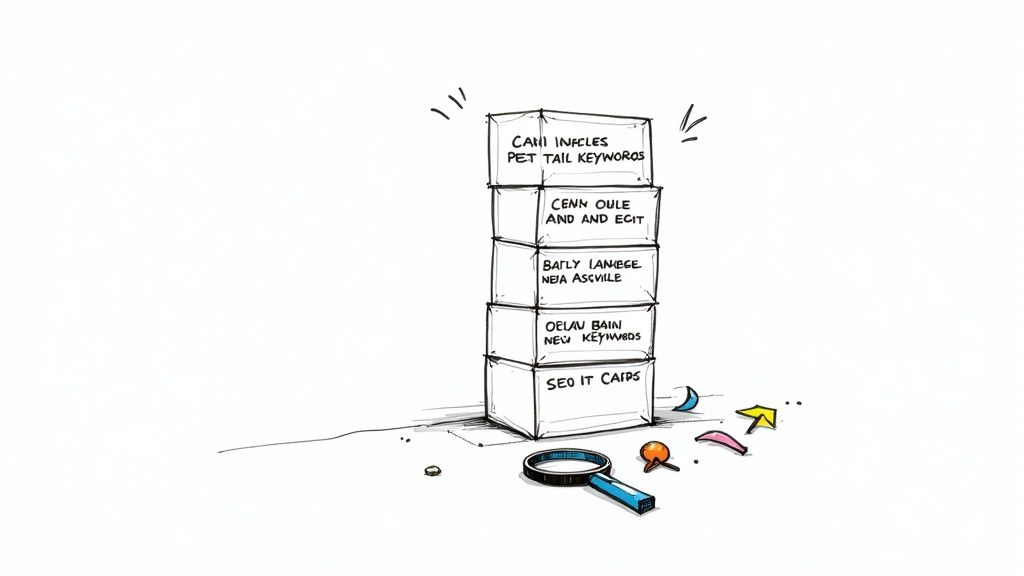
This chart gives you a good visual of how different keywords can build on each other.
You start with broad "seed keywords" and build up to those high-intent "long-tail keywords" that bring in the best traffic.
For vacation rentals, local SEO is just as important. You absolutely have to show up when people search for places "near me" or in your specific town. A huge piece of this puzzle is your Google Business Profile. Make sure it is completely filled out with accurate info, great photos, and a steady stream of positive reviews. This dramatically boosts your odds of landing in the coveted Google Map Pack at the top of the search results.
Our complete guide offers even more tips for mastering your vacation rental SEO and driving those crucial direct bookings.
The numbers don't lie. With the U.S. vacation rental market projected to grow at a CAGR of 7.4% from 2025 to 2030 and 95% of rentals booked online, showing up in search is no longer a "nice-to-have." It's essential for survival.
Driving Bookings with Email and Paid Ads
Getting traffic to your direct booking site with SEO is a huge win, but that's just getting people in the door. The real magic happens when you convert that traffic and—more importantly—turn one-time guests into repeat customers who book with you again and again.
This is where you build a powerful engine using smart email automation and laser-focused paid advertising.
Email is your direct line for building actual relationships with guests, not just for sending booking confirmations. At the same time, paid ads let you jump the line and capture high-intent travelers right when they're ready to book, giving you a serious edge over the OTAs.
Building Your Automated Email Marketing Machine
A well-oiled email strategy works for you around the clock, nurturing leads and pulling past guests back in without you having to lift a finger. The trick is to create automated sequences that hit the right person with the right message at the right time.
Think of it as your digital concierge. Instead of one generic newsletter blasted out to everyone, you need a series of triggered emails that guide guests through their entire journey with you.
Here are the must-have email sequences every property manager needs:
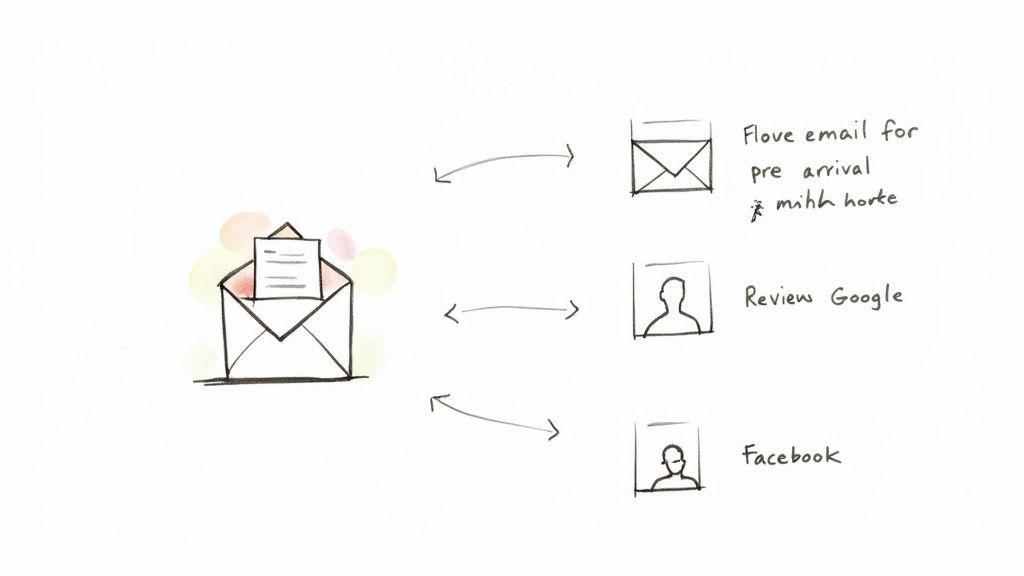
- The Pre-Arrival Hype Sequence: A week before check-in, send an email that builds excitement. Include the check-in details, a digital guidebook with your best local recommendations, and maybe an upsell offer like a late check-out.
- The Mid-Stay Check-In: A day after they arrive, send a quick, simple email asking if everything is perfect. This little proactive touch can stop a small issue from turning into a bad review.
- The Post-Stay Review Request: A day after checkout is your golden opportunity. Ask for a review on Google or your direct booking site while that great experience is still fresh in their mind.
- The Off-Season Re-Engagement Campaign: Don't let your email list get cold. During your slow season, send targeted deals to past guests. Something like a "Come Back and Save 20%" offer can be all it takes to drive repeat bookings when you need them most.
Pro Tip: You can automate all of this with a tool like hostMail. Set up these flows once, and you can be sure every single guest gets timely, personalized communication that makes their stay better and builds the kind of loyalty that turns them into regulars.
Launching Profitable Paid Advertising Campaigns
While email is for nurturing relationships, paid advertising is your tool for immediate impact. It’s how you get to the top of the search results instantly and stay on the radar of travelers who've already checked out your properties. With the right strategy, you can get a fantastic return on your ad spend.
Vacation rentals are a massive part of the travel industry. Take a competitive market like Puerto Vallarta, Mexico—it has around 12,477 listings that bring in an average of $19,500 a year per rental. With an average occupancy of 49% and a daily rate around $207, it's obvious a smart marketing strategy can pay off big time. You can dig into more short-term rental market analysis on iGMS.com.
Targeting Bottom-of-Funnel Keywords with Google Ads
Your best shot at a positive ROI with Google Ads is to zero in on "bottom-of-funnel" keywords. These are the super-specific, long-tail phrases people type in when they're just about ready to pull out their credit card. They're the same keywords you target with SEO, but now you're paying to guarantee you're at the top of the page.
So, instead of a broad, expensive term like "Miami vacation rentals," you'd bid on something much more specific:
- "oceanfront condo rental South Beach 2 bedroom"
- "pet friendly house with pool Key Biscayne"
By targeting these high-intent searches, you're spending your ad budget on clicks from people who are actually likely to book. You can go much deeper on this topic in our complete guide to effective vacation rental advertising.
Re-Engaging Visitors with Facebook and Instagram Retargeting
Ever look at a product online, then suddenly see ads for it all over your social media? That’s retargeting, and it’s an incredibly powerful tool for vacation rental managers.
Here’s how it works: A potential guest lands on your site and checks out your "Luxury Cabin with Mountain Views," but then they leave without booking. With a retargeting campaign, you can show them an ad on Facebook or Instagram featuring that exact cabin. Maybe add a message like, "Your mountain getaway is waiting. Book now and get a complimentary bottle of wine!"
It’s a simple way to stay top-of-mind and give them a gentle nudge to come back and finish what they started.
Finding New Guests with Lookalike Audiences
One of the most effective tactics for social media ads is creating lookalike audiences. You take your list of past guests—your absolute best customers—and upload it to a platform like Facebook. The algorithm then analyzes the demographics, interests, and behaviors of your list to find a whole new group of people who "look like" them.
This lets you market your properties to a fresh audience that’s already highly likely to be interested in what you offer. It’s like cloning your ideal guest and showing your ads directly to them. Your ad spend becomes dramatically more efficient.
Optimizing Your Pricing and Revenue Strategy
You can have the best marketing in the world driving a flood of potential guests your way, but if your pricing is static, you're just leaving money on the table. It’s a classic mistake. This is where the discipline of revenue management really earns its keep—it’s the art and science of getting the right guest in the right property at the right time, all for the right price.
Smart revenue management is so much more than just having a "high season" and "low season" rate. It's about making your pricing as agile and responsive as the rest of your marketing.
Embrace Dynamic Pricing to Maximize Every Booking
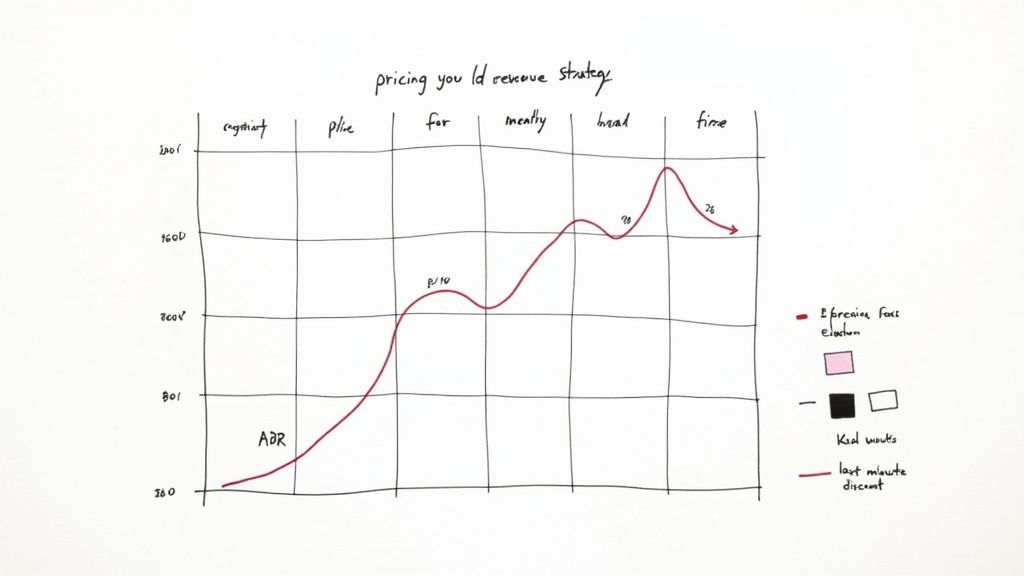
A static price sheet is the enemy of profit. In today's market, your rates need to breathe, constantly adapting to what's happening in real-time. This approach, known as dynamic pricing, is non-negotiable if you want to maximize both your occupancy and your Average Daily Rate (ADR).
Here are the key signals that should be influencing your rates, sometimes even hour by hour:
- Seasonality and Demand: Dig deeper than the obvious summer rush. Think about three-day weekends, school holidays, and those local "shoulder seasons" where a small bump in demand can mean a profitable opportunity.
- Local Events: Is a big concert, festival, or conference rolling into town? These events create market compression, and that's your cue to increase rates. A downtown condo near a convention center needs a completely different pricing calendar than a family beach house.
- Competitor Moves: You absolutely have to keep an eye on what similar properties are doing. If your direct competitors are all booked up for a certain weekend, that's a glaring neon sign that demand is high and you've got room to push your rates up.
Let's be real: manually tracking all of this is a fool's errand. It's just not possible. This is where AI-powered tools become invaluable, automatically crunching market data, competitor rates, and demand signals to suggest—or even fully automate—price adjustments. You'll never miss an opportunity again.
Get Strategic With Your Booking Rules
Your pricing strategy isn't just about the nightly number. It’s also about the rules surrounding the booking. A few smart, strategic rules can have a massive impact on revenue, especially during your busiest times.
Start with minimum night stays for high-demand weekends and holidays. Setting a three-night minimum for a holiday weekend, for instance, prevents those prime dates from getting chopped up by less profitable single-night stays that just create more operational headaches.
On the flip side, you can use flexible rules to plug those annoying calendar gaps. Got a two-night opening stuck between two longer bookings? An automated rule can trigger a last-minute discount specifically for a two-night stay, turning a likely vacancy into found money.
Create More Value with Packages and Upsells
Sometimes the smartest way to boost revenue isn't by raising the nightly rate, but by adding more value to the booking itself. This is where upselling and creative packaging come in—they're fantastic for increasing the total value of each stay.
Consider offering these simple add-ons that guests are often more than happy to pay for:
- Early Check-In / Late Check-Out: Offer this for a flat fee. It's a high-margin service that adds a ton of convenience for travelers.
- Mid-Stay Cleaning: For guests staying a week or more, offering a mid-stay refresh is a highly valued service.
- Experience Packages: Team up with local businesses. You could create a "Romantic Getaway" package with a bottle of local wine and a dinner certificate, or a "Family Adventure" package bundled with tickets to a nearby attraction.
These kinds of additions do more than just add a few bucks to each booking. They genuinely improve the guest experience, making a stay feel more special and memorable. That leads directly to glowing reviews and repeat guests, making your entire vacation rentals marketing engine more powerful and profitable in the long run.
Measuring What Matters for Your Business
Marketing without measurement is just guesswork. You might feel like you're moving forward, but you have no real idea if you're headed in the right direction. To build a genuinely profitable vacation rental business, you have to stop guessing and start tracking.
This means looking past the surface-level "vanity metrics" like social media likes and zeroing in on the Key Performance Indicators (KPIs) that actually put money in your bank account. It’s the data-driven approach that separates amateurs from seasoned pros, allowing you to confidently double down on what’s working and cut the channels that are just wasting your time and money.
Identifying Your Most Important KPIs
It's easy to get lost in a sea of charts and graphs, but not all data is created equal. A handful of core metrics can tell you almost everything you need to know about the health of your vacation rentals marketing. These are the numbers that should live on your dashboard.
You absolutely need to be tracking:
- Cost Per Acquisition (CPA): This is your bottom-line cost to get a single booking. For instance, if you spend $300 on Google Ads in a month and it brings in three direct bookings, your CPA is $100. It's the ultimate measure of your marketing efficiency.
- Return on Ad Spend (ROAS): This metric tells you exactly how much revenue you're generating for every dollar you put into advertising. A 4:1 ROAS means you’re getting $4 back for every $1 you spend. This is the single best measure of an ad campaign's profitability.
- Direct Booking Percentage: What percentage of your total bookings come from your own website versus the OTAs? A rising direct booking percentage is a clear signal your brand is getting stronger and that you’re saving a small fortune on commissions.
- Average Booking Value (ABV): This is the average dollar amount for each booking. Keeping an eye on ABV helps you see if your marketing is attracting higher-value guests over time.
If you can't measure it, you can't improve it. Consistently tracking these core KPIs is the single most important habit for growing a vacation rental business. It replaces gut feelings with hard facts, enabling smarter decisions that drive real growth.
To keep everything organized, I always recommend putting your most important metrics into a simple table. It keeps you focused on the numbers that truly move the needle.
Essential Vacation Rental Marketing KPIs
Here’s a breakdown of the key metrics to track, what they mean, and why they are so crucial for measuring the success of your marketing strategy.
| KPI | What It Measures | Why It's Important |
|---|---|---|
| Cost Per Acquisition (CPA) | The total marketing cost to secure one new booking. | Shows how efficiently your marketing budget is being spent to acquire guests. |
| Return on Ad Spend (ROAS) | The revenue generated for every dollar spent on advertising. | Directly measures the profitability and financial return of your paid ad campaigns. |
| Direct Booking Percentage | The percentage of total bookings made through your website vs. OTAs. | Indicates brand strength and your success in reducing costly OTA commissions. |
| Average Booking Value (ABV) | The average revenue from a single booking. | Helps you understand the quality of guests your marketing is attracting. |
| Website Conversion Rate | The percentage of website visitors who complete a booking. | A key indicator of your website's effectiveness and the user booking experience. |
| Occupancy Rate | The percentage of occupied nights out of the total available nights. | A fundamental measure of your property's performance and demand. |
By keeping this dashboard front and center, you can quickly assess performance and make informed decisions without getting overwhelmed by data.
Setting Up Your Tracking Foundation with GA4
The best place to pull all this information together is Google Analytics 4 (GA4). It’s a free and incredibly powerful tool that gives you a complete picture of your marketing ecosystem. For any serious property manager, getting it set up correctly on your direct booking site is non-negotiable.
Once it's installed, GA4 immediately starts showing you:
- Traffic Sources: Pinpoint exactly where your website visitors are coming from. Is it organic search? A Facebook ad? Your email newsletter? A referral from a local travel blog?
- User Behavior: See which pages people visit the most, how long they stay, and where they tend to drop off in the booking process. This is invaluable for finding and fixing weak spots on your site.
- Conversion Tracking: This is the magic bullet. You can set up "conversion events" to track every time a guest completes a booking. This is what allows you to measure metrics like CPA and ROAS with dead-on accuracy.
Connecting Actions to Outcomes
When you have proper tracking in place, your whole marketing strategy transforms. You’re no longer just launching campaigns and crossing your fingers. Instead, you can draw a straight line from a specific action to a tangible business result.
Let's say you run a Facebook retargeting campaign. In GA4, you can create a segment for all the users who came to your site from that specific ad. You can then see exactly how many of them went on to book a stay.
This direct attribution tells you if the campaign was a success. If the CPA is low and the ROAS is high, you know you’ve got a winner and can confidently increase the budget. If it's not performing, you can pause it and shift those funds to a channel that is delivering results. This is how you continuously optimize your strategy for maximum profitability.
Frequently Asked Questions About Vacation Rentals Marketing
Jumping into a modern marketing strategy for your vacation rentals will definitely bring up some questions. It's totally normal to wonder where you should actually put your time and money to get the best results. Let's dig into some of the most common questions we hear from property managers and give you some clear, no-fluff advice to help you move forward.
How Much Should I Budget for Marketing My Vacation Rental?
There's no magic number here, but a great place to start is earmarking 5-10% of your projected annual revenue for marketing. If you’re just launching a new property or an entire brand, you'll probably want to lean toward the higher end of that range to build some early momentum and get that crucial booking data flowing in.
But the key isn’t just how much you spend—it's where you spend it. You need to pour your budget into channels where you can actually measure your Return on Ad Spend (ROAS). Kick things off with a smaller, controlled budget for some highly targeted Google Ads or social media retargeting. From there, keep a close eye on your Cost Per Acquisition (CPA) and then double down on the campaigns that are actually making you money.
Quick tip: Stop thinking of your direct booking website as a marketing expense. It’s a long-term capital investment. The upfront cost gets paid back surprisingly fast when you start saving all that cash on OTA commissions.
Can I Really Compete with Big Platforms Like Airbnb and Vrbo?
Yes, absolutely. But you won't win by trying to play their game. Your advantage isn't a monster advertising budget; it's your ability to be nimble, personal, and hyper-focused on a niche. You compete by creating a unique brand experience that the big, faceless platforms just can't touch.
Your mission is to build direct, real relationships with your guests. Use your SEO strategy to go after very specific, long-tail keywords that the OTAs often ignore. Think things like "wheelchair-accessible rental with an ocean view in Miami." This is a game of inches, not miles.
Your other secret weapon? Your email list. By capturing guest information through your own direct booking site, you can launch re-engagement campaigns that bring people back again and again—something the OTAs actively prevent you from doing. Your power lies in personalization and direct communication, turning one-time bookers into loyal fans who wouldn't think of booking anywhere else.
What Is the Single Most Important Marketing Tactic to Start With?
If you do only one thing, do this: build your own direct booking website. This is the absolute, non-negotiable foundation for every other marketing move you make. It's the home base for your brand and the final destination for all the traffic you generate.
Every social media post, every email newsletter, and every ad you run should all point back to this single platform—the one you actually own and control. Owning your website means you can:
- Build a real brand identity that doesn't just blend in with a million other OTA listings.
- Capture priceless guest data that fuels all your future email and retargeting efforts.
- Save thousands of dollars in commissions over the long haul, which goes straight to your bottom line.
While your website is priority number one, professional photography for that site is a very close second. You can't underestimate the power of high-quality visuals to make that critical first impression and turn a casual looker into a booked guest.
Ready to build a powerful marketing engine that drives more direct bookings and grows your revenue? hostAI provides the tools you need, from AI-powered direct booking websites to automated email and advertising campaigns. Discover how we can help you take control of your marketing at https://gethostai.com.