

what is a/b testing in marketing
What Is A/B Testing in Marketing A Practical Guide for STRs
Posted on Jan 27, 2026
Ever feel like you're just guessing what your guests want? You write a headline, pick a photo, or set a price and just hope it works. We’ve all been there. But what if you could trade that guesswork for cold, hard data?
That's exactly what A/B testing is all about.
Think of it as a friendly competition between two ideas. You have your original version (let's call it 'A') and a new variation you want to try ('B'). You show each version to a different group of people and simply see which one performs better. No more gut feelings or office debates—just clear, actionable results.
Why Data-Driven Decisions Win
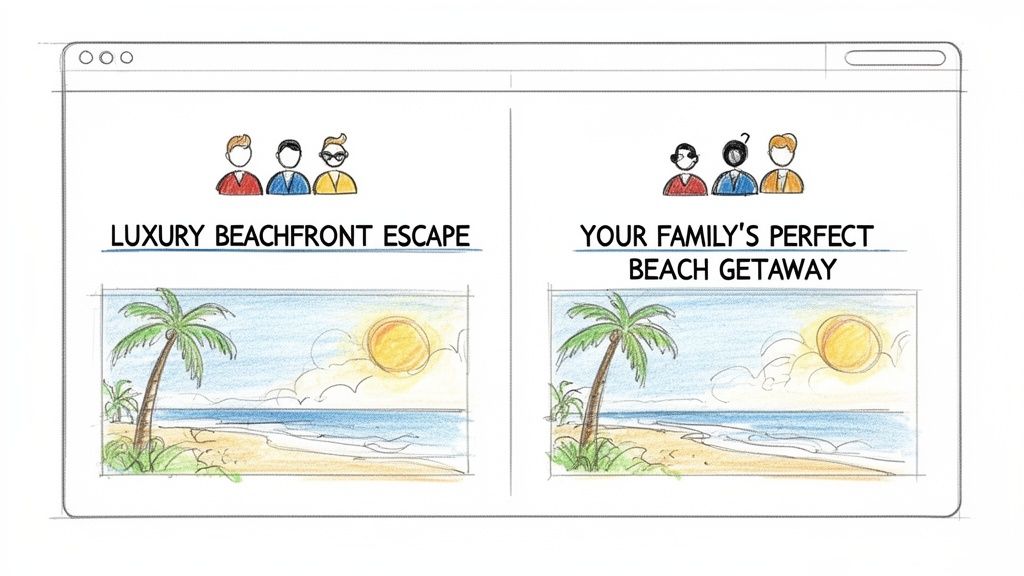
Let's make this real. Imagine you're trying to book up a beachfront property. You could write a headline that says, 'Luxury Beachfront Escape' (Version A). Or you could try something more family-focused, like 'Your Family's Perfect Beach Getaway' (Version B).
Without testing, picking the winner is a coin toss. But with A/B testing, you can show each headline to 50% of your website visitors and track which one actually leads to more bookings. This is the heart of A/B testing: making decisions based on real guest behavior, not just what you think sounds good.
This isn’t just some niche marketing trick; it’s a massive shift in how smart businesses operate. The A/B testing software market is set to explode from $1.5 billion in 2025 to a whopping $4.4 billion by 2035. The big players have known this for years—giants like Google, Amazon, and Booking.com run over 10,000 of these tests annually to perfect their customer experience. You can read more about the growth of the A/B testing market to see just how essential this has become.
For short-term rental managers, this is your most direct path to boosting direct bookings and your bottom line.
Here’s a quick breakdown of the core ideas to get you started.
A/B Testing At a Glance: What It Is and Why It Matters
| Concept | Simple Explanation | Why It Matters for STRs |
|---|---|---|
| Control vs. Variation | Your original version ("Control") goes up against a new idea ("Variation"). | Test if "Ocean View Balcony" performs better than "Private Seaside Terrace" in your listing title. |
| Hypothesis | An educated guess you want to test. "I believe a shorter booking form will get more inquiries." | Forms the basis of your test. It forces you to think about why you're making a change. |
| Key Metrics | The specific number you're measuring to decide the winner (e.g., booking rate, clicks, email sign-ups). | Tells you if your change actually worked. Did more people book, or just click around? |
| Statistical Significance | Proof that your results are real and not just random luck. Usually, you aim for 95% confidence. | Prevents you from making bad decisions based on a small or random sample of guest behavior. |
Understanding these basics is the first step toward building a more profitable, data-backed business.
So, why should you care? The benefits are crystal clear:
- Stop Guessing: Ditch the intuition and let your guests tell you what works with their actions.
- Boost Conversions: Even tiny tweaks to your website, listing photos, or email subject lines can lead to a serious jump in booking rates.
- Improve the Guest Experience: When you understand what your guests prefer, you can build a booking process that feels effortless and inviting.
This guide will walk you through everything you need to know, connecting A/B testing directly to your goal of growing your revenue. We'll explore how to apply it across your entire marketing strategy and show you how tools like hostAI are making it easier than ever to get started.
Understanding the Core Components of an A/B Test
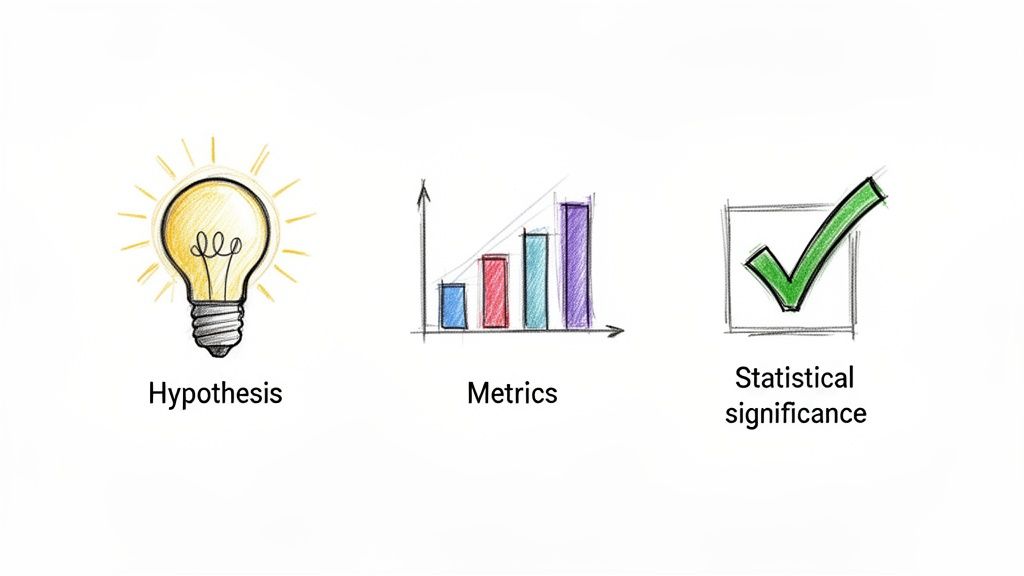
Before you jump into running experiments, you have to get the fundamentals down. These are the building blocks that separate a wild guess from a structured, data-driven process. Think of it like a recipe: get these three ingredients right, and you'll bake up some reliable results every single time.
A powerful A/B test doesn't start with a random idea. It starts with a clear, testable question—the foundation for everything that follows.
Start with a Solid Hypothesis
A hypothesis is really just an educated guess. It’s a simple statement that connects a change you want to make with a result you expect to see. Without a solid hypothesis, you’re just throwing things at the wall and hoping something sticks, which is a recipe for wasted time.
The trick is to be specific. A weak hypothesis sounds like, "Changing the photos will get more bookings." Yawn. A strong one sounds like, "Replacing the main living room photo with the one showcasing the ocean view will increase booking inquiries because guests prioritize scenic views." Now we're talking.
A great hypothesis always has these three parts:
- The Proposed Change: What, exactly, are you changing? (e.g., the call-to-action button color, the headline text, the main photo).
- The Expected Outcome: What number do you expect to go up or down? (e.g., click-through rate, booking conversion rate, email open rate).
- The Rationale: Why do you think this will work? (e.g., "...because it creates more urgency" or "...because it better highlights the property's best feature").
Choose the Right Metrics to Track
Your metrics are how you keep score. They're the hard numbers you use to declare a winner in your test. Picking the right metric is absolutely critical—otherwise, you might celebrate a "win" that does nothing for your bottom line.
For instance, you could change a button's text from "Learn More" to "Book Now" and see more clicks (a higher click-through rate). But if those clicks don't actually lead to more completed bookings (your conversion rate), was the change really a success? Probably not.
Key Takeaway: Always tie your main metric to your actual business goal. For short-term rental managers, that goal is almost always more direct bookings or qualified leads, not just vanity metrics like clicks or page views.
Ensure Statistical Significance
Finally, there's statistical significance. This is the concept that makes sure your results aren't just a fluke. Think of it like a political poll—you wouldn't trust a survey of only ten people to predict a national election, right? You need a big enough sample size to feel confident in the outcome.
In A/B testing, reaching statistical significance (usually a 95% confidence level) means you can be pretty darn sure that the winning version is genuinely better, not just lucky. It’s your safety net against randomness, confirming that the difference you saw between Version A and Version B is real and repeatable. This is what stops you from making major business decisions based on flimsy data.
How to Run Your First A/B Test Step by Step
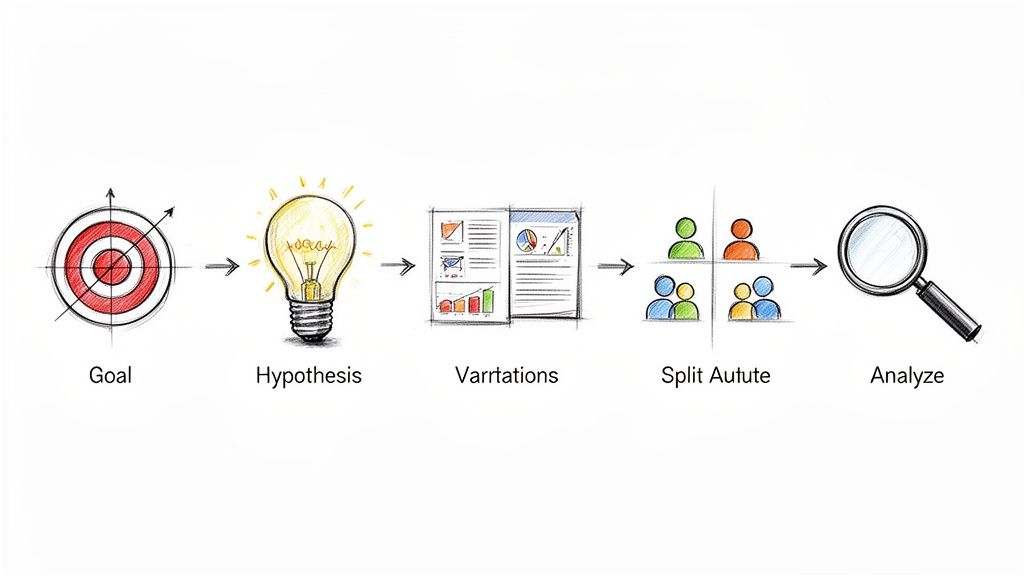
Alright, enough with the theory. This is where the rubber meets the road. Running an A/B test might sound technical, but it’s really just a simple, structured experiment.
We've boiled it down to a five-step process that takes the guesswork out of it. Follow these steps, and you’ll have a clear path from an idea in your head to real data you can act on.
Step 1: Identify a Clear Goal
First things first: what are you actually trying to improve? Before you touch a single button or rewrite a single headline, you need to know what winning looks like. A vague goal like "get more bookings" is a recipe for a confusing test.
Get specific. Pinpoint a single, measurable metric you want to move. For a short-term rental manager, that could look like:
- Increasing the booking conversion rate on your direct booking site.
- Boosting the open rate of your "last-minute deal" emails.
- Getting more people to fill out your website's contact form.
This goal becomes the north star for your entire experiment. Everything you do next will be in service of hitting that target.
Step 2: Form a Simple Hypothesis
With your goal locked in, it’s time to make an educated guess—your hypothesis. This isn't a wild shot in the dark; it's a logical statement that connects a specific change to an expected outcome.
Think back to the "If I change X, then Y will happen because..." framework.
Let’s say your goal is to increase bookings on your property pages. A solid hypothesis might be: "Changing the 'Book Now' button from a standard blue to a vibrant orange will increase clicks because the new color will create a stronger visual contrast, making it impossible to miss."
See how clear that is? It's specific, testable, and has a clear rationale.
Step 3: Create Your Variations
Now for the fun part—actually building the two versions of your test. You'll have your control (A), which is the current, untouched version of your page or email. Then you'll have your variation (B), which includes the one single change from your hypothesis.
Using a tool like hostAI's hostFront, you can easily clone a page and just tweak the button color without needing to write any code. The golden rule here is to only change one thing at a time. If you change the button color and the headline, you’ll never know which one was responsible for the results.
Step 4: Run the Test
With your two versions ready to go, it's time to flick the switch. Your A/B testing software will now automatically split your audience, usually 50/50. Half of your website visitors will see the original version, and the other half will see your new variation.
The crucial part here is patience. You have to let the test run long enough to collect enough data to be meaningful. Don't be tempted to call it a day just because one version jumps out to an early lead. That’s how you make bad decisions. Let the test run its course to get a result you can trust.
And before you launch, make sure your analytics are set up correctly. Our guide on setting up the tracking code for Google Analytics is a great place to start to ensure your data is clean.
Step 5: Analyze the Results
Once the test is complete, it's judgment day. Dive into the data and see what happened. Did the orange button actually get more clicks? If your variation won with statistical significance, that's your green light to roll out the change for everyone.
But what if it lost, or the results were basically a tie? That’s not a failure! You've just learned something valuable about what doesn't move the needle for your audience. For a more technical look at implementation, resources on simple A/B testing for Framer can offer deeper insights.
Either way, you take what you learned and start the process over again. This is how you make small, data-driven improvements that add up to big wins over time.
Practical A/B Testing Ideas for STR Managers
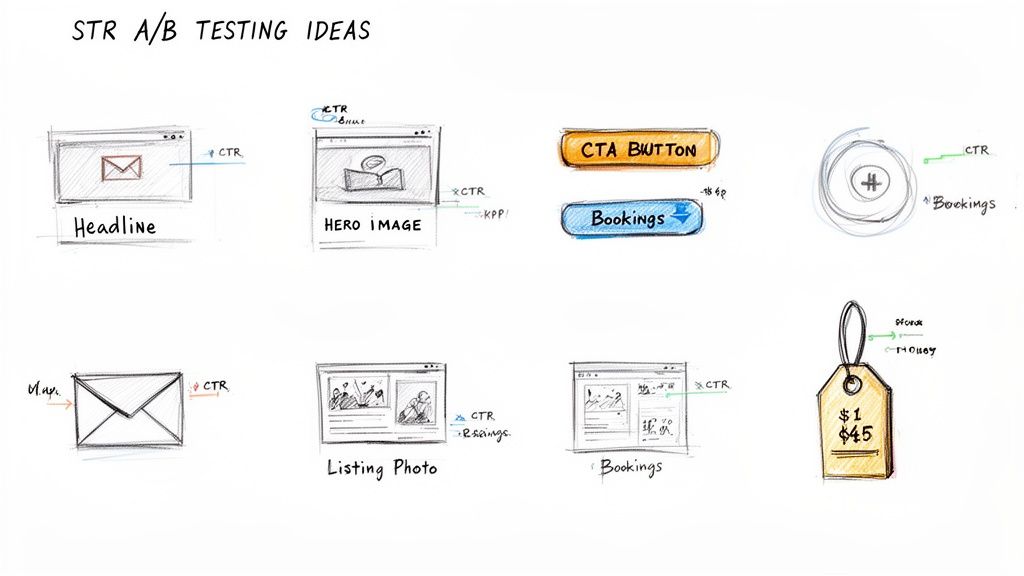
Alright, enough with the theory. The real magic happens when you start applying these concepts to your own business. Knowing what A/B testing is is step one; using it to get more heads in beds is the real goal.
Think of this section as your personal goldmine of test ideas, all tailored specifically for the vacation rental world. These aren't just abstract thoughts—they're practical, easy-to-run experiments you can launch today on your website, in your emails, and on your listings to see what truly makes potential guests click "Book Now."
Test Your Direct Booking Website
Your direct booking site is your digital storefront, and it’s the perfect laboratory for experimentation. Even tiny tweaks here can lead to a huge jump in direct bookings, which means less reliance on the OTAs and more money in your pocket.
Here are a few high-impact tests to get you started:
- Headline: Pit a feature-focused headline like "Luxury Oceanfront Villa" (Version A) against a benefit-driven one like "Your Unforgettable Family Beach Escape" (Version B). KPI: Booking Conversion Rate.
- Hero Image: See what grabs more attention. Try a stunning wide shot of the view (A) versus a cozy, detailed interior shot of the living room (B). KPI: Time on Page.
- Call-to-Action (CTA) Button: Does the button text matter? You bet. Test "Book Your Stay" (A) against something softer like "Check Availability" (B). KPI: Click-Through Rate (CTR) on the booking button.
This isn’t some niche tactic for tech startups. A whopping 77% of companies are already running A/B tests on their websites. And the payoff can be massive—a better user experience discovered through testing can boost conversions by up to 400%.
Optimize Your Email Marketing
Email is still one of your most powerful tools for bringing back past guests and filling those pesky last-minute vacancies. But you shouldn't just be sending emails; you should be optimizing them.
- Subject Line: Try a straightforward offer like "20% Off Your Next Stay" (A) against a more intriguing, curiosity-piquing line like "A Special Offer Just for You..." (B). KPI: Email Open Rate.
- Promotional Offer: What actually motivates guests to book? Test a percentage discount like "15% off a 3-night stay" (A) against a value-add like a "Free bottle of wine on arrival" (B). KPI: Click-Through Rate on the offer link.
Enhance Your Property Listings
Whether it's on your own website or an OTA, your property listing is your rental's resume. The smallest changes can be the difference between a guest scrolling right past or stopping to book.
- Primary Photo: What’s your hero shot? Does a dramatic exterior photo at twilight (A) draw more clicks than a bright, airy shot of the master bedroom (B)? KPI: Listing Click-Through Rate.
- Pricing Strategy: Experiment with how you present your rates. Test a simple flat nightly rate (A) against a slightly higher rate that includes a weekly discount (B) to see if you can encourage longer stays. KPI: Average Length of Stay.
- Amenity Highlighting: Which features should you lead with? Does "Private Hot Tub & Fire Pit" (A) get more interest than "Fully-Equipped Gourmet Kitchen" (B)? KPI: Inquiry or "Add to Favorites" Rate.
By methodically testing these different pieces of your marketing, you're no longer guessing what guests want—you're collecting hard data. This knowledge is the foundation of a rock-solid marketing strategy and is central to our guide on conversion optimization best practices. As you put these ideas into practice, you’ll see how A/B testing is a critical part of the bigger picture detailed in these Conversion Rate Optimization Best Practices.
The Best Tools to Simplify Your A/B Testing
Let's be honest: the idea of A/B testing can sound intimidating. You don't need a data science degree or a background in coding to make it work, though. The right platform handles all the heavy lifting, turning what seems like a complicated process into a straightforward, powerful part of your workflow.For short-term rental managers, this is a game-changer. It means you can focus on what the data is telling you about your guests, not wrestling with technical setups.
An integrated system like hostAI is built to make this kind of experimentation feel natural. Because its tools are designed to work together from the ground up, you can run tests across your entire marketing funnel without juggling a half-dozen different subscriptions or calling in a developer for help.
Integrated Platforms for Seamless Testing
The real magic of an all-in-one platform is that the testing features are baked right into the tools you already use every day. This eliminates a ton of friction and makes it easy to launch experiments on the fly.
For example, you could:
- Test Website Variations with hostFront: Instantly create and test different versions of your direct booking site. Wondering if a new hero image of the pool would get more clicks than the sunset view? Or if changing "Book Now" to "Check Availability" makes a difference? You can test it all right inside your website builder.
- Optimize Emails with hostMail: Your email marketing platform doubles as a testing lab. Run quick experiments on different subject lines, discount offers, or email layouts to see what actually gets your past and potential guests to click.
An integrated approach removes the technical headaches that so often stop STR managers from even trying to test. When your tools are already connected, you spend less time on setup and more time figuring out what your guests truly want.
Other Notable A/B Testing Tools
While an integrated solution like hostAI offers the simplest path forward, it's good to know about some of the standalone tools that specialize purely in optimization.
Platforms like VWO and Optimizely are heavyweights in the A/B testing world. They offer incredibly powerful and advanced features for running all sorts of experiments, but they often come with a steeper learning curve and require more technical effort to connect with your existing website and marketing tools.
Ultimately, the best tool is the one that fits your workflow and doesn't create more work. For most STR managers looking to get started quickly and see results, an integrated platform offers the most direct path from a good idea to a clear insight.
For a bigger picture of how various platforms can fit into your strategy, check out our guide on marketing campaign management tools.
Don’t Trip Up: Common A/B Testing Mistakes to Sidestep
Getting your first A/B test running is a great feeling. But diving in without a solid game plan can leave you with a mess of confusing data and a lot of wasted time. Knowing the common traps from the get-go is the secret to getting results you can actually trust—and use to grow your business.
The "Too Soon" Trap: Calling a Winner Prematurely
One of the easiest mistakes to make is ending a test too early. You might see your new version race ahead after a day or two and get tempted to pop the champagne. Hold on. Those early results are often just random noise, not a real trend.
To make a call you can stand behind, you need enough data to hit statistical significance. This is the mathematical proof that your result isn't just a lucky guess, but a repeatable outcome you can build on.
The "Kitchen Sink" Test: Changing Too Much at Once
Another classic blunder is changing a bunch of things in your new version. If you tweak the headline, swap out the hero image, and change the "Book Now" button color all at the same time, you’ll have zero idea which specific change made the difference. Was it the compelling new headline or just the brighter button? Who knows.
The golden rule here is simple: test one variable at a time. This is the only way to isolate the true impact of your change and walk away with a clean, actionable insight for the next test.
Remember: Every A/B test is a chance to learn. Even a "losing" variation is valuable—it tells you exactly what your audience doesn't like, helping you sharpen your marketing intuition for the long haul.
The "Context is King" Rule: Don't Ignore the Outside World
Your potential guests don't visit your website in a bubble. All sorts of external factors can skew your test results, and if you ignore them, you might draw the completely wrong conclusion.
Always keep an eye on the context:
- Seasonality: A test you run during your peak season will almost certainly perform differently than the same test in the quiet months.
- Holidays: A long weekend or major holiday can throw a wrench in normal booking patterns and user behavior.
- Marketing Campaigns: Are you pushing a big social media ad campaign? That can send a wave of unusual traffic to your site, which you need to account for.
Patience is everything in A/B testing. Research shows that only about 1 in 8 tests actually drives a significant positive result. That's why persistence is key. To get truly reliable data, big companies often wait for 25,000 visitors per variation before making a decision. This disciplined approach is why giants like Google and Bing, who run thousands of experiments a year, see such steady growth. If you want to dive deeper, you can learn more about the statistical realities of A/B testing and understand why volume is so important.
By sidestepping these common mistakes, you'll be able to trust your data and make confident, data-backed decisions that lead to what we all want: more direct bookings.
A Few Lingering Questions on A/B Testing
As you get ready to dive into data-driven marketing, a few practical questions always pop up. We hear these all the time from STR managers, so let's tackle them head-on and give you the final pieces of the puzzle.
"How Long Should I Actually Run an A/B Test?"
This is always the first question, and the honest answer is: it depends. There’s no magic number of days. The right duration is all about collecting enough data to reach statistical significance.
Think of it like an election poll. You need to survey enough people to confidently predict the winner. Running a test for a fixed period, like one week, is a common mistake. A slow Tuesday will give you wildly different results than a booking-heavy Saturday night.
The best practice? Let your A/B testing tool do the work. It will run the test until it has collected enough visitor data and conversions to declare a confident winner. Don't rush it.
"What if My Test Ends in a Tie? Did I Waste My Time?"
Not at all! Sometimes, a test ends and neither version is a clear winner. This isn't a failure—it's actually incredibly useful information.
An inconclusive result tells you that the element you tested, like a button color or a small headline change, probably doesn't make a real difference to your potential guests. That's a win. It means you can stop agonizing over tiny details and pivot your efforts to something that actually impacts bookings.
An inconclusive A/B test is a clear signal to move on to a bigger, bolder hypothesis. It saves you from endlessly optimizing something that doesn't truly matter to your audience.
"Can I Even A/B Test if My Website Doesn't Get a Ton of Traffic?"
Yes, absolutely. You just have to change your strategy. With lower traffic, trying to test tiny tweaks will take forever to produce a clear result. The key is to think bigger.
Instead of testing a blue button versus a green one, test something dramatic. Pit two completely different page layouts against each other. Test a "20% Off" offer against a "4th Night Free" promotion.
These "big swing" experiments are far more likely to generate a significant difference in performance, giving you a clear winner even with a smaller audience. This approach is how smaller operators can get powerful, actionable insights from what is A/B testing in marketing.
Ready to stop guessing and start growing your direct bookings with data-backed decisions? hostAI builds powerful A/B testing capabilities right into our website builder and email tools, making it simple to run experiments that actually boost your bottom line. Discover how our platform can help you optimize your marketing at the official hostAI website.